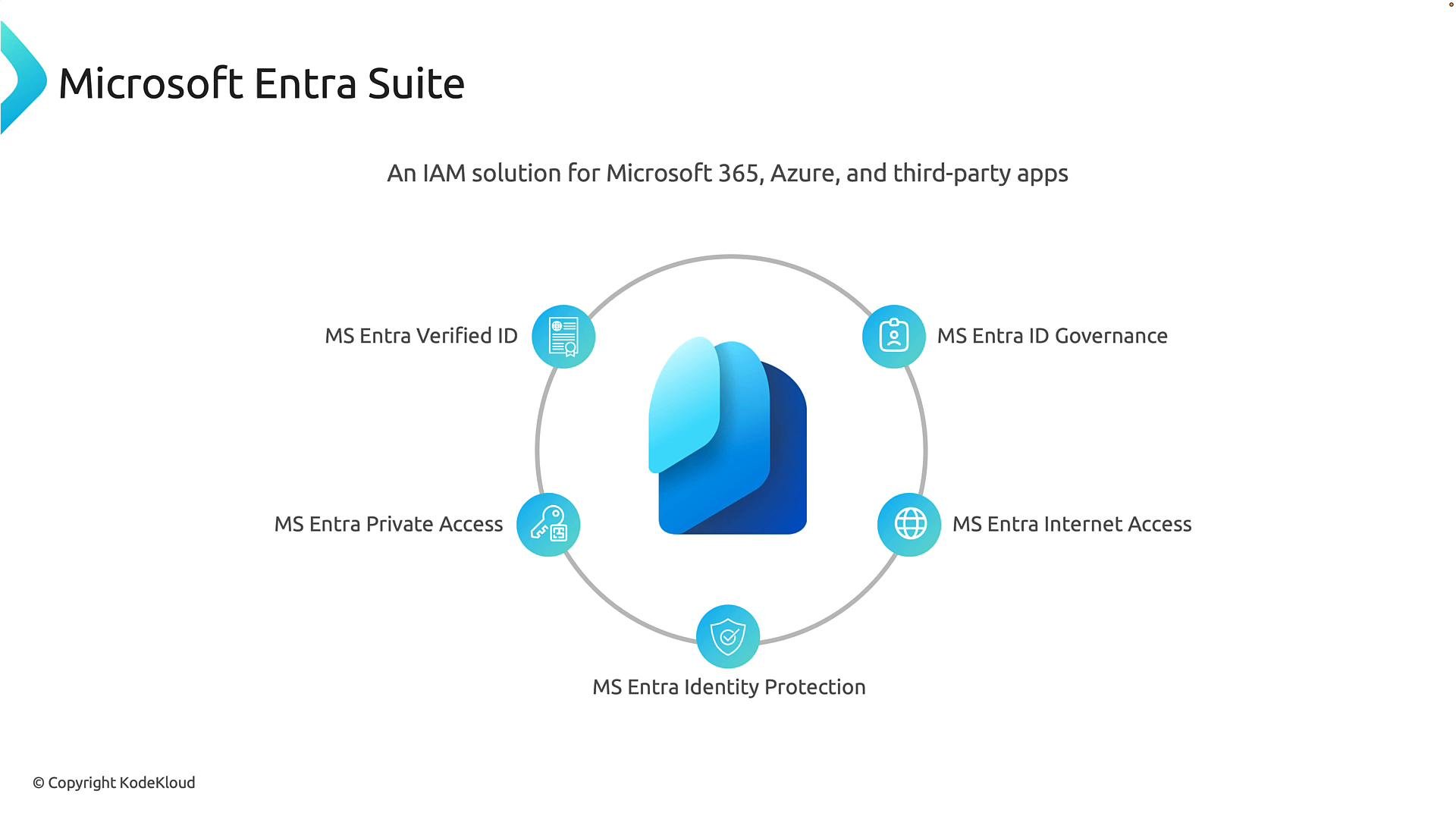
This article assumes a basic understanding of identities, authentication, authorization, and access control, and how those concepts map to a Zero Trust approach. We’ll review Microsoft Entra — the identity and access management (IAM) suite from Microsoft — covering the core services, governance controls, threat-detection features, and advanced identity solutions. Focus on what each service does and the business problem it solves rather than memorizing every configuration detail. Think of Microsoft Entra as a cloud identity platform and directory where users, groups, devices, and applications are stored and managed. Around that core are services that provide policy-based access, governance, threat detection, and modern secure connectivity.
A Microsoft Entra Suite graphic showing the Entra logo at the center with a circular layout of components around it (MS Entra Verified ID, ID Governance, Internet Access, Identity Protection, Private Access). The header labels it "An IAM solution for Microsoft 365, Azure, and third‑party apps."

Key Microsoft Entra services and the problems they solve

Two services are foundational in nearly every deployment: Entra ID (the directory) and Conditional Access (the policy engine).
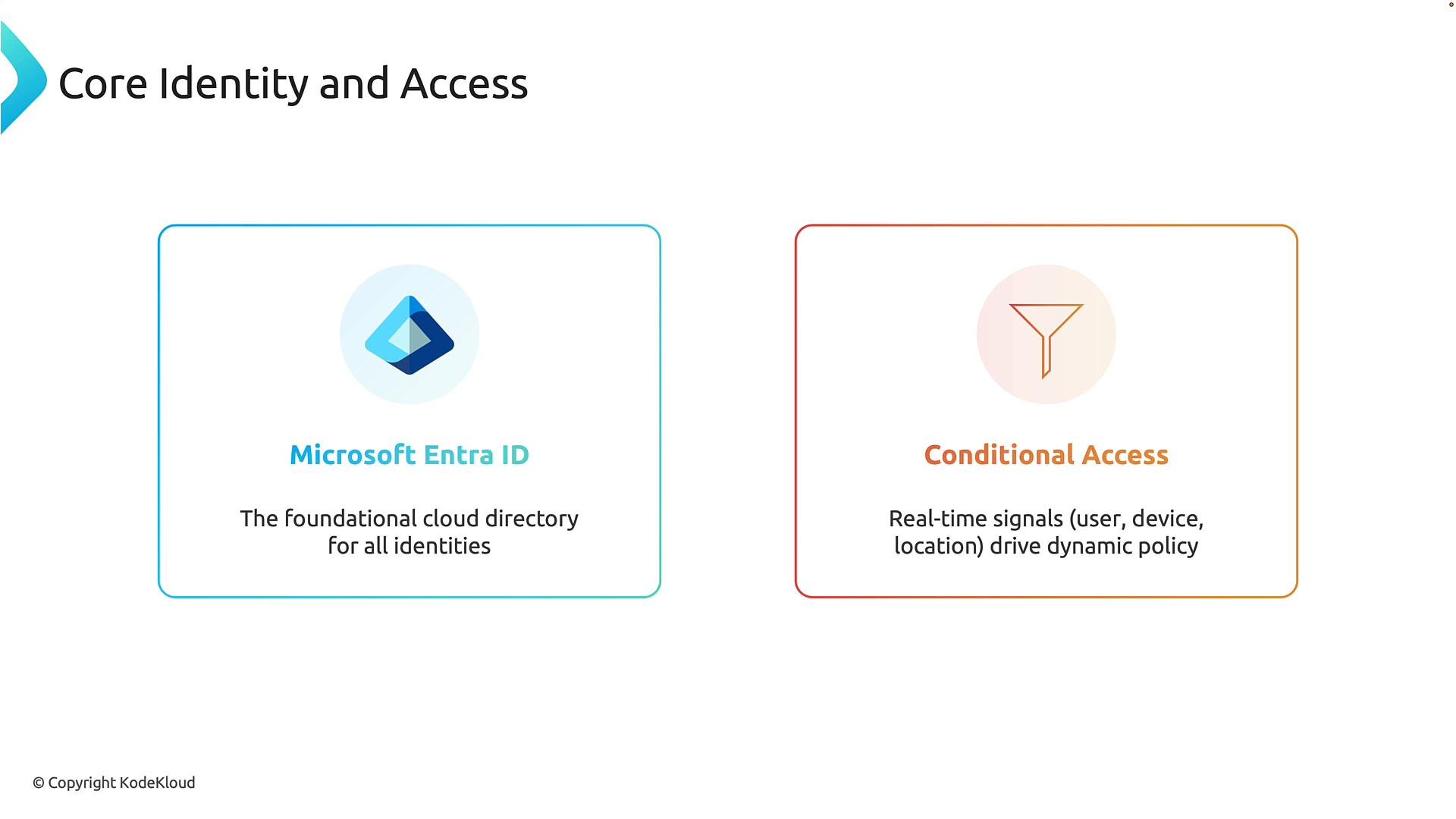
A slide titled "Core Identity and Access" showing two cards: Microsoft Entra ID described as the foundational cloud directory for identities, and Conditional Access described as using real-time signals (user, device, location) to drive dynamic policy.
  • Microsoft Entra ID (cloud directory): the central store for identities and the gatekeeper for authentication across the tenant.
  • Conditional Access (policy engine): evaluates signals such as who is signing in, device state, location, and risk indicators to make real‑time access decisions.
Together, Entra ID verifies who a user is and Conditional Access determines how and when access is allowed — the core of applying Zero Trust to identity.

Governance and privileged access: preventing permission sprawl

As organizations scale, user roles change, contractors come and go, and administrators need temporary elevated rights. Without governance, access rights accumulate and increase risk. Entra offers multiple controls to manage this complexity:
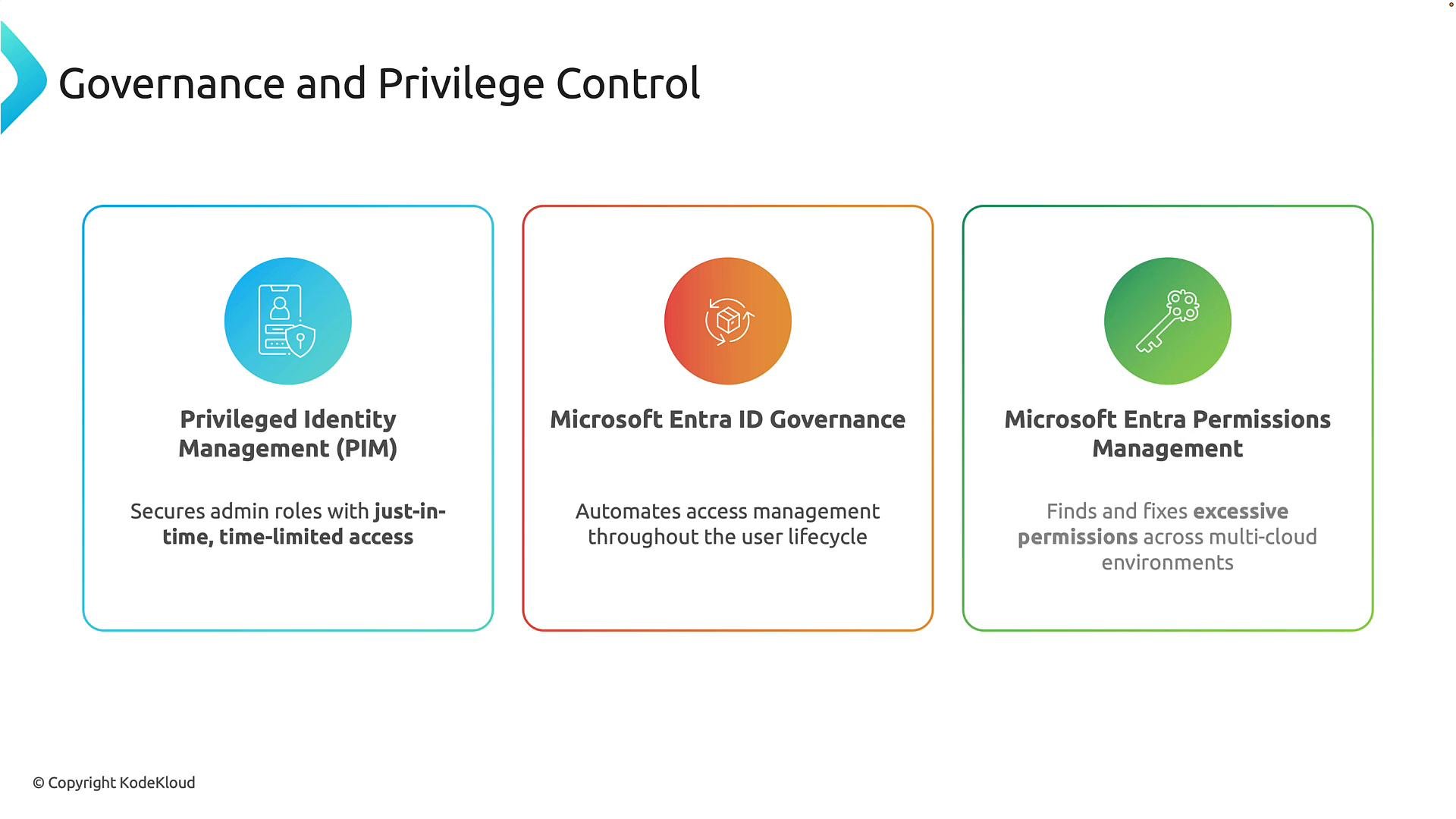
A slide titled "Governance and Privilege Control" showing three panels: Privileged Identity Management (PIM), Microsoft Entra ID Governance, and Microsoft Entra Permissions Management, each with a colored icon. Each panel includes a brief description of its function (just-in-time admin access, automated lifecycle access management, and finding/fixing excessive permissions).
  • Privileged Identity Management (PIM): implements just‑in‑time elevation and approval flows for admins to reduce standing privileges.
  • Entra ID Governance: automates lifecycle events, entitlement assignments, and access reviews to keep permissions aligned with roles.
  • Entra Permissions Management: inventories permissions across clouds and recommends actions to follow least‑privilege principles.
These services help reduce human error, enforce policy, and limit the blast radius from compromised accounts.

Identity threat detection and response

Identity is a primary target for attackers. Entra provides detection, scoring, and automated response capabilities to reduce risk and remediate incidents faster:
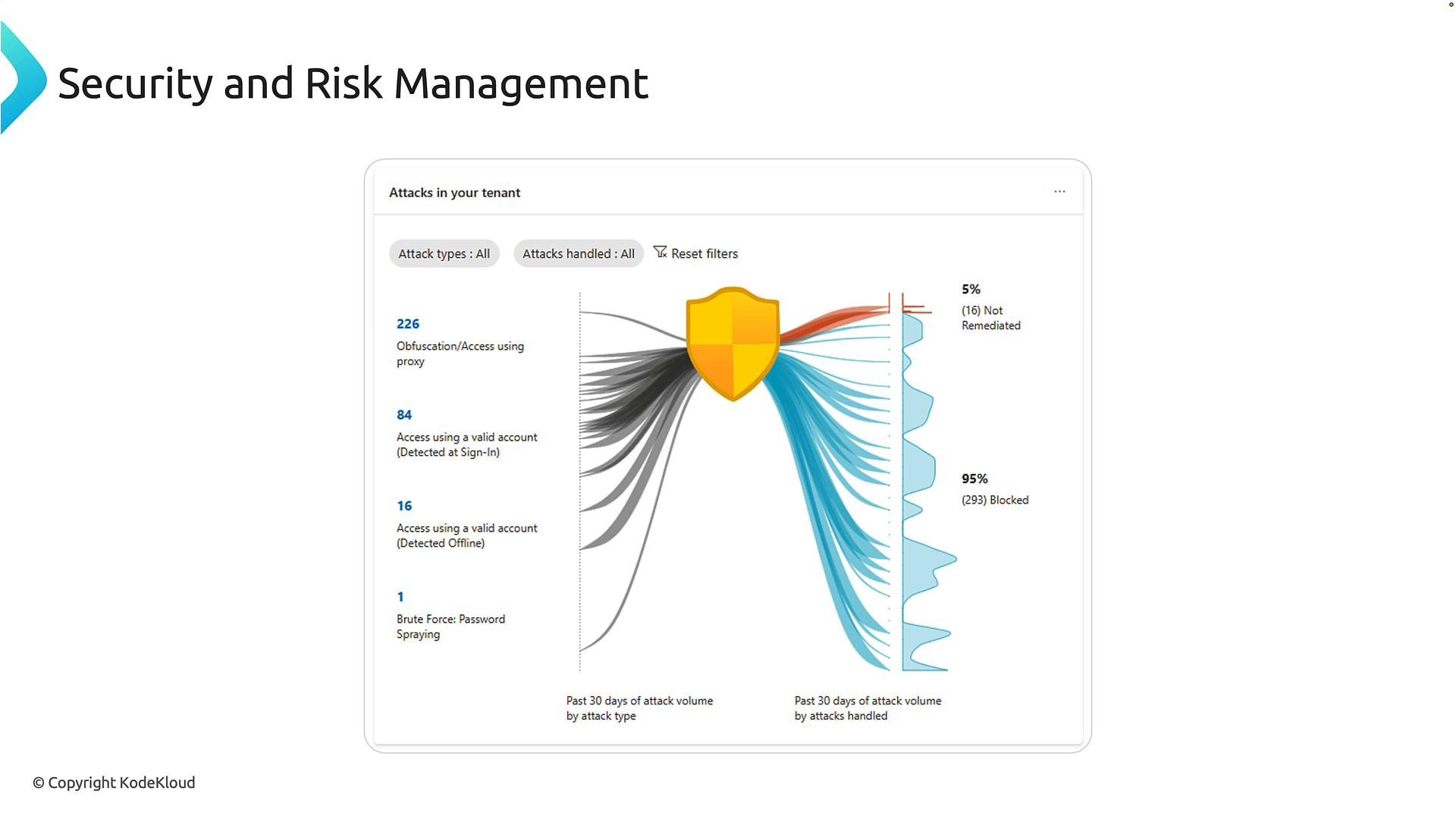
A slide titled "Security and Risk Management" showing a dashboard called "Attacks in your tenant" with a central shield and flow diagram mapping attack types to outcomes. The panel lists attack counts (e.g., obfuscation/proxy, valid account access, brute‑force) and shows 95% blocked vs 5% not remediated.
  • Entra ID Protection: continuously analyzes sign‑ins and user activity to flag risky behavior (e.g., impossible travel) and can trigger automated responses such as enforcing MFA or blocking access.
  • Identity Secure Score: provides an identity security posture score and prioritized recommendations (enable MFA, reduce legacy authentication, expand Conditional Access) to guide improvements.
Microsoft’s cloud‑scale threat intelligence helps detect and often block attacks before they affect your tenant, shifting teams from reactive response to proactive risk mitigation.

Advanced identity scenarios and modern access alternatives

Modern work requires new identity patterns — verifiable credentials, policy‑driven internet access, and identity‑aware private application access:
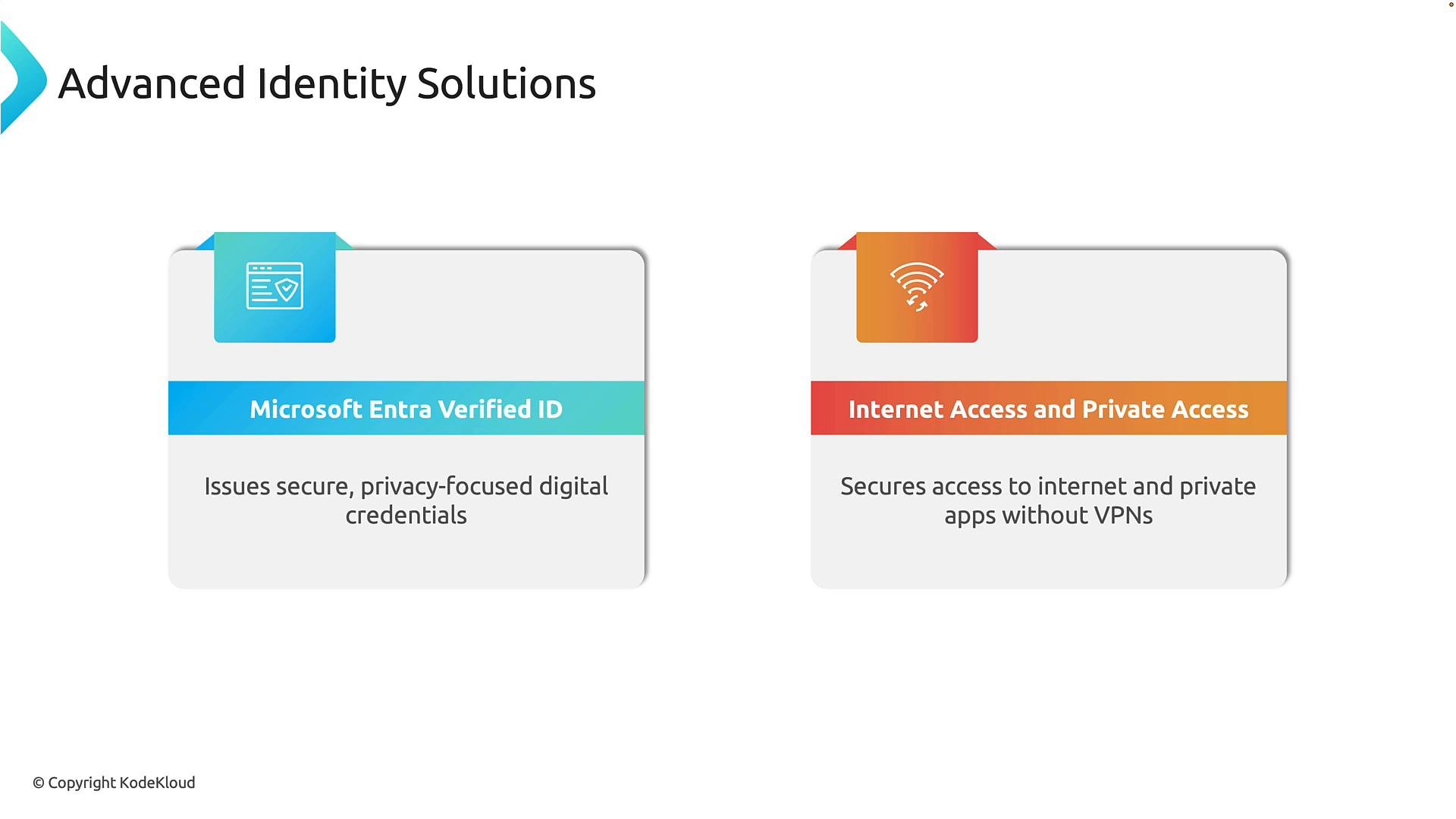
A slide titled "Advanced Identity Solutions" with two labeled panels. Left panel: "Microsoft Entra Verified ID" (issues secure, privacy-focused digital credentials); right panel: "Internet Access and Private Access" (secures internet and private app access without VPNs).
  • Entra Verified ID: issues verifiable credentials so users can present attestations (employee status, student enrollment, certifications) while retaining privacy and control.
  • Entra Internet Access and Entra Private Access: secure internet and private app traffic using identity and device signals rather than relying on network location — modern alternatives to traditional VPNs that align with Zero Trust network access.

Summary

You should now recognize the major Microsoft Entra services and understand the role each plays in identity, access management, governance, and security. Focus on the purpose and business value of each service — detailed UI steps and configuration specifics can be learned when you need to implement.
Tip: Focus on scenarios and outcomes for each Entra service (for example, PIM for temporary admin elevation; Verified ID for verifiable credentials). You do not need to memorize UI steps or configuration settings.

Where to find these services in the admin console

To explore these services:
  • Microsoft 365 Admin Center: https://admin.microsoft.com → open the Identity admin center.
  • Directly: https://entra.microsoft.com
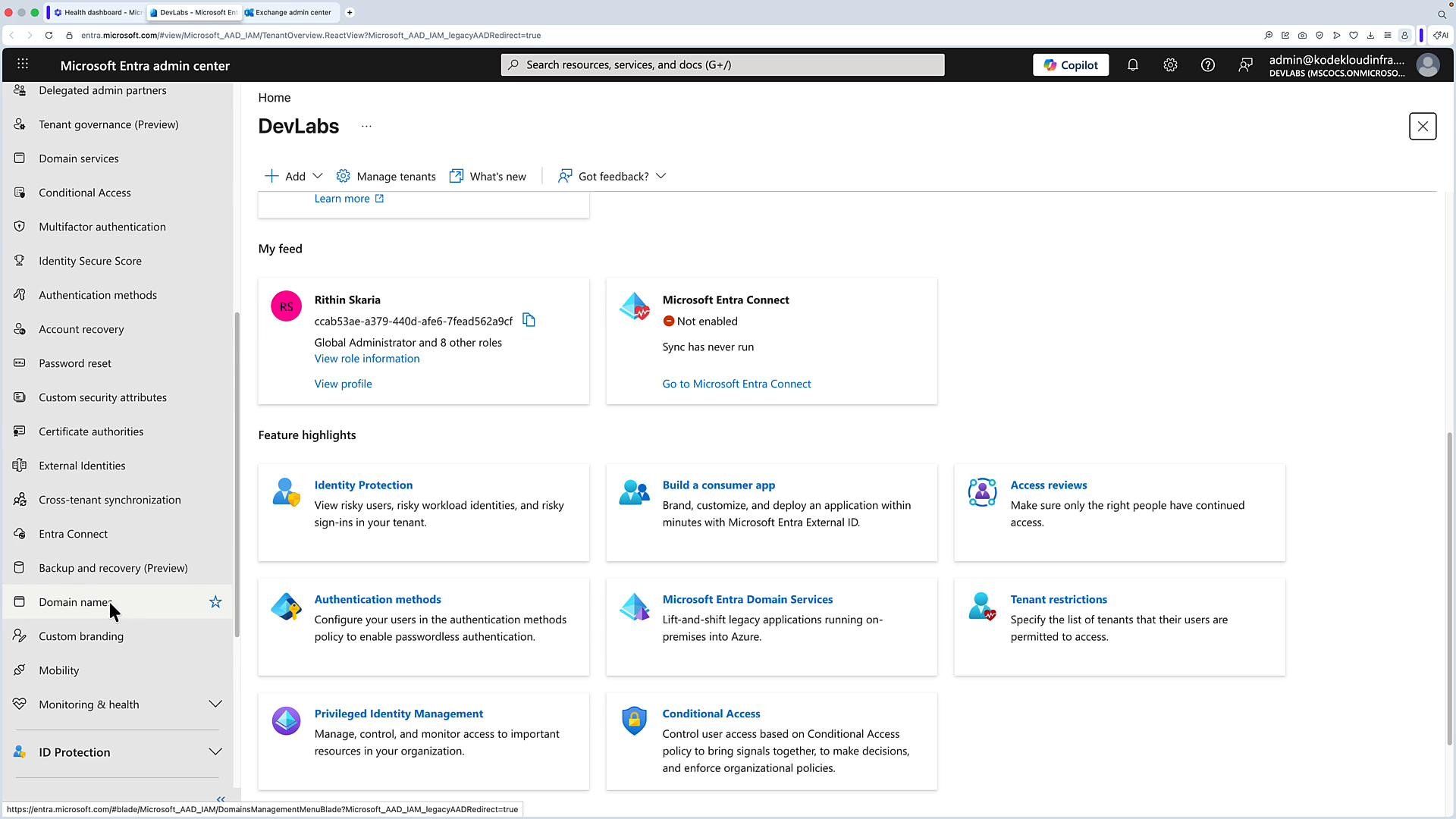
The Entra admin center provides access to Identity Protection, Access Reviews, Authentication Methods, Conditional Access, Privileged Identity, Verified ID, Private and Internet Access, and more.
A screenshot of the Microsoft Entra admin center dashboard for a tenant called "DevLabs," showing the left navigation menu and a central feed with feature cards (Identity Protection, Authentication methods, Conditional Access, etc.). The top bar shows search and account controls and a card indicates Microsoft Entra Connect sync is not enabled.
You do not need to configure these services now—just know what they provide and how they fit into a Zero Trust identity strategy.
  • Microsoft Entra documentation: https://learn.microsoft.com/entra
  • Microsoft Entra admin center: https://entra.microsoft.com
  • Microsoft 365 admin center: https://admin.microsoft.com

Watch Video