

Benefits
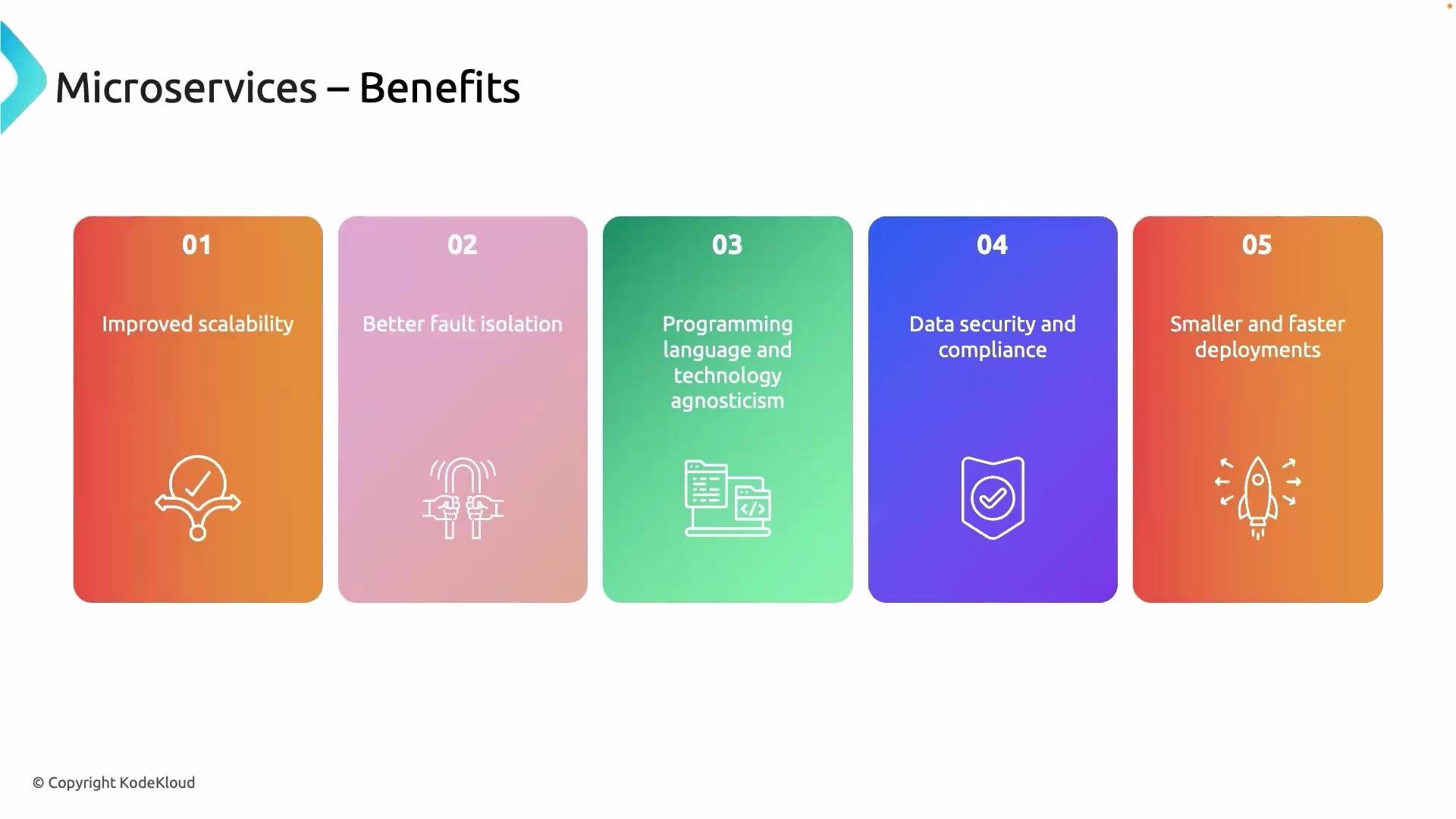
Microservices decompose a monolith into smaller, independently deployable services. This model delivers concrete operational and organizational advantages:- Improved scalability: Scale individual services to match demand. This reduces cloud costs and limits the blast radius when traffic spikes affect only one service.
- Fault isolation: Service boundaries contain failures, improving overall system availability and resilience.
- Polyglot development and platform flexibility: Teams can select the best language, framework, and runtime for each service, increasing developer productivity and enabling use of specialized tools where appropriate.
- Stronger security and compliance boundaries: Isolating sensitive data within a service boundary simplifies fine-grained access control and can help meet regulatory requirements when data locality is well-defined.
- Smaller codebases and faster releases: Independent repositories and CI/CD pipelines let teams release features more frequently, reducing deployment risk and shortening time-to-market.
Challenges
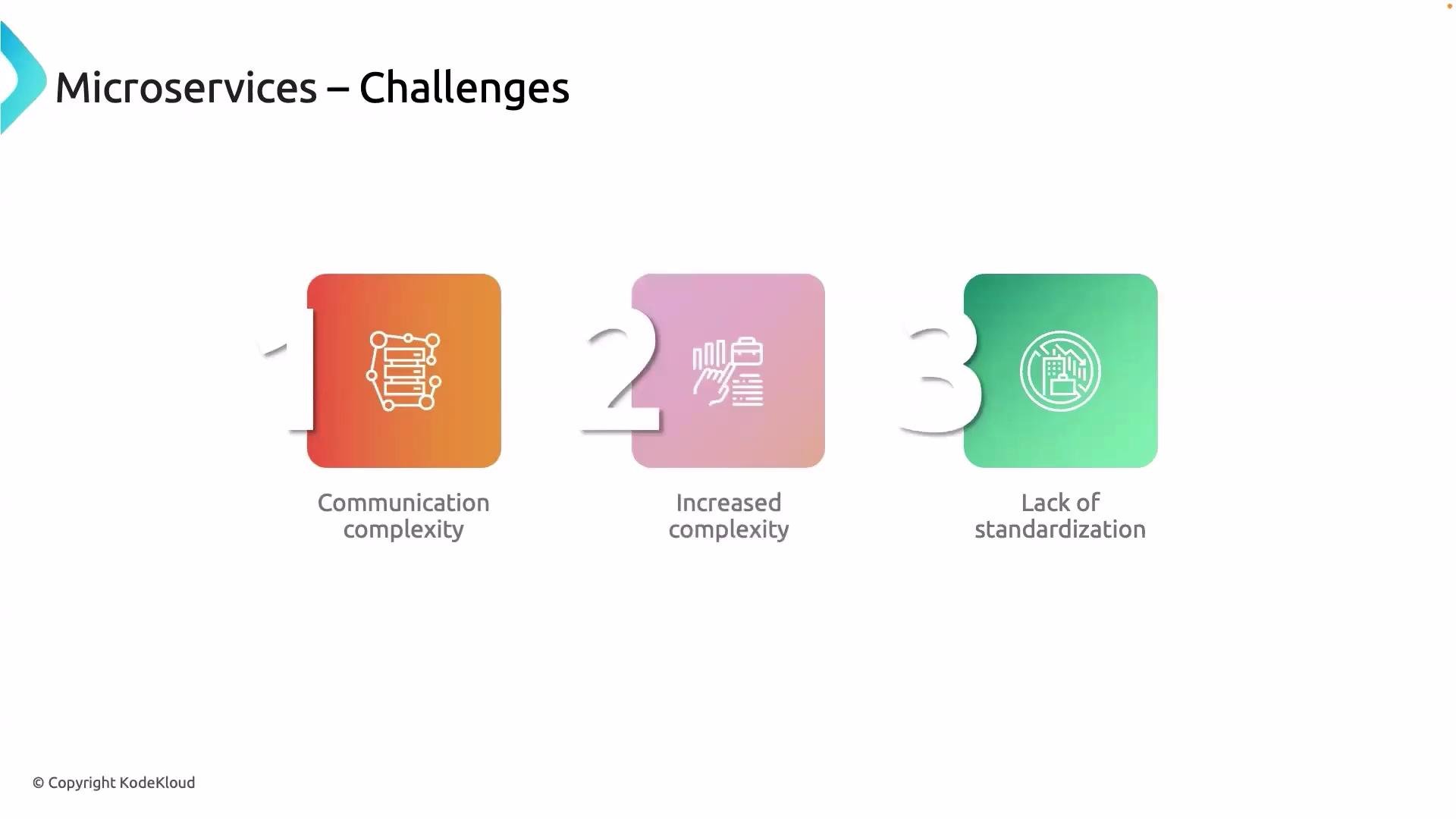
Moving to microservices introduces distributed-systems complexity. These are the most common challenges teams must address:- Communication complexity: Networked service-to-service communication adds latency and failure modes. You must design for retries, timeouts, idempotency, API versioning, service discovery, load balancing, and resiliency patterns such as circuit breakers.
- Increased operational overhead: Hundreds of services require platform capabilities: container orchestration (e.g., Kubernetes), automated CI/CD, centralized logging, distributed tracing, metrics, and alerting for effective observability.
- Data and consistency trade-offs: Distributed data ownership complicates ACID-style transactions. Teams adopt eventual consistency, sagas, and domain-driven approaches to manage cross-service workflows and guarantee correctness.
- Governance and standardization risks: Without clear platform standards, shared libraries, and API guidelines, a polyglot ecosystem can fragment—making integration and long-term maintenance harder.
Microservices are a trade-off: they deliver scalability and team autonomy at the cost of distributed-systems complexity. Successful adoption typically involves investing in platform tooling, robust CI/CD, comprehensive observability (logs, metrics, traces), and clear API and governance practices.