This article explores Azure Cache for Redis, a managed caching solution that enhances data retrieval speed, scalability, and reliability for various applications.
Azure Cache for Redis is a fully managed, high-performance caching solution on the Azure platform. Powered by the open-source, in-memory NoSQL data store Redis, it delivers extremely fast data retrieval and versatility. The community-driven development of Redis ensures continuous enhancements and robust reliability.Redis stores all data in memory, resulting in minimal latency for data retrieval. Operating as a key-value store, every value is accessed using a unique key. Its flexible data structures and scalability make it an excellent option for applications requiring real-time performance. For example, using the Redis CLI, you can set and retrieve a value as shown below:
> SET key "Hello World!"> GET key"Hello World!"
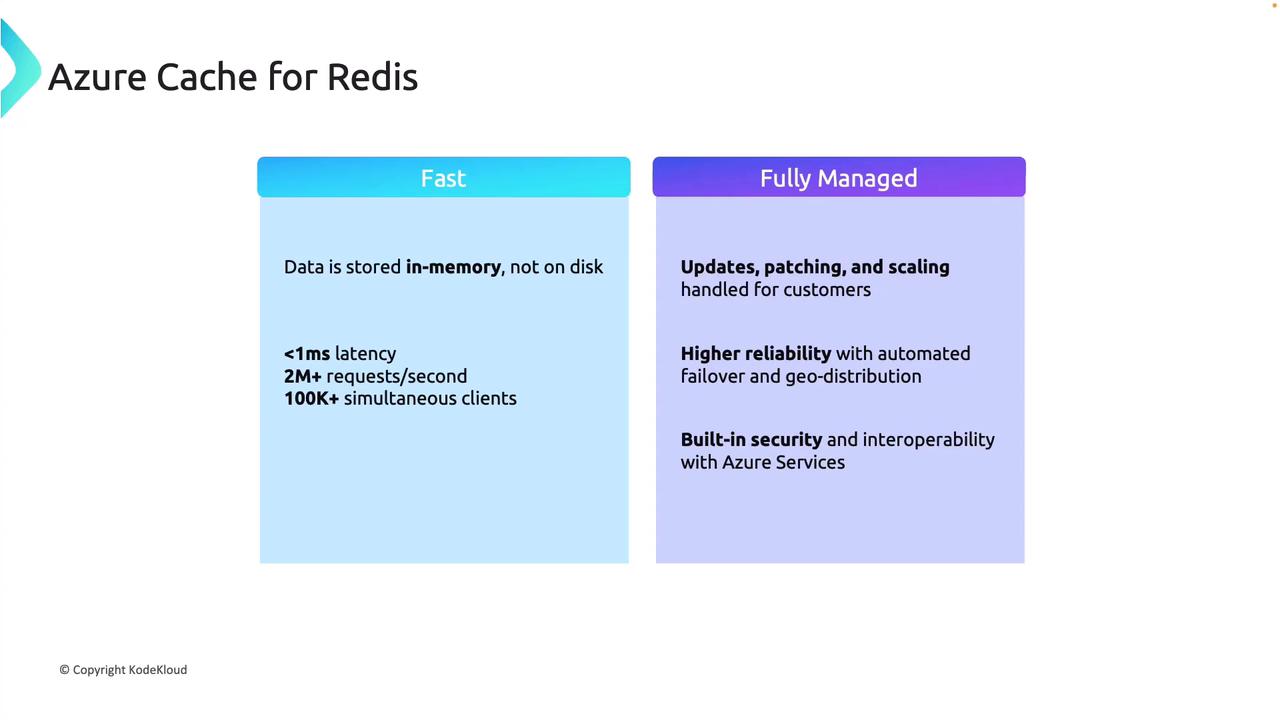
In this example, the key is associated with the value “Hello World!”, demonstrating the basic operations of Redis.Azure Cache for Redis further enhances these capabilities by offering a fully managed service that integrates seamlessly into the Azure ecosystem. This service provides a number of significant benefits:
In-memory data storage with latency under 1 millisecond.
The capacity to handle over 2 million requests per second.
Support for more than 100,000 simultaneous clients.
Automatic updates, patching, and scaling managed by Azure.
High reliability with automated failover and geo-replication.
Built-in security features and seamless integration with other Azure services.
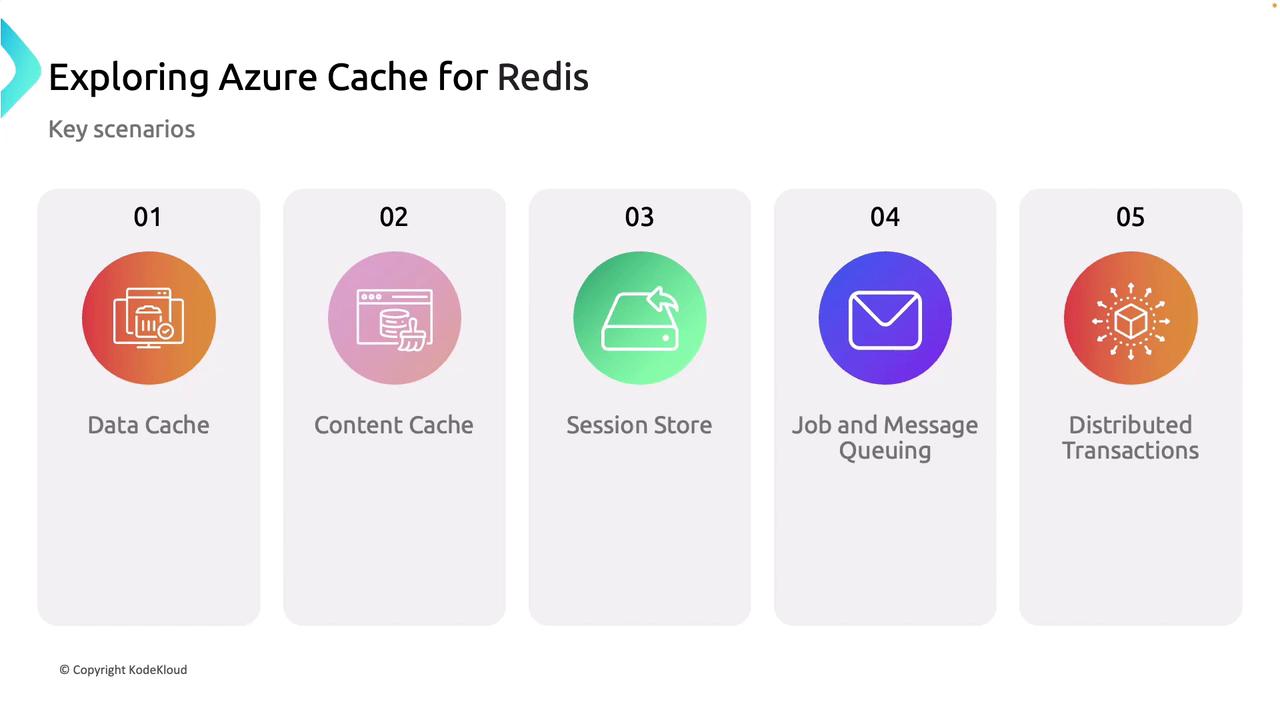
Azure Cache for Redis is ideal for several critical scenarios where speed, scalability, and reliability are essential:
Data Cache: Accelerates access to frequently used data by storing it in memory, greatly reducing latency.
Content Cache: Ensures content remains readily available for content-rich applications.
Session Store: Manages user session state data for real-time applications, providing a seamless user experience.
Job and Message Queuing: Supports rapid data retrieval and efficient management of background job processing and messaging.
Distributed Transactions: Maintains consistency and reliability in transactions across distributed systems.
These capabilities help businesses achieve faster data access, enhanced scalability, and reliable transaction handling. The key scenarios for Azure Cache for Redis are illustrated in the diagram below:
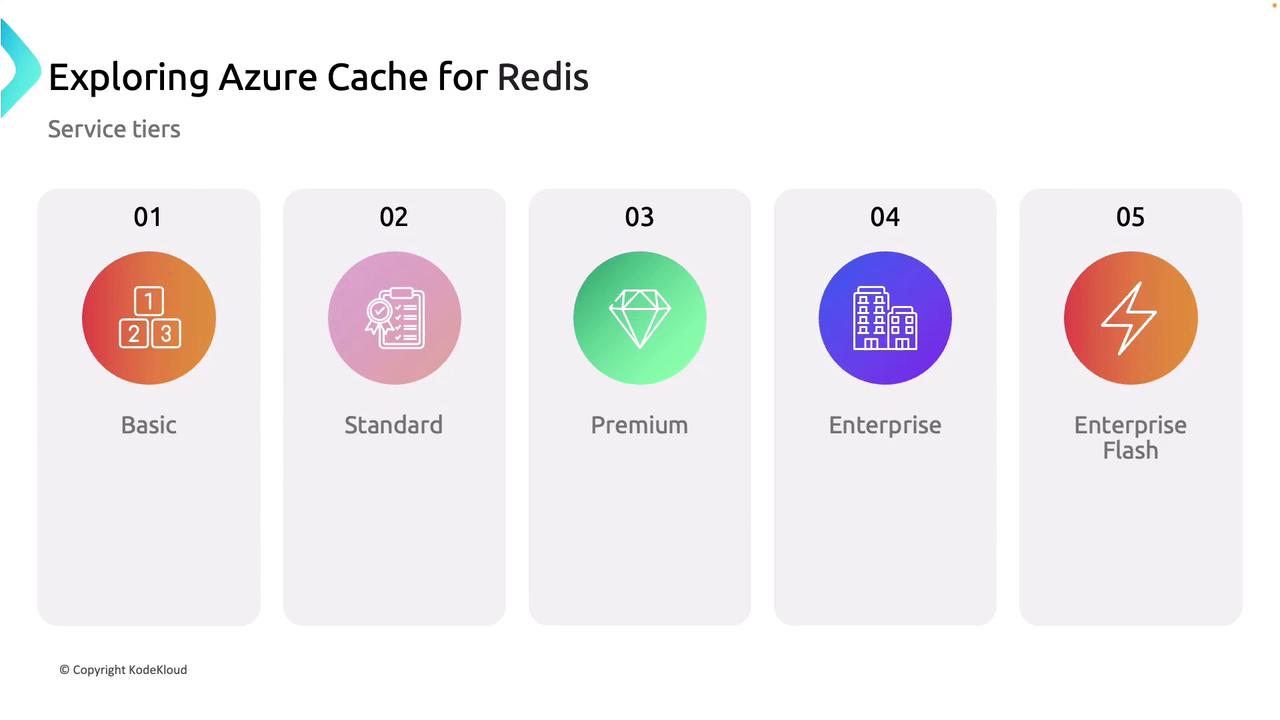
Azure Cache for Redis is available in multiple service tiers, each designed to meet different performance requirements and workload demands. The service tiers include:
Service Tier
Description
Basic
Ideal for non-critical applications and testing environments with fundamental caching needs.
Standard
Suitable for production workloads with built-in failover support and redundancy.
Premium
Delivers enhanced performance with advanced features such as clustering and improved failover capabilities.
Enterprise
Designed for large-scale, mission-critical applications offering high reliability, better scaling, and geo-distribution.
Enterprise Flash
Focuses on extremely low latency and high-throughput operations for demanding workloads.
This tiered structure enables organizations to choose the right level of performance and reliability based on specific application needs. The service tier comparison is depicted in the image below:
When selecting a service tier, make sure to evaluate your application’s performance requirements and data consistency needs. Upgrading tiers may involve additional costs.
With an understanding of what Azure Cache for Redis offers, along with its key scenarios and service tiers, you can now move on to configuring and integrating it into your applications effectively. This foundational overview provides you with the insight necessary to leverage Azure Cache for Redis for faster and more efficient data handling.For comprehensive guidance on configuration and best practices, please refer to the Azure Cache for Redis Documentation.By following these guidelines, you ensure that your applications can take full advantage of real-time caching, scalability, and reliability provided by Azure Cache for Redis.