

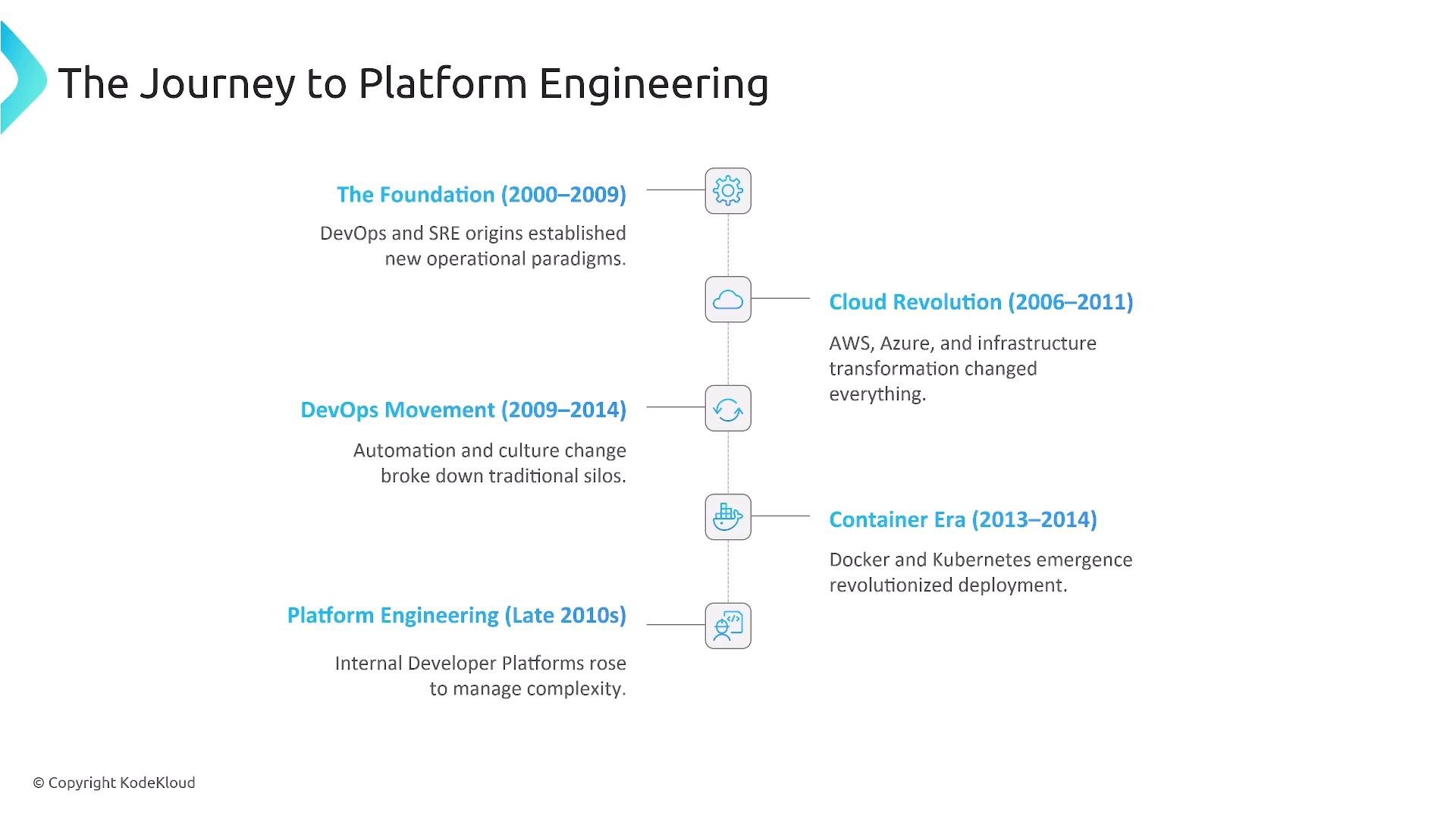
- Early Site Reliability Engineering (Google SRE) and formal reliability practices
- The cloud revolution (API-driven infrastructure)
- DevOps and Agile cultural practices
- Containerization (Docker) and orchestration (Kubernetes)
- GitOps and declarative automation
- The emergence of Internal Developer Platforms (IDPs) and platform teams
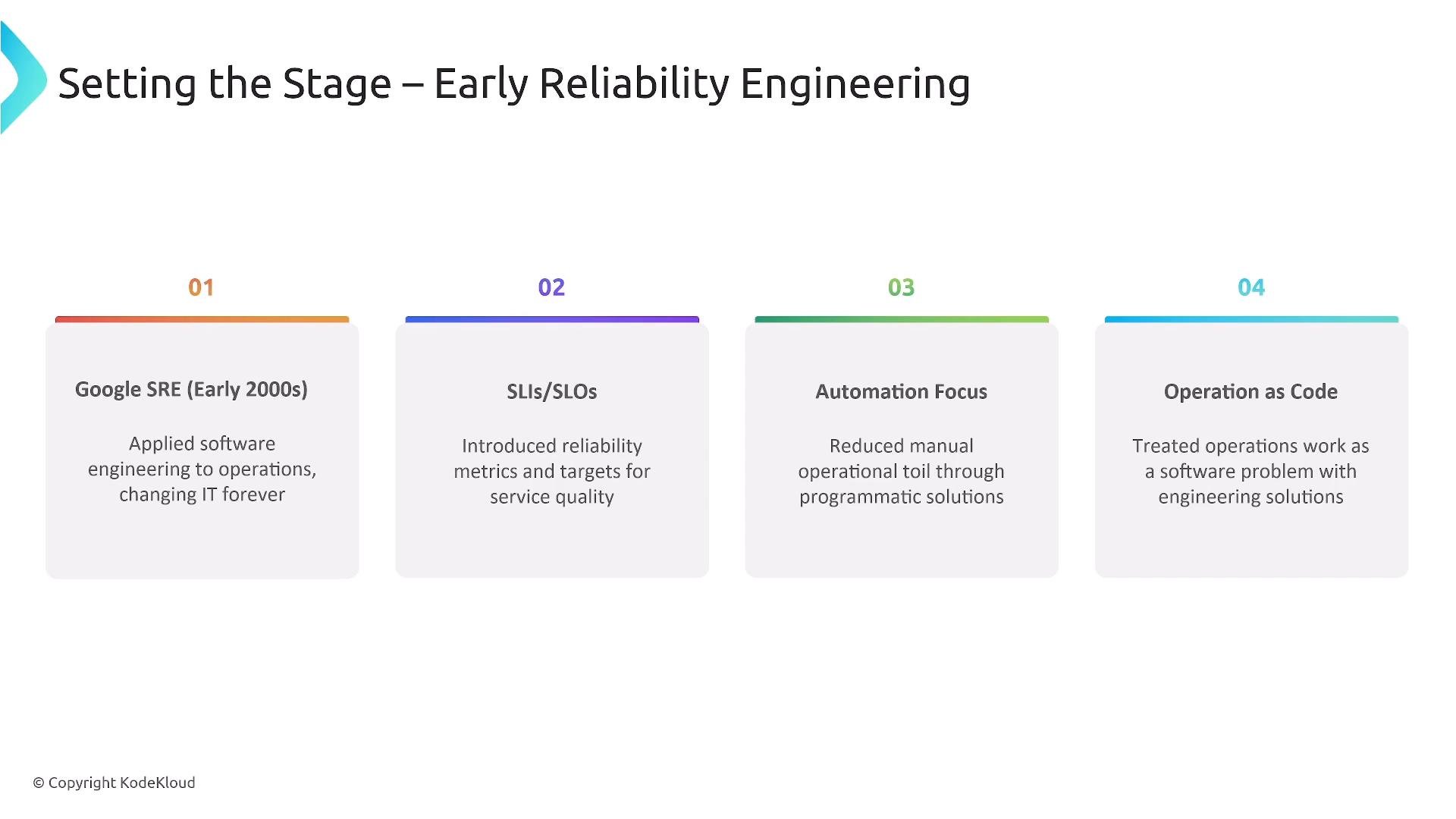
Foundations: SRE, SLIs/SLOs, and Operations-as-Code
- Google’s SRE practices (early 2000s) shifted thinking from manual operations to engineering reliability into systems. Core concepts include SLIs (Service Level Indicators), SLOs (Service Level Objectives), and SLAs.
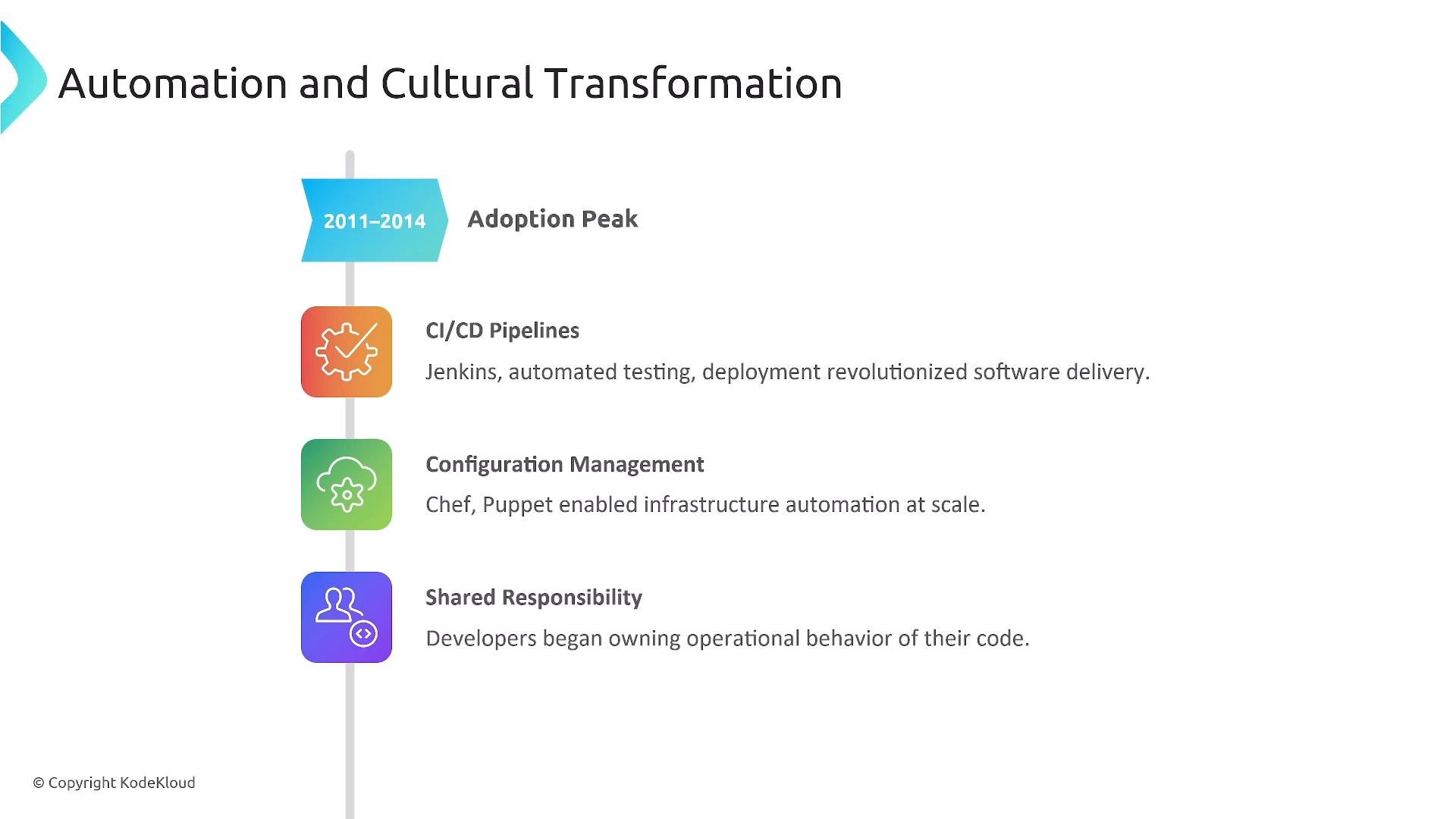
- Automation and “operations as code” became mainstream: configuration management tools like Chef, Puppet, and Ansible, plus version-controlled automation, made infrastructure repeatable and auditable.
- Version control (Git) enabled teams to treat infrastructure definitions and automation scripts as first-class, reviewable artifacts.
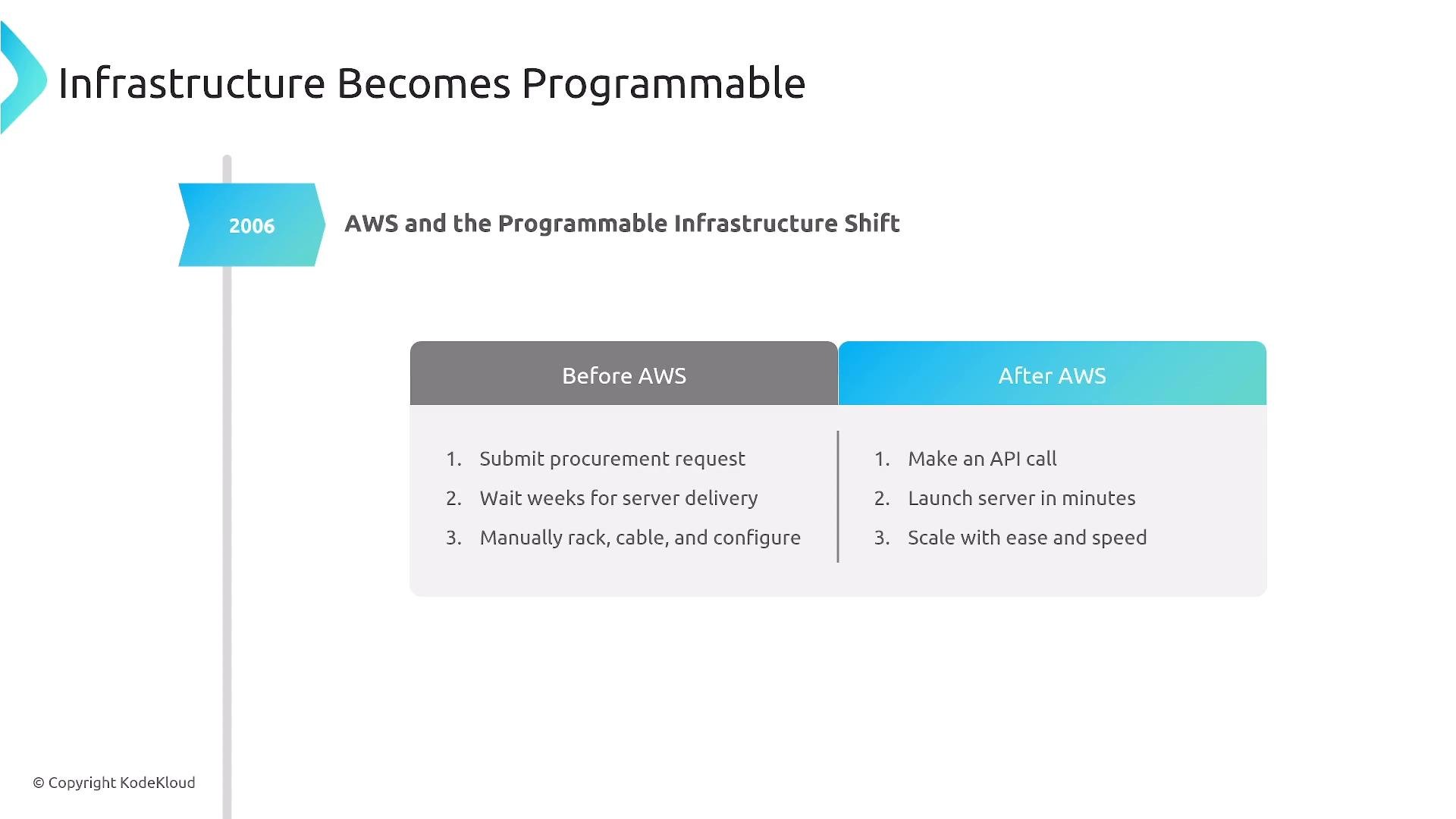
The Cloud Revolution: self-service, API-driven infrastructure
- AWS (and later other public clouds) made infrastructure consumable through APIs. Teams could programmatically provision compute, storage, and networking in minutes instead of weeks.
- Reduced provisioning friction enabled much faster iteration and practical automation at scale. As cloud security and governance improved, adoption accelerated across organizations.
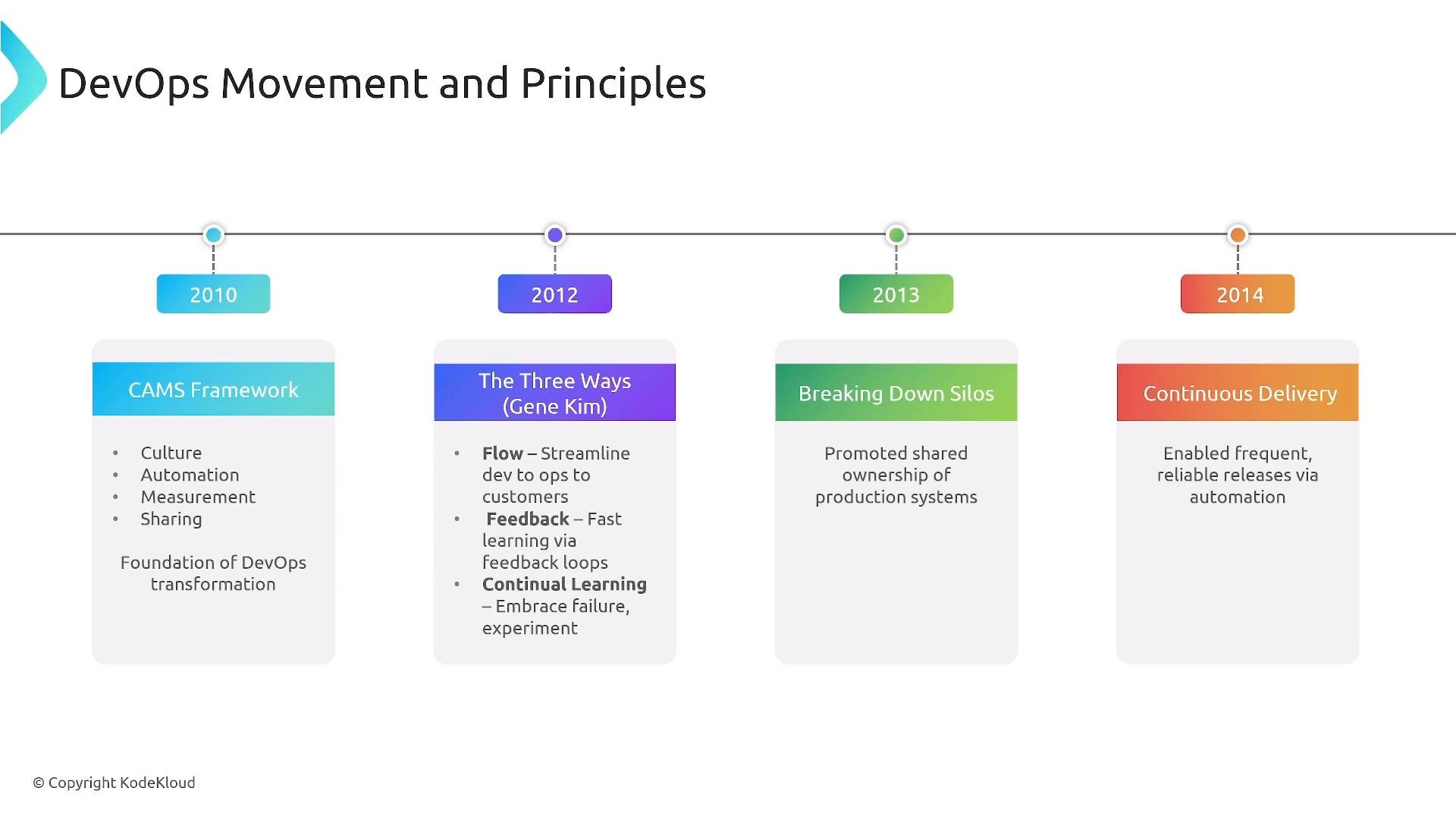
DevOps: culture, automation, feedback
- The DevOps movement (gaining momentum after 2009) emphasized culture, automation, measurement, and sharing (CAMS), plus The Three Ways: flow, feedback, and continual learning.
- DevOps introduced CI/CD, trunk-based development, automated testing, and continuous delivery — reducing lead time to production and promoting shared responsibility between developers and operations.
- Tools like Terraform and CloudFormation enabled declarative, version-controlled infrastructure definitions that could be reused and reviewed.
- Image and configuration tooling (Packer, Chef, Puppet, Ansible) supported reproducible, immutable infrastructure patterns.
Containerization: portable application packaging (Docker)
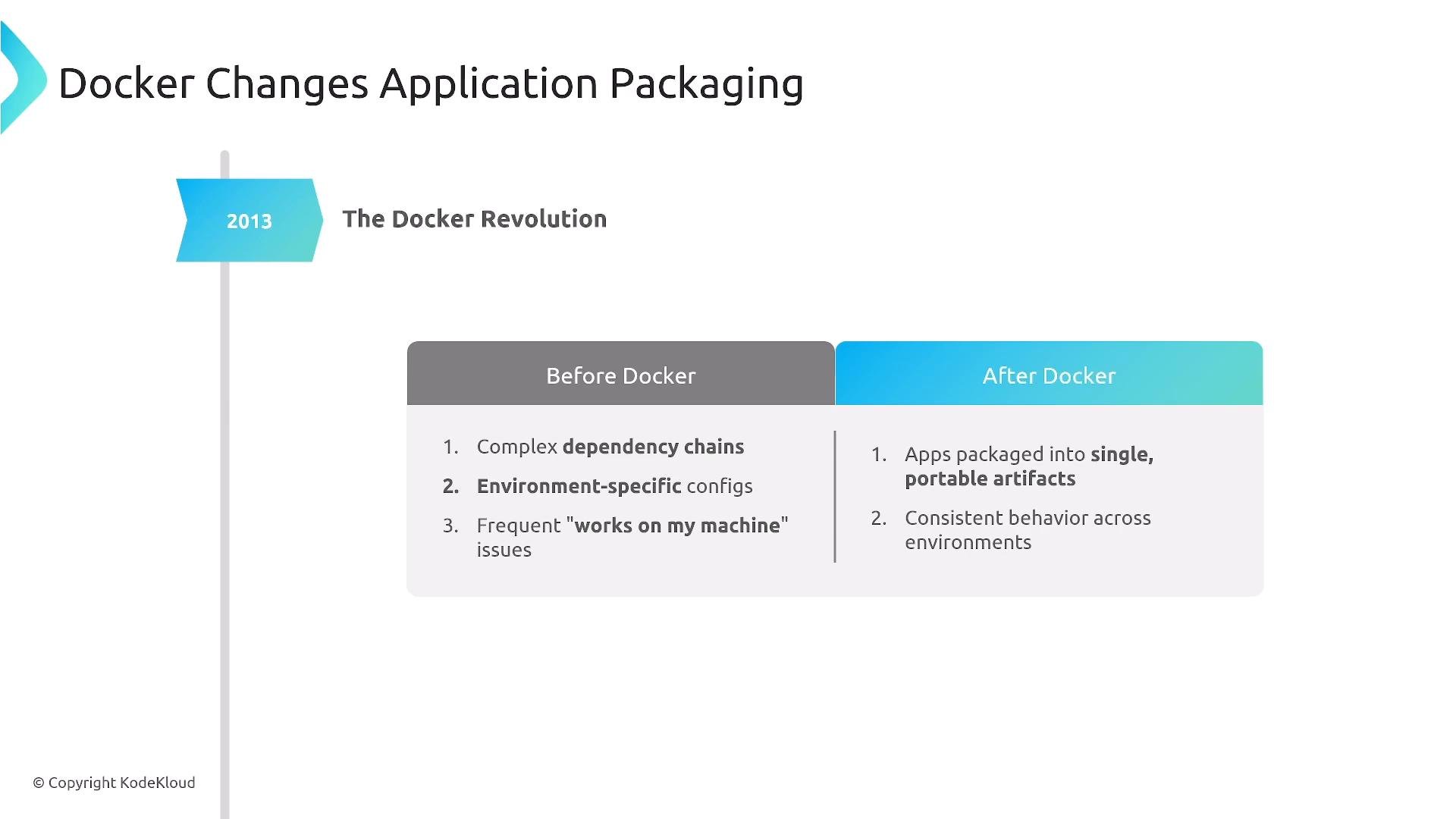
- Docker popularized container images (circa 2013), standardizing how applications and their dependencies are packaged into portable artifacts.
- Containers reduced “works on my machine” issues and made it possible to move the same artifact across dev → test → staging → production with predictable behavior.
Container orchestration: Kubernetes
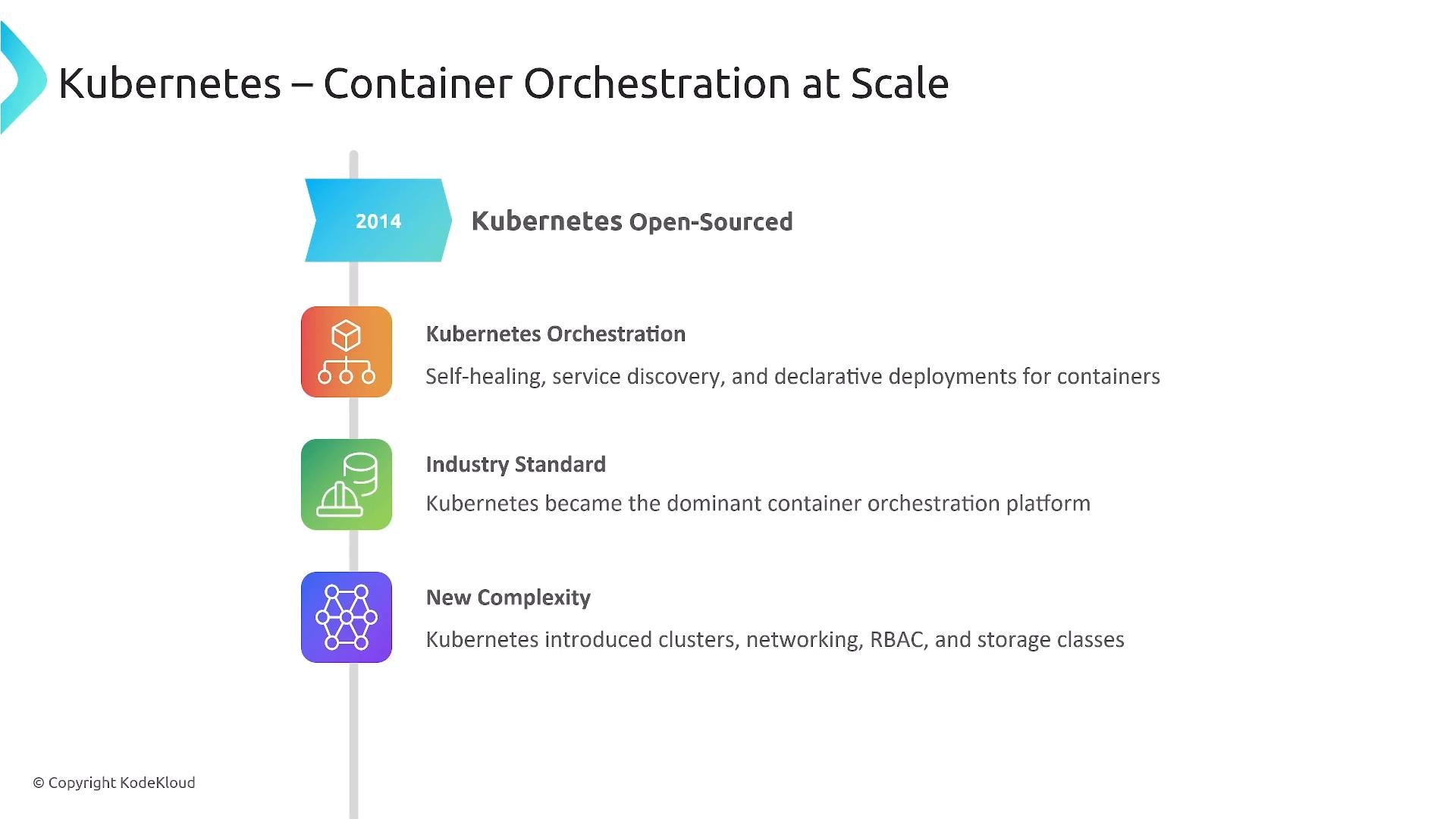
- As containers proliferated, orchestration for scheduling, scaling, service discovery, and self-healing became necessary. Kubernetes (open-sourced in 2014) emerged as the industry standard for container orchestration.
- Kubernetes introduced powerful declarative primitives but also added operational complexity: networking, persistent storage, authentication/authorization, and observability all required new operational practices.
Kubernetes solves many problems but increases platform complexity. Platform teams often abstract Kubernetes details away from app developers so teams can focus on features rather than cluster internals.
GitOps and declarative automation
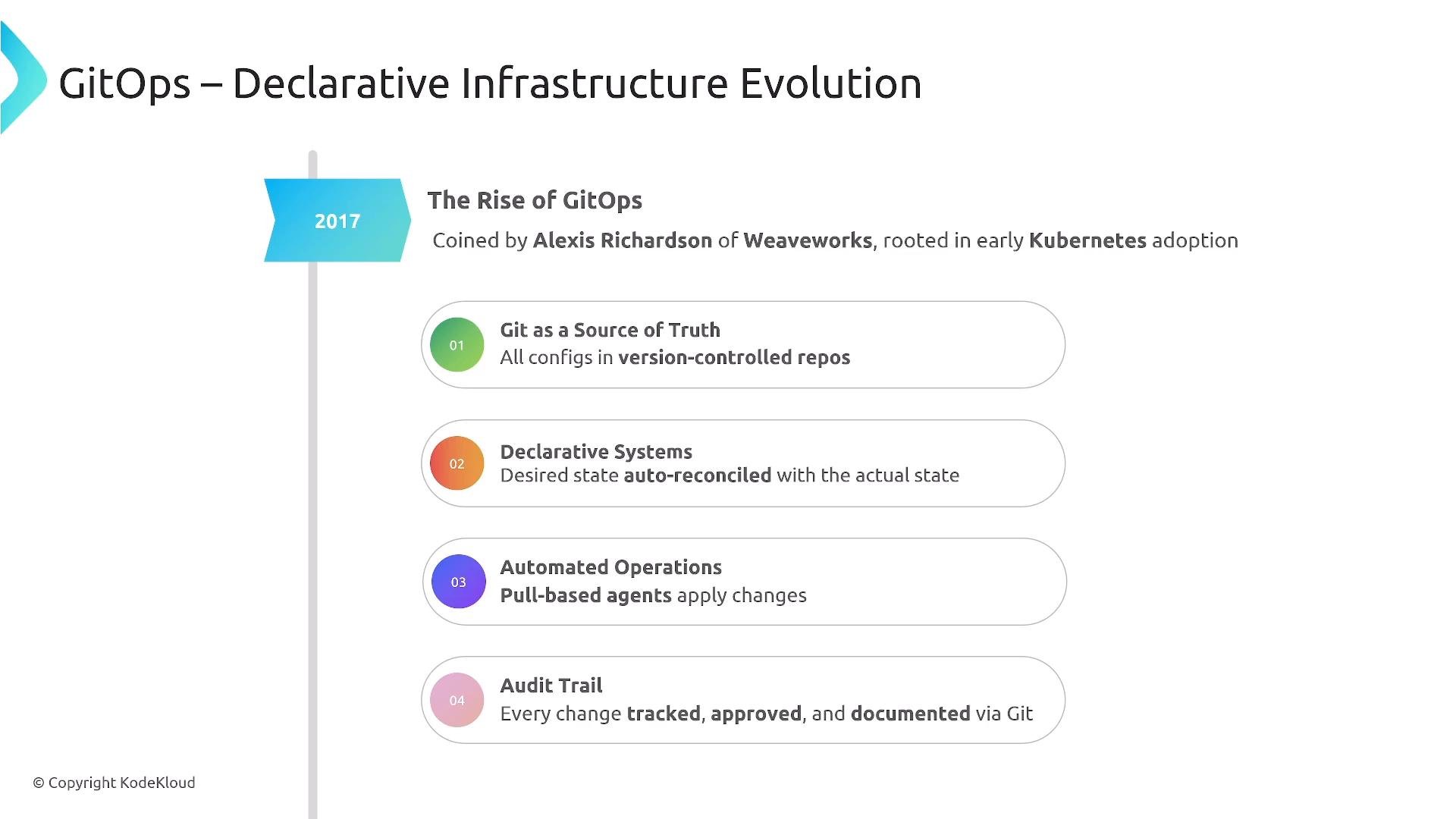
- GitOps (popularized around 2017) treats Git as the single source of truth for cluster and application configuration. Automated controllers reconcile the actual state to the declared state in Git.
- GitOps adds a clear audit trail, supports pull-request-driven workflows, and enables automated reconciliation and approval workflows for infrastructure changes.
The rise of platform engineering and Internal Developer Platforms (IDPs)
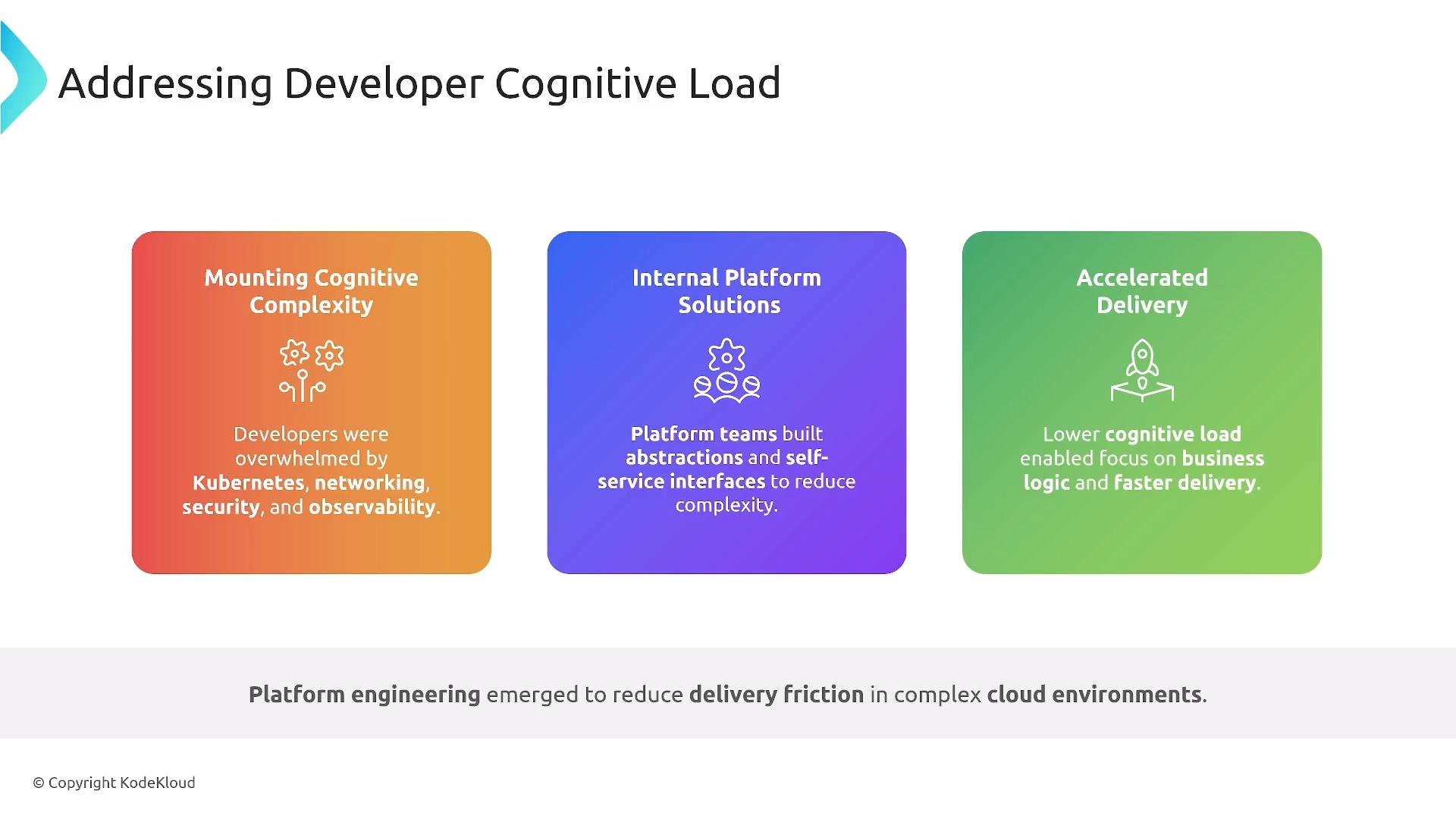
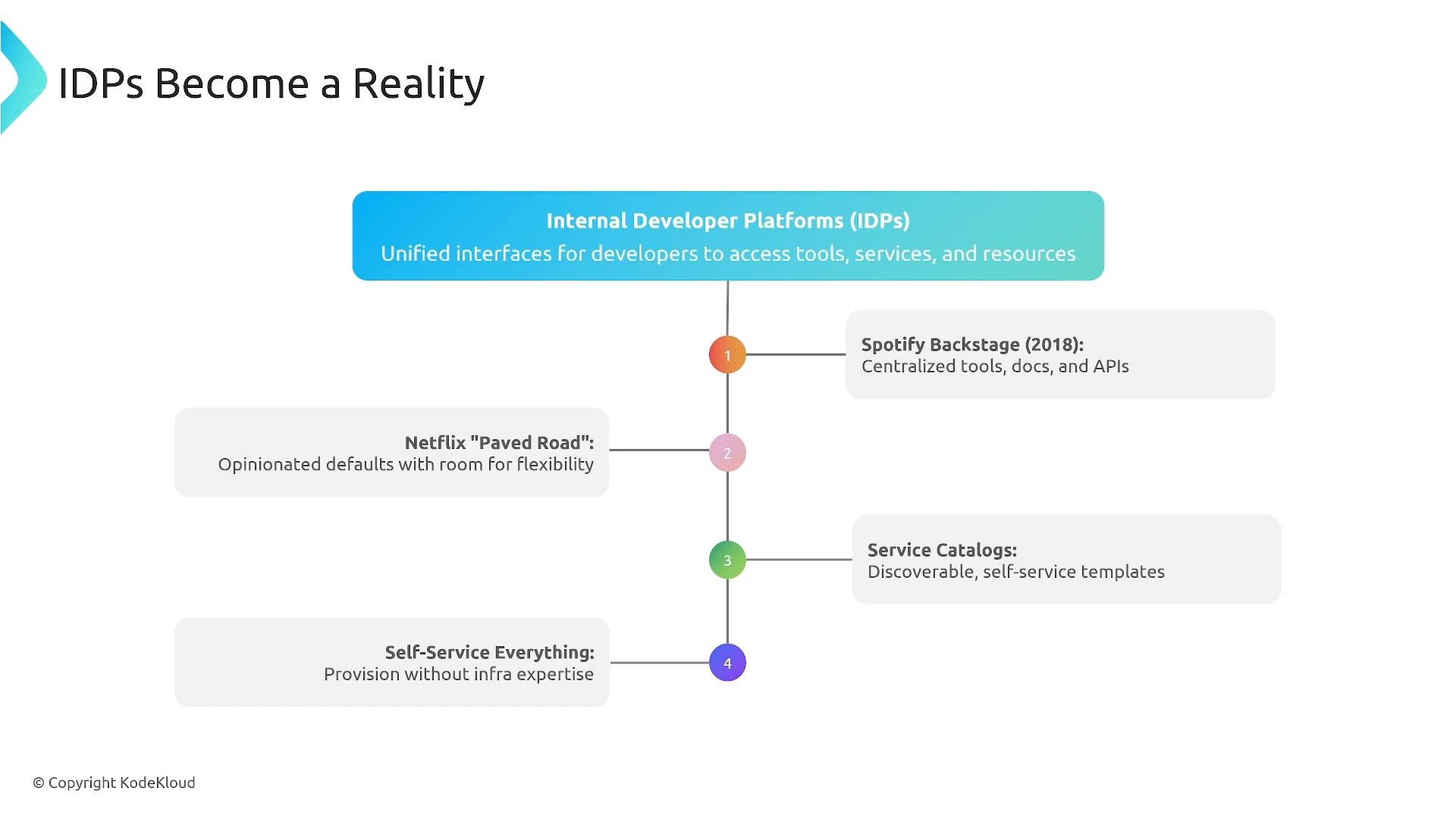
As cloud, containers, Kubernetes, CI/CD, and observability capabilities accumulated, developer cognitive load increased. Platform engineering emerged to reduce that load by building IDPs — self-service abstractions and APIs that hide platform complexity from application developers. An IDP typically provides:- A service catalog or templates for common patterns (databases, queues, etc.)
- Opinionated “paved road” defaults that encode best practices
- Automated provisioning and lifecycle management (often via GitOps)
- Integrated security, observability, and CI/CD workflows
IDPs in practice: tools and examples
- Spotify’s Backstage is a developer portal that centralizes tooling, documentation, and service metadata.
- Netflix popularized “paved road” and contributed many high-scale operational practices (chaos engineering, Spinnaker for CD).
- Cloud providers now offer service catalogs and managed services that platform teams leverage to build self-service, policy-driven provisioning.
Real-world example: Sparkle Pony Ranch
Imagine Sparkle Pony Ranch building an IDP in 2025. The platform team includes:- Alan — infrastructure lead who focuses on provisioning, networking, and storage (Kubernetes and cloud resources)
- Swathi — DevOps/platform engineer building automation, CI/CD pipelines, and GitOps flows
- Phong — cloud-native developer who consumes the IDP to deploy features without managing infrastructure details
Milestones at a glance
Industry influences and outcomes
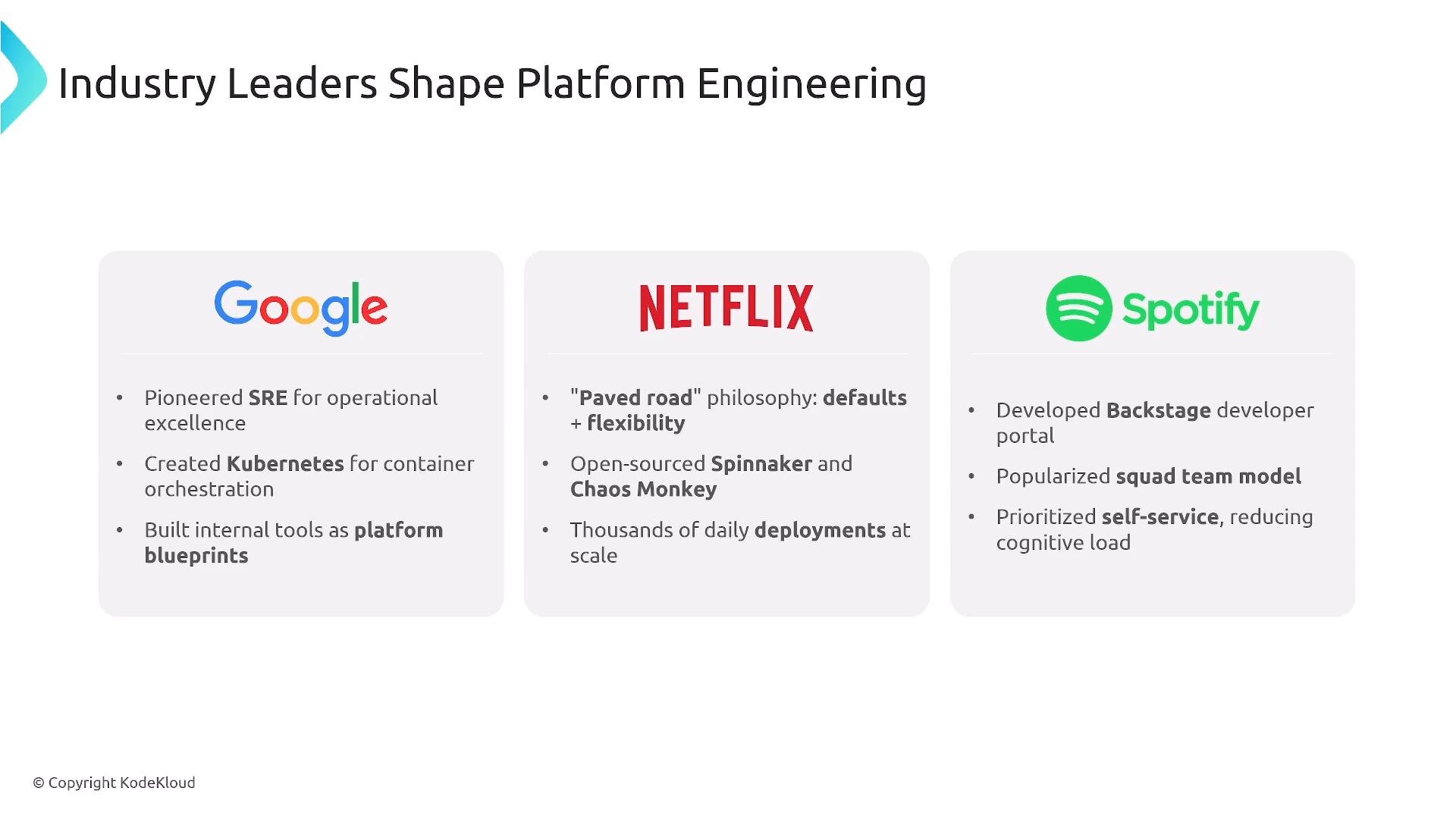
- Google, Netflix, and Spotify shaped platform engineering through SRE practices, chaos engineering, developer portals, and team models.
- A well-designed platform and IDP typically enable faster delivery, better reliability, improved security posture, and closer operational alignment with engineering teams.
Where platform engineering is headed
- Expect richer abstractions and improved developer experience on top of Kubernetes.
- Policy-as-code and stronger security integrations will be embedded earlier in platform pipelines.
- AI/agentic tooling may automate more aspects of platform lifecycle management, but careful design and guardrails will remain critical.
Summary
- Platform engineering is the product of technological and cultural shifts across the last two decades.
- Its core purpose is to reduce developer cognitive load and enable faster, safer delivery through consistent, self-service platforms and automation.
- Internal Developer Platforms (IDPs) are the practical expression of these trends: curated experiences that let developers focus on business logic rather than infrastructure plumbing.
If you’d like, we can dive deeper into any era (SRE, GitOps, Kubernetes, or IDP design patterns) or walk through a practical IDP architecture and implementation examples.
Links and references
- Google SRE Book — https://sre.google/sre-book/
- AWS EC2 — https://learn.kodekloud.com/user/courses/amazon-elastic-compute-cloud-ec2
- Docker crash course — https://learn.kodekloud.com/user/courses/crash-course-docker-for-absolute-beginner
- Kubernetes beginner course — https://learn.kodekloud.com/user/courses/kubernetes-for-the-absolute-beginners-hands-on-tutorial
- Git for beginners — https://learn.kodekloud.com/user/courses/git-for-beginners
- Terraform basics — https://learn.kodekloud.com/user/courses/terraform-basics-training-course
- Backstage — https://backstage.io/
- Weaveworks on GitOps — https://www.weave.works/technologies/gitops/
- Chaos engineering resources — https://learn.kodekloud.com/user/courses/chaos-engineering
- Spinnaker — https://spinnaker.io/