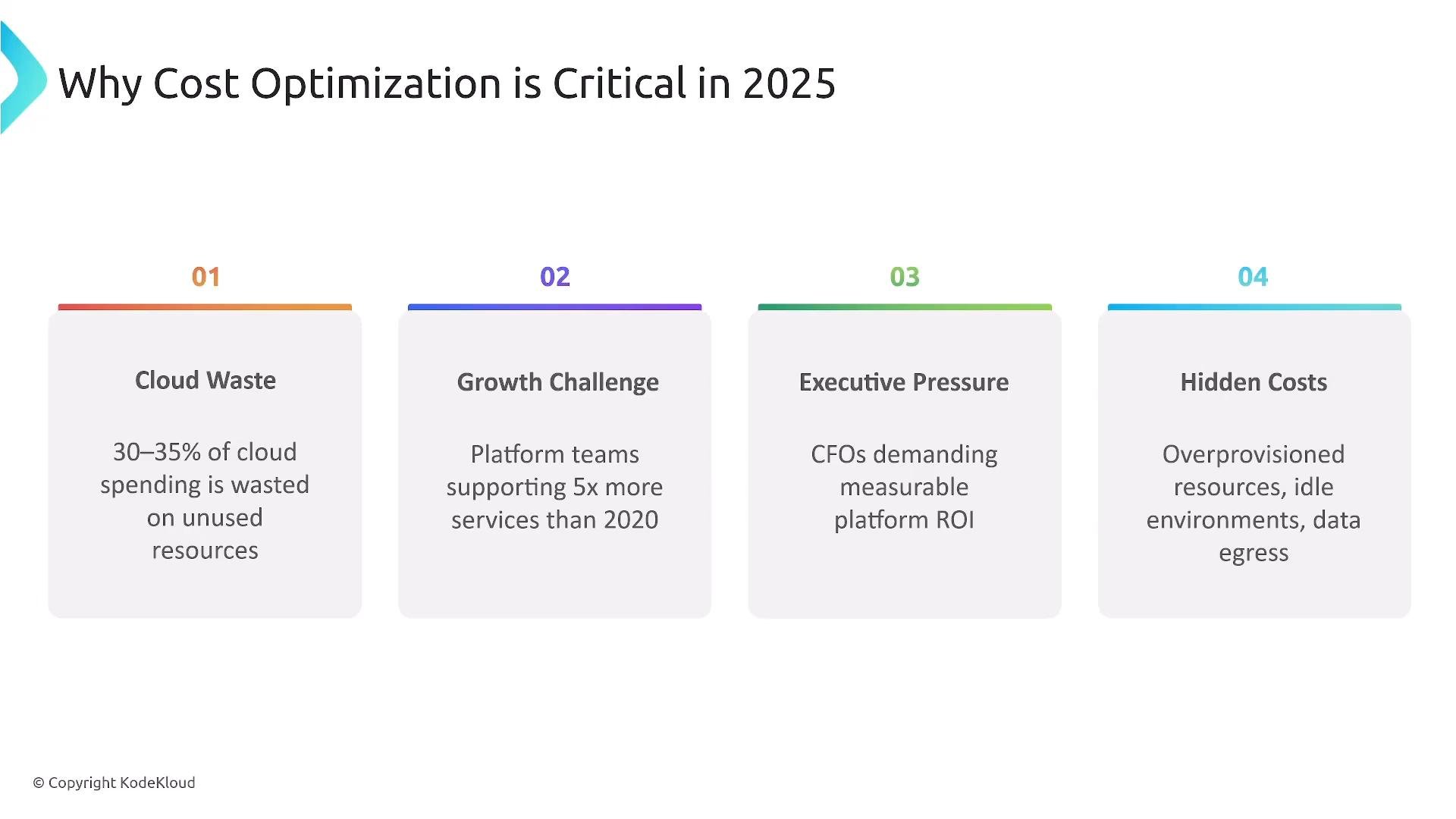
Welcome — this lesson covers a business-critical topic for platform teams: demonstrating measurable return on investment through cost optimization. In 2025 and beyond, platform engineering must balance enabling developer velocity while preventing surprise cloud spend. Common causes of flexible costs include over‑provisioned resources, idle environments, and unexpected data egress. Managing cloud waste is ongoing work: platform teams need visibility, automation, governance, and culture to make optimization repeatable and measurable.
A presentation slide titled "Why Cost Optimization is Critical in 2025" with four numbered boxes. The boxes list: Cloud Waste (30–35% of cloud spending wasted), Growth Challenge (platform teams supporting 5x more services), Executive Pressure (CFOs demanding measurable ROI), and Hidden Costs (overprovisioned resources, idle environments, data egress).
Why this matters to Sparkle Pony Ranch (SPR): Swati, Alan, and Phuong each run platform services and must show business value without overspending. The pragmatic toolkit below — monitoring, autoscaling, right-sizing, purchasing strategies, and governance — helps surface cost signals, prioritize actions, and measure impact.

Core tooling and patterns (quick reference)

OpenCost — real-time Kubernetes cost visibility

OpenCost is a CNCF open-source project that provides granular, near real-time visibility into Kubernetes spend. It enables breakdowns by CPU, memory, storage, network, and workload, historical trends, and budget alerts so teams avoid surprises and can prioritize optimizations.
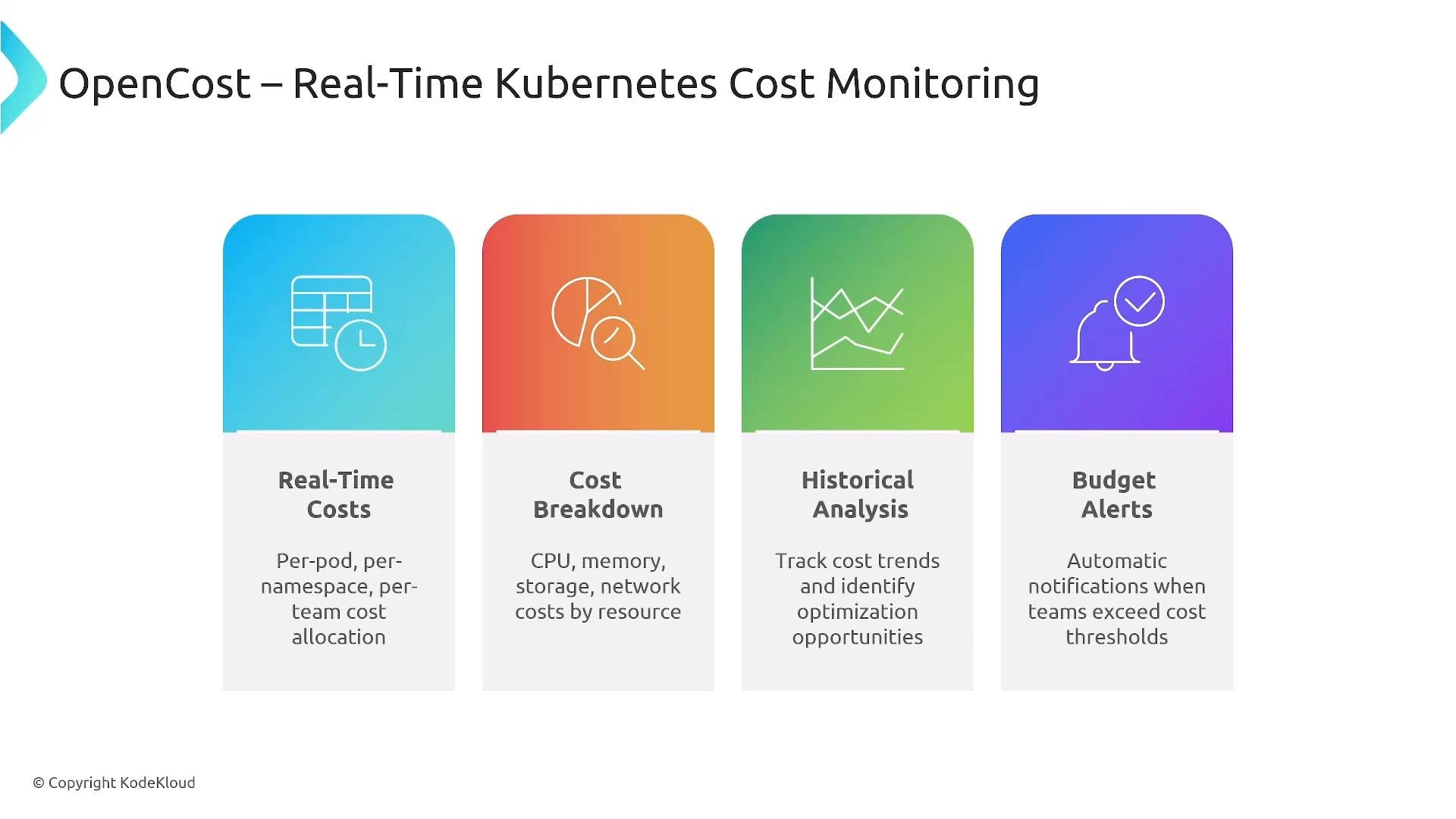
A presentation slide titled "OpenCost – Real-Time Kubernetes Cost Monitoring" showing four colored feature panels: Real-Time Costs, Cost Breakdown, Historical Analysis, and Budget Alerts. Each panel has an icon and a short description of the corresponding capability.
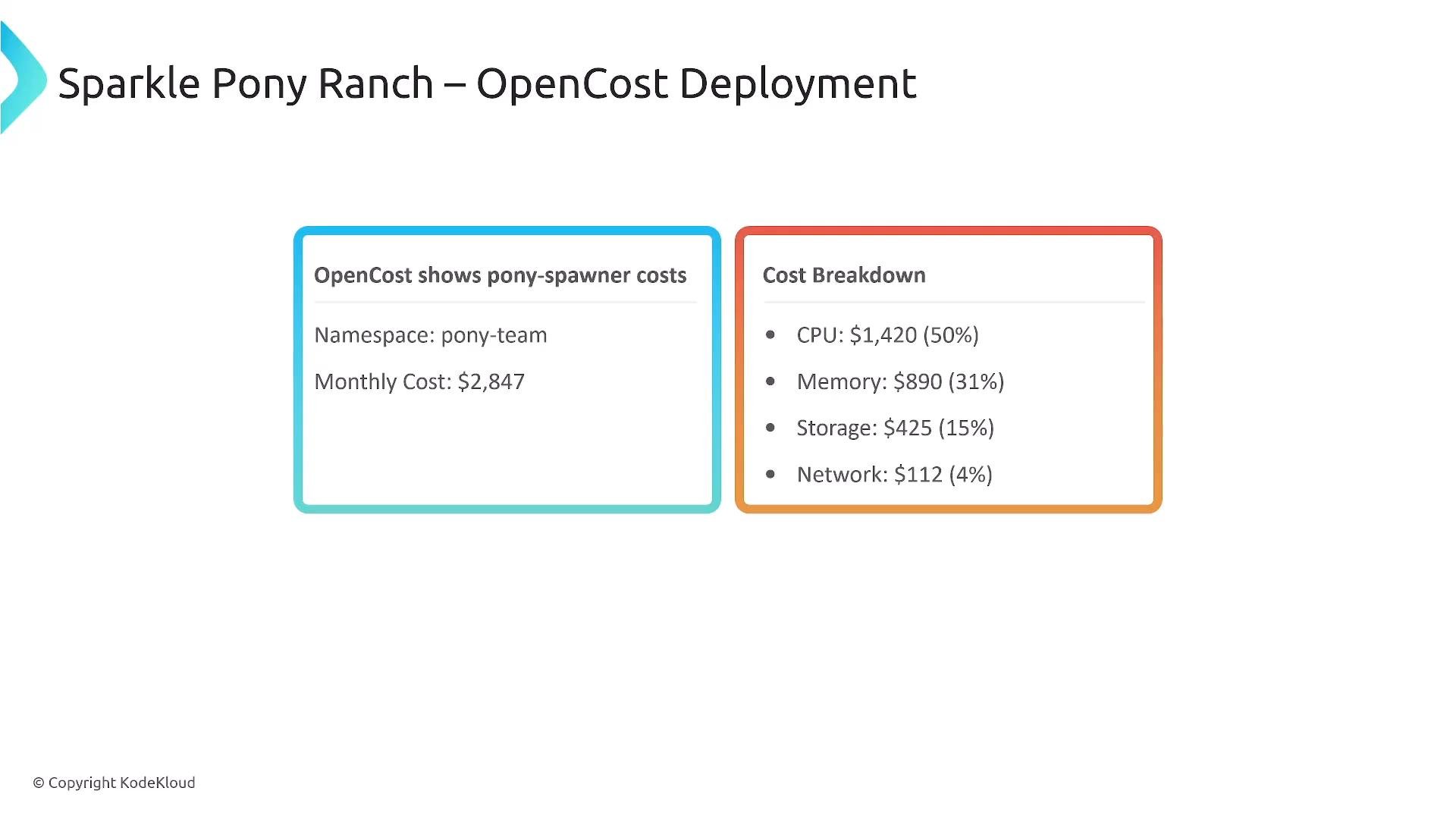
OpenCost makes cloud costs transparent and actionable. SPR uses it to see how CPU, memory, storage, and network contribute to a namespace’s spend and to prioritize work (for example, focusing on CPU if it represents 50% of spend).
A slide titled "Sparkle Pony Ranch – OpenCost Deployment" showing that the namespace "pony-team" has a monthly cost of 2,847. A cost breakdown lists CPU 1,420 (50%), Memory 890 (31%), Storage 425 (15%), and Network $112 (4%).
FinOps is the cross-functional discipline that aligns engineering, finance, and product teams to drive cost visibility, accountability, and continuous optimization. Instrumentation from tools like OpenCost provides the operational foundation for a FinOps practice.
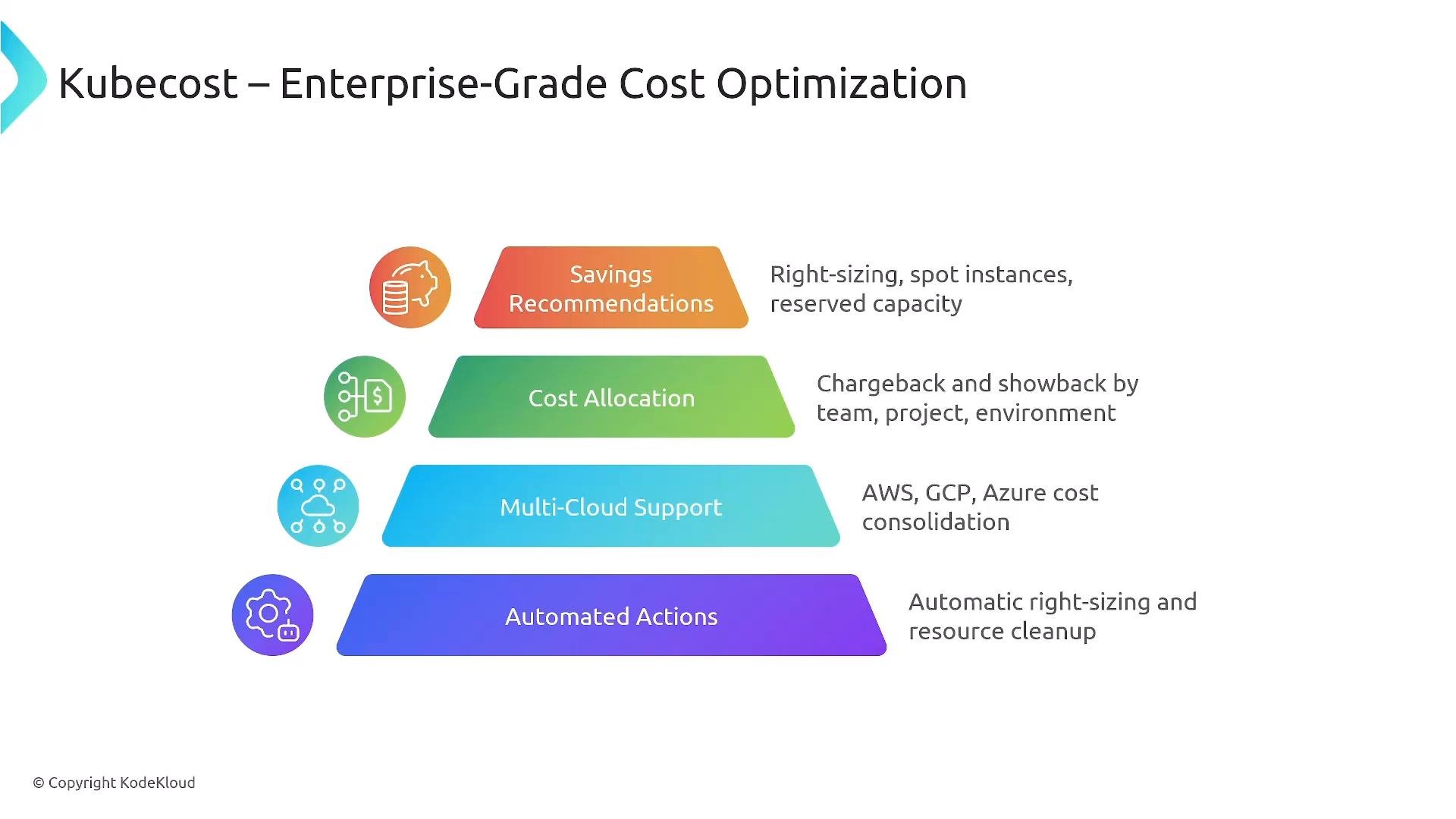
Commercial alternatives Commercial products (for example, Kubecost) add enterprise features such as automated savings recommendations, richer cost allocation, multi-cloud support, and remediation actions. They can accelerate time-to-value, while OpenCost remains a transparent open-source starting point.
A presentation slide titled "Kubecost – Enterprise-Grade Cost Optimization" showing a colorful four-layer stacked diagram. Each layer lists features—Savings Recommendations, Cost Allocation, Multi-Cloud Support, and Automated Actions—with brief notes like right-sizing, chargeback, cloud consolidation, and automatic cleanup.

Dynamic scaling: KEDA (event-driven autoscaling)

Event-driven autoscaling saves large amounts for non‑production and spiky workloads. KEDA can scale workloads from zero based on business metrics or external events (queue length, messages, custom metrics), minimizing idle cost.
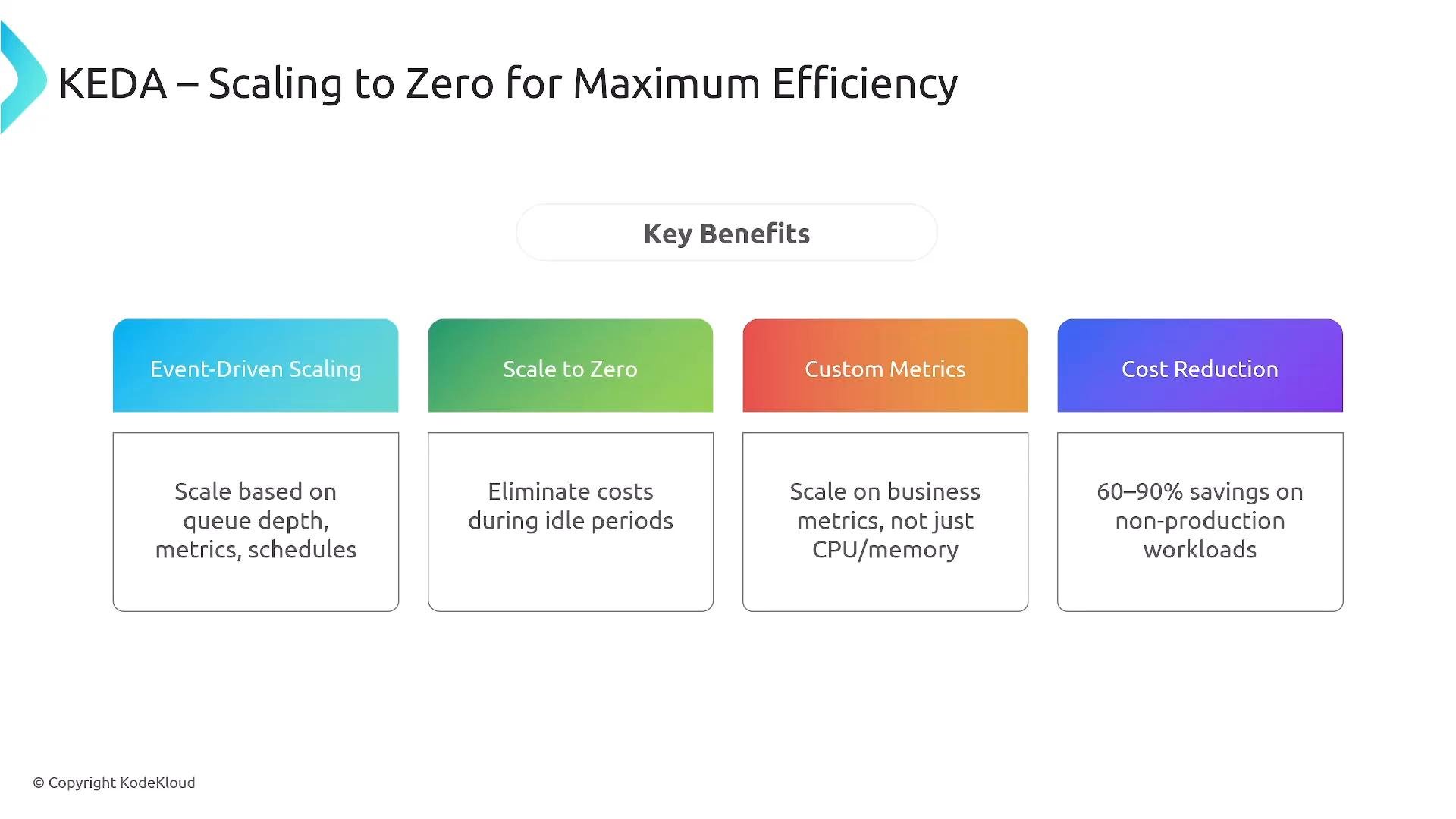
A presentation slide titled "KEDA – Scaling to Zero for Maximum Efficiency" listing four key benefits: Event-Driven Scaling, Scale to Zero, Custom Metrics, and Cost Reduction. Each benefit has a short description (e.g., scale on queue depth/metrics, eliminate idle costs, use business metrics, and 60–90% savings on non-production workloads).
Example KEDA ScaledObject (SQS trigger) This YAML shows a minimal ScaledObject that scales a Deployment named pony-processor between 0 and 10 replicas driven by an Amazon SQS queue. In production add a TriggerAuthentication for AWS credentials and fine-tune queueLength.

Node-level autoscaling and right-sizing

Pair KEDA with cluster-level autoscalers that manage node lifecycle and capacity. Cluster Autoscaler and Karpenter can right-size nodes, scale down during off-hours, and mix spot and on-demand instances. Spot/preemptible instances deliver large savings for fault‑tolerant workloads but require interruption handling (checkpointing, graceful shutdowns).
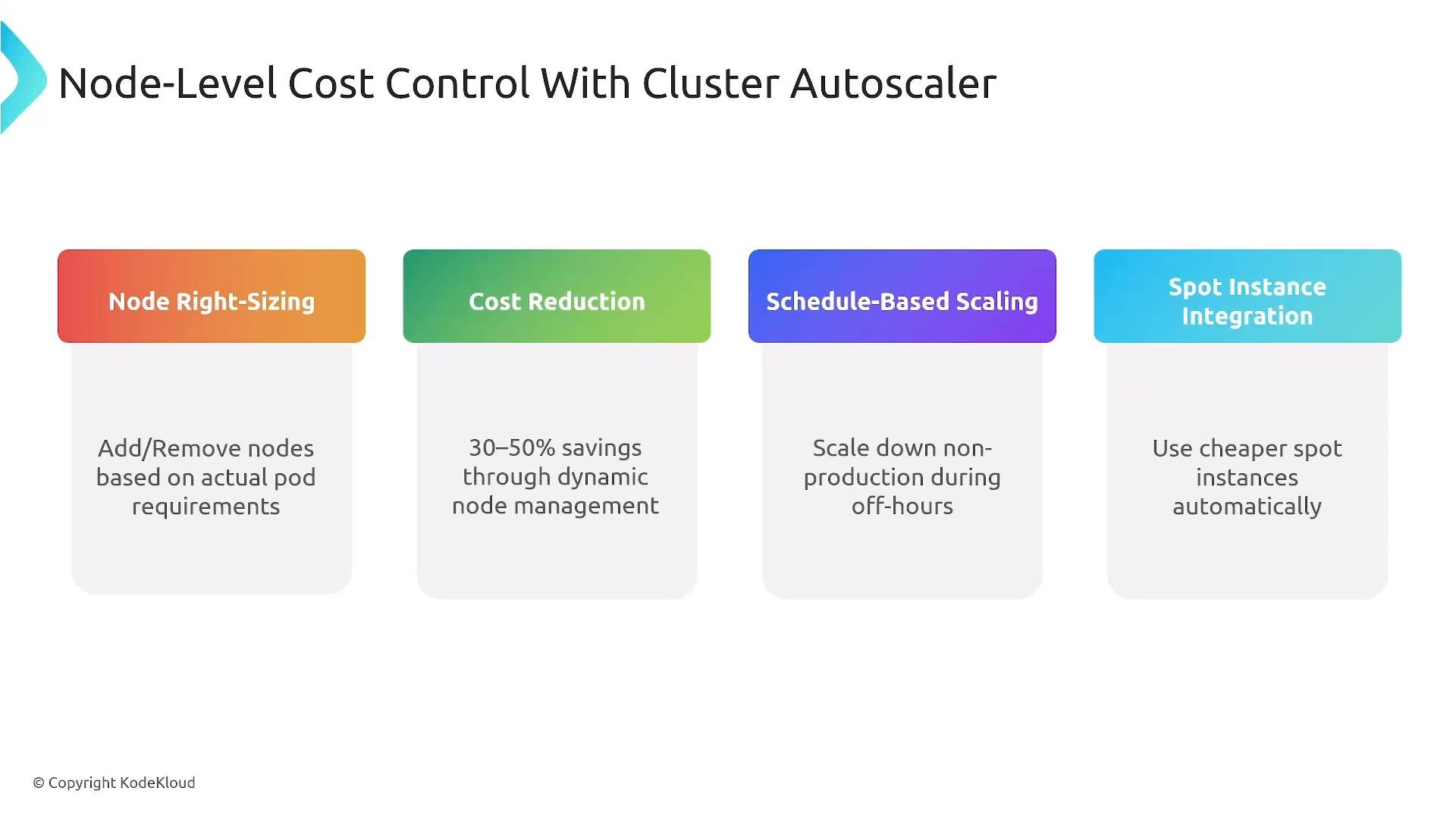
A slide titled "Node-Level Cost Control With Cluster Autoscaler" showing four colored feature boxes: Node Right-Sizing, Cost Reduction, Schedule-Based Scaling, and Spot Instance Integration. Each box includes a short description of how the autoscaler reduces costs (e.g., add/remove nodes, 30–50% savings, scale down off-hours, use spot instances).

Vertical resource optimization (VPA and advisors)

Vertical Pod Autoscaler (VPA) and data-driven right-sizing advisors analyze historical usage to recommend or apply changes to requests/limits. These tools reduce waste when developers over-request resources.
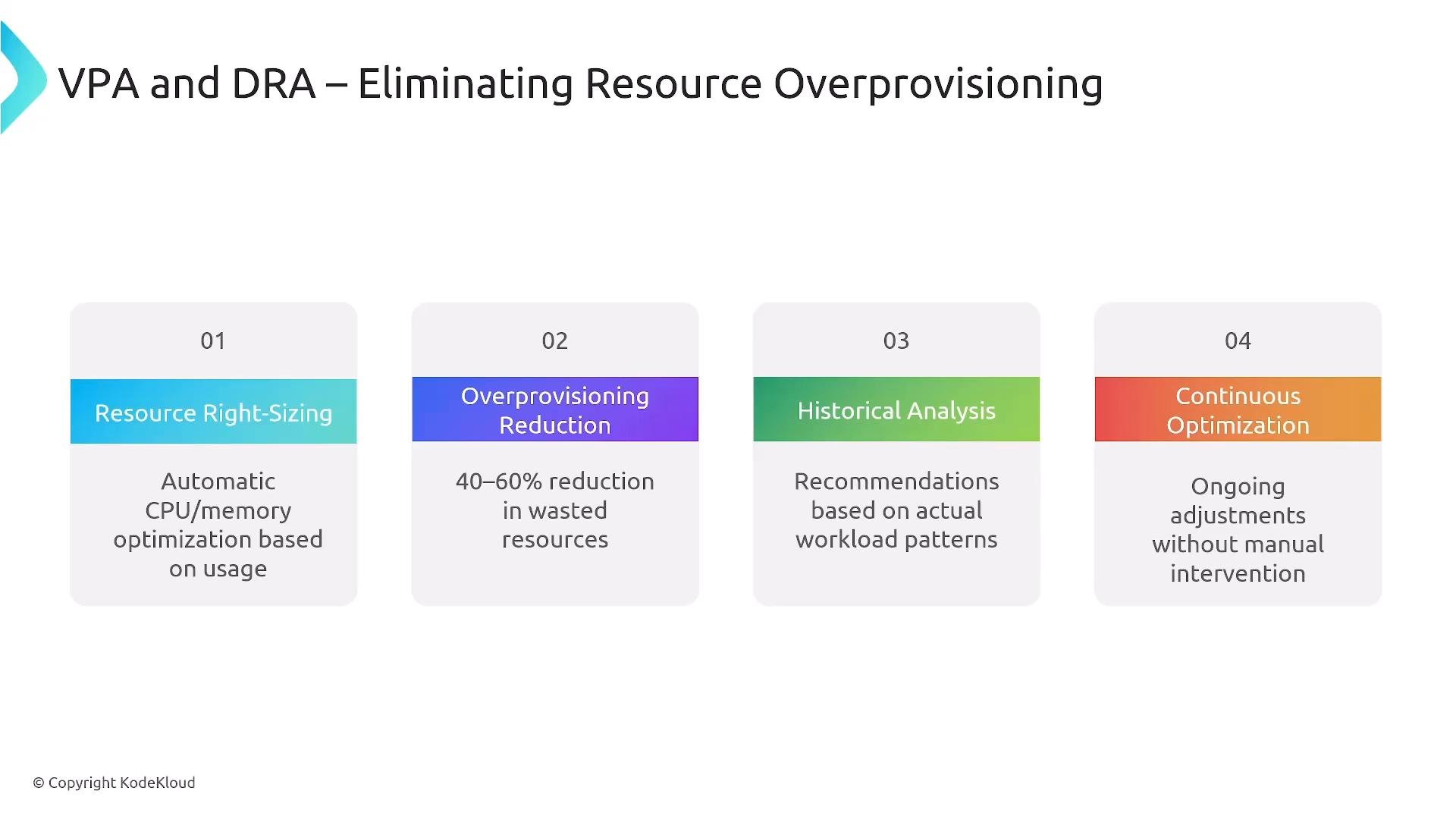
A presentation slide titled "VPA and DRA – Eliminating Resource Overprovisioning" with four numbered boxes: Resource Right-Sizing, Overprovisioning Reduction, Historical Analysis, and Continuous Optimization. Each box lists benefits like automatic CPU/memory optimization, 40–60% reduction in wasted resources, recommendations from workload history, and ongoing adjustments without manual intervention.
Example: if a developer requests 2 CPU cores but observed peak CPU usage is 0.4 cores, VPA can recommend or apply a lower request to match actual utilization.

Spot & preemptible instances

Spot/preemptible instances can cut compute costs dramatically (often 60–90%) for fault-tolerant workloads. Use a mix of instance types and ensure applications handle interruptions (checkpointing, stateless designs, graceful shutdowns).
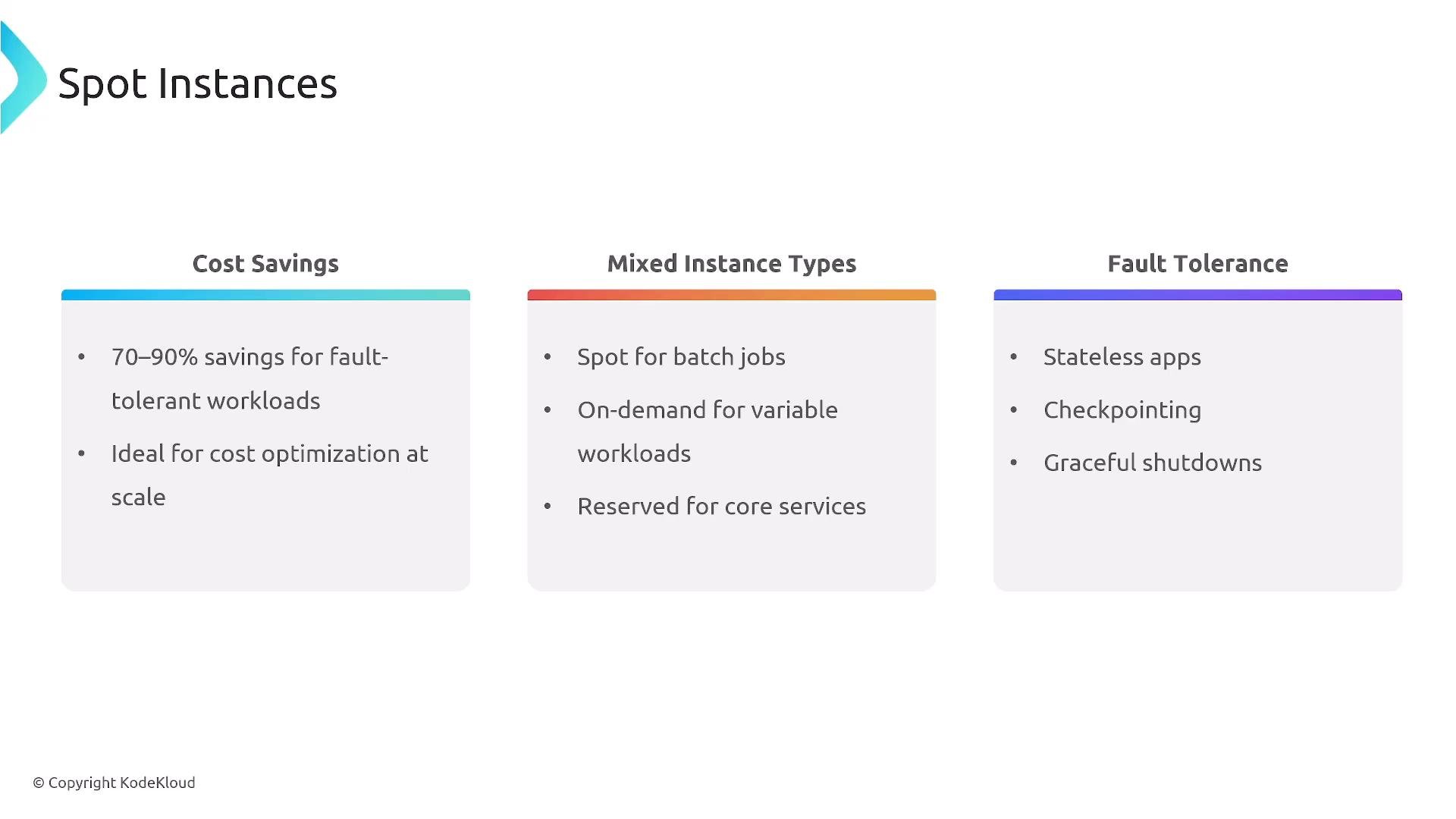
A presentation slide titled "Spot Instances" with three panels: Cost Savings, Mixed Instance Types, and Fault Tolerance. Each panel lists key points like 70–90% savings for fault-tolerant workloads, using spot/on-demand/reserved instances for different jobs, and recommendations such as stateless apps, checkpointing, and graceful shutdowns.

Governance: Resource quotas and limits — first line of defense

Use ResourceQuota objects and enforce Pod requests/limits to prevent runaway consumption. Set sensible defaults and enforce quotas at the namespace/team level to cap resource requests and control spending.

Runtime security and cost protection

Runtime security tools (e.g., Falco) detect abnormal behavior such as sudden high CPU usage or crypto-mining and can trigger alerts or automated mitigations. Runtime detection helps prevent both malicious and accidental cost spikes.
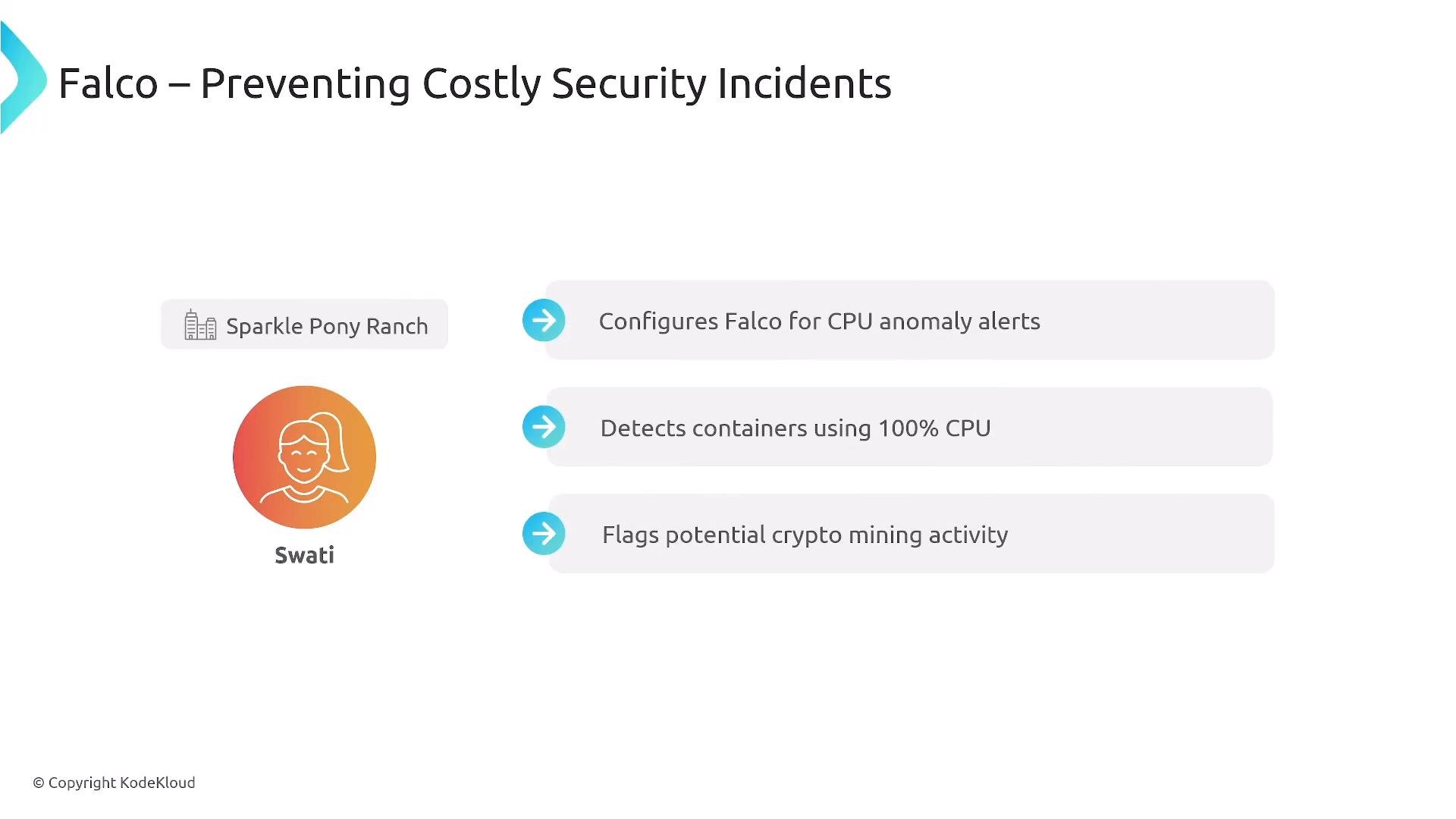
A presentation slide titled "Falco — Preventing Costly Security Incidents" showing a user (Swati / Sparkle Pony Ranch) and three actions: configures Falco for CPU anomaly alerts, detects containers using 100% CPU, and flags potential crypto-mining activity.

Immutable infrastructure and thin images

Immutable infrastructure (redeploy rather than patch) and thin images make sizing predictable, speed up scaling, simplify cleanup, and reduce configuration overhead. Faster startup times improve bin-packing and node utilization.
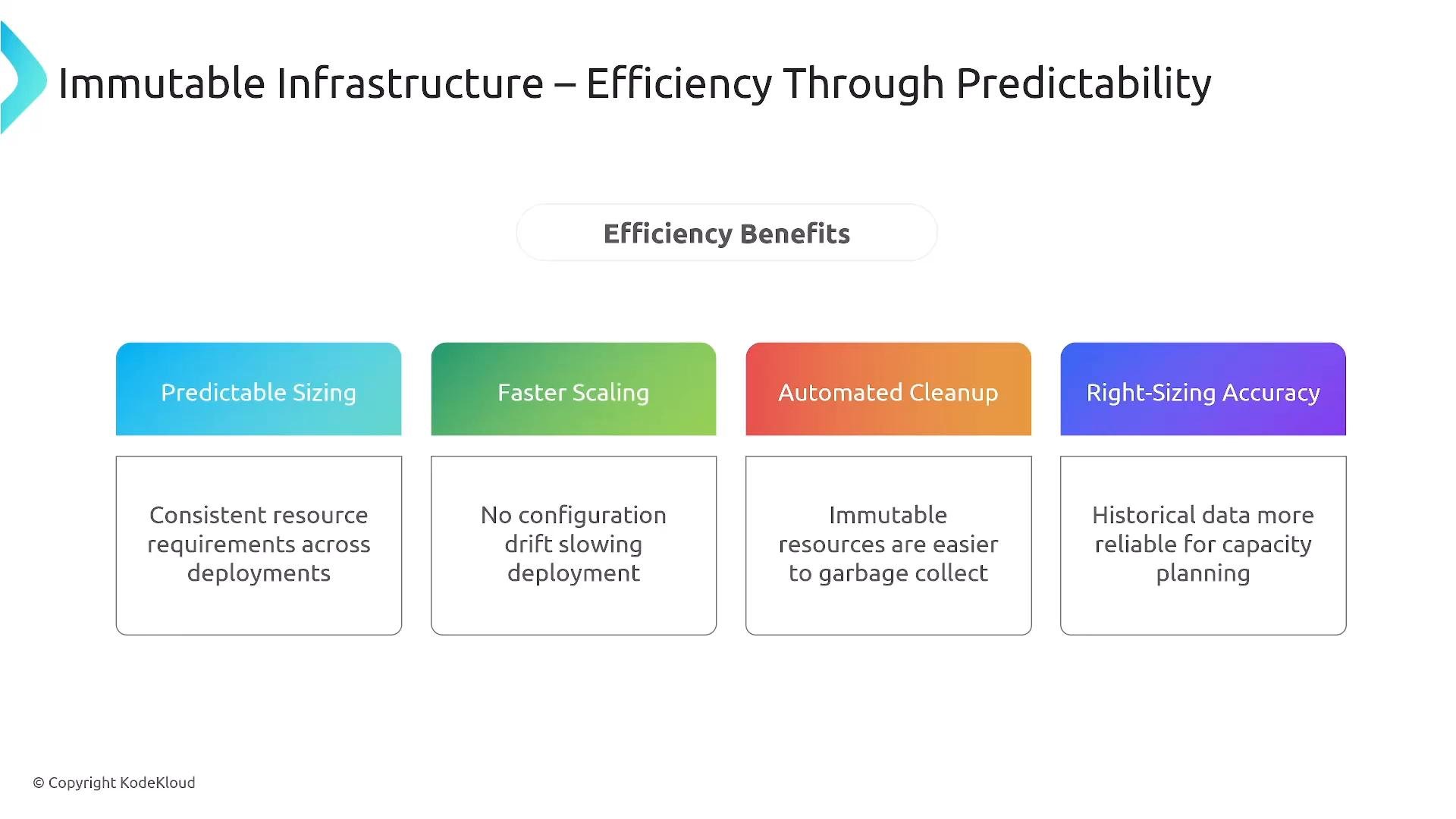
A presentation slide titled "Immutable Infrastructure – Efficiency Through Predictability" showing an "Efficiency Benefits" row. Four colored boxes list benefits: Predictable Sizing, Faster Scaling, Automated Cleanup, and Right‑Sizing Accuracy with short explanatory notes.

Bin packing, multi-tenancy, and utilization targets

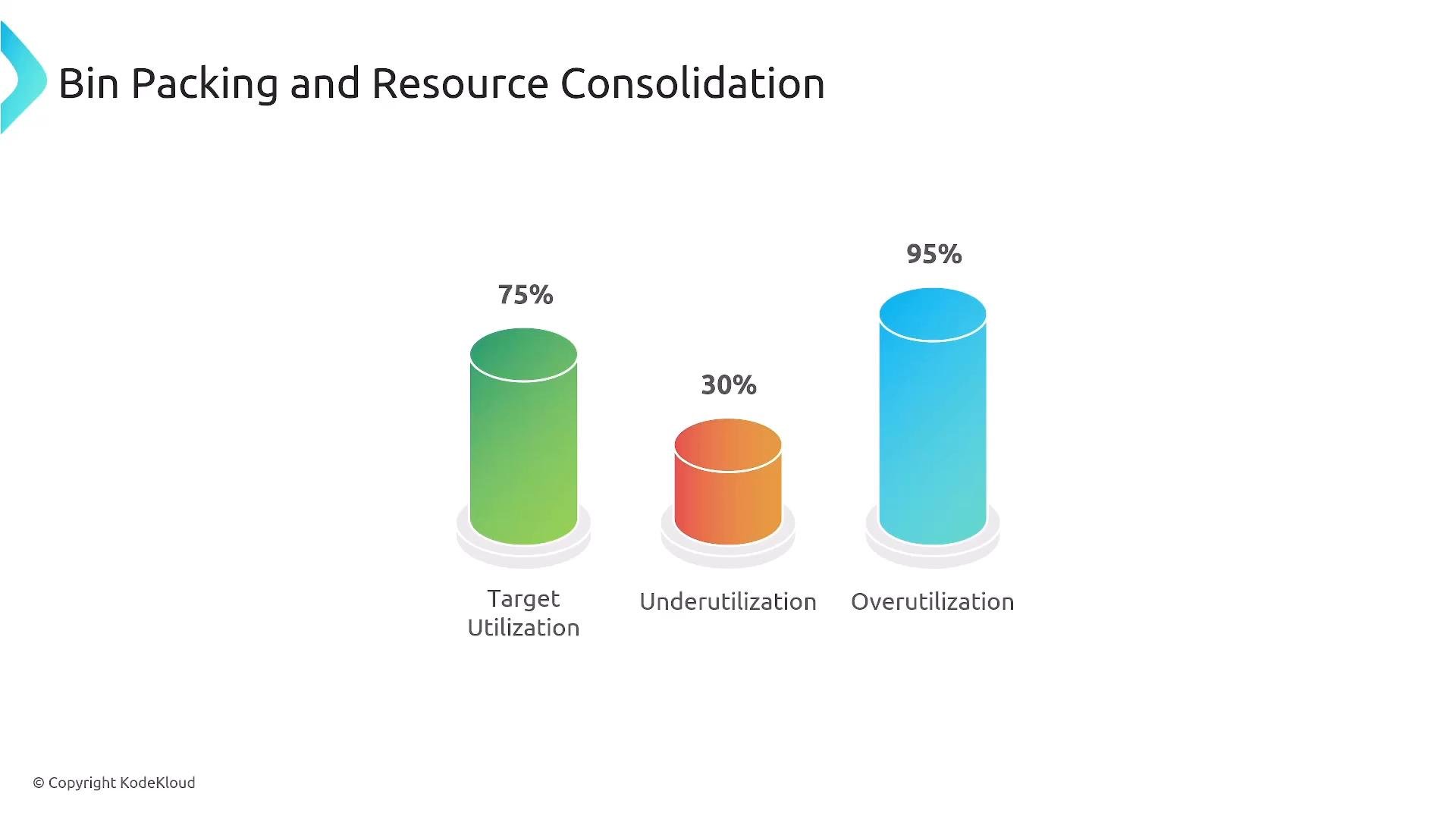
Aim for balanced node utilization (typical target ~75%). Underutilization wastes money; overutilization risks instability. Techniques include affinity/anti-affinity, time-based sharing of nodes, and consolidating similar workloads to improve packing.
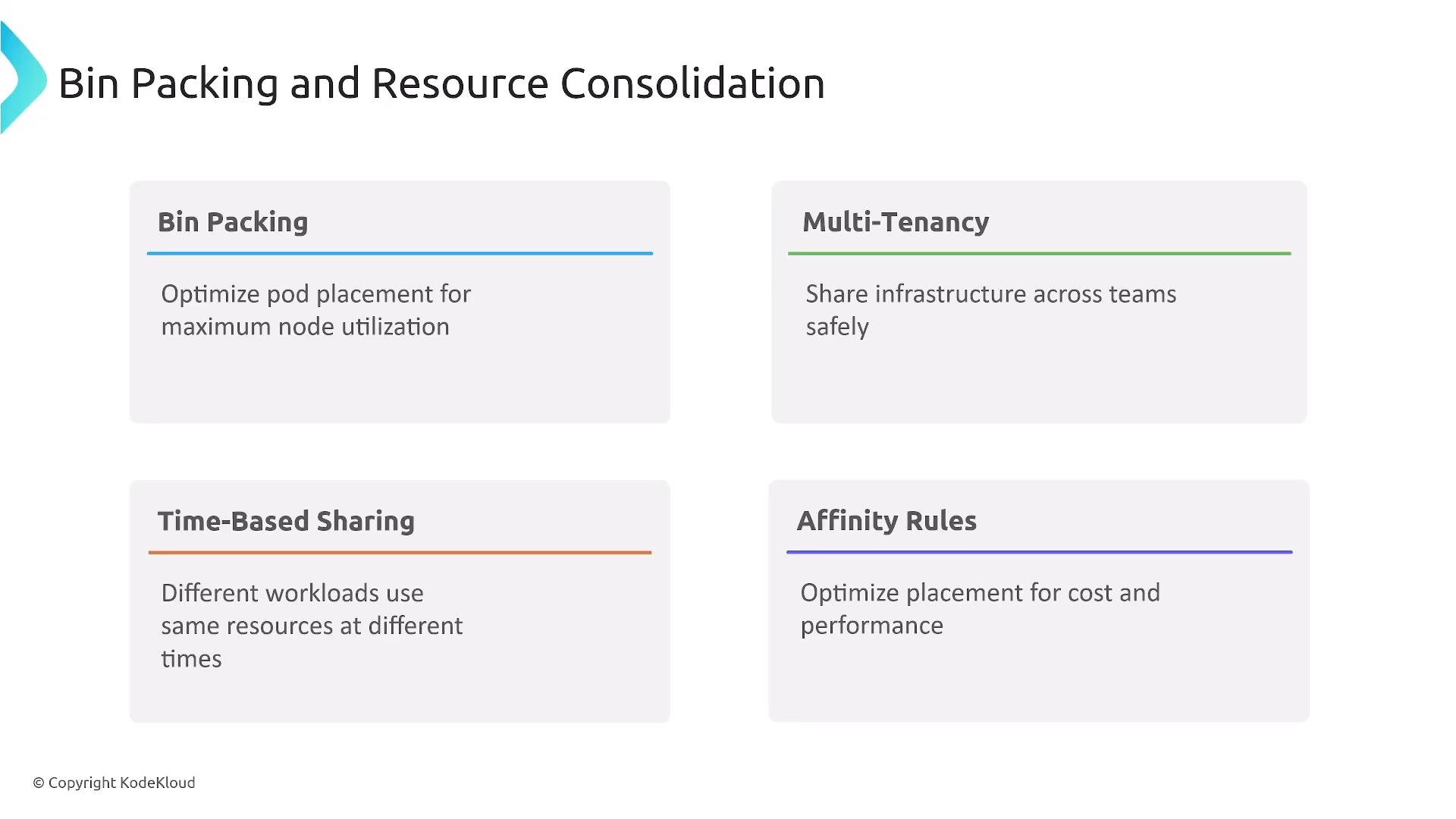
A slide titled "Bin Packing and Resource Consolidation." Four boxes list strategies—Bin Packing, Multi‑Tenancy, Time‑Based Sharing, and Affinity Rules—each with a brief explanatory line.
A slide titled "Bin Packing and Resource Consolidation" showing three colored cylindrical bars labeled Target Utilization 75%, Underutilization 30%, and Overutilization 95%. The bars are green, orange, and blue respectively.

Data storage as a hidden cost

Storage choices drive sustained costs. Common issues include using SSDs where HDDs suffice or leaving volumes unattached and unarchived. Offer storage classes, lifecycle policies, thin provisioning, and compression so developers get appropriate storage without unbounded cost.
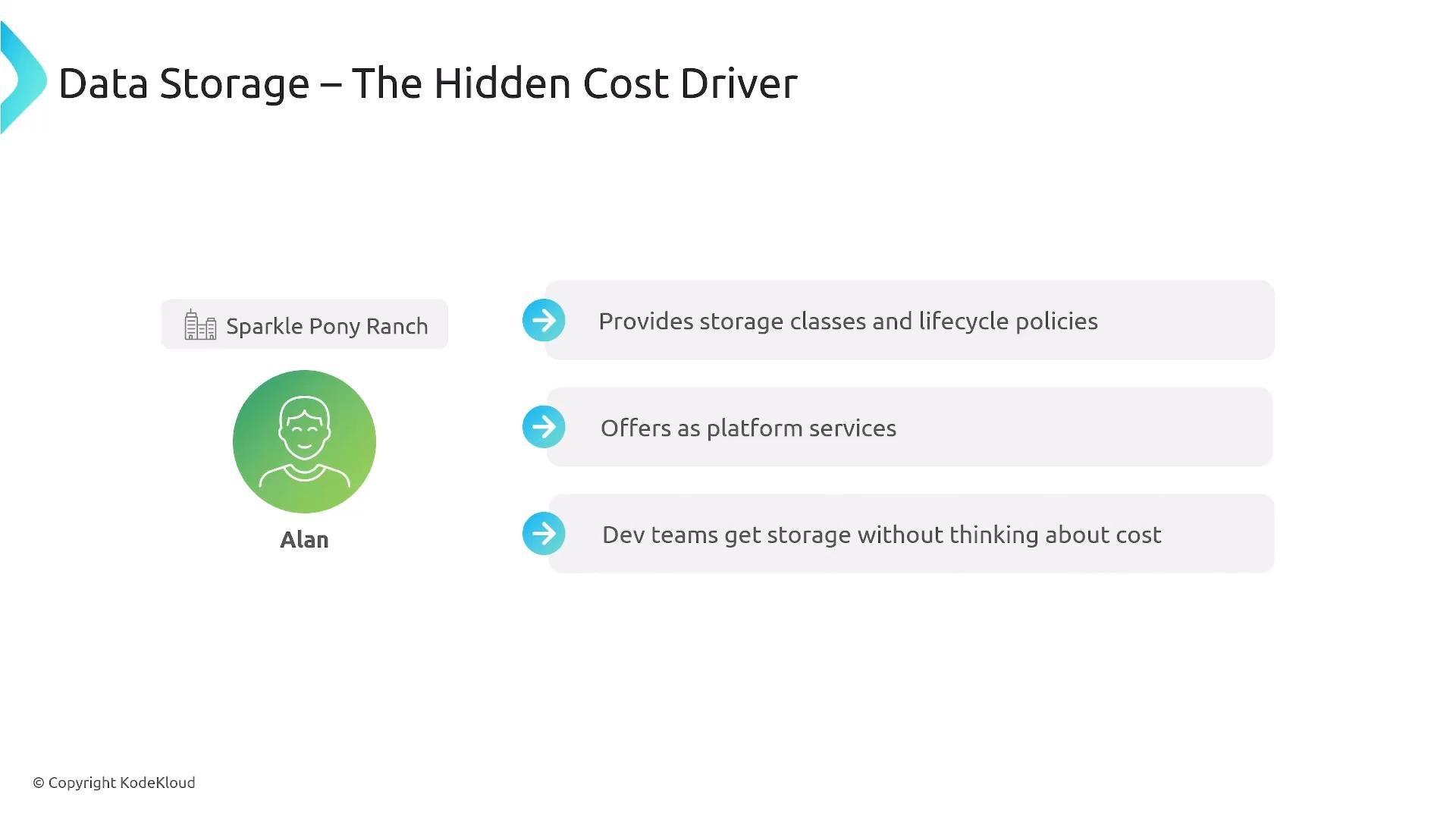
A presentation slide titled "Data Storage – The Hidden Cost Driver" showing a user avatar labeled "Alan" (Sparkle Pony Ranch) and three points: provides storage classes and lifecycle policies; offers platform services; and dev teams get storage without thinking about cost.

Network and egress optimization

Network (especially cross-region and egress) can be expensive. Optimize placement with regional endpoints, use CDNs/caching, analyze traffic patterns, and apply service-mesh or routing optimizations to reduce cross-region hops.
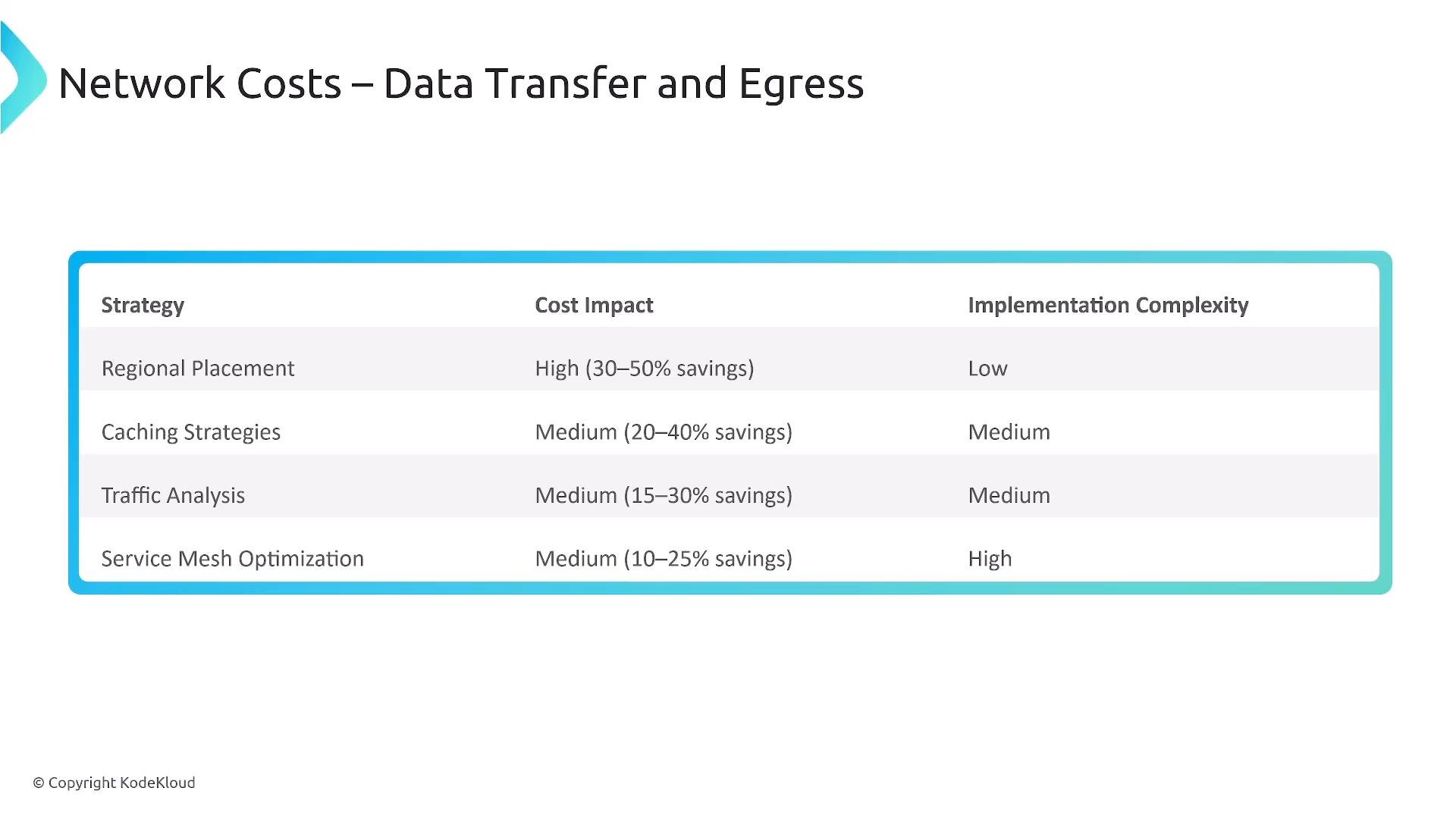
A slide titled "Network Costs – Data Transfer and Egress" showing a table of strategies (Regional Placement, Caching Strategies, Traffic Analysis, Service Mesh Optimization) with their estimated cost impact and implementation complexity.

FinOps culture and measurable ROI

FinOps is a cross-functional approach: shared responsibility, real-time visibility, transparency, and an optimization mindset. When developers (like Phuong) can see cost effects of changes, they can make better trade-offs between performance, latency, and spend. Real results at SPR Combining OpenCost/Kubecost, KEDA, autoscalers, right-sizing, spot instances, governance, and runtime security produces measurable savings. Common wins include scaling dev/test environments to zero during off-hours and applying autoscaling and resource recommendations to reduce idle spend.
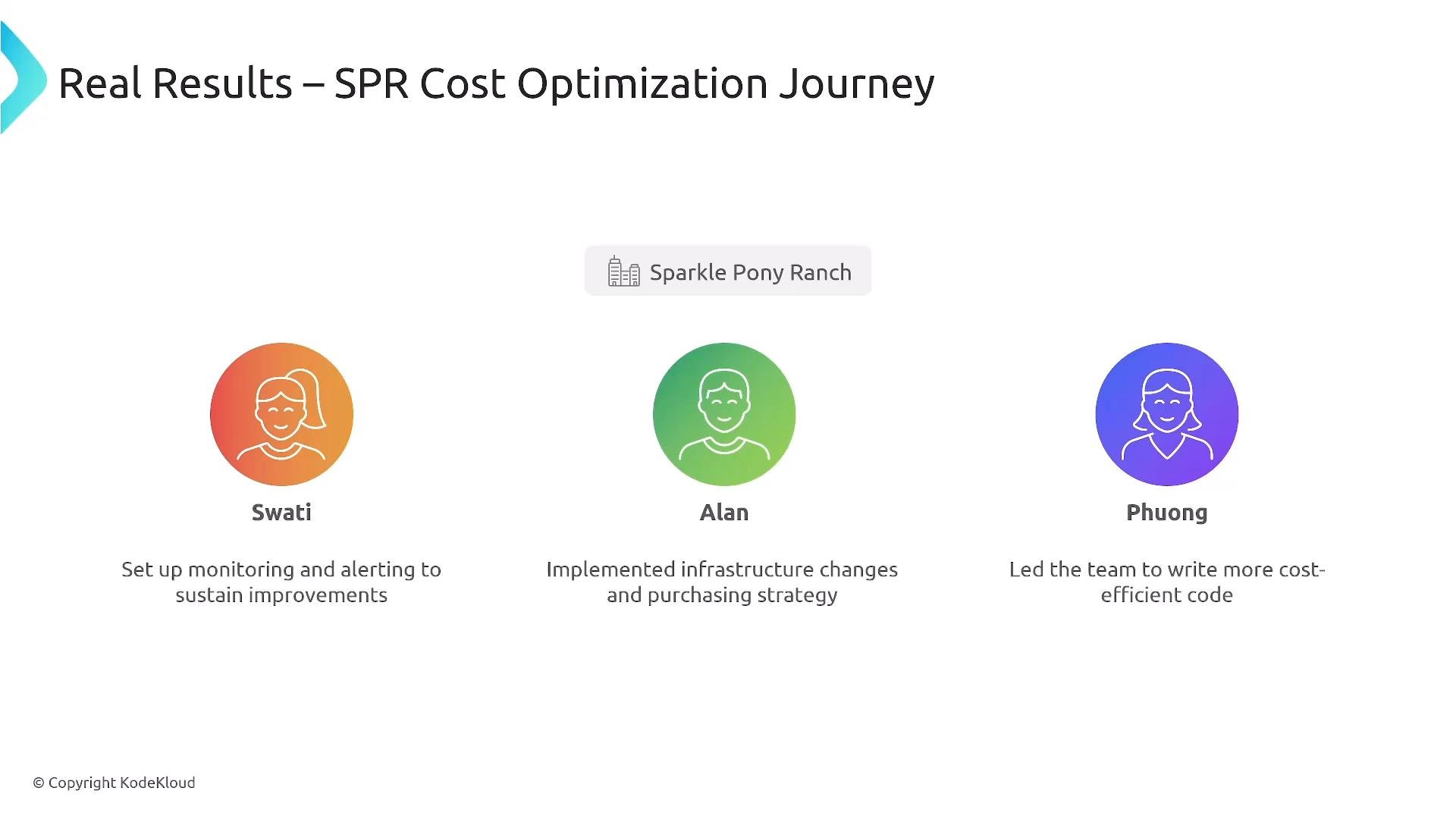
A presentation slide titled "Real Results – SPR Cost Optimization Journey" showing three circular avatar icons labeled Swati, Alan, and Phuong with brief descriptions of their cost-optimization contributions under the project "Sparkle Pony Ranch." The slide credits KodeKloud.

Governance and advanced controls

Governance extends beyond quotas to include policies enforced by admission controllers or CRDs that block unsafe or costly configurations (for example: pods without limits, disallowed instance types, or volumes lacking lifecycle policies).
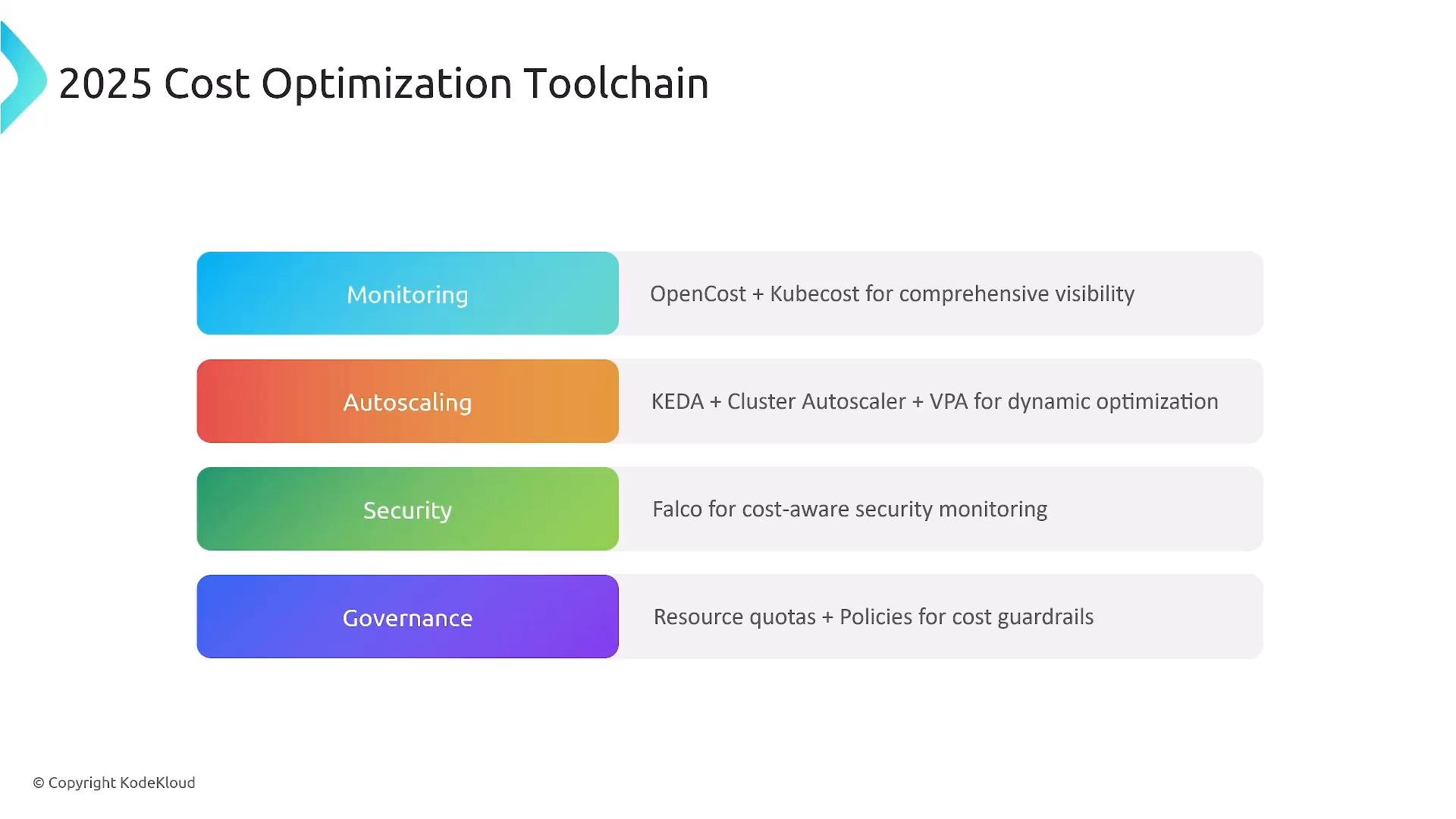
A slide titled "2025 Cost Optimization Toolchain" showing colored blocks for Monitoring, Autoscaling, Security, and Governance. Each block lists example tools and approaches (e.g., OpenCost/Kubecost; KEDA + Cluster Autoscaler + VPA; Falco; resource quotas and policies).

ROI and ongoing value

When measuring ROI include license costs, engineering time, and infra changes against direct savings. Also account for indirect benefits: faster deployments, higher reliability, and improved developer productivity. Long-term value is cultural: continuous improvement, measurable outcomes, and reframing platform teams as strategic enablers rather than cost centers.
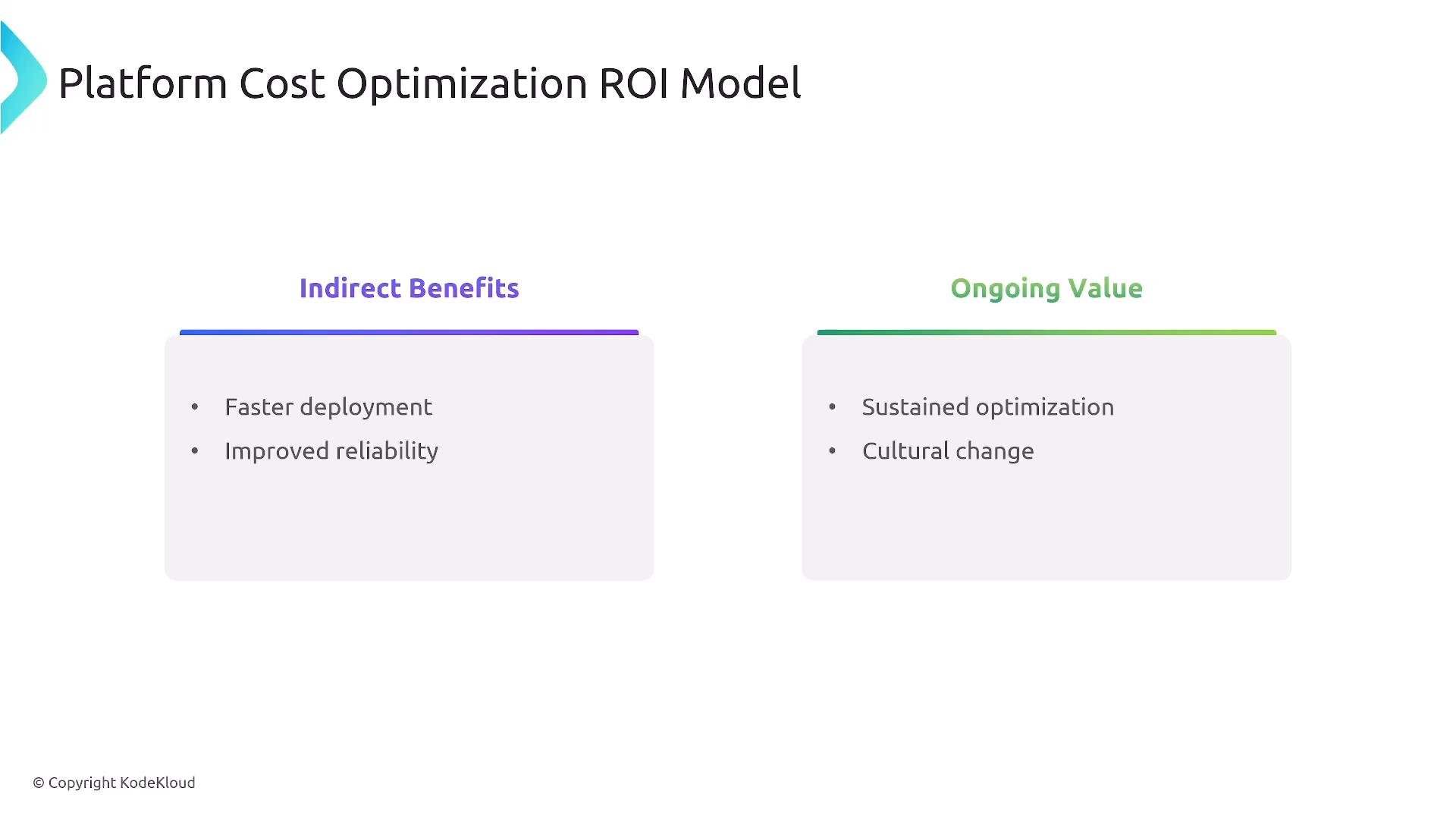
A presentation slide titled "Platform Cost Optimization ROI Model" with two sections: "Indirect Benefits" listing faster deployment and improved reliability, and "Ongoing Value" listing sustained optimization and cultural change. Copyright KodeKloud appears at the bottom.

Looking ahead

Watch these trends as cost optimization evolves beyond 2025:
  • AI-driven optimizations (AIOps) that recommend and automate tuning.
  • Carbon-aware scheduling to balance cost and sustainability.
  • Serverless cost models where fine-grained billing reshapes trade-offs.
  • Edge computing driving new placement and data transfer trade-offs.
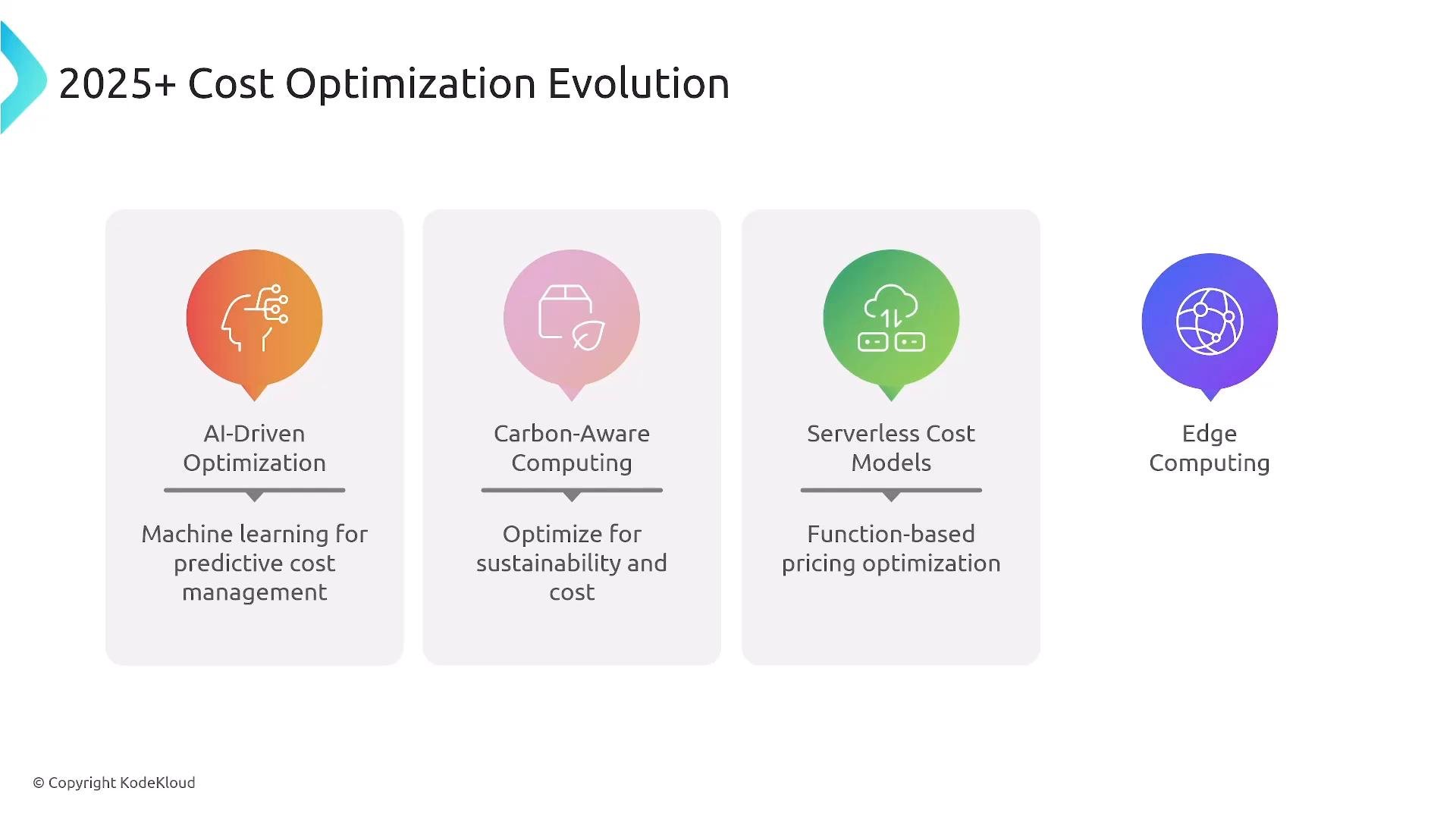
A presentation slide titled "2025+ Cost Optimization Evolution" showing four colored icons and brief captions for AI-driven optimization, carbon-aware computing, serverless cost models, and edge computing.

Key takeaways

  • Visibility first: instrument cost visibility (OpenCost/Kubecost) so teams can act.
  • Dynamic scaling: use KEDA, Cluster Autoscaler/Karpenter, and VPA/DRA to reduce idle spend and right-size workloads.
  • Strategic purchasing: use spot/preemptible and reserved capacity judiciously.
  • Security integration: runtime detection (Falco) helps prevent malicious or accidental cost spikes.
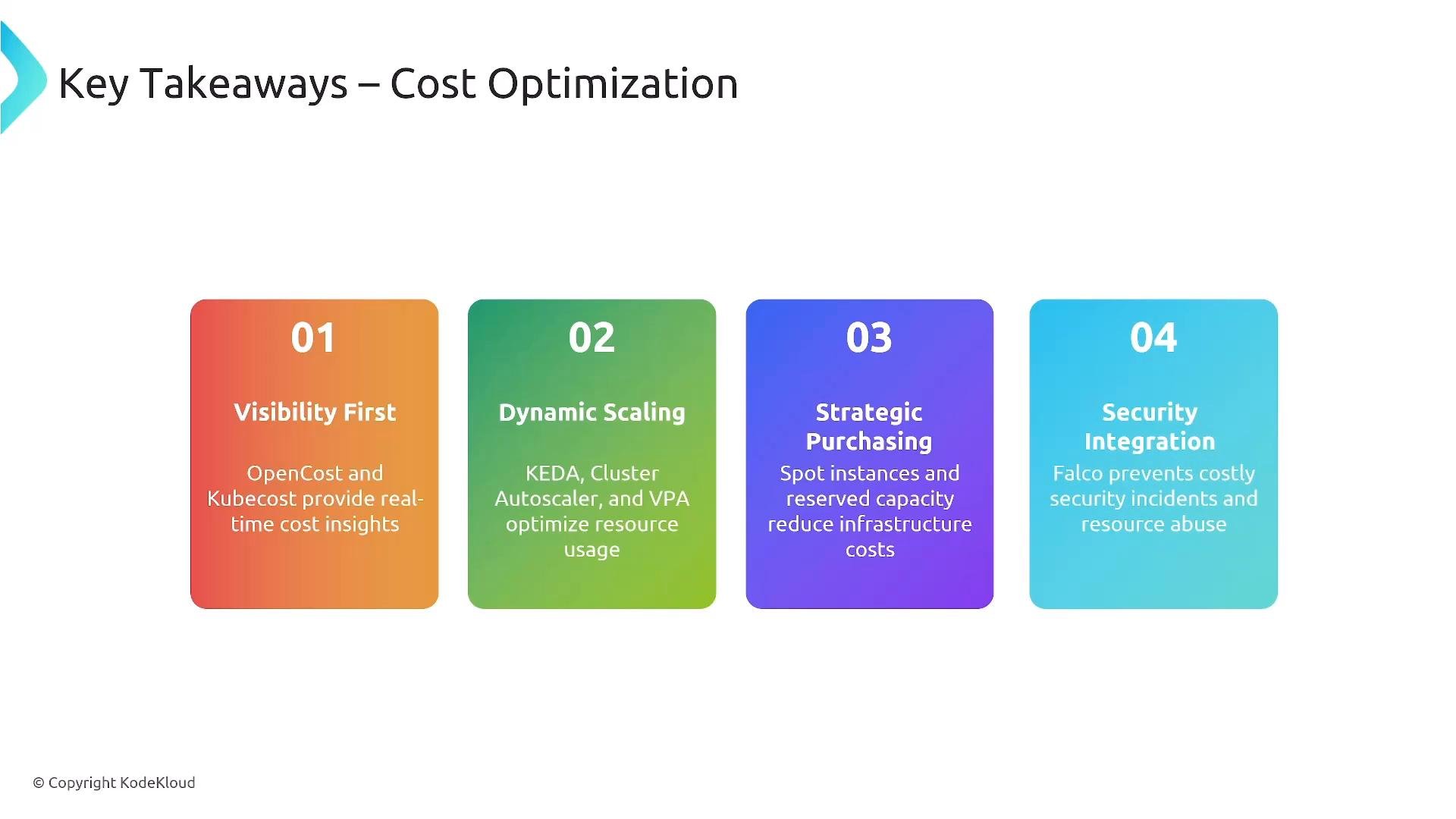
A presentation slide titled "Key Takeaways – Cost Optimization" showing four colored cards: 01 Visibility First (OpenCost/Kubecost), 02 Dynamic Scaling (KEDA, Cluster Autoscaler, VPA), 03 Strategic Purchasing (spot instances/reserved capacity), and 04 Security Integration (Falco to prevent incidents).
Final note: cost optimization is a continuous practice combining tools, governance, and culture. For platform engineers, mastering these patterns is central to delivering both developer velocity and measurable business value. This concludes the article.

Watch Video