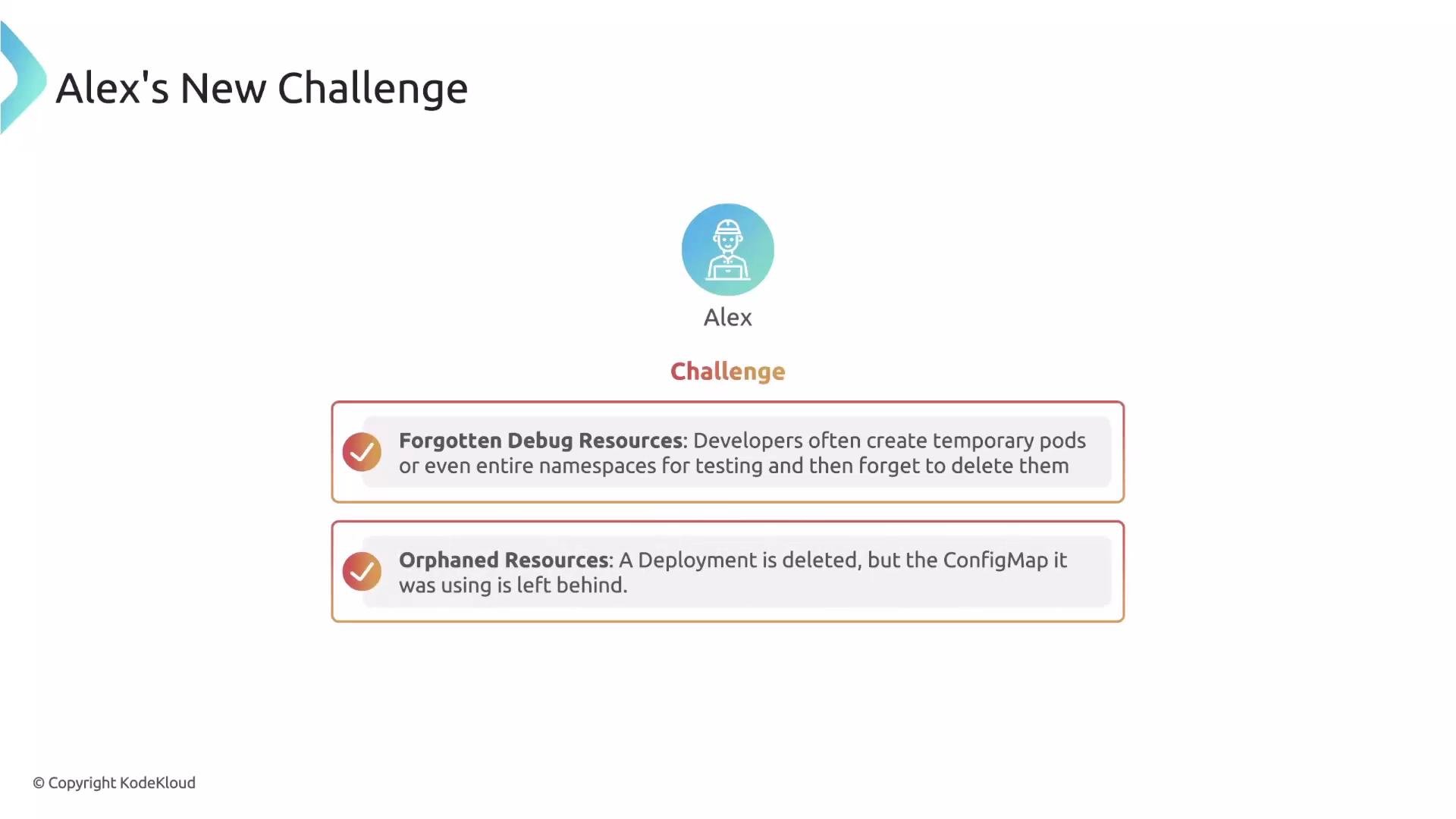
We previously examined what happens when resources are created or updated: how Kyverno validates and mutates resources, generates additional objects, and creates policy exceptions. But resource lifecycle management continues beyond creation. Creating resources is straightforward; keeping clusters tidy as resources age or become unnecessary is an ongoing operational challenge. Kyverno can automate this housekeeping for you, helping enforce cluster hygiene without manual intervention. Let’s check back in with Alex. Thanks to his hard work, the cluster is running smoothly. However, a new class of problems is accumulating: development teams often spin up temporary resources for debugging — a short-lived Pod here, a throwaway Namespace there — and then forget to clean them up. Alex is also discovering orphaned objects such as ConfigMaps left behind after their Deployments were deleted.
The image titled "Alex's New Challenge" lists two challenges: "Forgotten Debug Resources" and "Orphaned Resources," related to temporary pods and residual ConfigMaps.
Relying on kubectl delete for manual cleanup does not scale across teams and clusters. Alex needs a way to detect resources that match rules and remove them automatically, reducing toil and preventing resource sprawl.
The image presents "Alex's New Challenge," showing a dilemma about automatically cleaning up old and unneeded cluster resources without manually running kubectl delete.
Kubernetes cleanup capabilities are built to address this class of housekeeping problems. Kyverno offers two complementary approaches for automatic cleanup:
  • A declarative, policy-driven approach using CleanupPolicy and ClusterCleanupPolicy.
  • A lightweight, dynamic approach driven by the TTL label cleanup.kyverno.io/ttl.
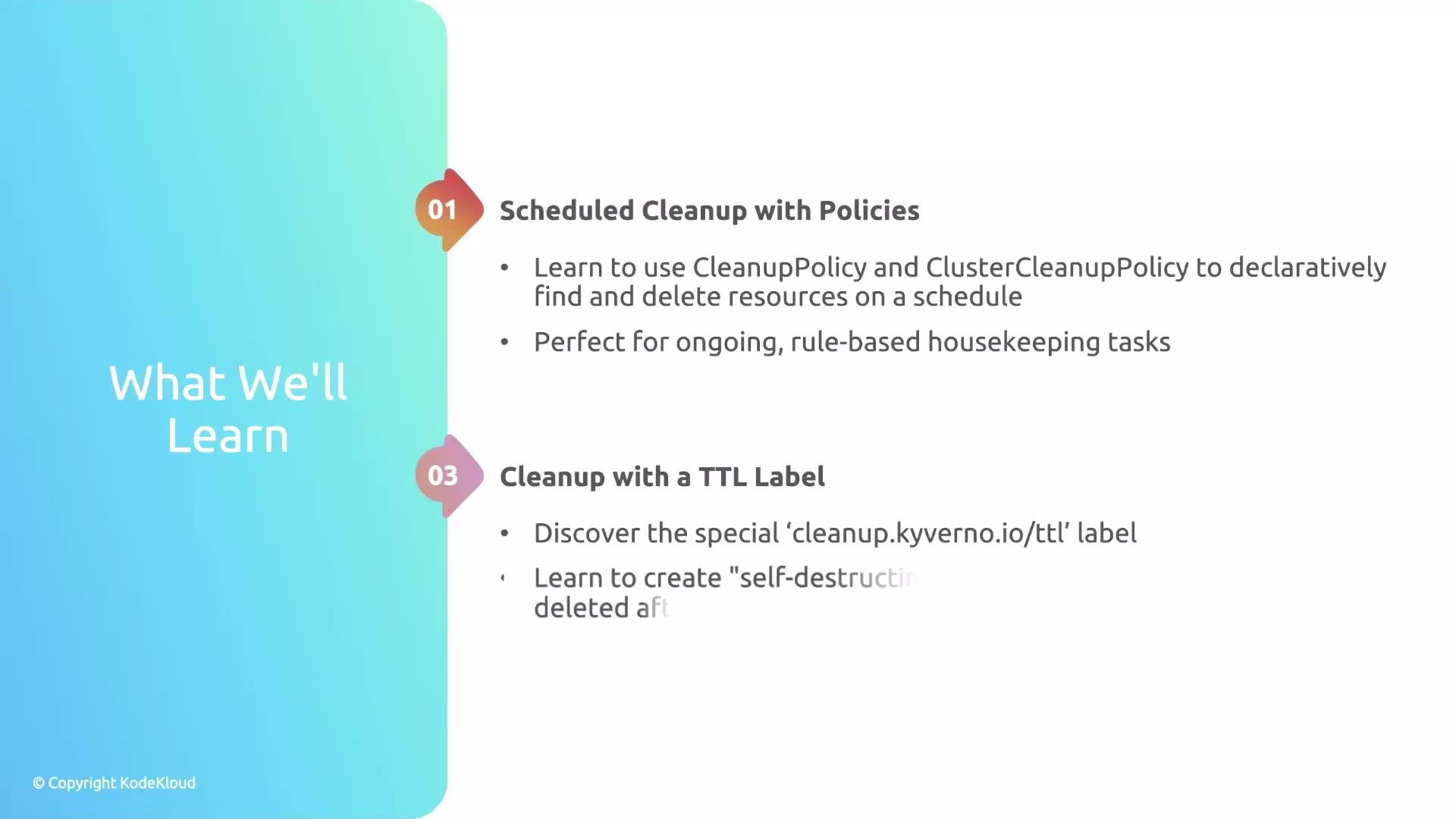
The image outlines a learning agenda about performing scheduled cleanup with policies and cleanup using a TTL label. It includes learning points related to CleanupPolicy, ClusterCleanupPolicy, and using the 'cleanup.kyverno.io/ttl' label.
Below is a quick comparison to help choose the right approach for your use case.
Kyverno’s cleanup features let you automate resource lifecycle management — either centrally with CleanupPolicy/ClusterCleanupPolicy or per-resource with the cleanup.kyverno.io/ttl label. For implementation details and examples, see the official Kyverno cleanup documentation: Kyverno Cleanup Policies.

Watch Video