

- Sidecar-less architecture reduces CPU/memory overhead and the number of proxies to manage.
- Transparent Layer 4 controls remain available for all workloads.
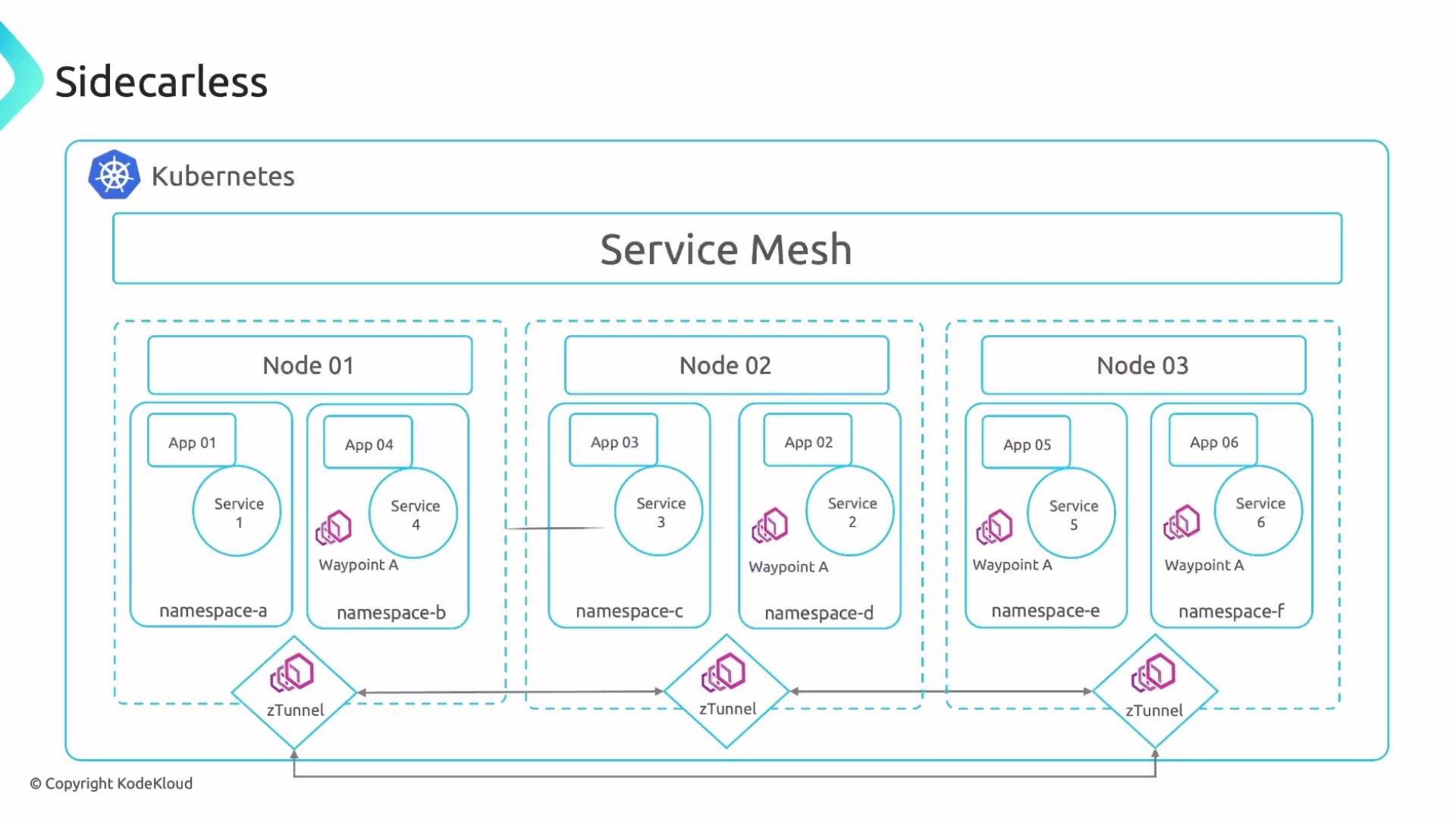
- Layer 7 capabilities are provided on-demand using per-namespace Waypoint proxies.
- ztunnel — a Rust-based transparent proxy deployed as a DaemonSet (one per node). It intercepts inbound and outbound traffic for the node’s workloads and provides mTLS, authentication/authorization checks, and telemetry for pod traffic on that node.
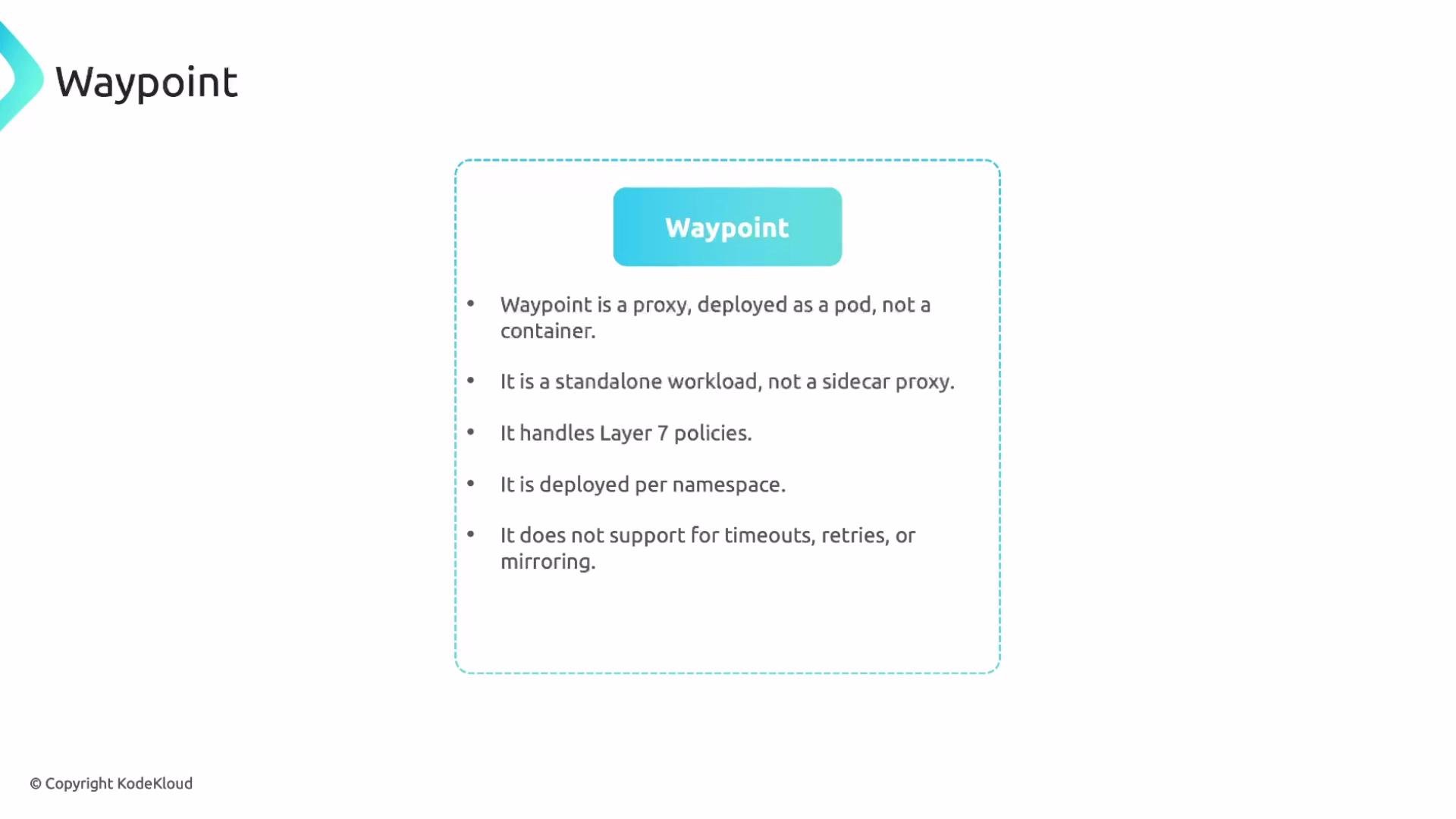
- Waypoint — an Envoy-based proxy deployed as a standalone pod in a namespace when Layer 7 features are required. It handles application-layer routing and policies without being injected as a per-pod sidecar.
ztunnel is a Rust-based transparent proxy running as a DaemonSet (one per node). Waypoint is an Envoy-based proxy deployed as a pod (per-namespace) when L7 features are required.
- ztunnel (Layer 4)
- Transparent interception of TCP/UDP traffic for all workloads on the node
- mTLS (encryption/decryption)
- Node-level authentication/authorization and telemetry
- Basic routing to healthy endpoints
- Waypoint (Layer 7)
- Application-level routing (path/header matches, rewrites)
- Traffic splitting, fault injection, delays, aborts
- Advanced L7 features where required (deployed per-namespace)
- If you only need secure transport and basic connectivity controls, ztunnel (Layer 4) covers most use cases with minimal overhead.
- If you need application-layer routing, policy enforcement, header/path-based behavior, or traffic-splitting, deploy Waypoint in the target namespace to enable L7 capabilities for those workloads.
HTTPRoute — is a common pattern for L7 routing in ambient deployments, and integrates with Waypoint when application-layer features are required.
Example: HTTPRoute splitting traffic between two service backends
The Gateway API approach differs from Istio’s sidecar-based VirtualService and DestinationRule model. For the Prep Course - Istio Certified Associate (ICA) Certification, installing Ambient mode and labeling namespaces is the primary requirement — in-depth Gateway API and Waypoint configuration is outside the exam scope. For current feature details and roadmap, see the Istio Ambient Mesh docs.
- Ambient Mesh removes the per-pod sidecar. ztunnels run on each node to handle Layer 4 traffic; Waypoint proxies are deployed per-namespace only when L7 functionality is required. Make sure to label namespaces appropriately so Ambient behavior applies to workloads in those namespaces.
- Not all sidecar-mode features are yet available in Ambient Mesh. Some fine-grained timeout/retry/mirroring semantics and specific L7 behaviors may be absent or different in Waypoint.
- The Istio project is actively evolving Ambient Mesh; consult the official docs for the latest information: https://istio.io/latest/docs/ops/deployment/ambient/
Benefits summary
- Reduced proxy footprint (fewer proxies overall vs. sidecar-per-pod)
- Lower resource usage per node and per-cluster
- Simpler operational model for many deployment patterns
- Istio Ambient Mesh docs: https://istio.io/latest/docs/ops/deployment/ambient/
- Gateway API: https://gateway-api.sigs.k8s.io/