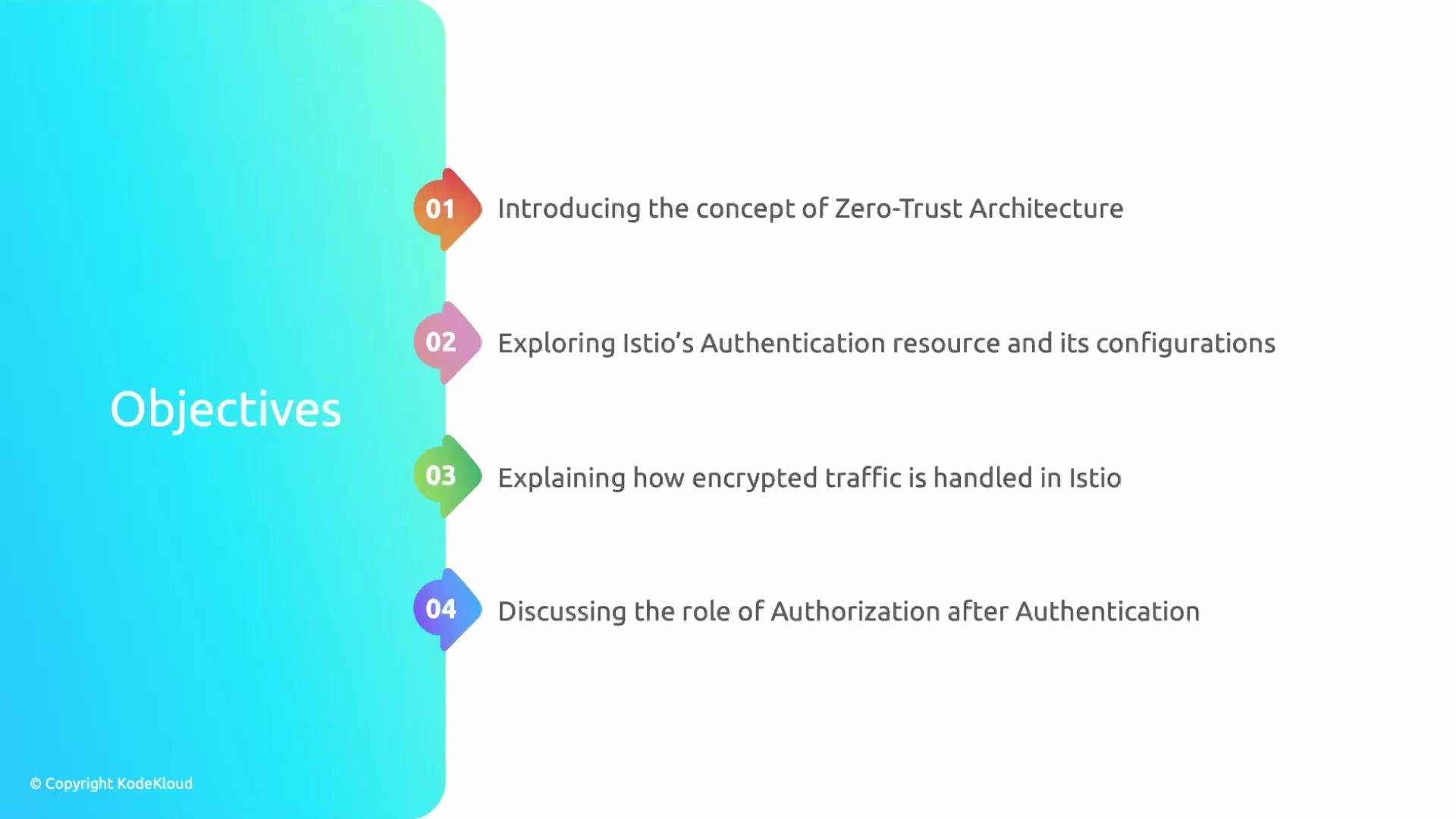
This short section is important for understanding how Istio implements zero-trust security across the mesh. In this lesson/article you’ll learn Istio’s zero-trust building blocks: how authentication and authorization work, which resources control them, and how encrypted traffic is handled in practice. We’ll revisit Istio’sDocumentation Index
Fetch the complete documentation index at: https://notes.kodekloud.com/llms.txt
Use this file to discover all available pages before exploring further.
PeerAuthentication resource, examine common configuration options, and explain how Istio enforces—or bypasses—encryption in different deployment modes.

- Authentication (who is the principal?): Revisiting
PeerAuthentication, mutual TLS (mTLS), and identity propagation. - Authorization (what can an authenticated principal do?): How
AuthorizationPolicylets you allow or deny actions, with patterns for scoping policies and handling precedence. - Encrypted traffic: How Istio encrypts traffic between workloads, how TLS is negotiated and enforced, and how encrypted traffic interacts with policy enforcement.
- Ambient mode: How Istio’s ambient mode changes enforcement and deployment considerations (note: ambient mode is not part of the ICA exam objectives but is useful to understand operational differences).
AuthorizationPolicy resource provides fine-grained allow/deny rules (by principals, namespaces, workloads, ports, and HTTP attributes). These policies are powerful but can become complex; later sections will cover common patterns, how to reason about policy scope and precedence, and pitfalls to avoid.
You’re likely to see exam-style questions that ask you to reason about interactions between PeerAuthentication, AuthorizationPolicy, and mesh-wide defaults, so this lesson focuses both on concepts and the practical configuration details you’ll need.
Finally, we examine how Istio’s ambient mode interacts with authentication and authorization. Ambient mode changes the enforcement surfaces and how identity and traffic encryption are handled, which affects deployment and troubleshooting workflows. Again, ambient mode is useful to know but not required for the ICA exam objectives.
This lesson/article covers authentication, authorization, and how encrypted traffic is handled in Istio. Ambient mode is discussed for completeness, but it is not part of the ICA exam objectives.
- Istio PeerAuthentication docs: https://istio.io/latest/docs/reference/config/security/peer_authentication/
- Istio AuthorizationPolicy docs: https://istio.io/latest/docs/reference/config/security/authorization-policy/
- Istio Mutual TLS overview: https://istio.io/latest/docs/concepts/security/mtls-migration/
- Istio Ambient Mode: https://istio.io/latest/docs/setup/additional-setup/ambient/
- ICA exam objectives: https://learn.kodekloud.com/user/courses/istio-certified-associate-ica-certification
| Topic | Focus | Example outcome |
|---|---|---|
| Authentication | Understand PeerAuthentication and mTLS modes | Explain difference between DISABLE, PERMISSIVE, STRICT modes |
| Authorization | Apply AuthorizationPolicy to workloads and namespaces | Write a policy that restricts access to a service by principal or JWT claim |
| Encrypted traffic | Understand TLS negotiation and termination points | Explain how sidecar and ambient modes handle encryption |
| Troubleshooting | Diagnose authN/authZ failures | Interpret telemetry and logs to find policy conflicts or TLS mismatches |