Documentation Index

Fetch the complete documentation index at: https://notes.kodekloud.com/llms.txt

Use this file to discover all available pages before exploring further.

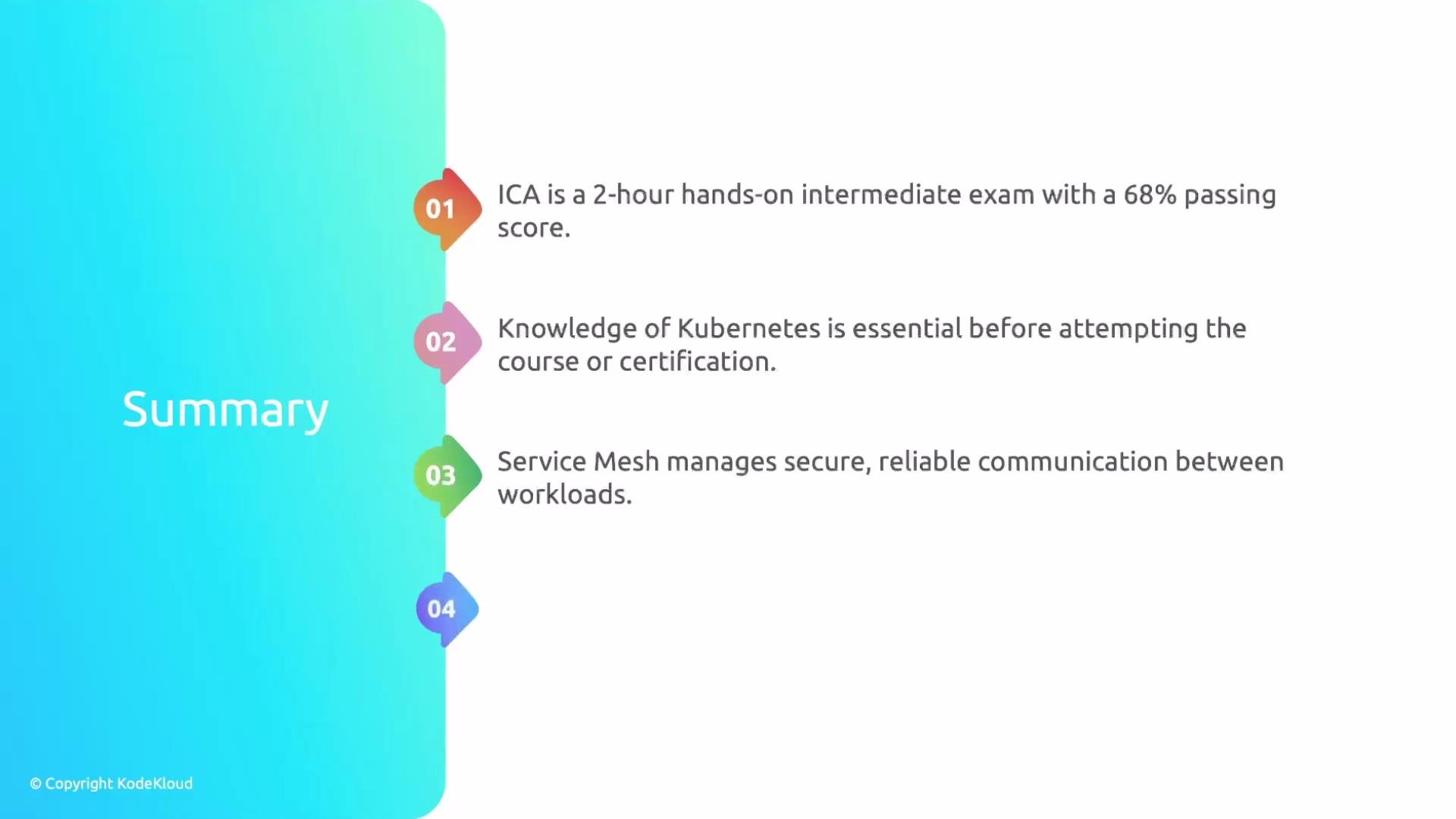
This section recaps the key concepts from the introduction: the ICA exam overview, what a service mesh provides, the role of sidecars (proxies), and Istio’s ambient mode.

ICA exam — quick facts

  • Level: Intermediate
  • Duration: 2 hours
  • Format: 16 hands-on practical tasks (the multiple-choice section has been removed)
  • Reported passing rate: ~68% (subject to change)
Before proceeding, be comfortable using Kubernetes. Familiarity with kubectl, Pods, Services, Deployments, and basic networking is a recommended prerequisite — do not continue unless you have this foundation.
AttributeDetailsExample / Notes
Exam formatPractical, hands-on16 tasks — no multiple choice
Time limit2 hoursPlan time per task accordingly
DifficultyIntermediatePractical Kubernetes experience required

What a service mesh provides

A service mesh enhances communication between microservices by adding features Kubernetes does not provide out of the box, including:
  • Advanced traffic management (routing, load balancing, retries, timeouts)
  • Policy enforcement (access control, mTLS)
  • Observability (tracing, metrics, logging)
  • Stronger security controls between services
A service mesh applies these capabilities without requiring changes to application code.

Sidecar proxies — purpose and benefits

  • Sidecars run as a secondary container in the same Pod and transparently intercept inbound/outbound traffic for the application container.
  • They centralize cross-cutting concerns such as authentication, encryption, retries, timeouts, circuit breaking, distributed tracing, and logging.
  • This offloads infrastructure responsibilities from application developers so teams can focus on business logic.
Sidecars let teams focus on business logic while the mesh handles connectivity, security, and observability for services.

Istio and ambient mode

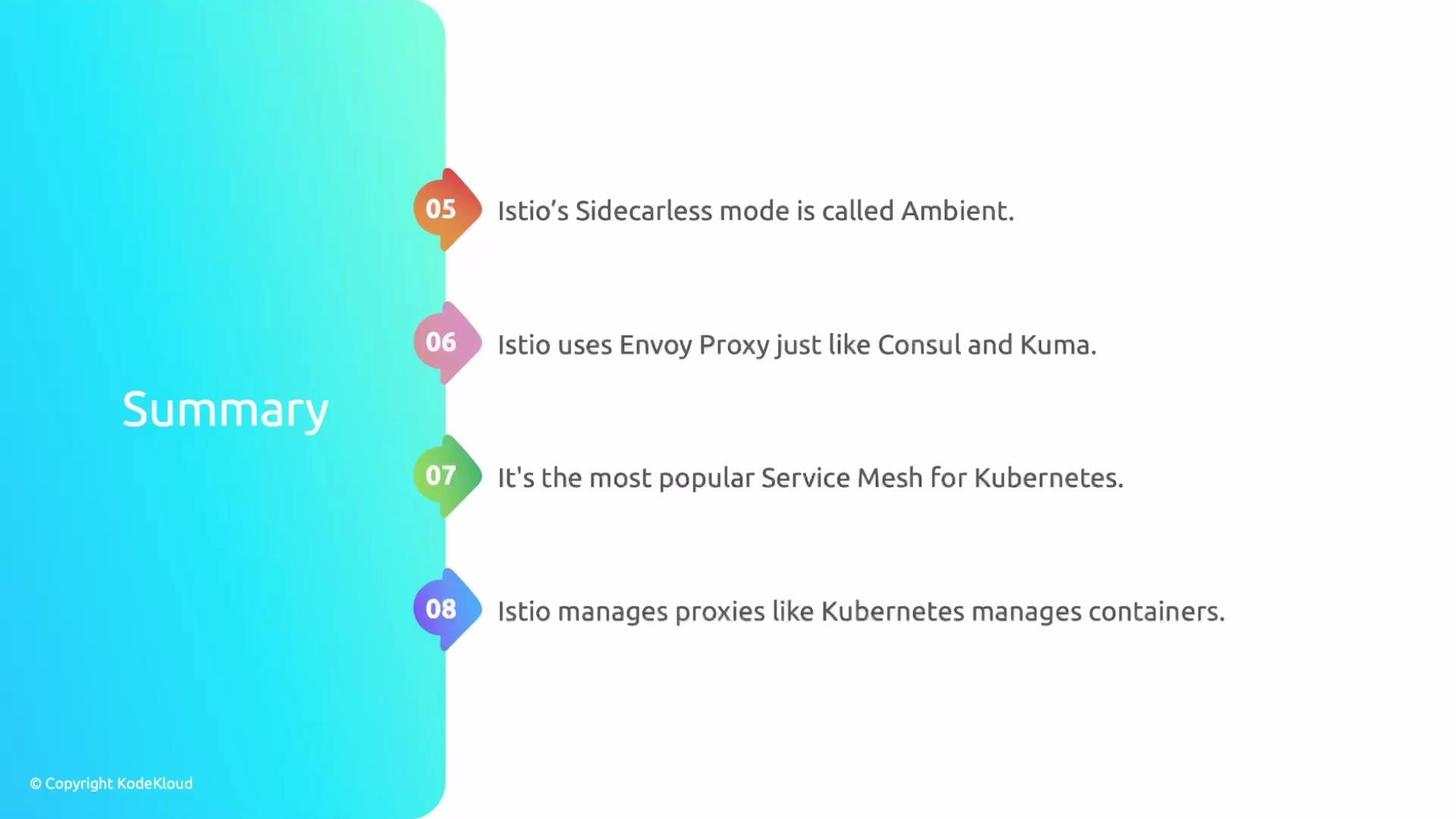
  • Istio is a widely adopted service mesh that typically deploys Envoy proxies as per‑pod sidecars. Envoy is a high-performance proxy used by multiple service meshes.
  • Ambient mode is a newer Istio operating mode that reduces or eliminates per‑pod sidecar injection. Instead, it rethinks where proxying and policy enforcement are applied to provide mesh features with lower operational overhead.
  • Think of Istio as an orchestrator for proxies and mesh policies—similar to how Kubernetes orchestrates containers—so you can enforce consistent behavior across services without changing application code.

Final notes and further reading

  • The service mesh pattern (and Istio specifically) is most valuable in environments with many microservices requiring consistent traffic control, security, and observability.
  • For hands-on practice, ensure you are comfortable with Kubernetes primitives and basic networking.
Links and references:

Watch Video