Explains the sidecar pattern, how Envoy proxies support service meshes like Istio by offloading traffic management, security, observability, and how Istio automates sidecar deployment and configuration
To understand Istio, start with the concept of a sidecar.Think back to learning how to ride a bike. At first you try to balance on your own and might fall. A sidecar is like an extra rider who helps keep balance, watches for traffic, navigates, and communicates with others so you can focus on driving. In software, a sidecar offloads auxiliary responsibilities from your main application so the application can focus on its core logic.In short: a sidecar handles supporting tasks, organizes communication, improves safety, and provides observability so the main application can stay focused on business functionality.
Proxies used as sidecars are central to service-mesh traffic management. The most widely adopted proxy in modern service meshes is Envoy Proxy, which Istio uses (Istio provides its own distribution and configuration of Envoy). Other meshes and projects also adopt Envoy—examples include HashiCorp Consul and Kuma; AWS App Mesh can also use Envoy.There are alternative proxies and proxy-based meshes as well:
Envoy Proxy is an open-source, high-performance service proxy originally created at Lyft and now part of the Cloud Native Computing Foundation (CNCF). It functions like modern software load balancers (for example, NGINX) but is purpose-built for distributed, microservice architectures and the needs of service meshes.A quick terminology note: “proxy” vs “sidecar”
A proxy is the software that handles traffic (e.g., Envoy).
A sidecar is the deployment pattern where that proxy runs alongside your application in the same Pod (or host).
When people mention “sidecar injection,” they refer to adding a proxy container (such as Envoy) to a workload so it intercepts and manages the application’s traffic.
Sidecar injection means adding a proxy container (for example, Envoy) to a workload so the proxy runs alongside the application and intercepts inbound/outbound traffic.
How does an Envoy sidecar work?Think of Envoy as a traffic controller or assistant for your application. In a system with many services that communicate, Envoy helps ensure messages reach the right destination efficiently and securely. In Kubernetes, the Envoy sidecar runs as a separate container inside the same Pod as your application container. It typically intercepts inbound and outbound communication (often via network-level redirection) and acts as a middleman that can enforce policies, secure traffic, route requests, and gather telemetry.
Core responsibilities of an Envoy sidecar
Responsibility
What it does
Routing
Determines paths and forwards requests to the appropriate service instances; supports advanced routing (header-based, path-based)
Load balancing
Distributes traffic across healthy replicas using algorithms such as round-robin, least-request, ring-hash
Security
Enables encryption between services (e.g., mTLS), and enforces authentication and authorization policies
Observability
Collects metrics, logs, and traces (latency, request counts, error rates) for monitoring and debugging
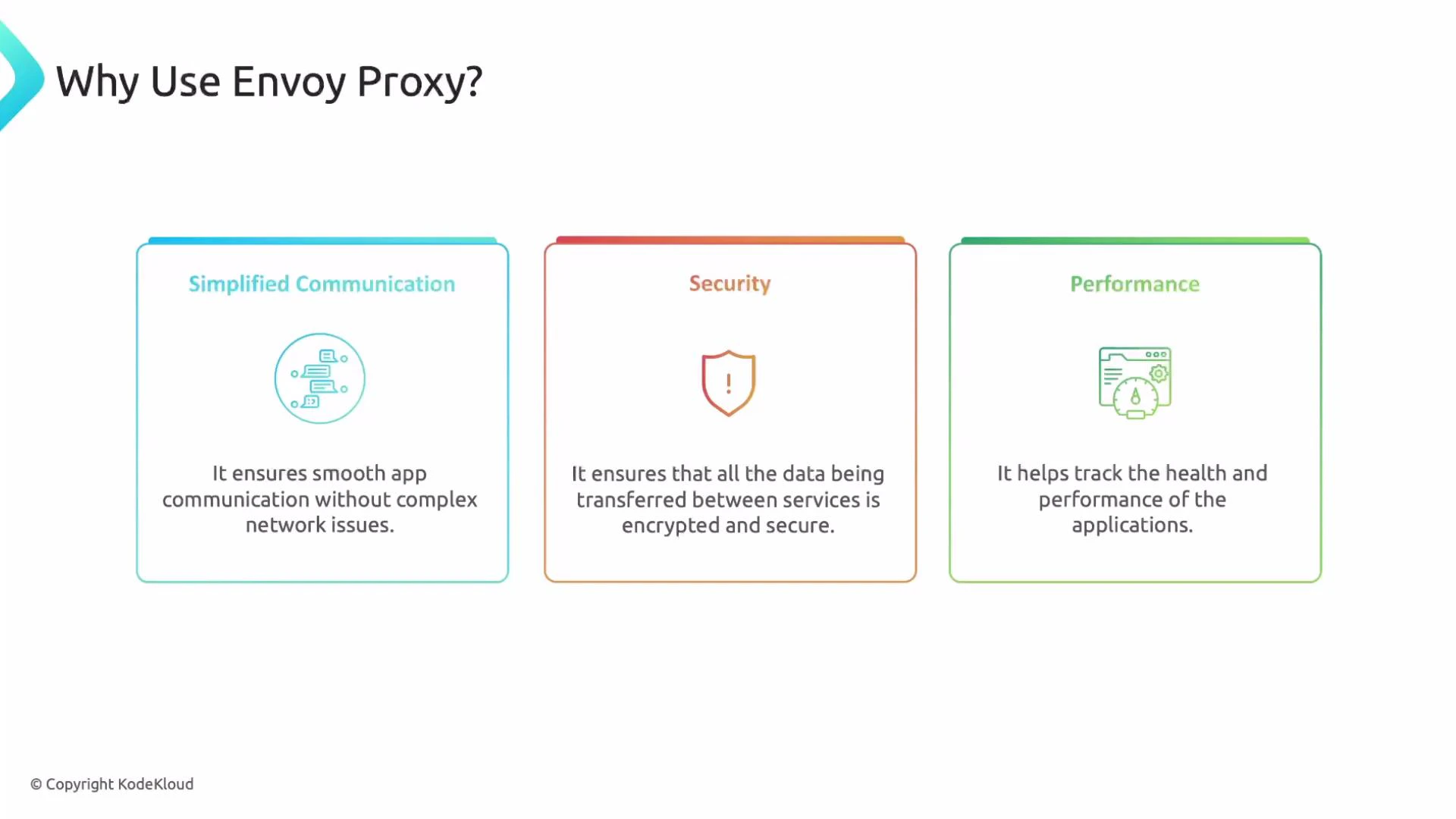
These capabilities simplify interservice communication, improve security posture, and provide actionable telemetry for operations teams.
Reliability and advanced traffic controlEnvoy improves reliability by routing traffic away from unhealthy instances, applying retry and timeout policies, and enabling traffic-shaping features like rate limiting and traffic mirroring. These mechanisms help with safer rollouts, fault isolation, and graceful degradation during failures.
Installing EnvoyYou can install Envoy on many platforms (Linux distributions, macOS) or deploy it inside Kubernetes (for example via Helm). Managing Envoy instances manually for every workload in a large cluster is complex; service meshes like Istio provide control-plane components that automate sidecar injection, configuration, and lifecycle management.Example installation commands:
Why use a service mesh like Istio?Managing each proxy instance across many services—keeping configurations consistent, rotating certificates, applying global policies, and collecting telemetry—creates operational overhead. Istio provides a control plane that automates sidecar injection, distributes configuration, manages certificates (for mTLS), and offers higher-level traffic-management APIs so you don’t manage every Envoy manually.Later sections will build on this sidecar foundation to explain how Istio leverages Envoy for traffic management, security, and observability across microservices.Links and references