

- Always verify identity first, regardless of traffic origin. In Istio this is enforced by a
PeerAuthenticationresource applied either mesh-wide (global) or scoped to a specific namespace. - Mutual TLS (mTLS) is negotiated and enforced by the data-plane proxy. In sidecar mode this is the Envoy sidecar injected into the workload. In Istio Ambient mode, TLS is handled by the ambient dataplane (ztunnel / ambient dataplane) and requires different labels and deployment patterns, but it still authenticates traffic to workloads.
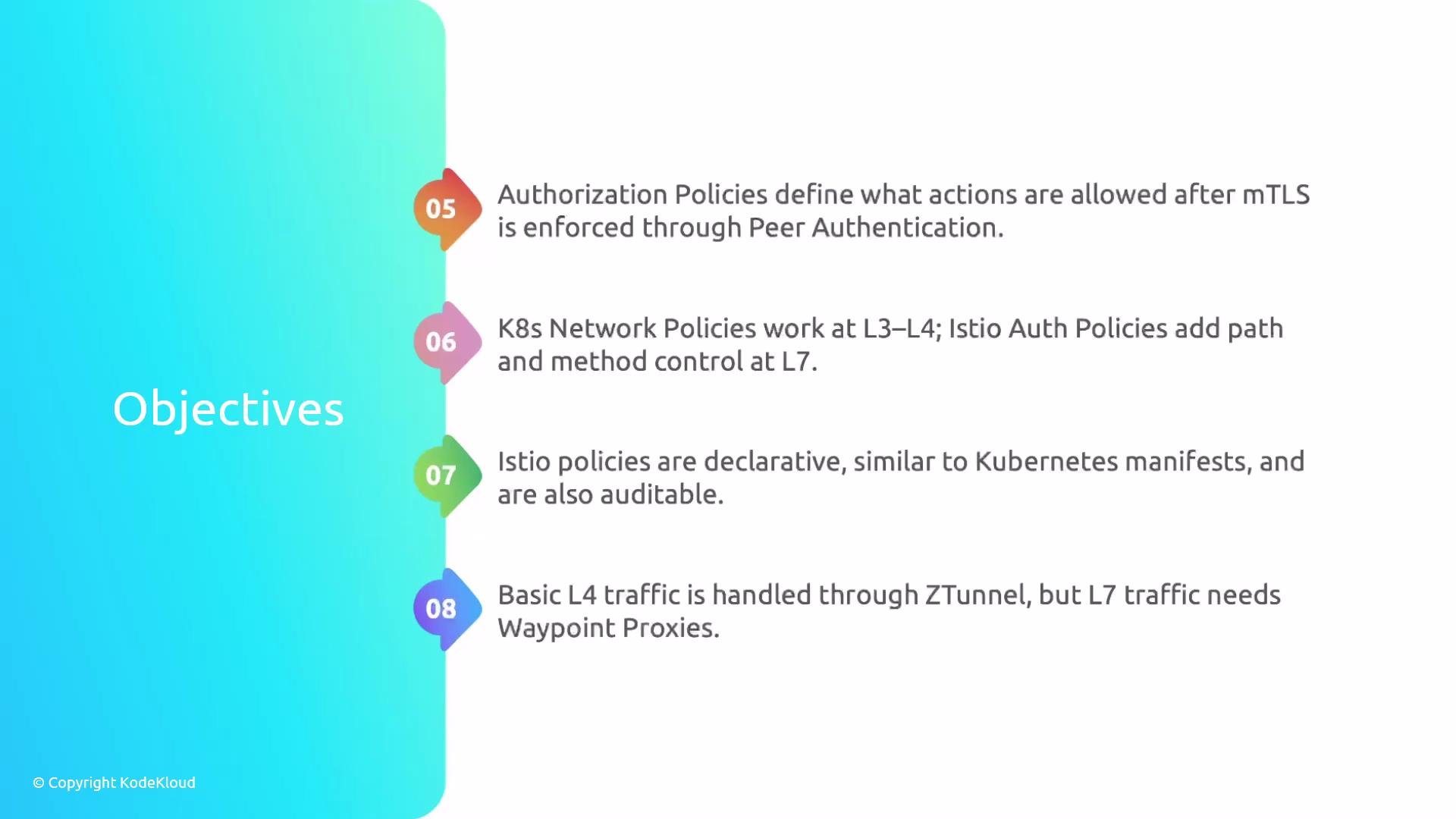
- Authentication (who is making the request) is only the first step. After a client is authenticated, you must decide what that client is allowed to do. Istio
AuthorizationPolicyobjects define application-layer permissions (allow/deny) and evaluate attributes like principals, HTTP methods, paths, and other metadata.
- Kubernetes
NetworkPolicyresources operate at OSI layers 3 and 4 (network and transport). They control IP-level and port-level connectivity. - Istio
AuthorizationPolicyobjects operate primarily at layer 7 (application). They enable request-level controls based on attributes such as HTTP methods, paths (for example,GET /api), or other application-level metadata. - If your cluster uses the ambient dataplane (ztunnel) and you only need basic L4 redirection across namespaces, ztunnel will handle that traffic steering. For L7 controls (path- or method-specific rules), a waypoint proxy must be deployed for the workload; without a waypoint proxy, L7 rules may not be enforced.
- Enforce mTLS with
PeerAuthentication(mesh or namespace scope). - Use
AuthorizationPolicyto grant/deny access at the application layer. - Prefer
serviceAccountprincipals for clearer, auditable authorization bindings. - If using ambient mode and you need L7 controls, deploy a waypoint proxy and label the namespace appropriately.
- Mesh-wide PeerAuthentication to enforce mTLS:
- AuthorizationPolicy using a service account principal and HTTP method/path constraints:
Links and references
Practical checklist: first enforce mTLS with a
PeerAuthentication, then layer AuthorizationPolicy rules to grant or deny access. Use service accounts as principals for clearer, auditable authorization bindings where appropriate.Exam note: Ambient mode specifics are less likely to be heavily tested on the Istio Certified Associate exam, but you should understand differences between sidecar and ambient dataplanes and when a waypoint proxy is required for L7 enforcement. Review the Istio docs and practice hands-on; practical exercises align closely with exam topics.