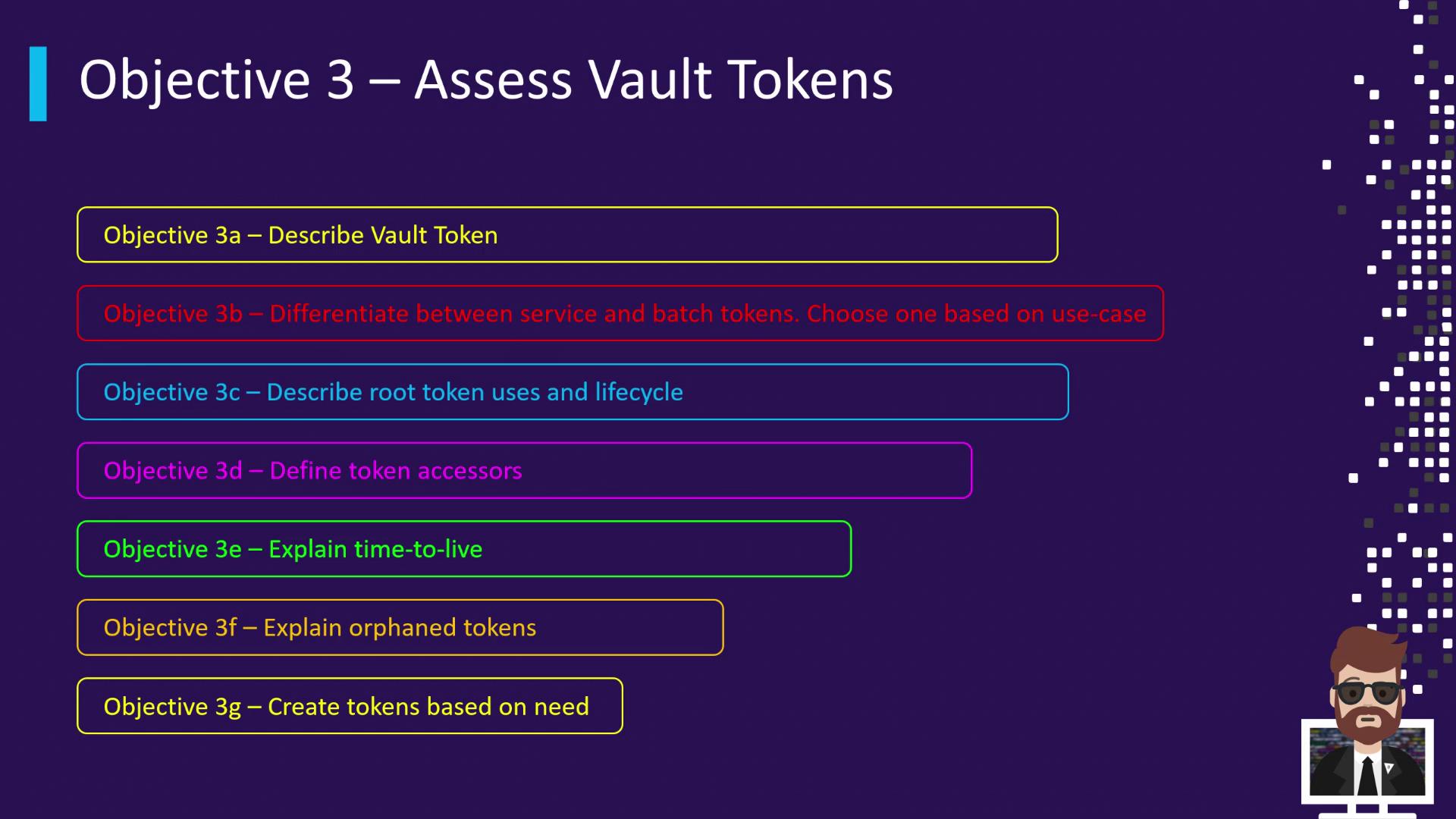
This article covers Vault tokens, their role in authentication, and essential objectives for assessing them in HashiCorp Vault.
In this article, we delve into Vault tokens—the foundational authentication mechanism in HashiCorp Vault. Regardless of the configured auth method (AppRole, LDAP, AWS, etc.), Vault uses tokens to represent identities and enforce access control. Given their critical role, we’ll cover seven essential objectives for assessing Vault tokens, aligned with Objective 3 of the HashiCorp Vault Associate exam.
Vault tokens carry policies that define permissions, grant access to secrets, and are central to audit logging. Effective token management helps maintain a secure and compliant Vault deployment.
Objective
Description
1
Describe what a Vault token is and its components
2
Differentiate between service and batch tokens
3
Explain the root token’s uses and lifecycle
4
Define token accessors and their use cases
5
Explain time-to-live (TTL) and renewal mechanics
6
Distinguish orphan, periodic, service, and other token types
7
Select the appropriate token type based on operational requirements
Let’s begin with our first topic: understanding the anatomy and functionality of a Vault token.