

This summary is designed to help you quickly recall the essential Kubeflow concepts and practical tasks you can now perform. Use it as a checklist when preparing clusters, building pipelines, or deploying models to production.
What you will be able to do after this section
- Explain the Kubernetes architecture and how Kubeflow leverages it for ML workflows.
- Install and configure Kubeflow on a Kubernetes cluster.
- Identify major Kubeflow components and navigate the Kubeflow central dashboard.
- Prepare a Kubernetes cluster for ML workloads (storage, GPU, networking, and RBAC).
- Design and execute end-to-end Kubeflow Pipelines with reusable components.
- Pass parameters and artifacts between pipeline steps, use control flow, and develop interactively with notebooks.
- Serve trained models with KServe and optimize them with Katib.
- Configure user authentication (Dex), create Kubeflow Profiles, and apply namespace isolation and RBAC for secure multi-user collaboration.
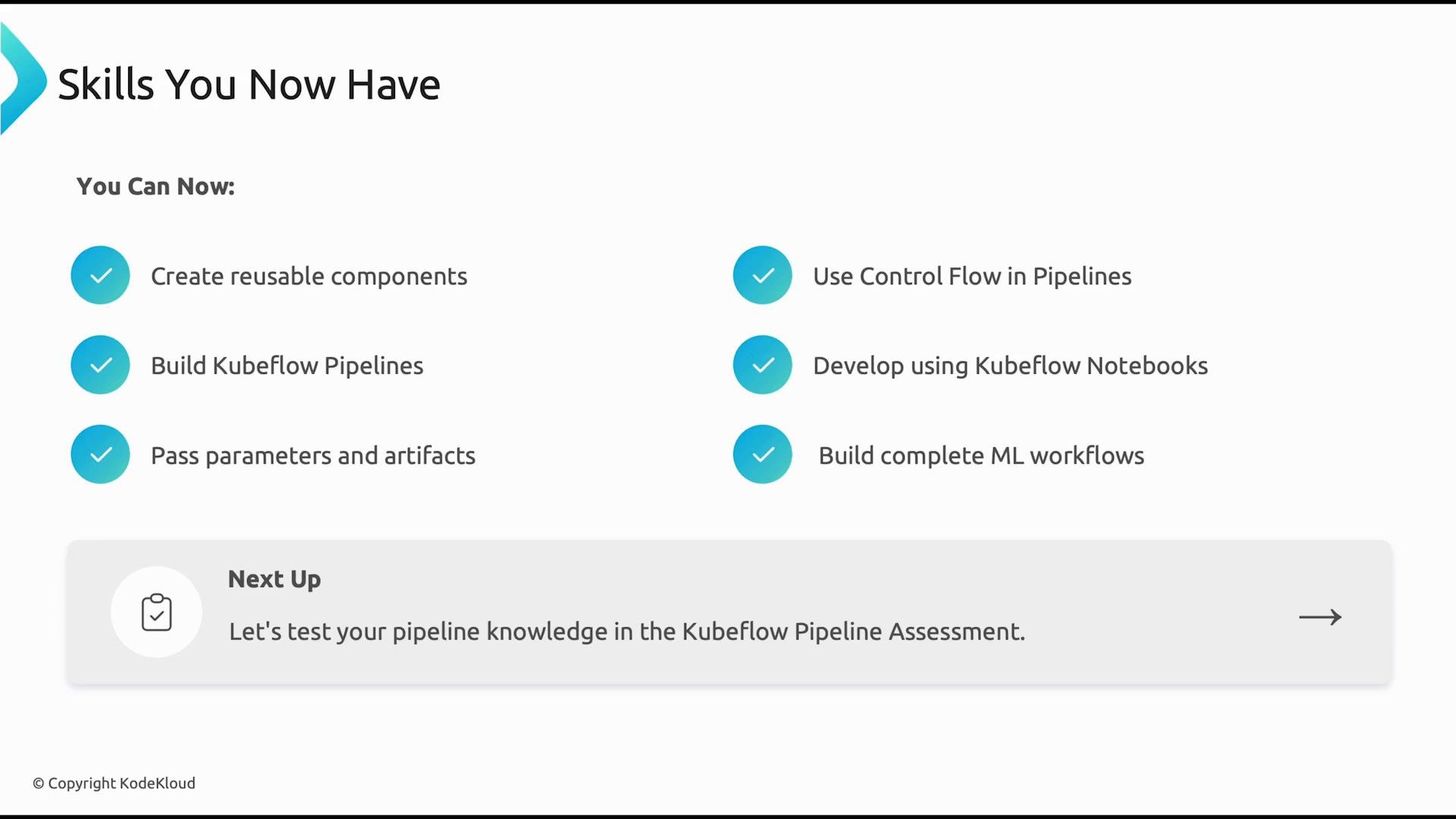
Kubeflow Pipelines — Design, Reuse, and Reproducibility
Kubeflow Pipelines let you define reproducible, portable ML workflows that run on Kubernetes. You practiced:- Creating reusable components (containerized steps).
- Passing parameters and artifacts between steps.
- Using control flow constructs (conditionals, loops).
- Developing interactively with Kubeflow Notebooks.
Quick reference table — Kubeflow Pipeline concepts
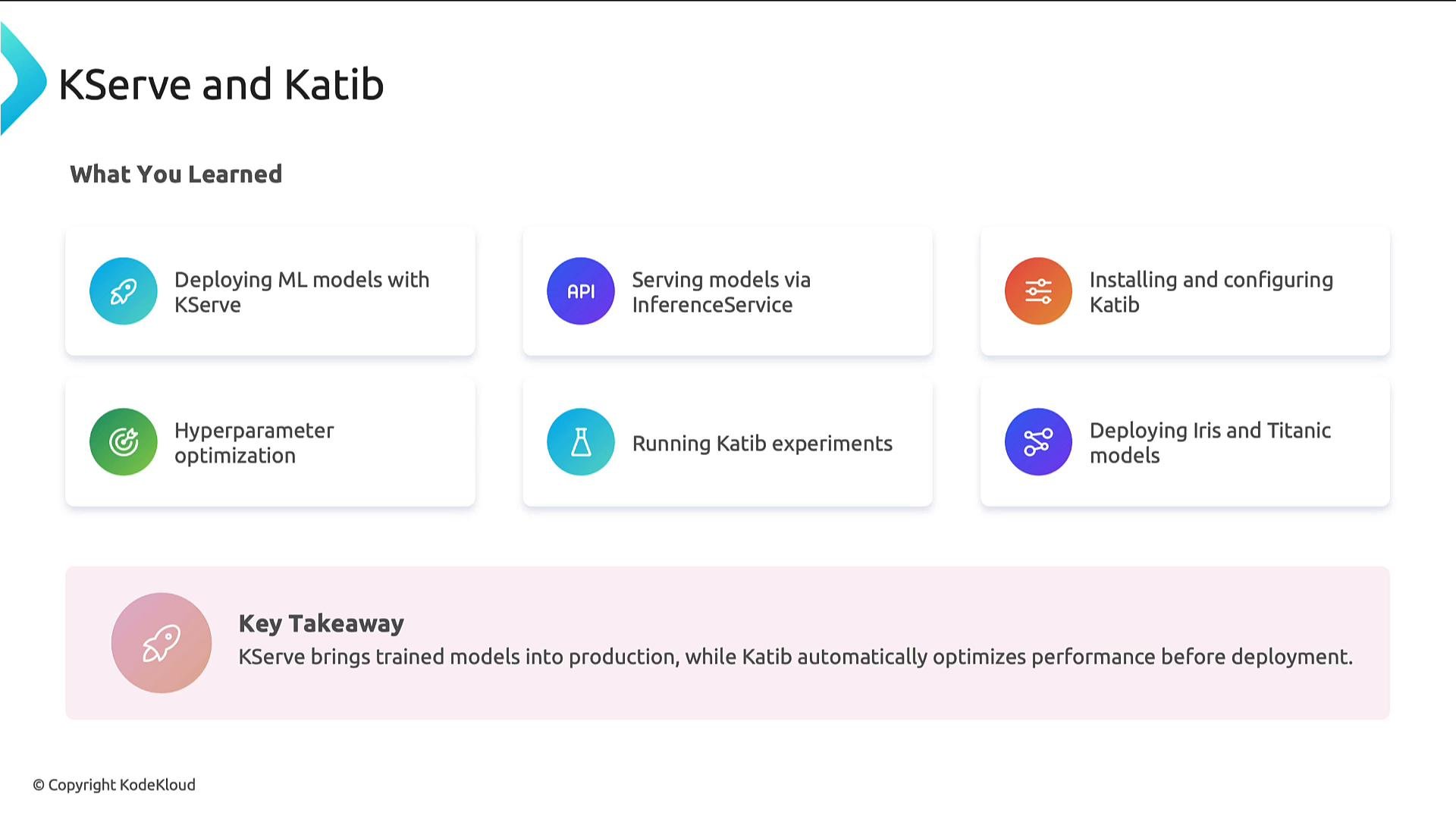
Model serving and tuning — KServe + Katib
You learned how to deploy scalable, production-ready inference endpoints using KServe and how to optimize model performance using Katib hyperparameter tuning. The demos showed:- Creating an InferenceService to expose prediction endpoints with autoscaling.
- Running Katib experiments to automatically search hyperparameter space and improve model metrics before deployment.
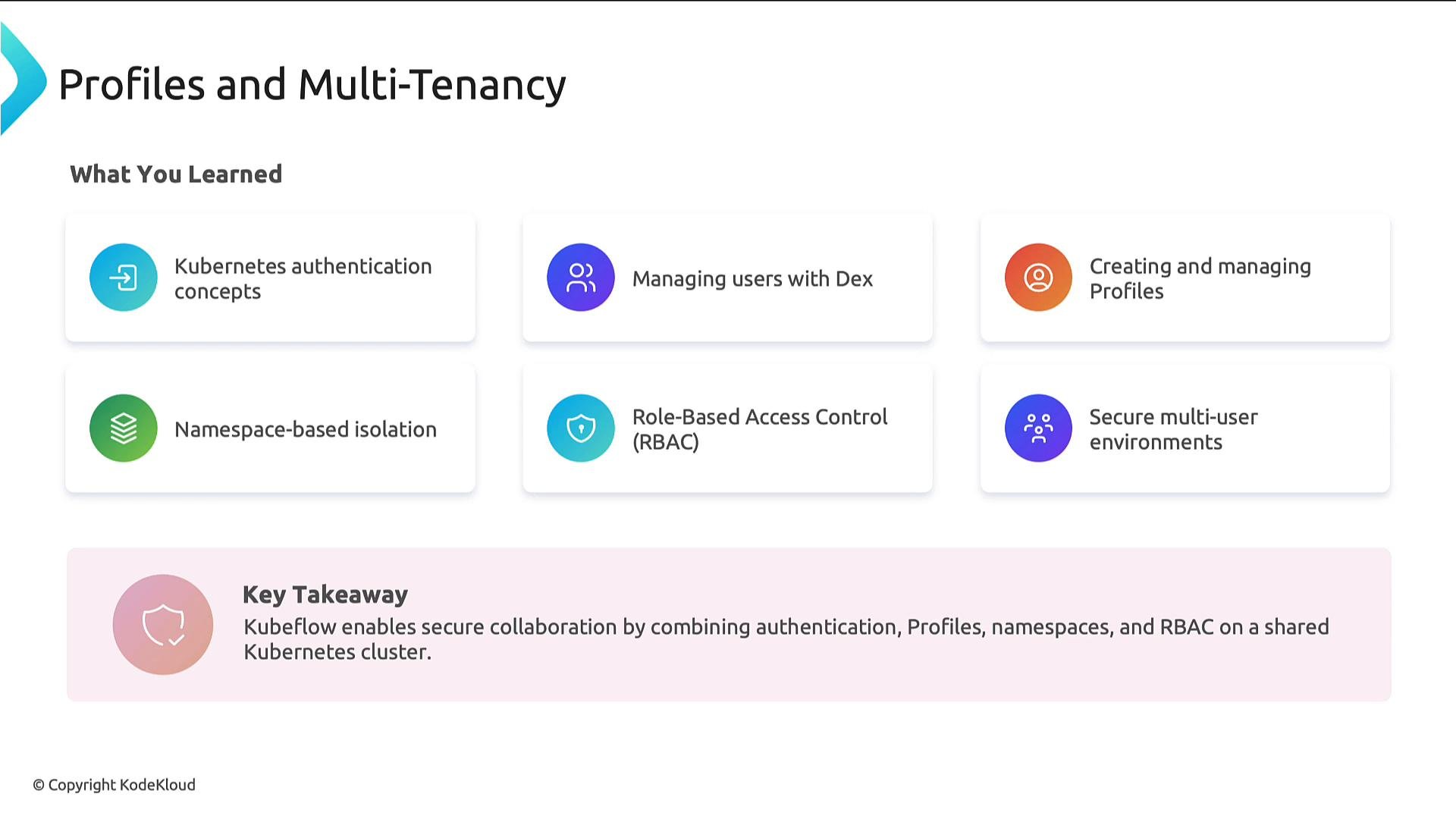
Secure multi-user collaboration — Profiles, Dex, and RBAC
Kubeflow supports secure, multi-tenant workflows by integrating authentication, namespace isolation, and Kubernetes RBAC. You explored:- Authentication with Dex (OAuth / OIDC connectors).
- Creating Kubeflow Profiles to provision namespaces and default resources for users or teams.
- Using namespace isolation and RBAC to enforce least privilege in shared clusters.
- Adding contributors and managing access to projects and resources.
Actionable checklist — Prepare your cluster and projects
- Validate Kubernetes cluster version and resources (CPU, memory, GPUs).
- Configure storage and object storage endpoints for artifacts and model registry.
- Install Kubeflow using your chosen installer (Kfctl, manifests, or distribution) and confirm central dashboard access.
- Set up Dex (or your identity provider) and create Profiles for users/teams.
- Configure KServe and Katib; run a sample InferenceService and a small Katib experiment.
- Test pipelines end-to-end, including artifact passing and conditional logic.
When moving to production, verify cluster resource quotas, secure network policies, and RBAC rules. Always test deployments in a staging environment before production rollout.
Useful links and references
- Kubeflow documentation: https://www.kubeflow.org/docs/
- KServe: https://www.kserve.dev/
- Katib (Kubeflow hyperparameter tuning): https://www.kubeflow.org/docs/components/hyperparameter-tuning/katib/
- Dex identity provider: https://dexidp.io/
- Kubernetes concepts: https://kubernetes.io/docs/concepts/