

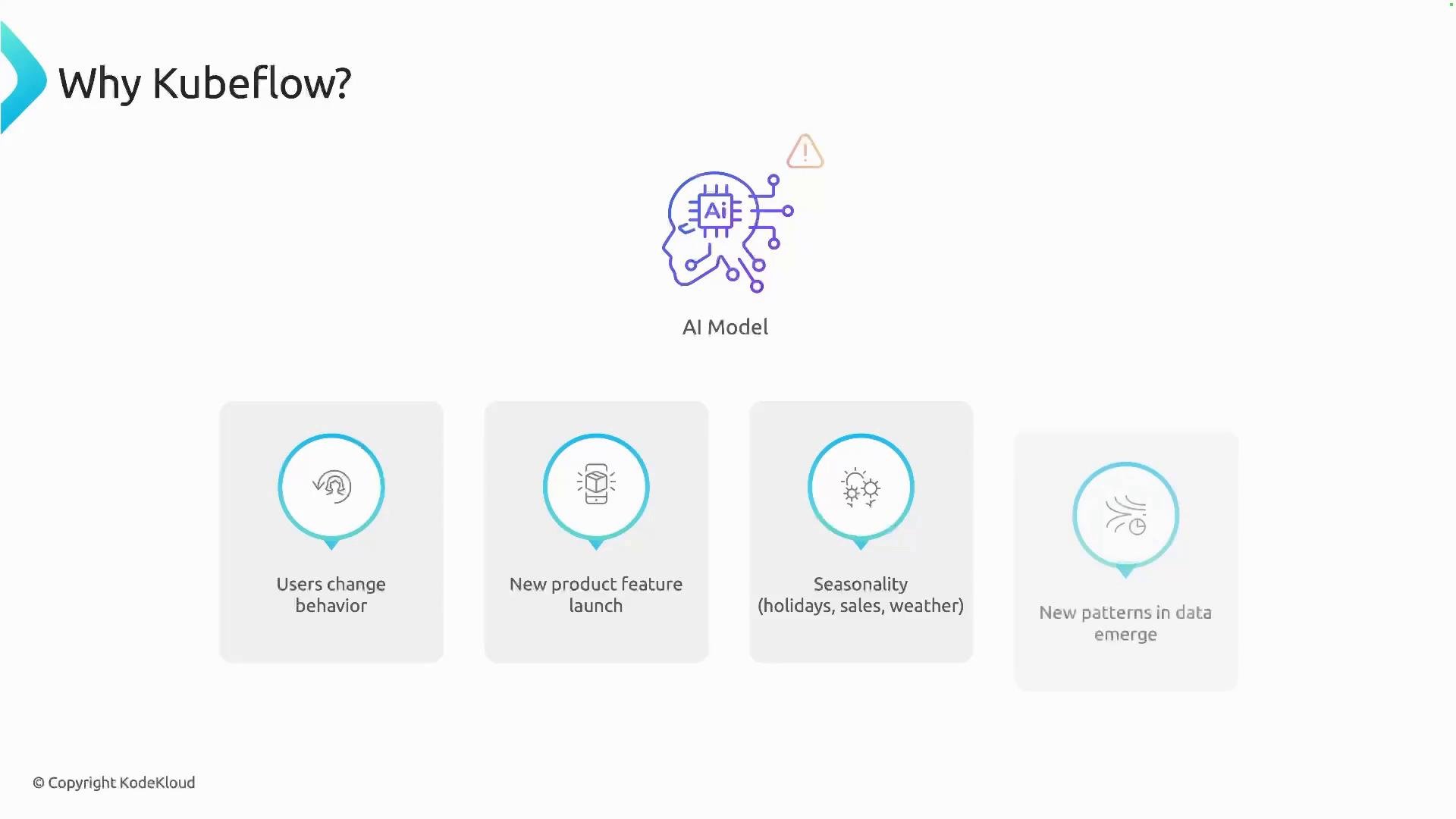
The ML lifecycle — repeated, automated, and fragile
A typical ML engineering workflow follows a sequence of steps that are repeated many times:- Data collection and ingestion — gather data from databases, logs, APIs and files; ensure historical and continuous availability and define how to pull the data.
- Data validation — check schemas, feature distributions, missing values, detect leakage and data-quality issues early.
- Data cleaning and preprocessing — handle missing values, encoding, normalization, deduplication.
- Feature engineering — create meaningful features from raw data.
- Model training — train models and produce model artifacts.
- Model evaluation and versioning — evaluate performance and track which model versions correspond to experiments and deployments.
- Model deployment and inference — serve the model so users or applications can request predictions.
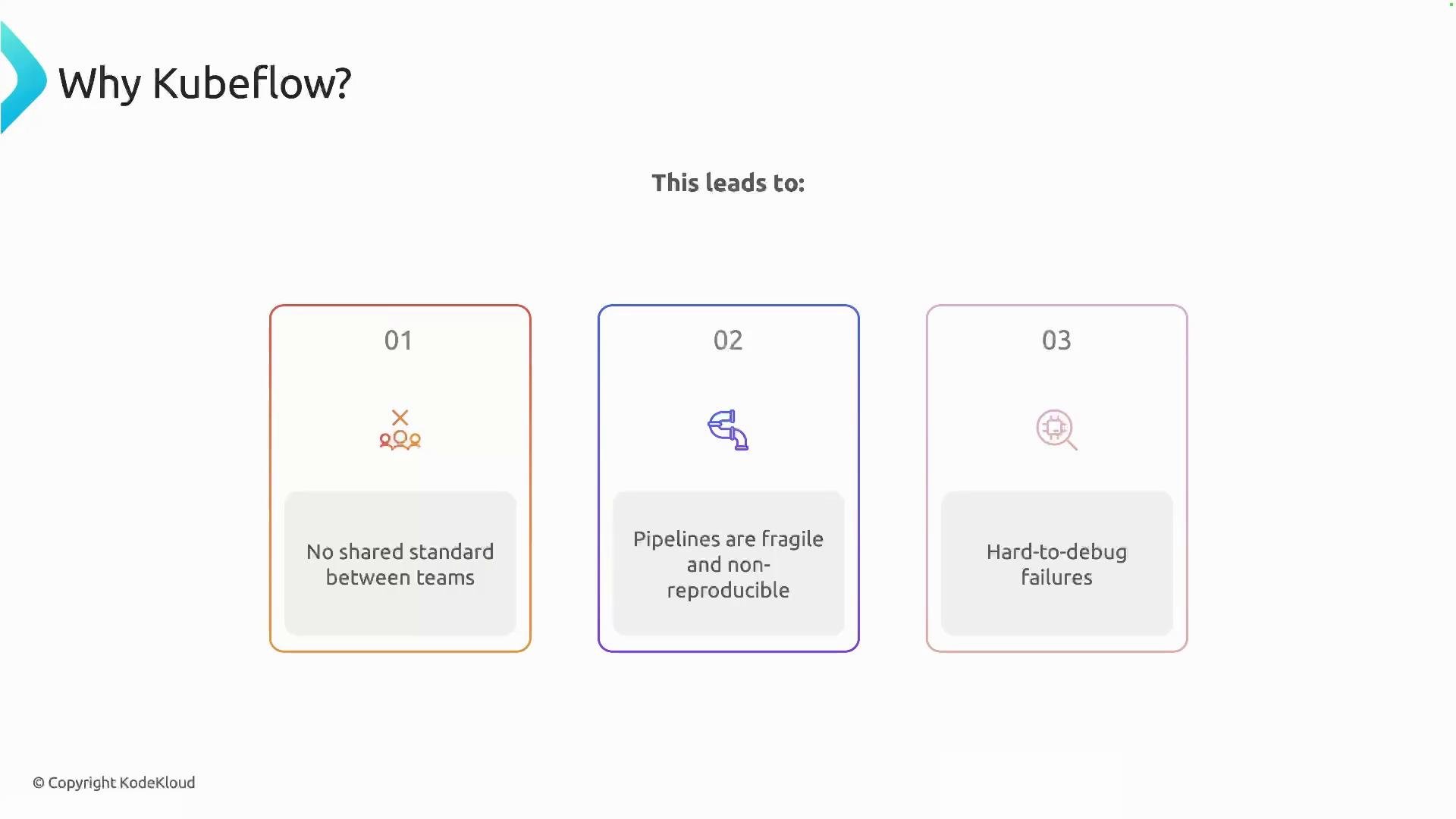
- No shared standards between teams — duplication of effort and inconsistent approaches.
- Fragile, non-reproducible pipelines — difficult to rerun experiments or reproduce results.
- Hard-to-debug failures — brittle scripts and unclear ownership make troubleshooting slow.
Infrastructure challenges at scale
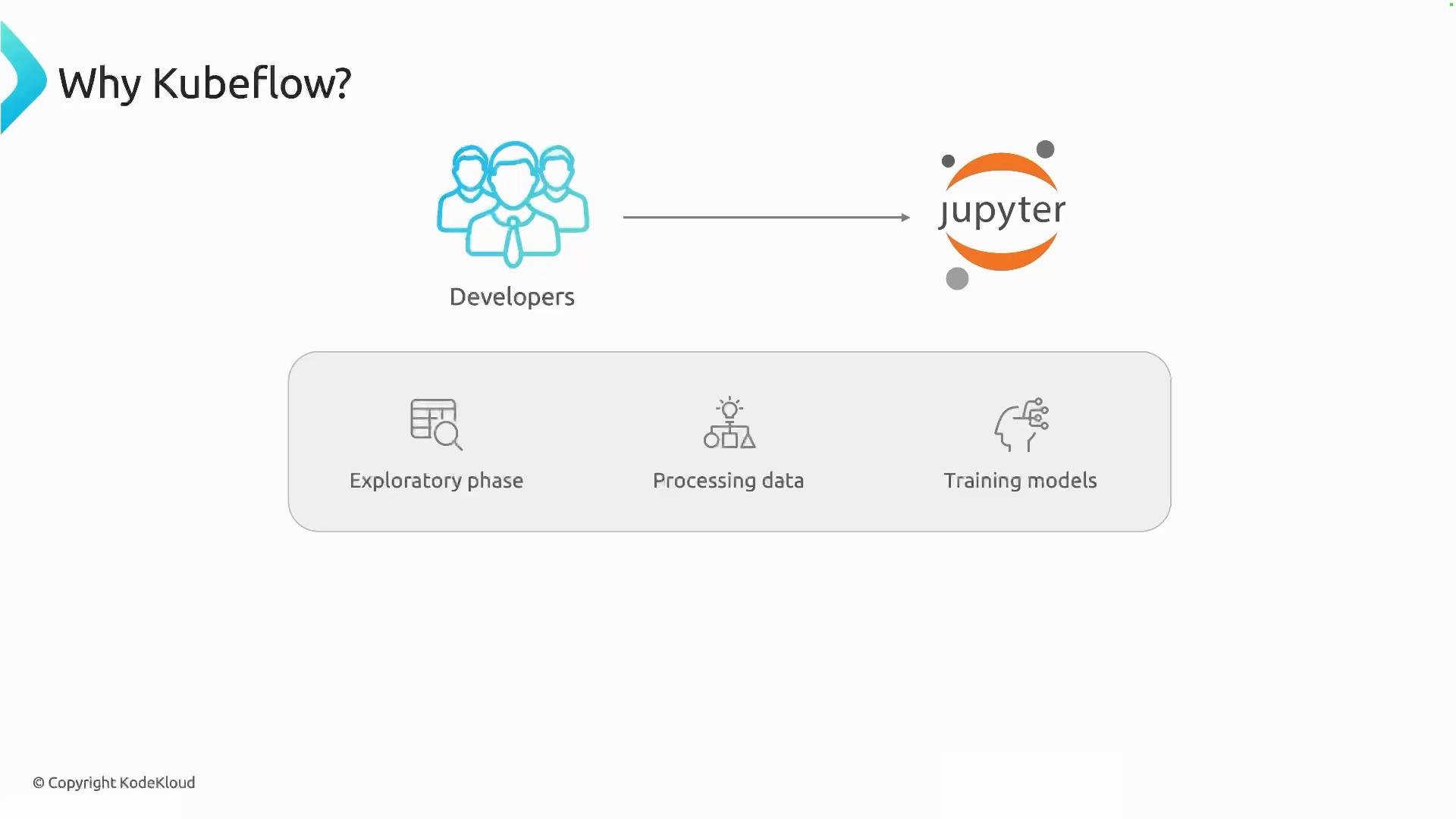
Different phases of ML work use different compute and tooling:- Exploration: interactive notebooks (e.g., Jupyter) for data exploration and prototyping.
- Preprocessing: batch jobs for feature extraction and transformation.
- Training: scheduled jobs that may require GPUs or TPUs.
- Job scheduling so teams don’t interfere with each other.
- Resource isolation so one team cannot modify or delete another’s artifacts.
- Quotas and limits to prevent resource starvation.
Why Kubernetes alone is not enough
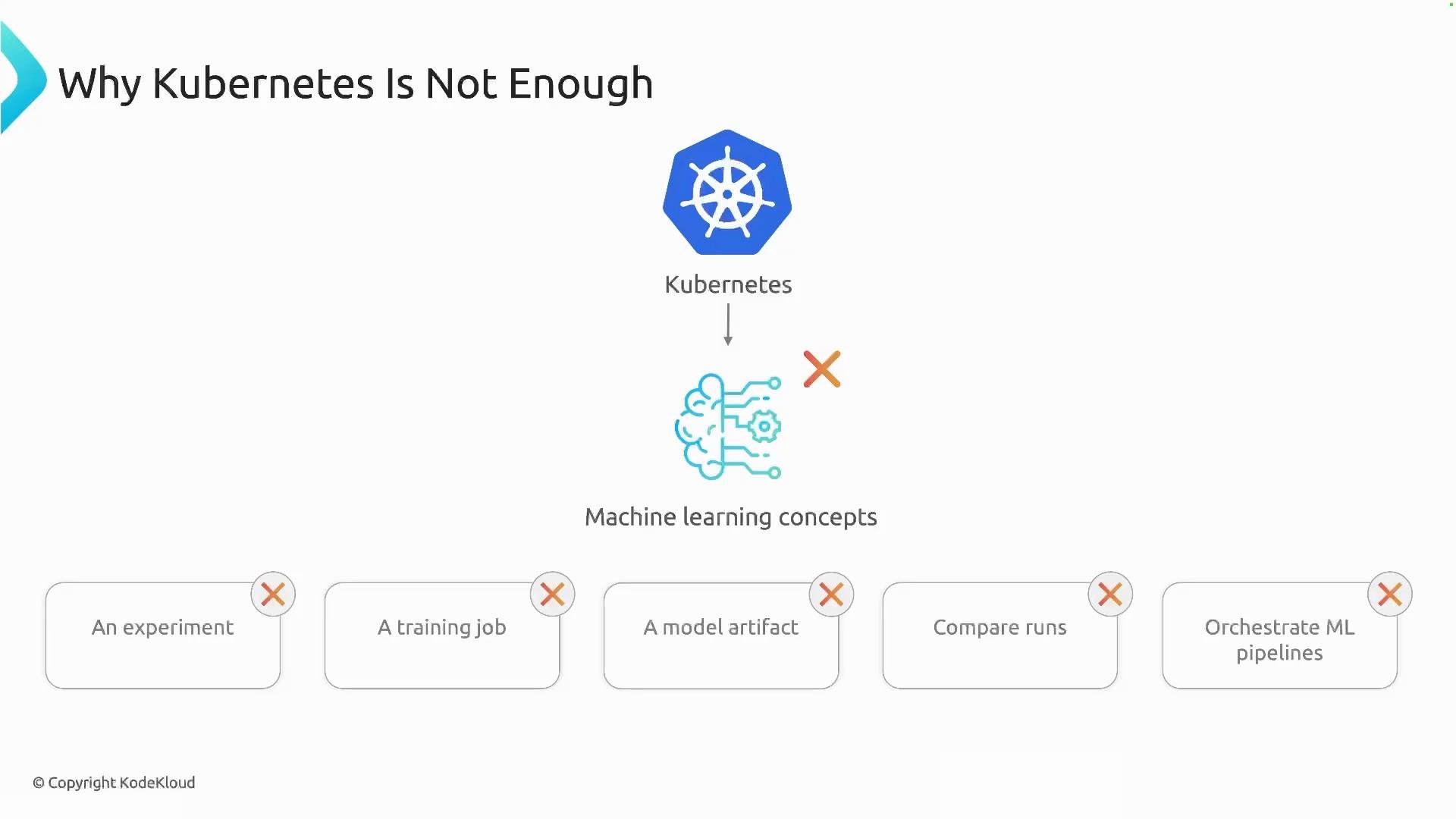
Kubernetes solves many orchestration and scheduling problems: it runs containers, monitors health, autos-scales, and schedules workloads across a cluster. But Kubernetes is infrastructure-focused. It does not natively understand ML-specific concepts such as:- Experiments and runs
- Training jobs and hyperparameter tuning
- Model artifacts and model versioning
- Orchestrated ML pipelines and lineage tracking
Kubeflow fills the gap
Kubeflow builds ML-aware abstractions on top of Kubernetes. It provides components and APIs for training, experiments, pipelines, and model serving so teams can compose, run, monitor, and version end-to-end ML workflows on Kubernetes infrastructure.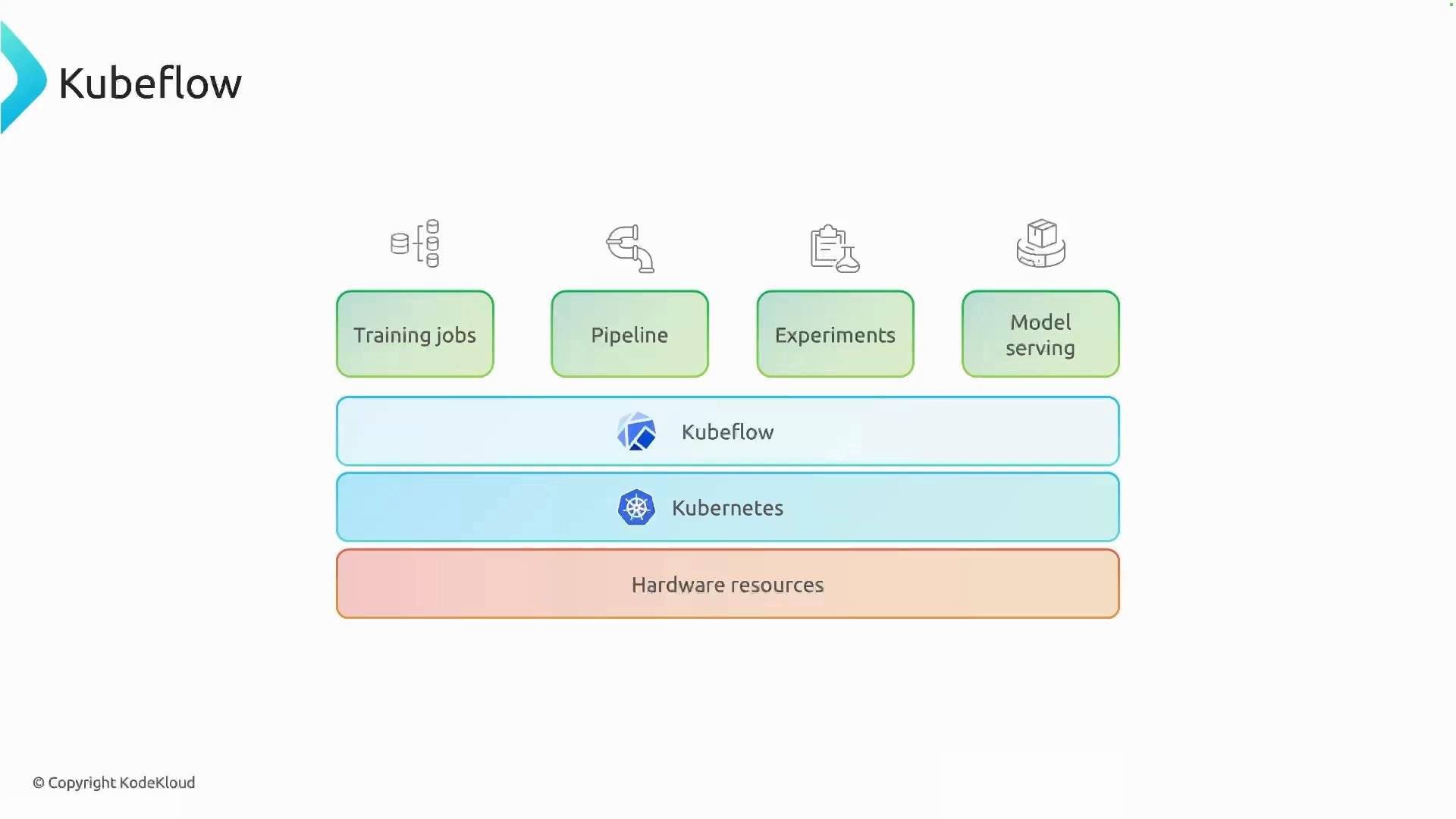
- Reproducible pipelines and experiment tracking
- Scale-out training across CPUs, GPUs, and TPUs using Kubernetes schedulers
- Centralized, collaborative notebooks and shared infrastructure
- Operating ML systems using Kubernetes best practices (scheduling, isolation, quotas)
Kubeflow leverages Kubernetes for resource management while adding ML-specific concepts (pipelines, experiments, model serving). This enables teams to build repeatable, scalable machine learning systems with better collaboration and reproducibility.
How Kubeflow maps to the ML lifecycle
When to consider Kubeflow
- You need repeatable, versioned ML pipelines across teams.
- You want to scale experiments and training on shared GPU/TPU clusters.
- You need collaboration (shared notebooks, common components) and reproducibility.
- Your ML workloads must integrate with Kubernetes-based infrastructure and follow platform governance (quotas, RBAC, namespaces).
Links and references
- Kubeflow official site: https://www.kubeflow.org/
- Kubernetes documentation: https://kubernetes.io/docs/
- Jupyter project: https://jupyter.org