

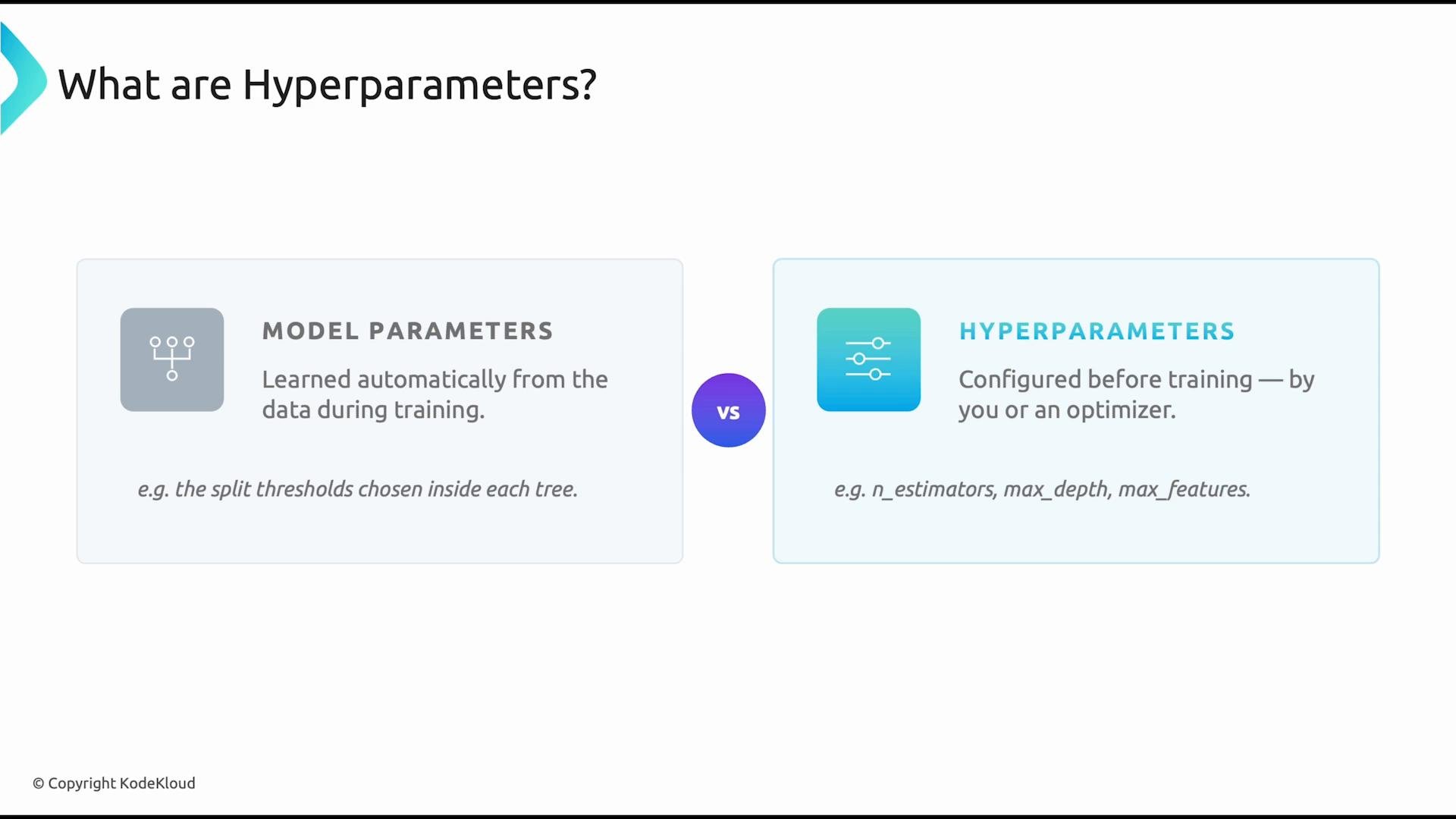
Hyperparameter tuning balances model accuracy, training cost, and generalization. Start with reasonable defaults, run validation experiments, and iterate while monitoring compute and latency constraints.
Why hyperparameter tuning matters
- Improves predictive performance and stability.
- Controls underfitting vs. overfitting.
- Directly impacts training time and resource usage.
- Enables reproducibility by making configuration explicit.
Common tuning methods
- Grid search — exhaustive search over a specified parameter grid.
- Random search — randomized sampling over parameter distributions (often more efficient than grid for high-dimensional spaces).
- Bayesian optimization — models the objective function to suggest promising hyperparameters.
- Dedicated tools — Katib, Optuna, Ray Tune, or cloud-managed hyperparameter services.
Random Forest — Key Hyperparameters
Random forests have several hyperparameters that determine ensemble behavior. The most commonly tuned include:
These hyperparameters interact — changing one can change the optimal values of others — so tuning typically considers several simultaneously.
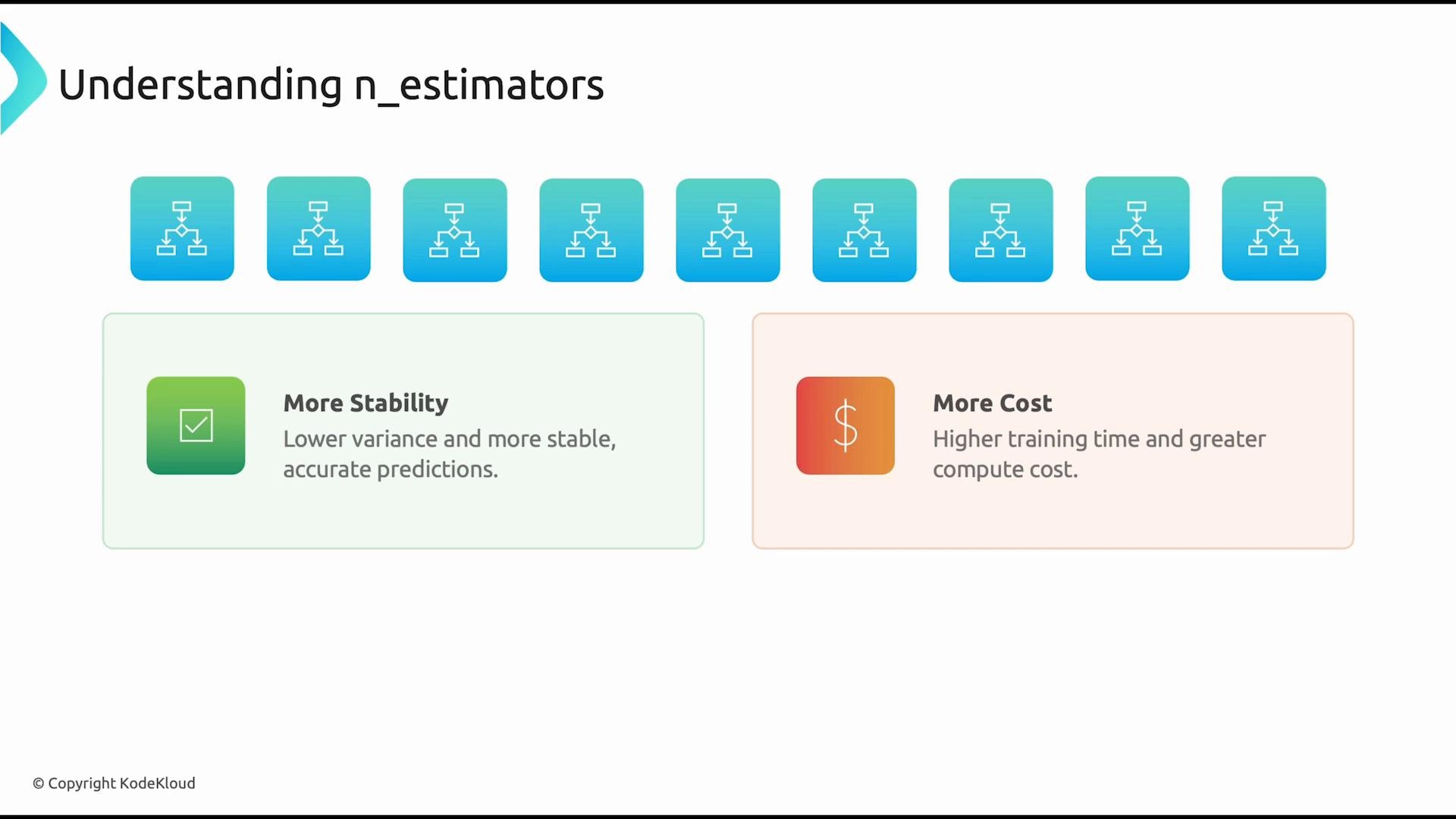
The n_estimators trade-off
The n_estimators parameter controls the number of trees. Each tree contributes via averaging (regression) or majority voting (classification). Increasing this value tends to reduce model variance and improve stability, but it increases training time and memory usage. If compute is constrained, start smaller and increase only if validation performance improves meaningfully.
The max_depth trade-off
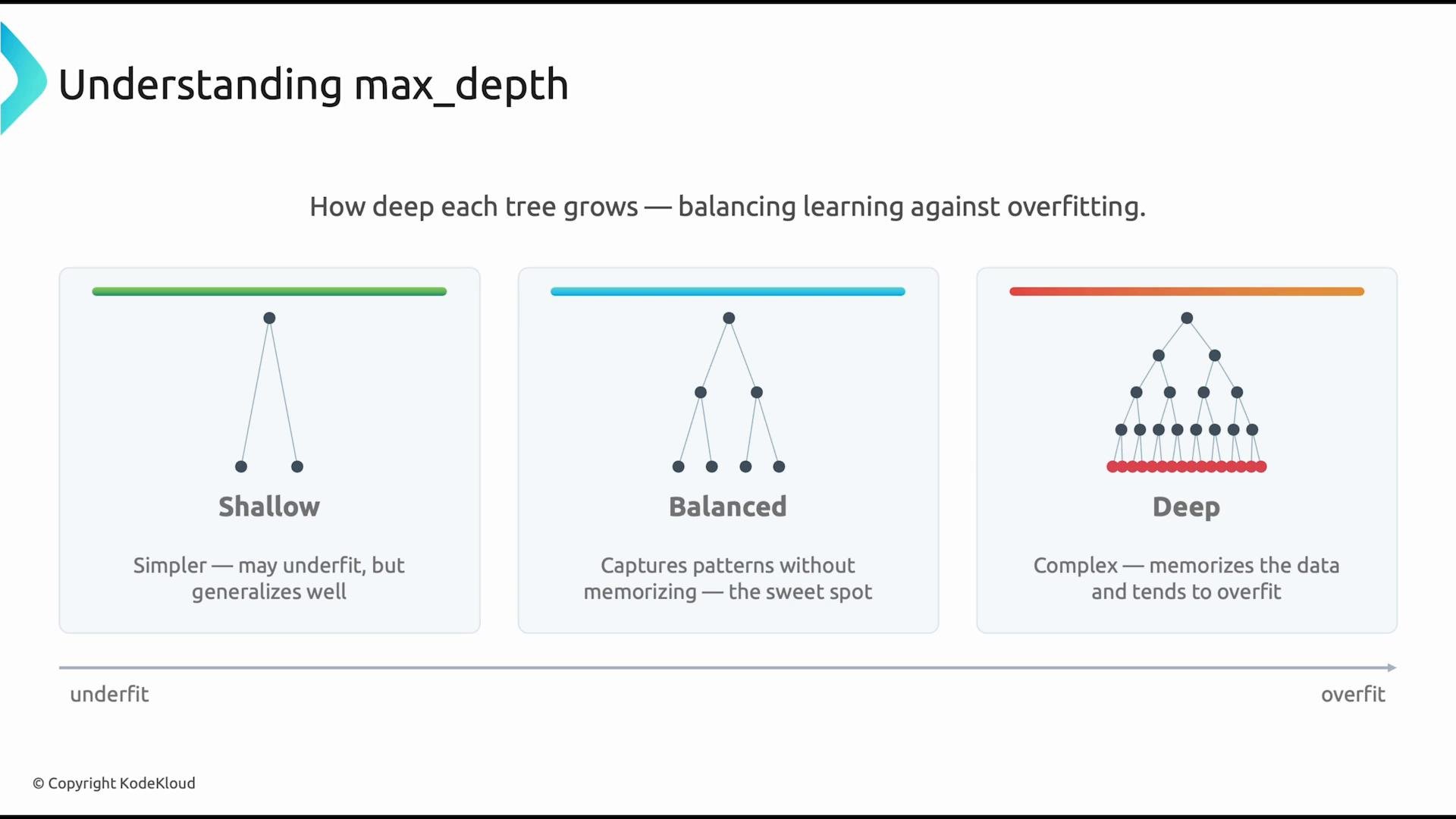
The max_depth hyperparameter limits how deep each decision tree can grow. Deep trees can model complex relationships but may overfit; shallow trees may underfit. The right depth depends on the dataset and other regularization hyperparameters like min_samples_leaf and max_features. Use cross-validation or inspect learning curves to guide depth selection.
Practical tuning workflow
- Choose a small set of important hyperparameters (e.g.,
n_estimators,max_depth,max_features,min_samples_leaf). - Pick a tuning method (random search or Bayesian optimization for efficiency).
- Use cross-validation with a consistent scoring metric.
- Monitor training time and resource usage; prefer models that meet performance and cost constraints.
- Iterate — widen or refine the search space based on results and diagnostics.
Careful: exhaustive grid searches can be very expensive for large grids or expensive models. Use random search or Bayesian methods to explore high-dimensional spaces efficiently, and always monitor compute and memory usage.
Tips for robust tuning
- Use stratified splits for classification tasks to keep class balance in folds.
- Log experiments with consistent naming and parameter serialization (e.g., MLflow, Weights & Biases).
- Start with coarse search ranges and refine around promising regions.
- Consider early stopping or incremental training for large datasets.
References and further reading
- Scikit-learn — RandomForestClassifier
- Kubernetes Documentation
- Katib (Kubeflow) — Hyperparameter Tuning