

- Cilium agent (per-node daemon)
- eBPF programs (in-kernel datapath)
- Cilium operator (cluster-wide controller)
- Envoy proxy (L7 proxy)
- Hubble (observability)
- kube-proxy (and Cilium’s kube-proxy replacement mode)
- Service mesh models: sidecar vs sidecarless
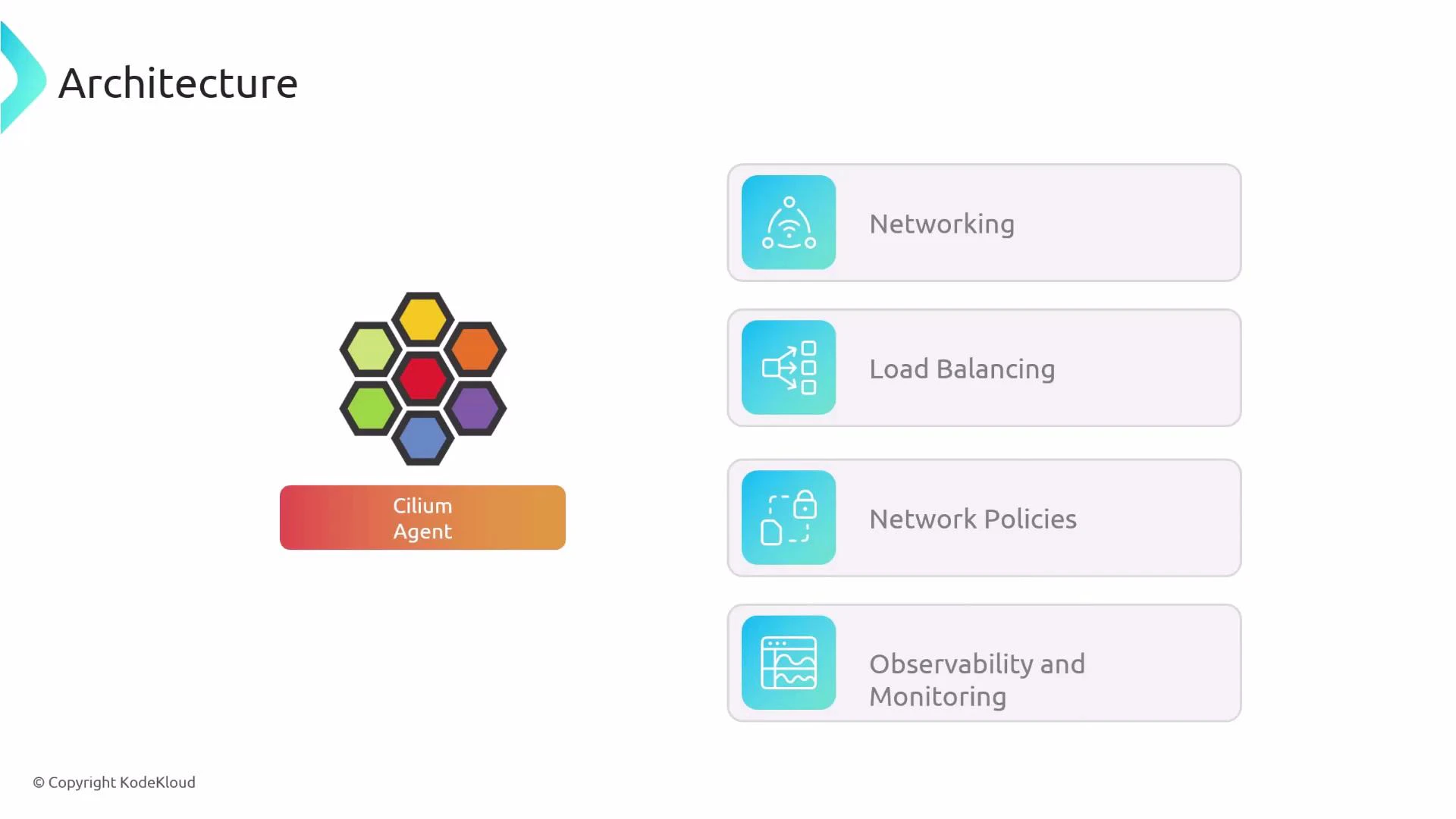
Cilium agent
The Cilium agent runs on every node (typically as a DaemonSet). It is responsible for translating Kubernetes cluster state into datapath configuration and ensuring the kernel runs the correct programs. Primary responsibilities:- Watch Kubernetes API events (Pods, Services, Endpoints, CRDs) and translate cluster state into datapath configuration.
- Compile, load, and attach eBPF programs to the appropriate kernel hooks and network interfaces.
- Enforce network policies and implement service/load-balancing rules using eBPF.
- Route traffic to Envoy when L7 processing is required.
- Host a local Hubble server for per-node flow capture and metrics.
eBPF datapath
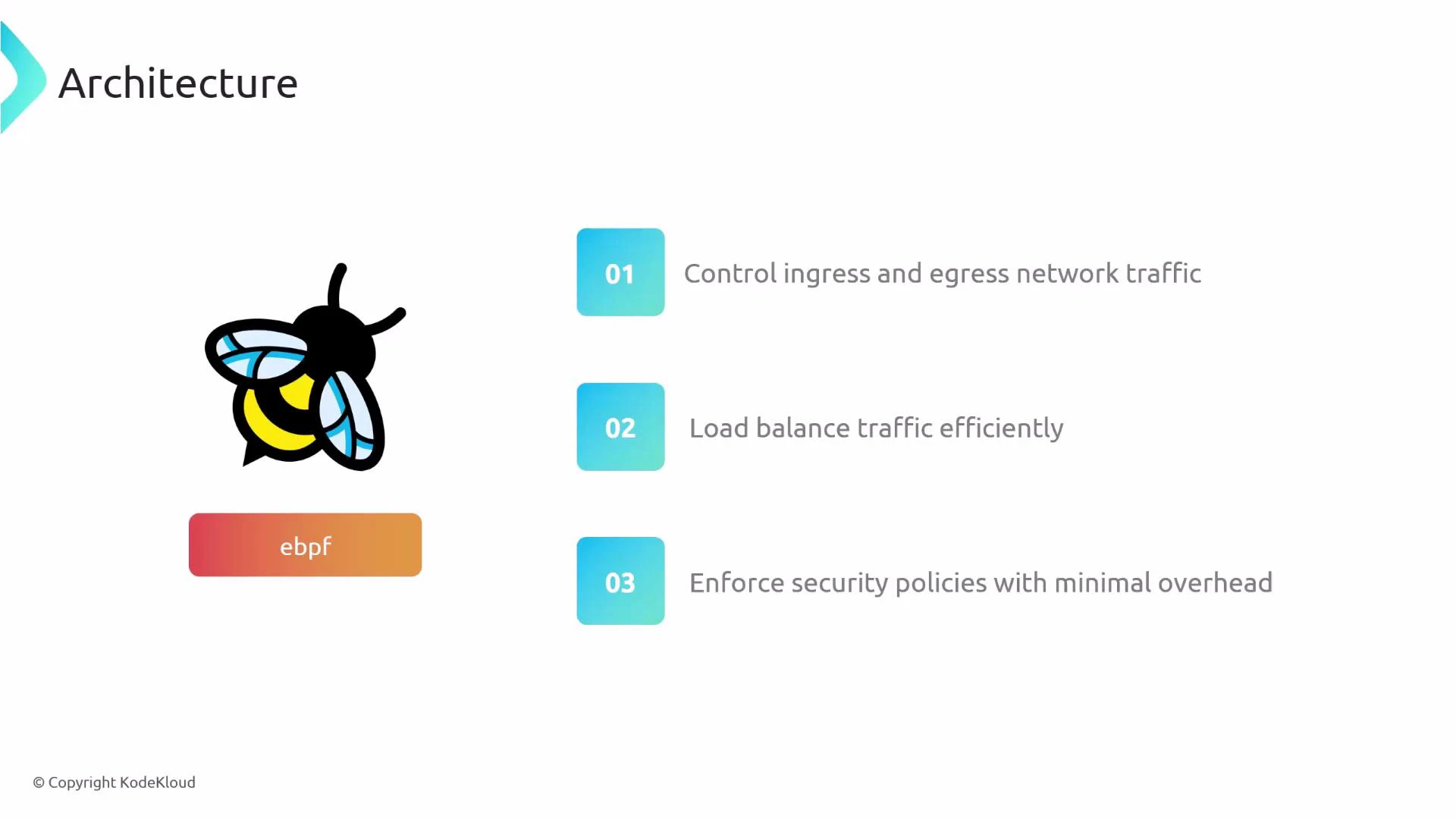
Cilium leverages eBPF to implement the datapath inside the Linux kernel. eBPF programs provide a fast, flexible way to control networking without costly user/kernel context switches. What eBPF provides for Cilium:- L3/L4 ingress and egress packet processing (IP/TCP/UDP).
- In-kernel, efficient load balancing for Services.
- Low-overhead enforcement of network and security policies.
Cilium operator
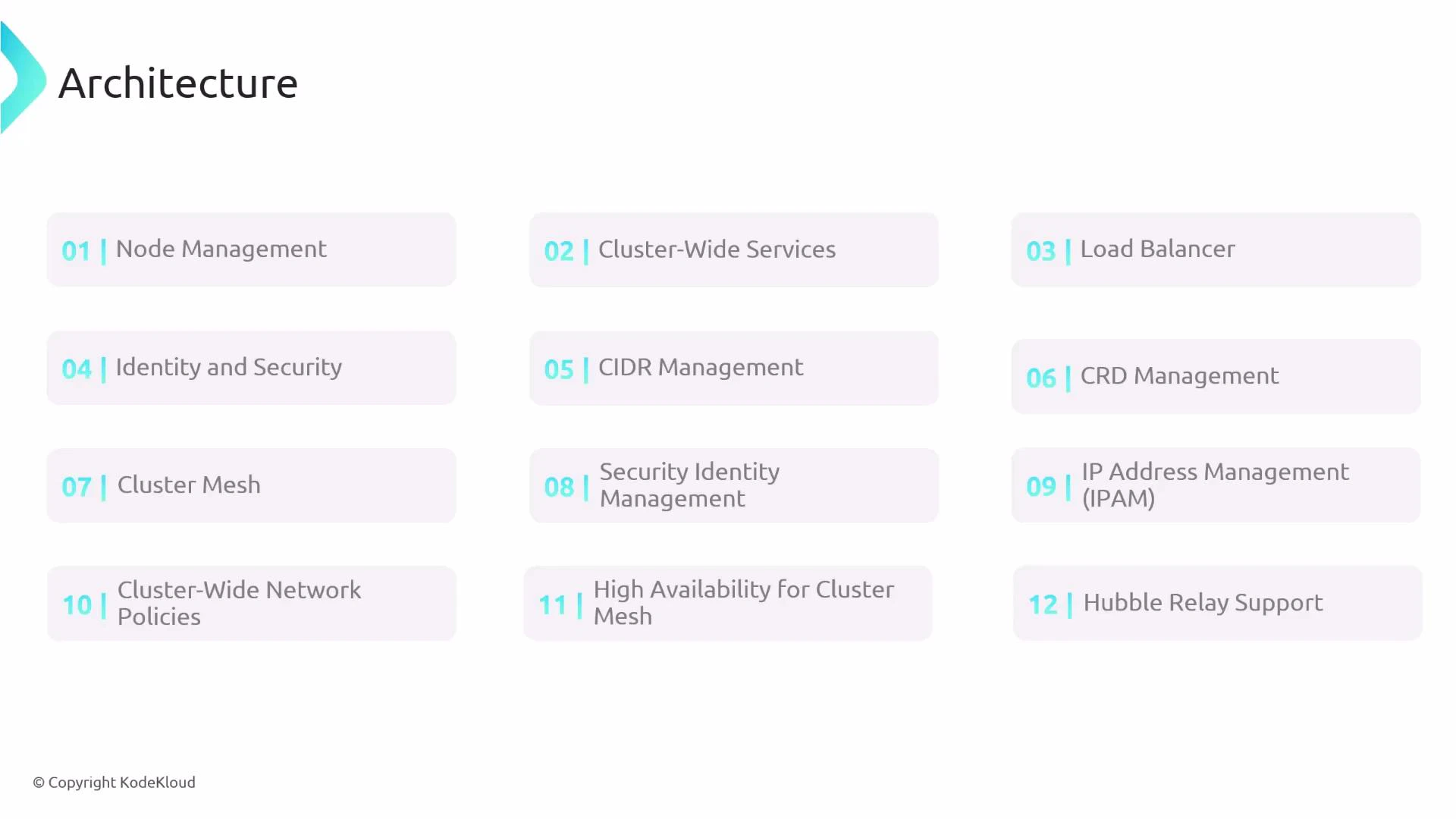
The Cilium operator handles cluster-scoped duties that don’t belong to any single node agent. It keeps cluster-wide state synchronized and performs tasks that require global knowledge. Operator responsibilities:- Synchronize node IPs and lifecycle between Kubernetes and Cilium.
- Coordinate cluster-wide service information so nodes program consistent service maps.
- Manage IP allocation for services when using Cilium’s eBPF-based load balancer.
- Allocate and synchronize security identities (used by network policies).
- Manage CIDRs, CRDs, and IPAM tasks for cluster-scoped resources.
- Assist Cluster Mesh / multi-cluster configuration and CRD lifecycle.
- Aggregate or coordinate Hubble relays and observability across the cluster.
Envoy proxy (L7)
Envoy is used by Cilium to provide Layer‑7 features that cannot be implemented in-kernel. Typical L7 responsibilities include HTTP/gRPC routing, rate limiting, TLS/mTLS termination, and deep request inspection for observability and policy. Deployment options:- Embedded in the Cilium agent (in‑agent Envoy).
- Deployed as a single Envoy pod per node (node-level proxy).
Kubernetes CRDs
Cilium installs several Kubernetes CRDs to represent policies, observability settings, and other Cilium-specific configuration. These CRDs provide a Kubernetes-native interface to express Cilium network policies, service mesh configuration, and observability controls across the cluster.Hubble: per-node server, relay, CLI, UI
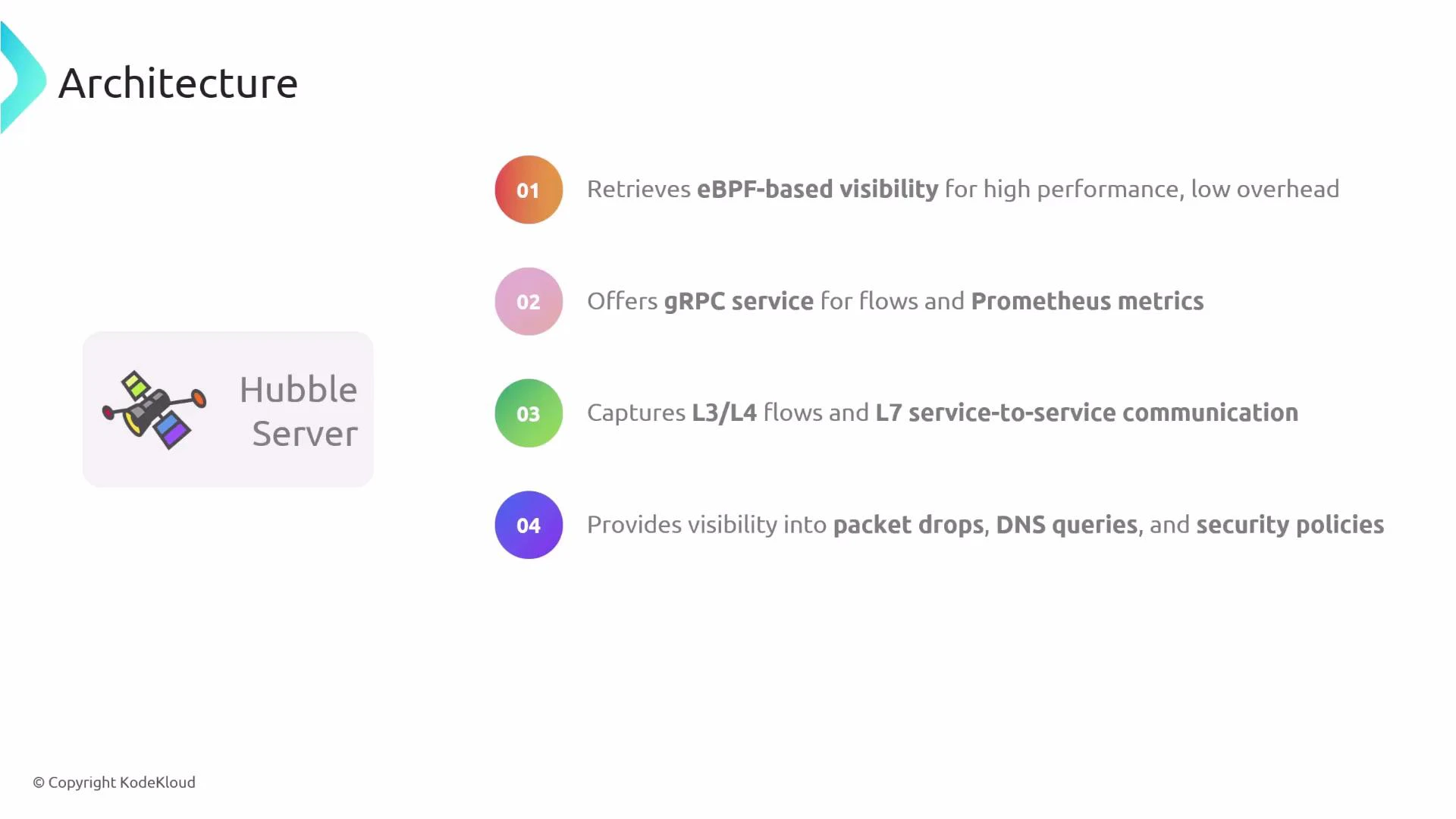
Hubble provides high-performance observability built on eBPF flow capture. Each Cilium agent includes a Hubble server for local flow telemetry. Hubble components and capabilities:- Per-node Hubble server that streams eBPF-based flow data with low overhead.
- gRPC API and Prometheus metrics endpoints for integration and monitoring.
- Capture of L3/L4 flows and optional L7 telemetry (when Envoy provides L7 context).
- Visibility into packet drops, DNS queries, policy decisions, and more for debugging.
kube-proxy and Cilium’s kube-proxy replacement
Kubernetes uses kube-proxy on each node to program iptables/ipvs rules for Services. Cilium can either run alongside kube-proxy or replace it entirely by implementing service handling in eBPF. Benefits of kube-proxy replacement mode:- Service load-balancing and routing are programmed directly in the kernel via eBPF.
- Improved performance and scalability compared to iptables/ipvs.
- Reduced complexity by removing the need for kube-proxy in the datapath.
Cilium can run in kube-proxy replacement mode: instead of running kube-proxy, Cilium programs the service datapath using eBPF for more efficient Service traffic handling.
Service mesh: sidecar vs sidecarless
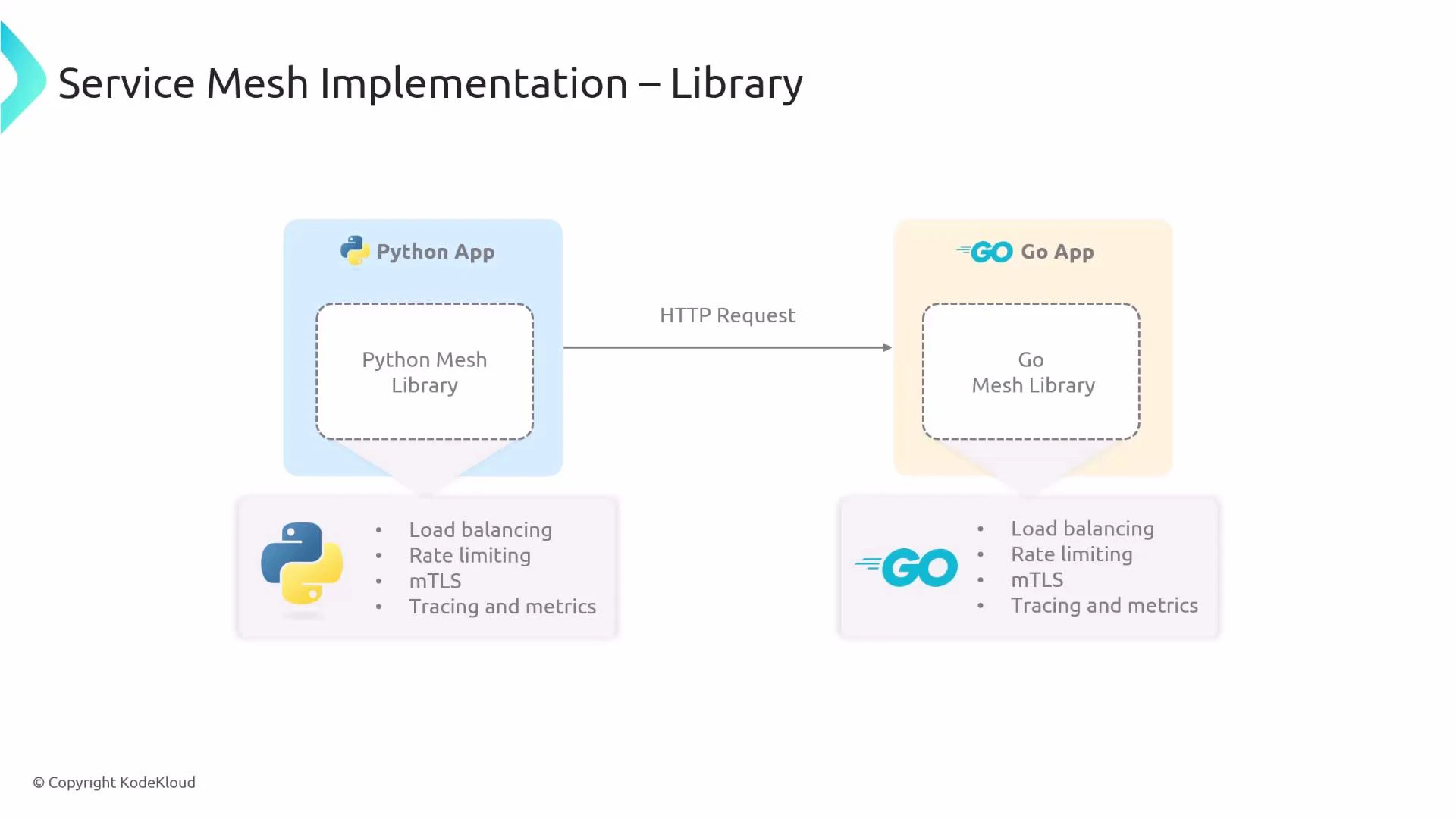
Service meshes historically required either application libraries or a sidecar proxy per pod to implement features such as load balancing, mTLS, rate limiting, tracing, and observability.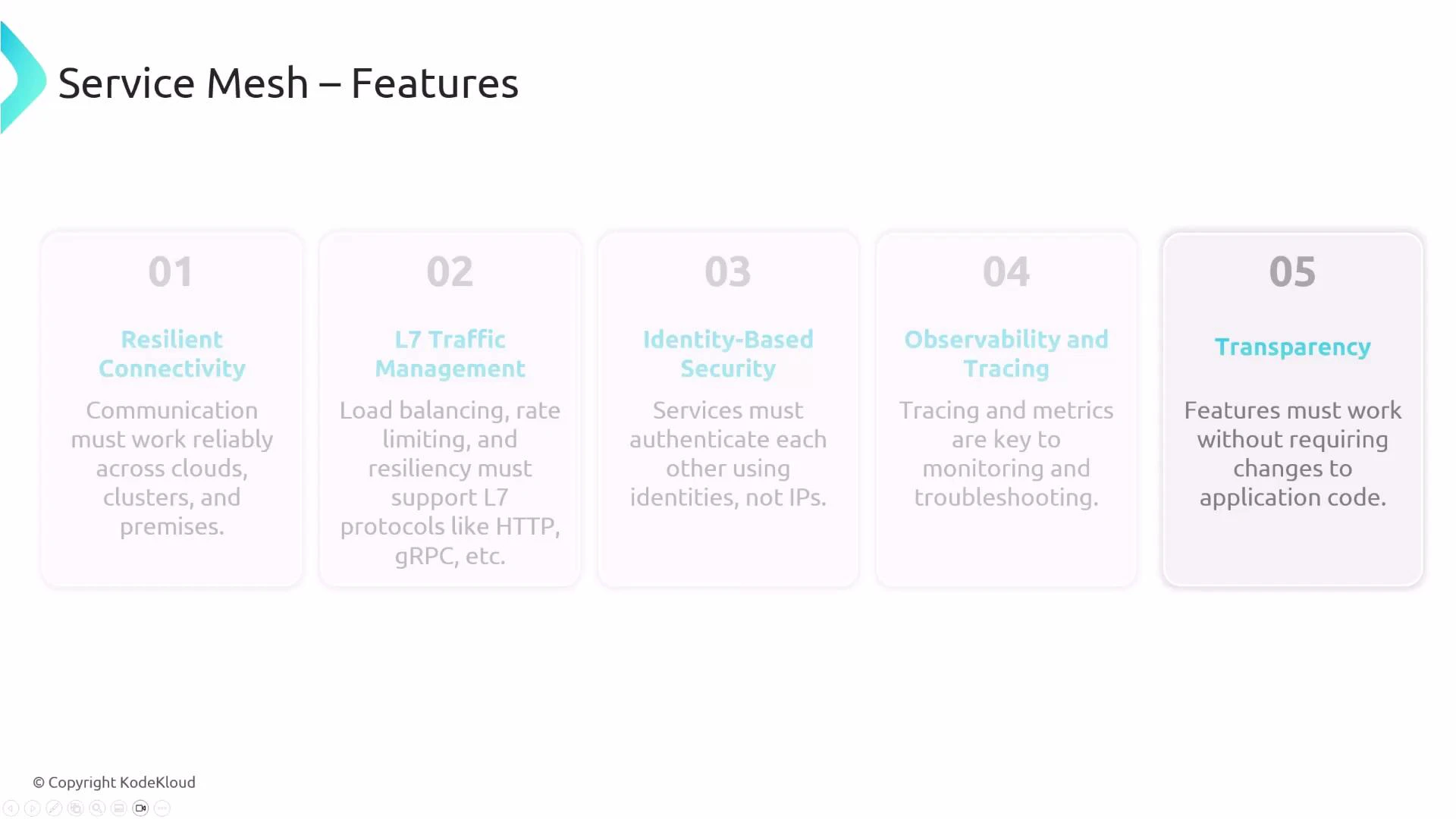
Sidecar model
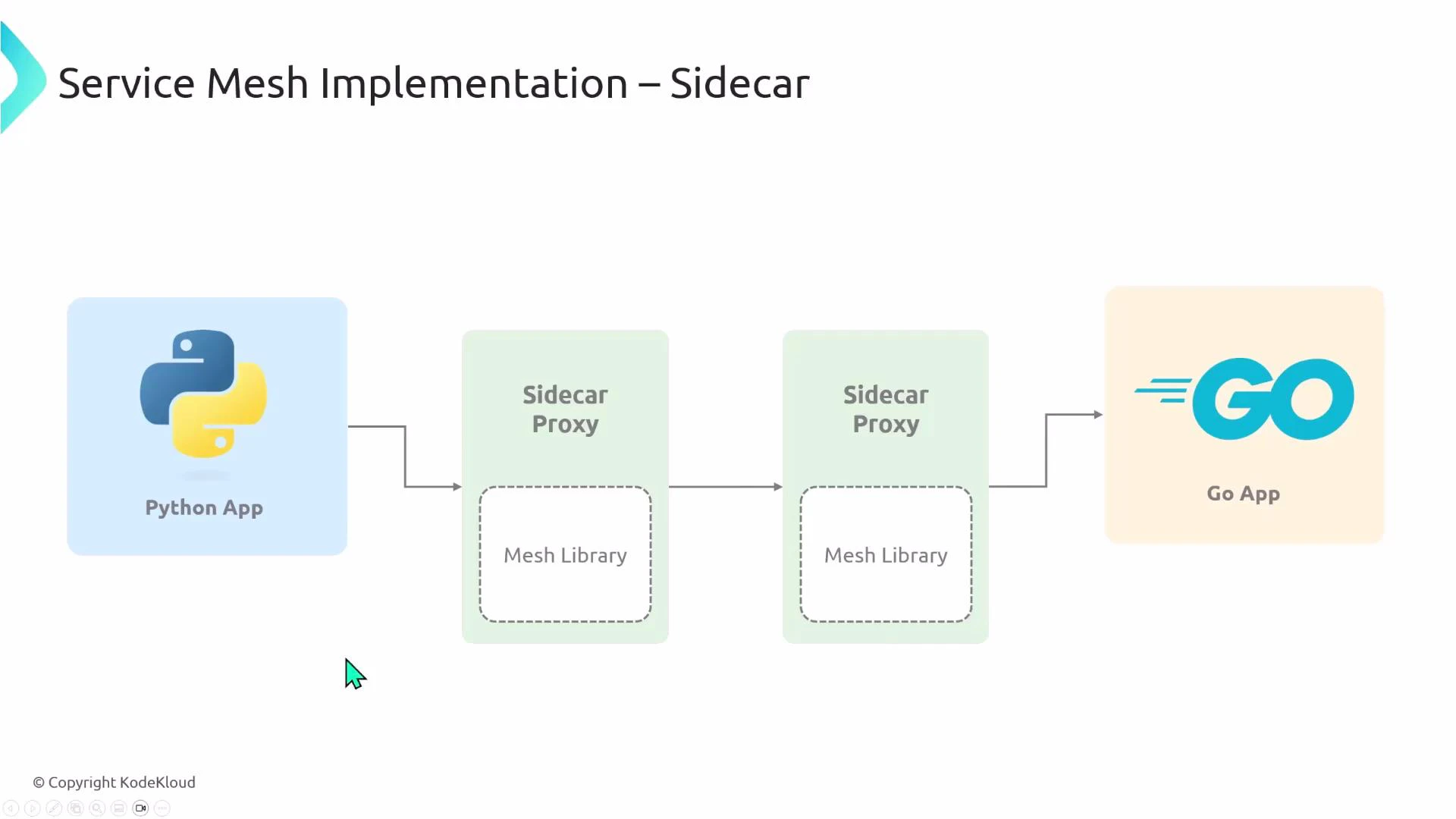
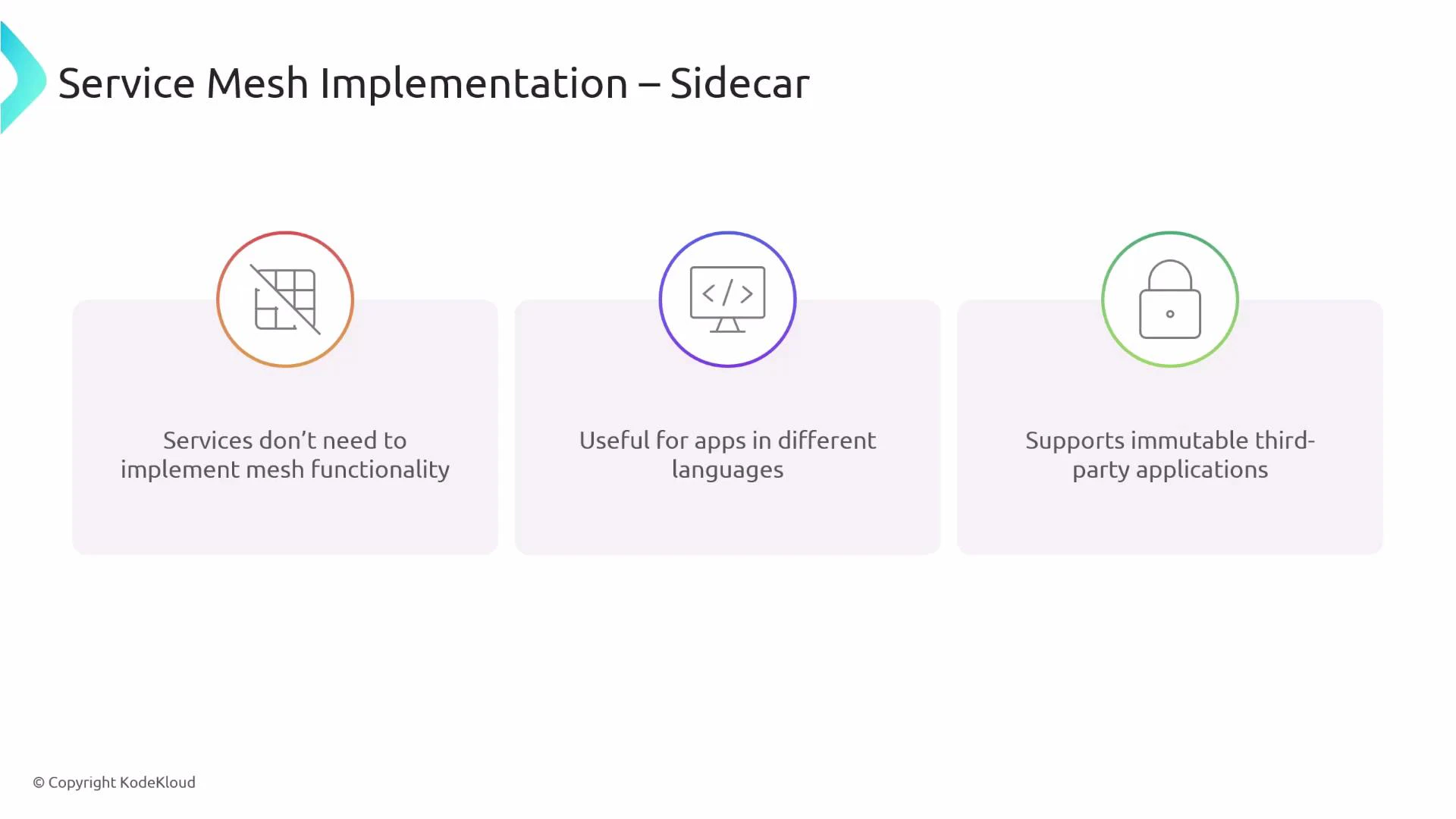
The sidecar pattern deploys a proxy (commonly Envoy) next to each application container in the pod. The proxy implements mesh features so application code remains unchanged. Benefits:- No application changes required; language-agnostic.
- Works for immutable third‑party apps.
- Mesh responsibilities are offloaded to the proxy.
- One proxy per pod increases resource usage (CPU/memory).
- Operational complexity for proxy configuration and lifecycle.
- Potential startup and readiness race conditions because proxies must initialize.
- Extra network hop per request increases latency.
Sidecarless model (Cilium)
Cilium’s sidecarless approach moves most mesh capabilities into the kernel using eBPF, and uses a smaller number of Envoy proxies for L7 features. Key characteristics:- L3/L4 logic (routing, policy enforcement, service load balancing) is handled in-kernel by eBPF.
- L7 features (HTTP/gRPC routing, rate limiting, deep inspection, application-protocol policies) are handled by Envoy.
- Instead of one Envoy per pod, Cilium commonly runs a single Envoy per node (or an Envoy embedded in the agent), drastically reducing per-pod resource overhead.
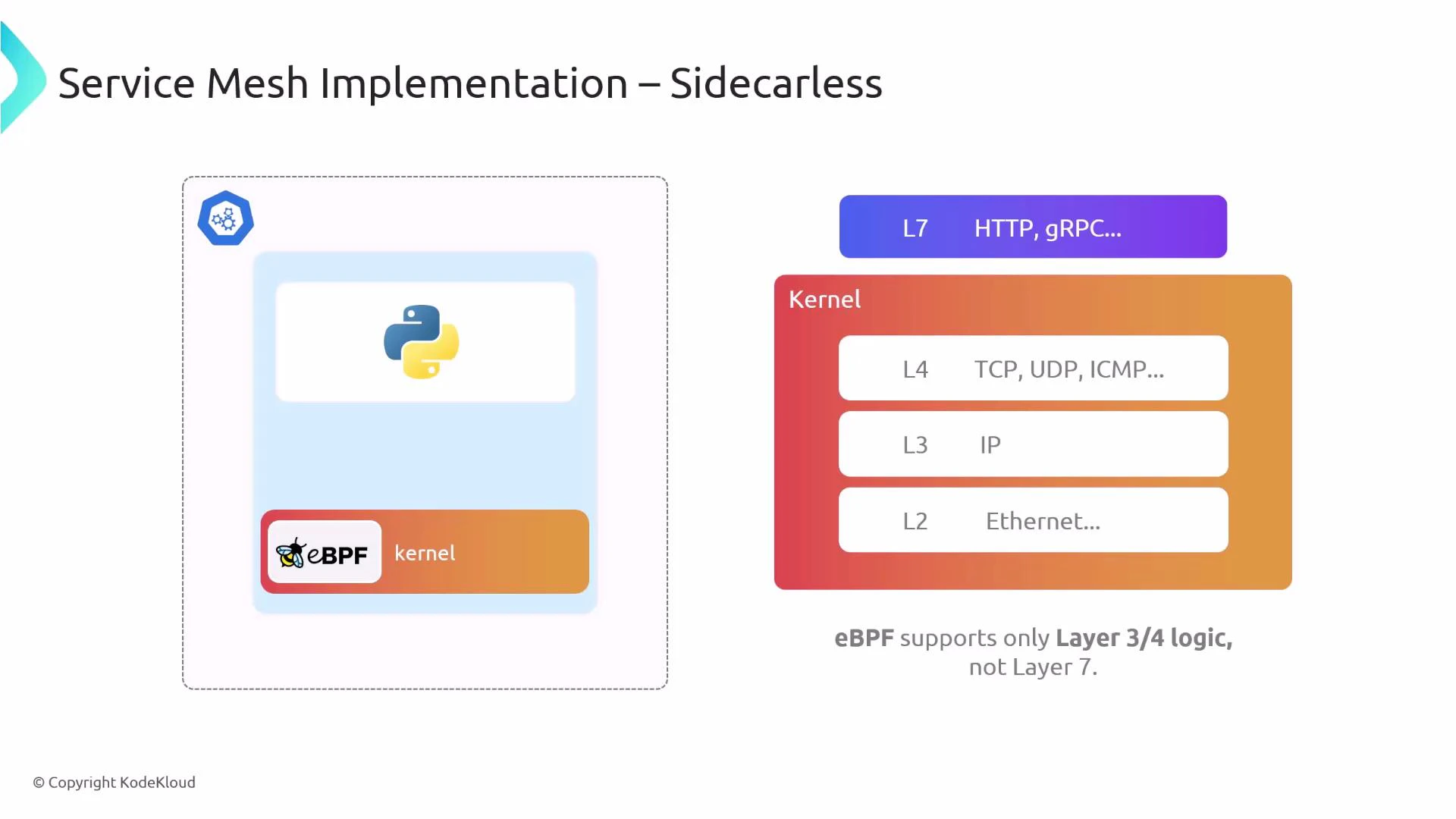
Sidecarless reduces per-pod resource usage and latency for L3/L4 flows, but advanced L7 features still depend on user‑space proxies (e.g., Envoy). Plan proxy placement and capacity accordingly.
Traffic flow comparison
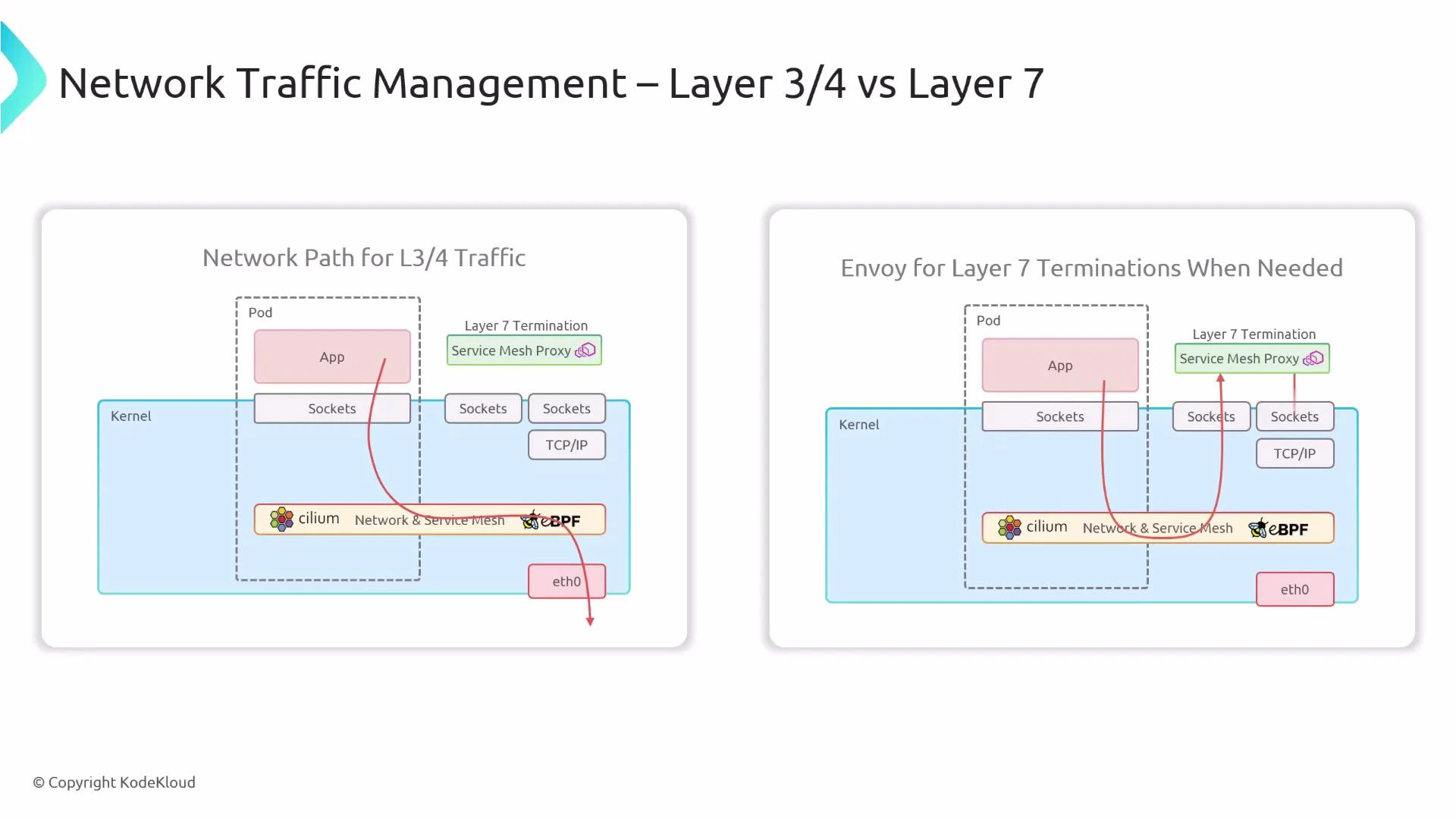
- L3/L4-only flow: the application socket sends packets into the kernel where eBPF implements routing, policy, and forwarding (no sidecar hop).
- L7 flow: eBPF detects the need for L7 processing and redirects traffic to the Service Mesh proxy (Envoy) for termination and deep inspection; Envoy then forwards or proxies the request to the destination.
- Fewer containers per pod and lower aggregate CPU/memory usage.
- Better performance for L3/L4 workloads because eBPF runs in-kernel.
- Reduced complexity from fewer per-pod proxies to manage.
- Compatible with other mesh solutions when needed, enabling hybrid deployments.
- L7 features still require an Envoy proxy component; Cilium optimizes this by using fewer proxies (one per node).
- Some advanced L7 capabilities remain necessarily in user-space proxies.
Summary
- Cilium agent runs on each node and watches the Kubernetes API to convert cluster state into kernel programs and policies.
- eBPF programs implement the high-performance datapath for L3/L4 networking, load balancing, and policy enforcement.
- The Cilium operator handles cluster-wide responsibilities (node, service, identity, IPAM, multi-cluster).
- Envoy provides L7 functionality; Cilium routes L7 flows to Envoy and can embed Envoy in the agent or run a node-level proxy.
- Hubble provides per-node flow capture; Hubble relay aggregates flows cluster-wide; the Hubble CLI and UI expose observability.
- Cilium can operate alongside kube-proxy or replace it by implementing service handling in eBPF.
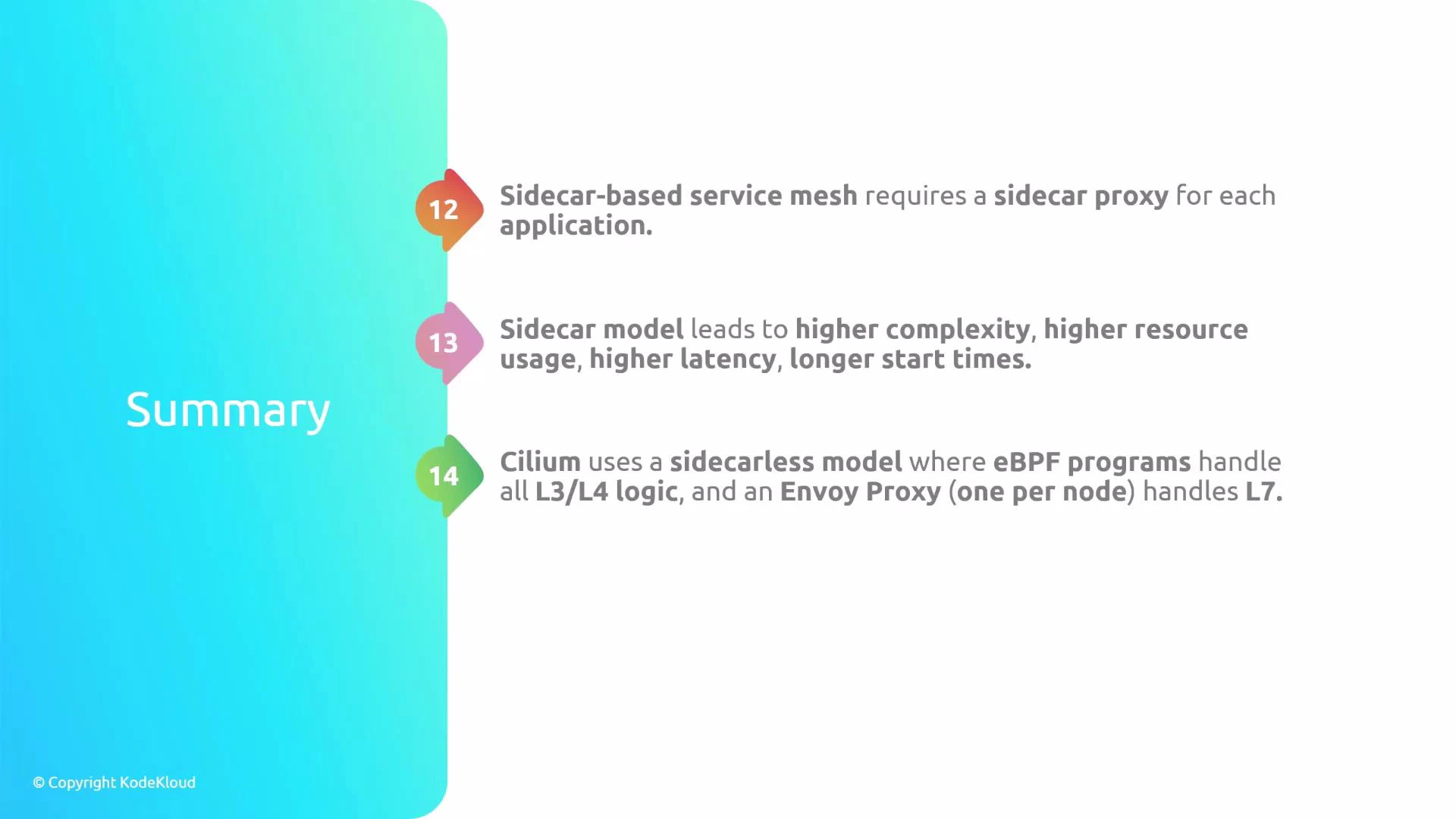
- For service mesh functionality, the traditional sidecar model runs a proxy per pod; Cilium’s sidecarless approach uses eBPF for L3/L4 and a node-level Envoy for L7, reducing resource use and operational complexity.
Links and references
- Cilium documentation: https://cilium.io/docs/
- eBPF community: https://ebpf.io/
- Envoy proxy: https://www.envoyproxy.io/
- Hubble concepts: https://cilium.io/docs/concepts/hubble/
- Kubernetes kube-proxy docs: https://kubernetes.io/docs/reference/command-line-tools-reference/kube-proxy/