

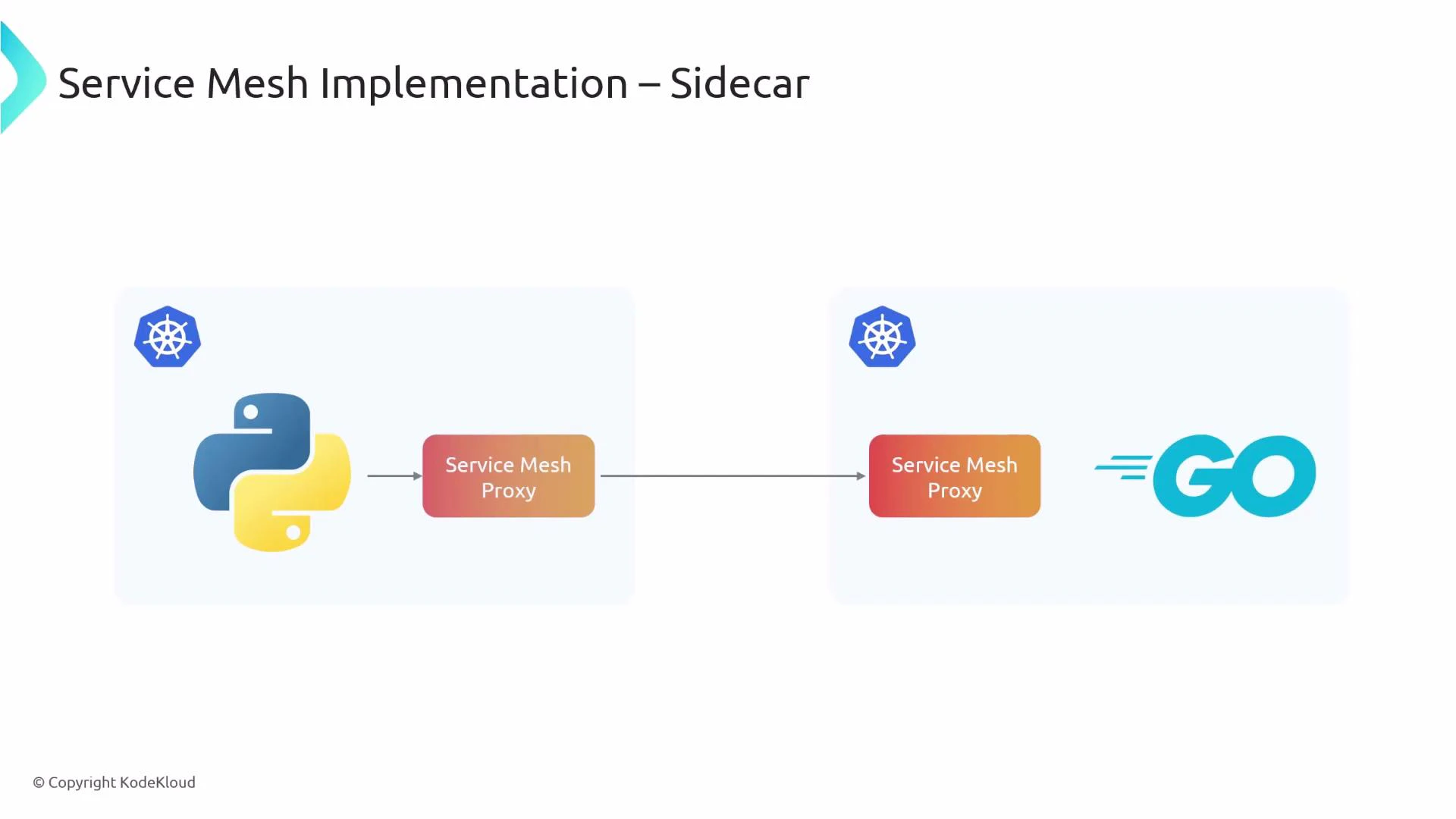
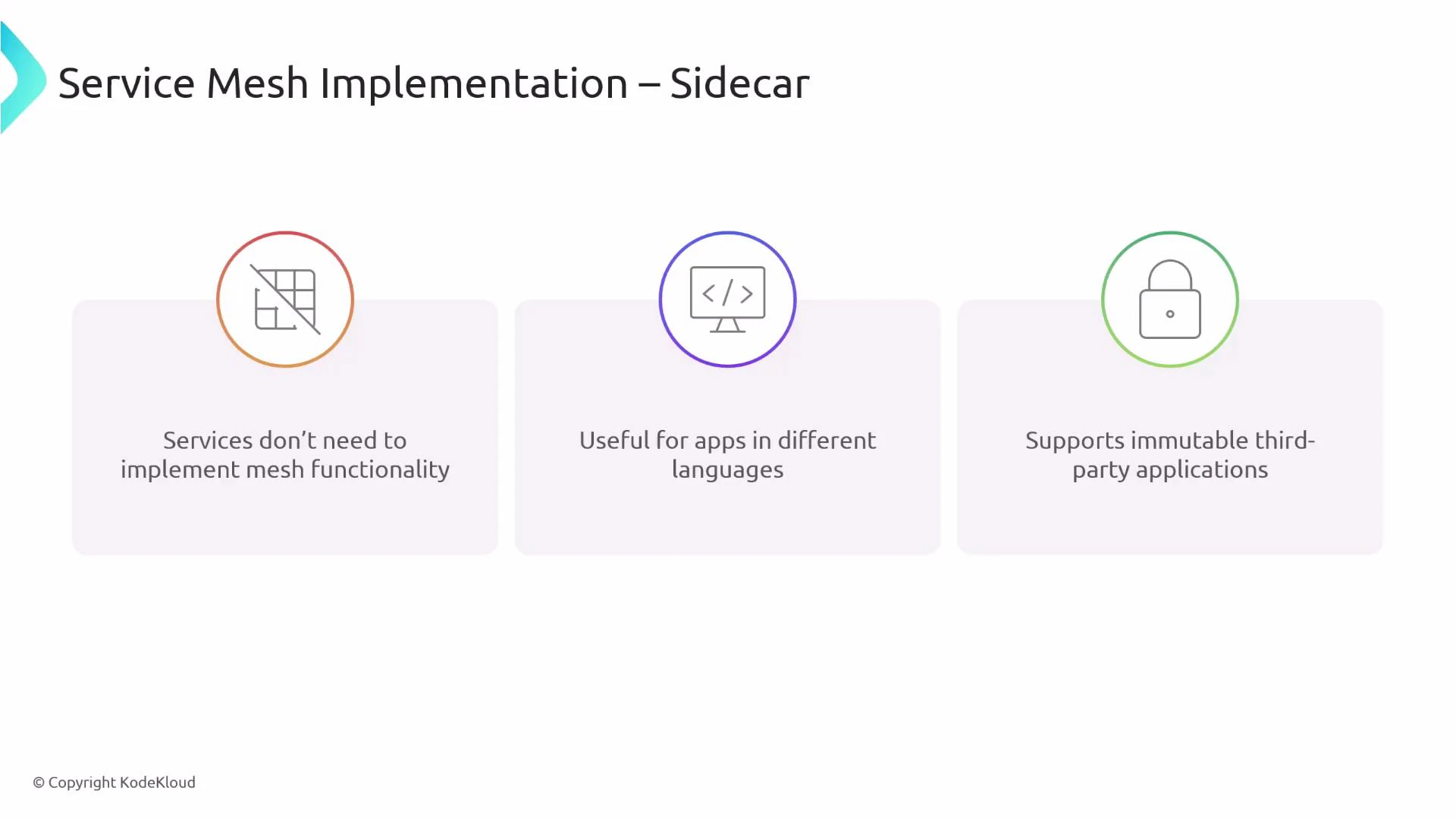
- Services don’t need to implement mesh features themselves; sidecars provide observability, traffic control, mTLS, retries, circuit-breaking, etc.
- Language-agnostic: applications written in any language benefit from the same network features without changing application code.
- Supports immutable or closed-source applications because features are attached via a proxy, not code changes.
- Higher resource usage: a proxy instance runs per pod, increasing CPU and memory consumption cluster-wide.
- Operational complexity: operators must manage proxy configuration for each pod (per-pod sidecars).
- Slower lifecycle and startup complexity: pods may wait for sidecar readiness, introducing potential race conditions.
- Extra network hop: each request typically traverses the application → sidecar → network path, adding latency.
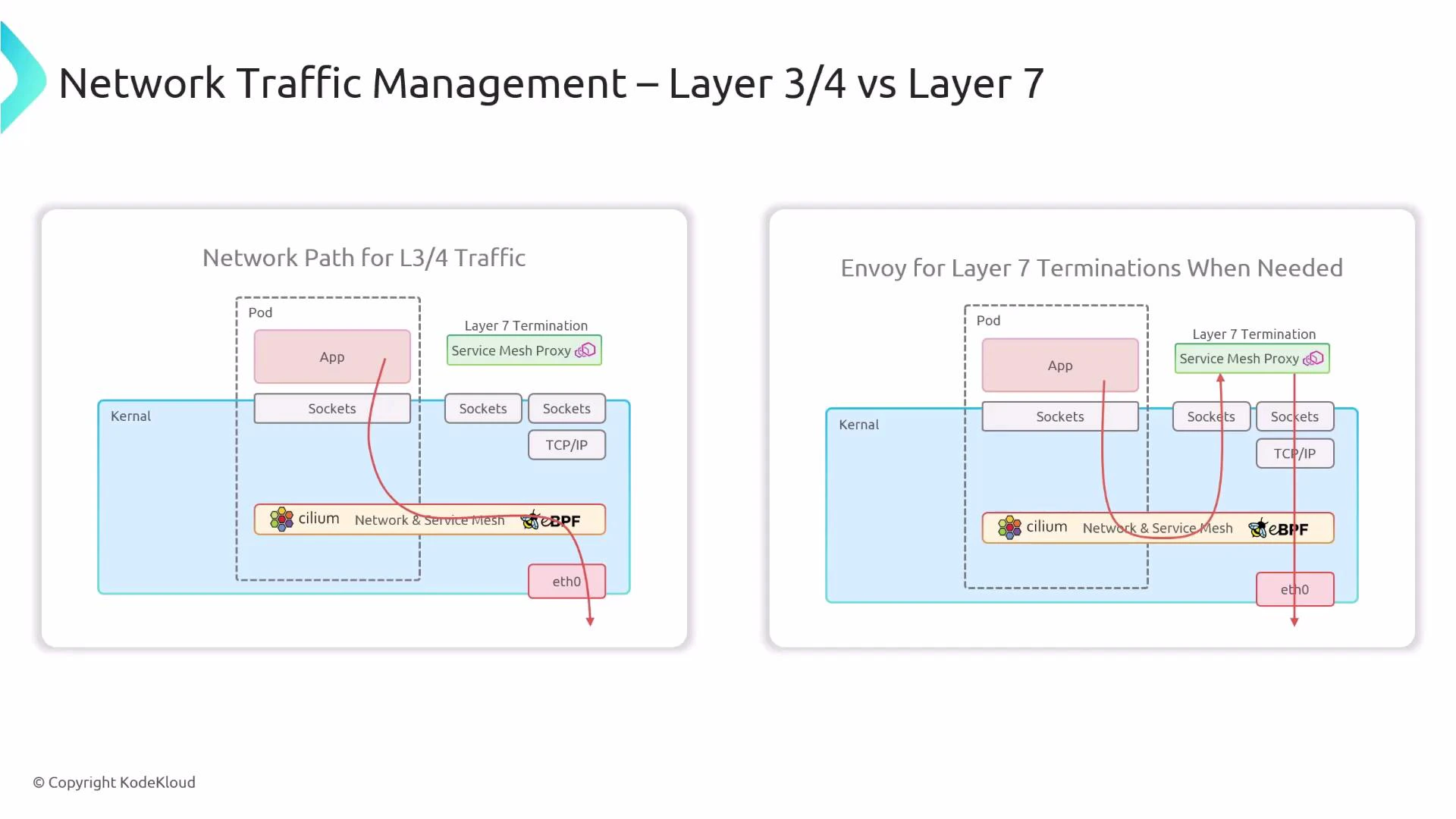
- eBPF in-kernel processing: Cilium programs operate at L3/L4 (network and transport layers) inside the kernel, allowing efficient packet processing without additional proxies.
- L7 functionality via Envoy: for application-layer (L7) features—HTTP routing, L7-aware telemetry, or protocol-specific filtering—Cilium forwards traffic to Envoy. The crucial difference is that Envoy is deployed as a node-local instance (one Envoy per node), not one per pod. That typically means far fewer Envoy instances across the cluster (e.g., two nodes → two Envoy instances).
- L3/L4 traffic: handled directly by eBPF inside the kernel — no extra proxy hop.
- L7 traffic: intercepted and forwarded to the node-local Envoy proxy for L7 termination or advanced processing — one proxy hop only for L7 paths.
When to choose which approach:
- Use a sidecar model when you need per-pod L7 controls tightly coupled with the application, or when an existing ecosystem relies on per-pod proxies.
- Choose Cilium (sidecarless) when you want lower per-pod resource overhead, high-performance L3/L4 processing, and a simplified operational model while still supporting L7 functionality through node-local Envoy instances.
- Cilium can integrate with other meshes if you need hybrid setups or incremental migration.
- Cilium — eBPF-based networking and security for cloud-native environments
- eBPF — extended Berkeley Packet Filter: safe kernel-level programs
- Envoy — high-performance edge and service proxy
- Istio — example sidecar-based service mesh
Cilium’s approach reduces per-pod overhead by using eBPF for L3/L4 while still providing L7 capabilities via node-local Envoy instances—combining performance with feature completeness.