

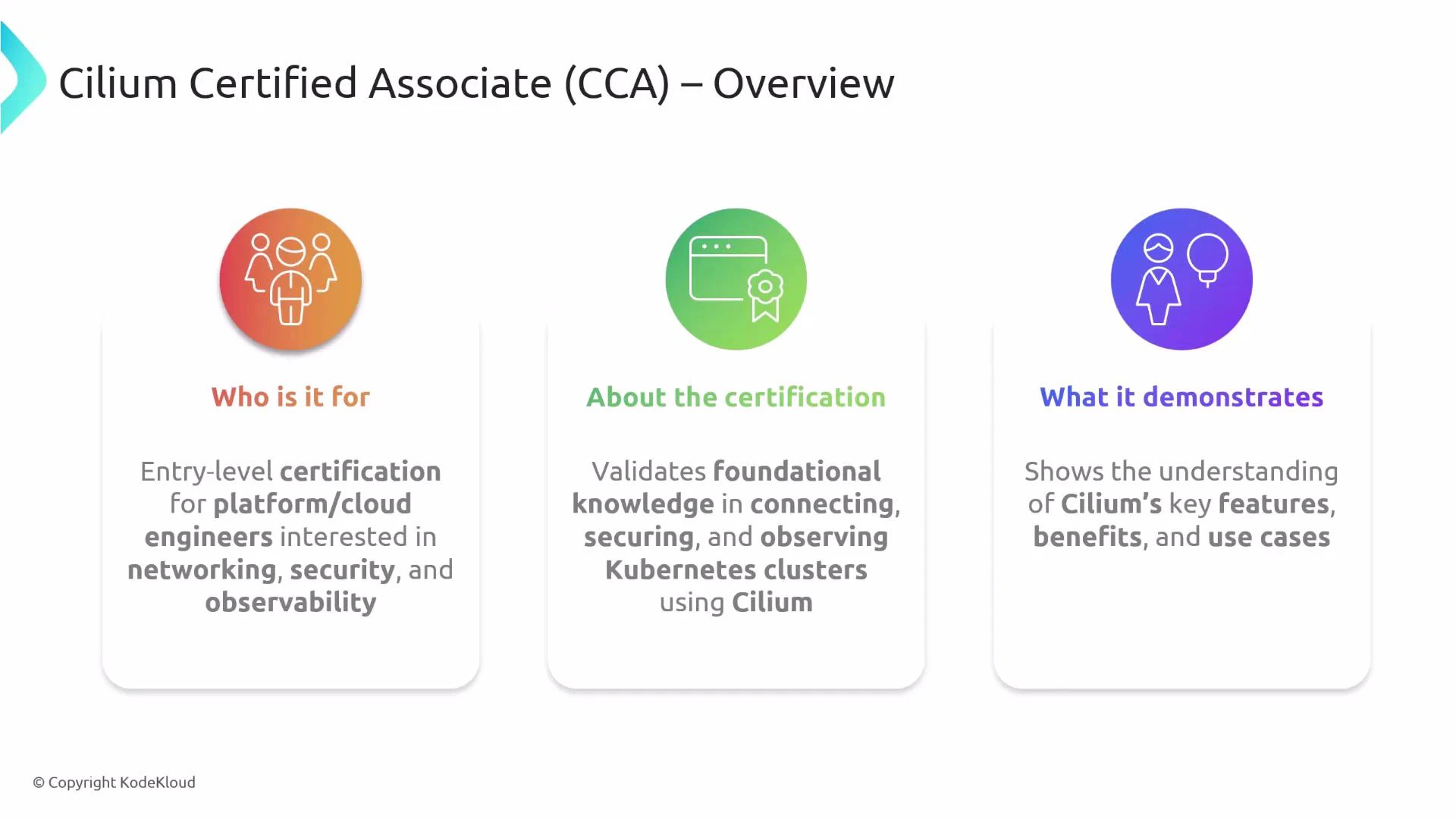
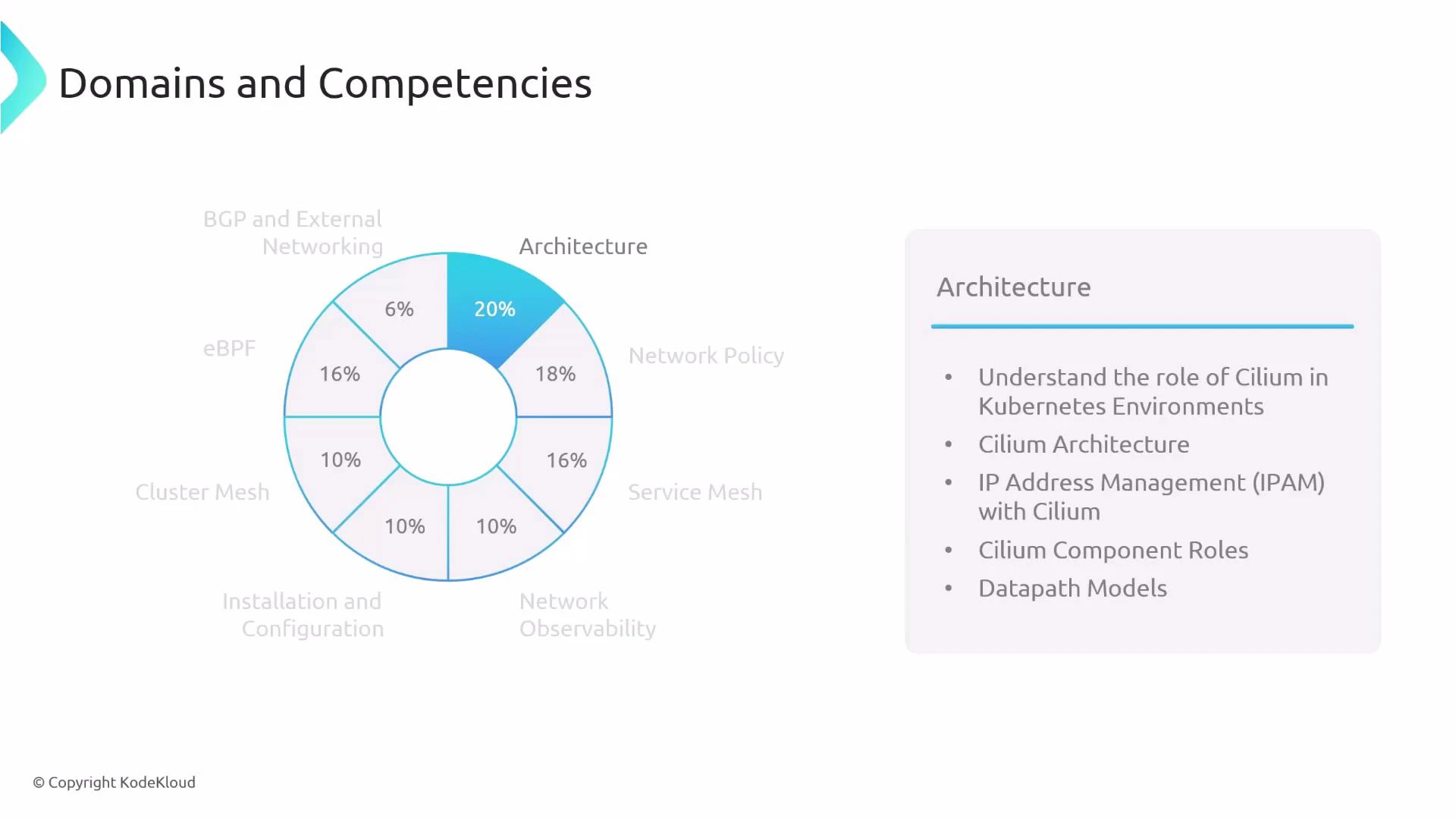
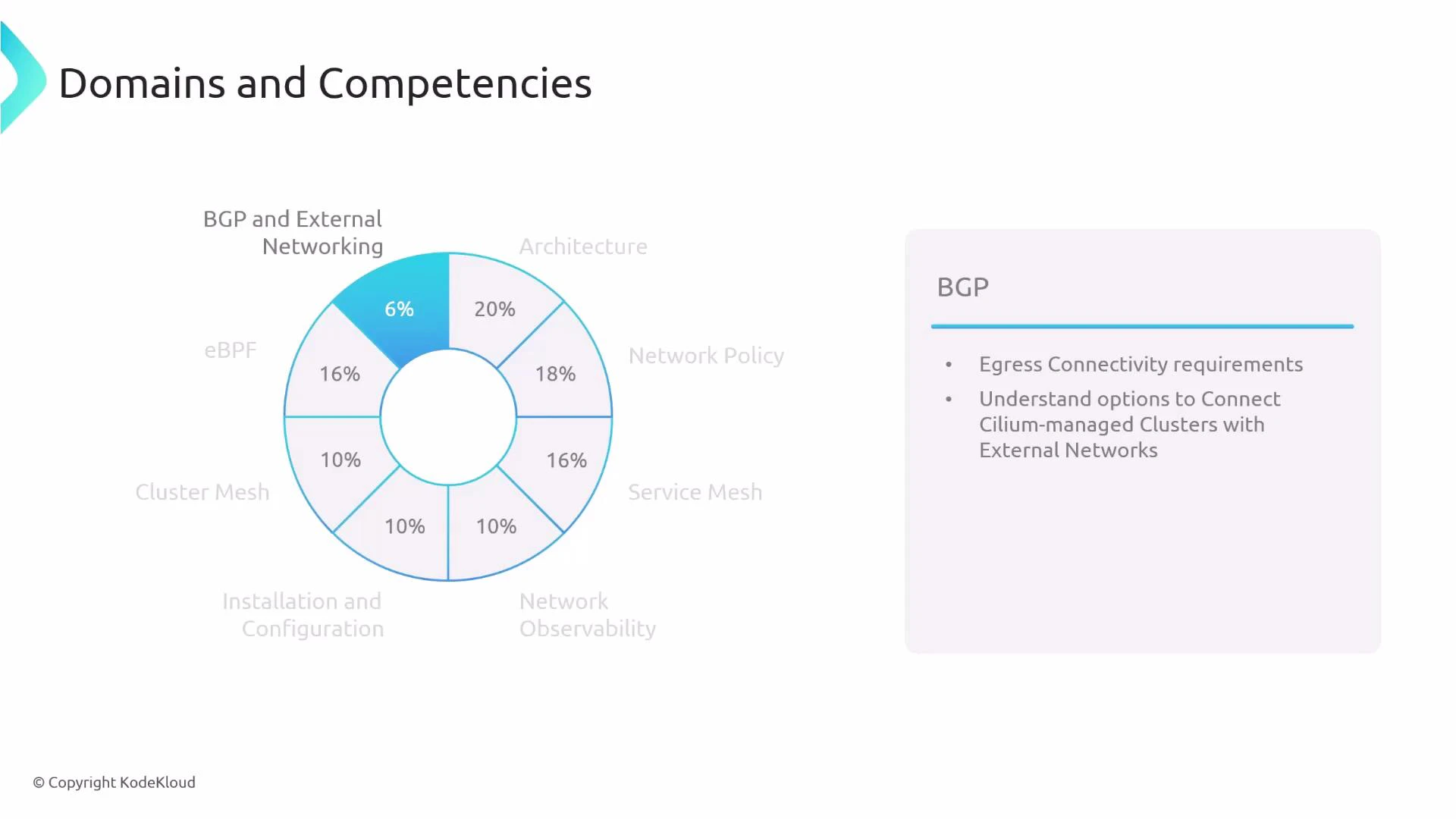
This overview focuses on the knowledge you’ll be expected to demonstrate: Cilium architecture, network policy, observability (Hubble), eBPF fundamentals, installation/operations, Cluster Mesh, and external networking (BGP). Use the domain weights below to prioritize study time.
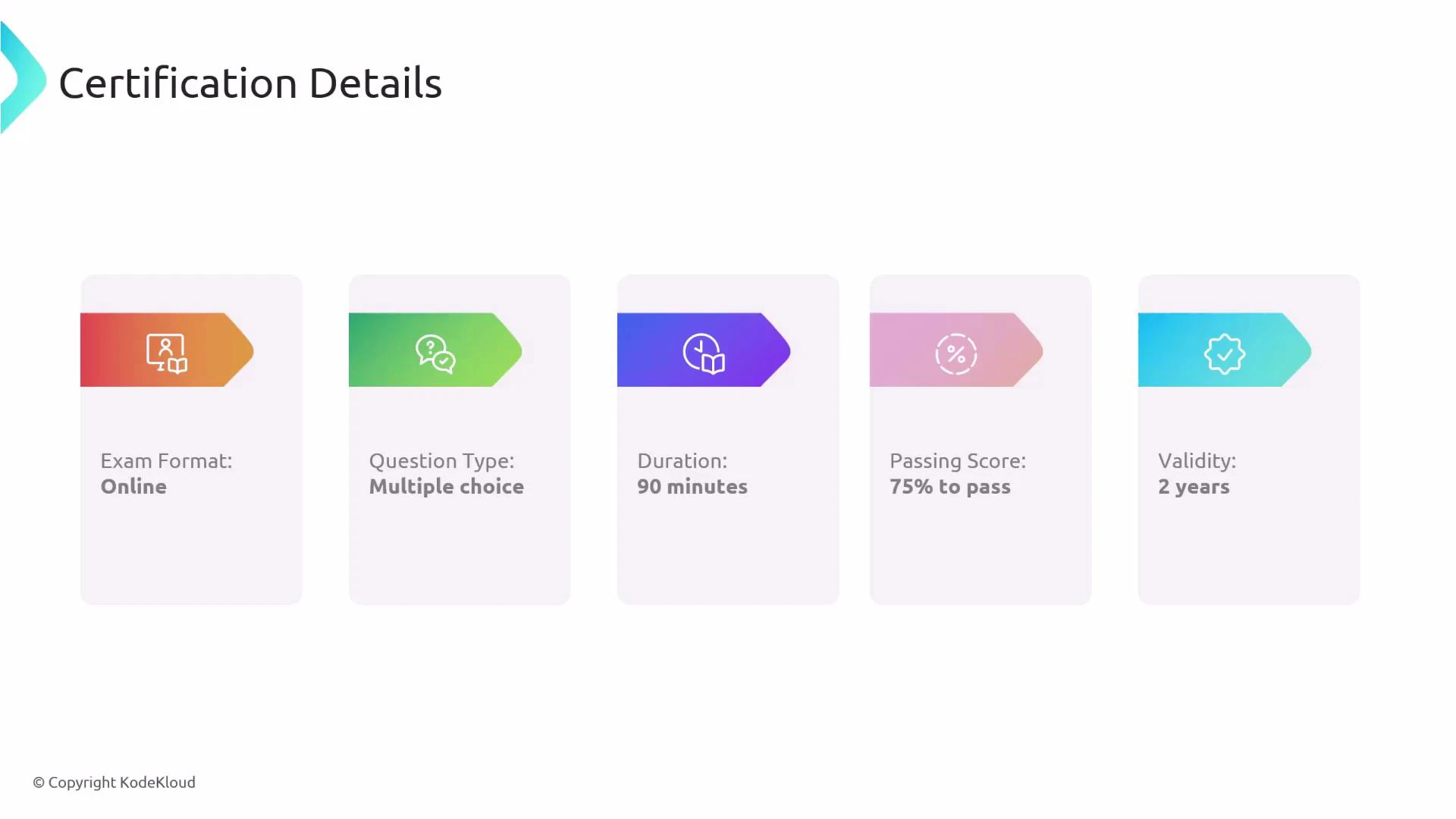
The exam is proctored — the proctor has access to your webcam and microphone. Prepare your environment (lighting, background, and ID) and follow the proctor’s instructions to avoid interruptions or disqualification.
Architecture — 20%
- Understand Cilium’s role within a Kubernetes environment and how it complements the Kubernetes control plane and data plane.
- Know the major components and responsibilities: Cilium agent, Cilium operator, datapath components (e.g., eBPF programs), and clustering support.
- Understand IPAM approaches and the datapath models that Cilium supports (how pod addressing and routing are handled).
- Be able to reason about where policy enforcement and observability hooks exist in the architecture.
- Interpret and reason about Cilium Network Policies and the intent behind policy rules. See Cilium policy docs: https://docs.cilium.io/en/stable/policy/
- Understand Cilium’s identity-based security model (endpoints are selected by identity derived from labels) and how this differs from IP-only approaches.
- Know the structure of policy rules, selectors, L3/L4 vs. L7 controls, and enforcement considerations.
- Compare Kubernetes NetworkPolicy (IP-centric) vs. Cilium NetworkPolicy (richer L7 capabilities and flexible selectors): https://kubernetes.io/docs/concepts/services-networking/network-policies/ and https://docs.cilium.io/en/stable/policy/
- Know basic service mesh concepts and common use cases (mTLS, traffic routing, observability).
- Understand ingress routing using Kubernetes Ingress resources and the newer Gateway API; know why the Gateway API addresses limitations of legacy Ingress: https://gateway-api.sigs.k8s.io/ and https://kubernetes.io/docs/concepts/services-networking/ingress/
- Be familiar with Cilium options for encrypting traffic in transit and approaches to East-West and North-South encryption.
- Understand differences between traditional sidecar-based meshes and sidecar-less architectures and how Cilium can enable sidecar-less or lighter-weight proxying.
- Be familiar with Hubble (Cilium’s observability tool) and how it provides flow visibility and troubleshooting: https://www.cilium.io/docs/concepts/hubble/
- Know how to enable L7 protocol visibility, use Hubble CLI to inspect flows, and use the Hubble UI for graphical insights.
- Know how to install and configure Cilium using the Cilium CLI and common workflows for verifying health and connectivity: https://docs.cilium.io/en/stable/gettingstarted/
- Be able to perform common operational checks and run connectivity tests.
- Understand Cluster Mesh concepts and how it enables multi-cluster connectivity and service discovery across clusters: https://docs.cilium.io/en/stable/concepts/clustermesh/
- Know how Cluster Mesh supports cross-cluster load balancing and the trade-offs involved (consistency, latency, and operational overhead).
- Understand the role of eBPF in Cilium’s architecture: how kernel eBPF programs implement networking, security, and observability features.
- Know the advantages eBPF provides over legacy iptables-based approaches: improved performance, programmability, lower latency, and finer-grained control. Learn more at https://ebpf.io/
- Understand egress and external connectivity considerations and how Cilium integrates with external routers and networks.
- Know the basics of advertising services and routes to external networks (for example using BGP) so cluster services can be reachable outside the cluster.
- Start with conceptual understanding: architecture, identity-based security, and eBPF fundamentals.
- Practice reading and reasoning about policies — translate policy intent into expected behavior.
- Use the Cilium CLI to install a test cluster, inspect status, run connectivity tests, and explore Hubble flows.
- Prioritize domains by weight: focus first on Architecture, Network Policy, eBPF, and Service Mesh, then cover Observability, Installation, Cluster Mesh, and BGP.
- Cilium documentation: https://docs.cilium.io/
- Hubble (observability): https://www.cilium.io/docs/concepts/hubble/
- Cilium Network Policy: https://docs.cilium.io/en/stable/policy/
- Kubernetes NetworkPolicy: https://kubernetes.io/docs/concepts/services-networking/network-policies/
- Cilium Getting Started / CLI: https://docs.cilium.io/en/stable/gettingstarted/
- Cluster Mesh concepts: https://docs.cilium.io/en/stable/concepts/clustermesh/
- eBPF overview: https://ebpf.io/
- Gateway API: https://gateway-api.sigs.k8s.io/