In this lesson we’ll cover the essential Cilium configuration options and concepts needed to deploy and operate Cilium in Kubernetes. The goal is to give you a practical understanding of common, high-impact settings, the different routing modes Cilium offers, and how the kube-proxy-less architecture accelerates Kubernetes service handling. You’ll also learn Cilium-specific terminology that appears in configuration and observability tools, and finish with a deep packet walk that traces how packets traverse nodes and the cluster network when Cilium is in use. What you’ll learn:
  • Configuration options and recommended settings for production and testing
  • Routing modes supported by Cilium and when to use each
  • How the kube-proxy-less architecture works and why it improves performance
  • Important Cilium terminology used in policies and telemetry
  • A step-by-step deep packet walk (packet flow through nodes and the cluster)
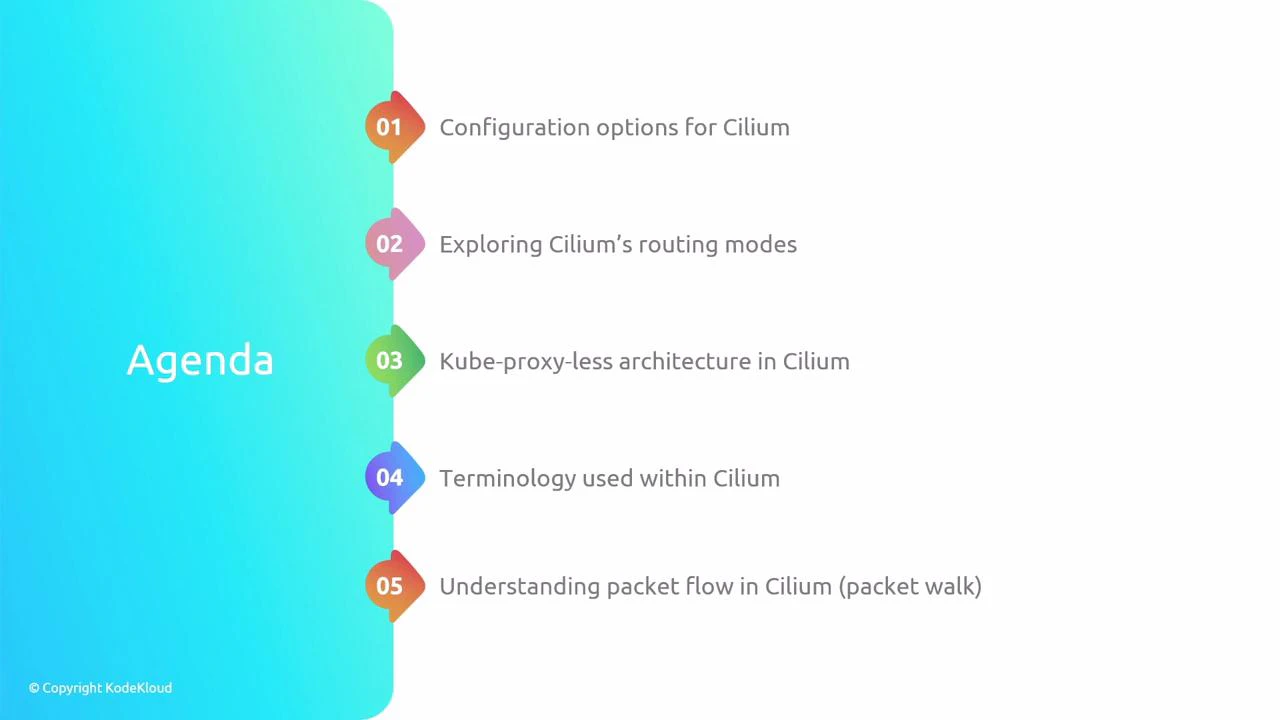
A presentation agenda slide with a vertical timeline of five numbered colored markers beside the word "Agenda." The items list Cilium topics: configuration options, routing modes, kube-proxy-less architecture, terminology, and understanding packet flow.
This lesson focuses on actionable, production-relevant topics. If you’re preparing for Cilium-related certification or improving cluster networking performance, pay close attention to the routing modes and kube-proxy-less sections — they cover common pitfalls and optimization strategies.
Key topics at a glance:
TopicWhy it mattersWhere to apply
Configuration optionsAffects security, performance, and observabilityCluster bootstrapping, CI/CD, production clusters
Routing modesDetermines packet path and load-balancing behaviorMulti-node clusters, cloud vs bare metal
Kube-proxy-less architectureReduces latency and CPU by offloading services to BPFHigh-throughput services, latency-sensitive apps
TerminologyUnderstand logs, metrics, and policy rulesDebugging, writing policies, readouts in dashboards
Deep packet walkVisualizes actual packet handling to diagnose issuesTroubleshooting and performance tuning
Links and references: Next, we’ll dive into Cilium’s configuration options, followed by routing modes and the kube-proxy-less architecture.

Watch Video