Welcome — this lesson is the first step toward building a high-impact FinOps capability. By the end you’ll understand why a dedicated FinOps capability matters, how to structure it for maximum impact, and practical first steps to get started. FinOps is not just about hiring finance people. It’s a cross-functional capability that bridges finance, engineering, and product operations — think of it as assembling your cloud cost-optimization Avengers. The organizational shift a proper FinOps capability delivers is simple but powerful: decentralize day-to-day accountability while centralizing macro-level functions. Key distinctions:
  • Decentralized accountability: give product and engineering teams ownership of the cloud costs they consume so they can optimize in real time. Empower teams to make decisions and provide curated, actionable insights at the team level.
  • Centralized macro functions: deliver organization-wide insights, alignment to business strategy, governance, frameworks, and coordination across teams.
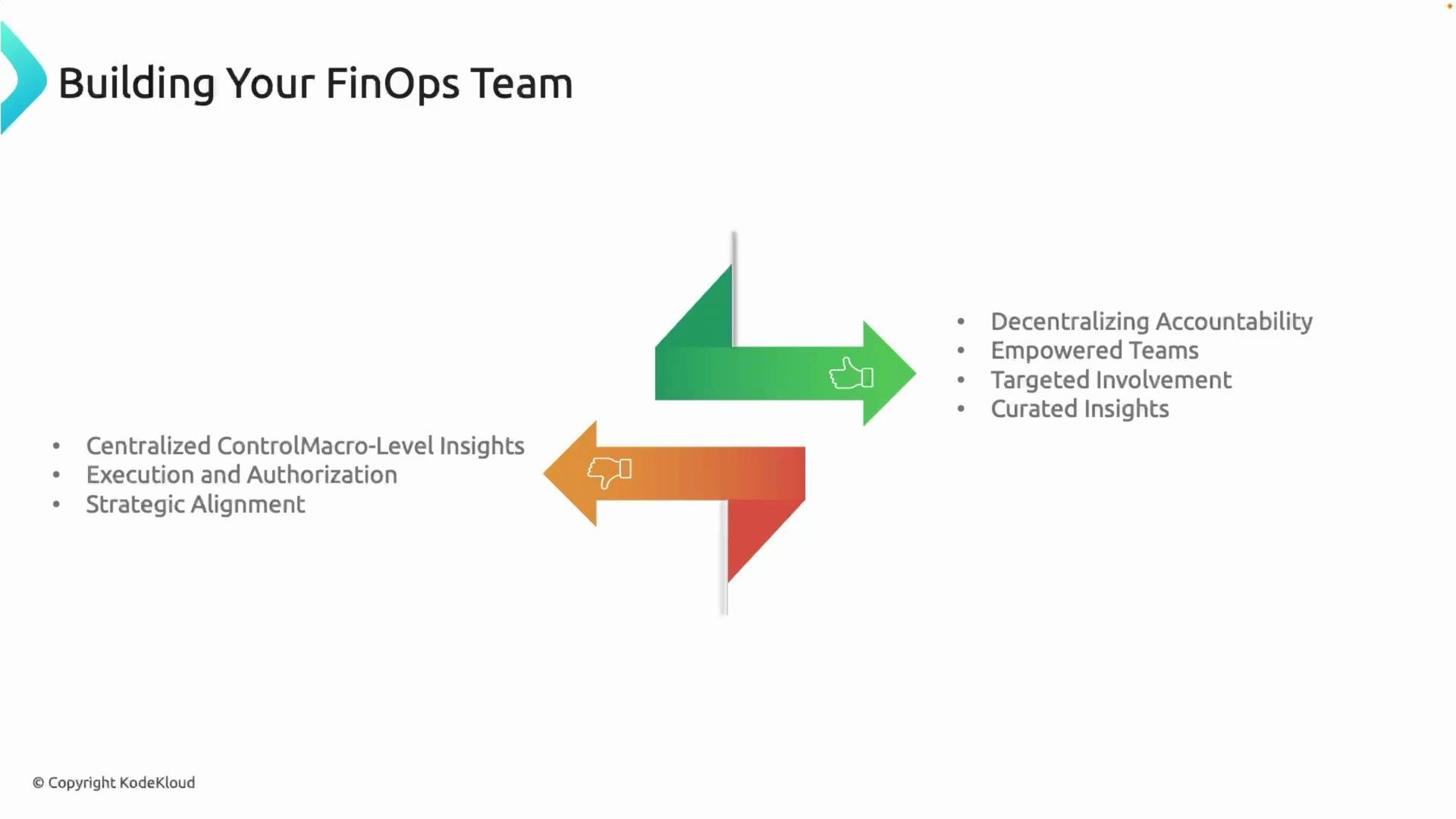
The image describes building a FinOps team, contrasting centralized control with decentralized accountability using green and red arrows with thumbs up and down. Key points include macro-level insights, strategic alignment, empowered teams, and curated insights.
Think of the model as an orchestra: each team (musician) plays its own instrument while a central FinOps function (the conductor) ensures everyone performs the same symphony. Starting a FinOps program can feel overwhelming. That’s normal. No organization gets its structure perfect on day one. Adopt an iterative mindset: start small, measure impact, and scale the capability as your cloud spend and organizational complexity grow.
Start with a minimum-viable FinOps capability, measure impact, then evolve structure and roles as your spend and complexity grow.

Five Fundamental Questions for Building a FinOps Team

Below are five practical questions every organization should answer when creating a FinOps capability. These guide rails are useful for heads of product, engineering leads, and engineering managers.
QuestionPractical guidance
Who should be in the FinOps team?Look beyond job titles. Include people who influence cloud spend today: cloud architects, senior developers, product managers, finance reps, and ops engineers. Often the best contributors are engineers who consistently ask, “Why does this cost so much?”
What roles fit the organization?Align roles to how your company operates: startups often need multi-hat contributors; mid-size orgs benefit from roles like FinOps engineer, cloud financial analyst, and business value manager; enterprises need layered teams for governance and enablement.
How many people are needed?Use a minimum-viable-team approach: start with 2–3 people and scale with spend/complexity. A rough guideline: ~1 dedicated FinOps person per $10M annual cloud spend, counting full- and part-time contributors.
What should reporting look like?Report into a leader with influence across tech and finance (CTO, CFO, or COO). This reporting line empowers FinOps to remove blockers and drive cross-functional change.
What are the barriers to effectiveness?Identify cultural, technical, and organizational blockers early (e.g., lack of billing access, unclear ownership, misaligned incentives), then create a plan to remove or mitigate them.

Who should be on the team?

  • Identify people who already influence cost decisions: cloud architects, senior engineers, product managers, finance partners, and SREs.
  • Include domain experts who can translate cost signals into product and engineering trade-offs.
  • Promote practitioner-level FinOps skills (tagging, usage attribution, rightsizing) alongside financial literacy.

Typical roles and responsibilities

RolePrimary responsibilityTypical in
FinOps EngineerImplement tooling, tagging, reporting automationMid/Enterprise
Cloud Financial AnalystAnalyze spend, forecasting, showback/chargebackMid/Enterprise
Business Value ManagerAlign cost optimization with product/business outcomesMid/Enterprise
Cross-functional PractitionersDevelopers/archs who own team-level cost optimizationAll sizes

How many people?

Start with a small corps of dedicated contributors and a broader set of part-time collaborators embedded in product and engineering teams. Use workload and spend as scaling signals.

Where should FinOps report?

Reporting into a leader who can influence both finance and engineering (CTO/CFO/COO) helps with authority and cross-functional execution. If separate reporting is unavoidable, create strong sponsorship and a clear charter.
Common blockers include poor access to billing and usage data, unclear ownership of cost outcomes, and incentives that favor feature velocity over cost efficiency. Address these early to unlock results.
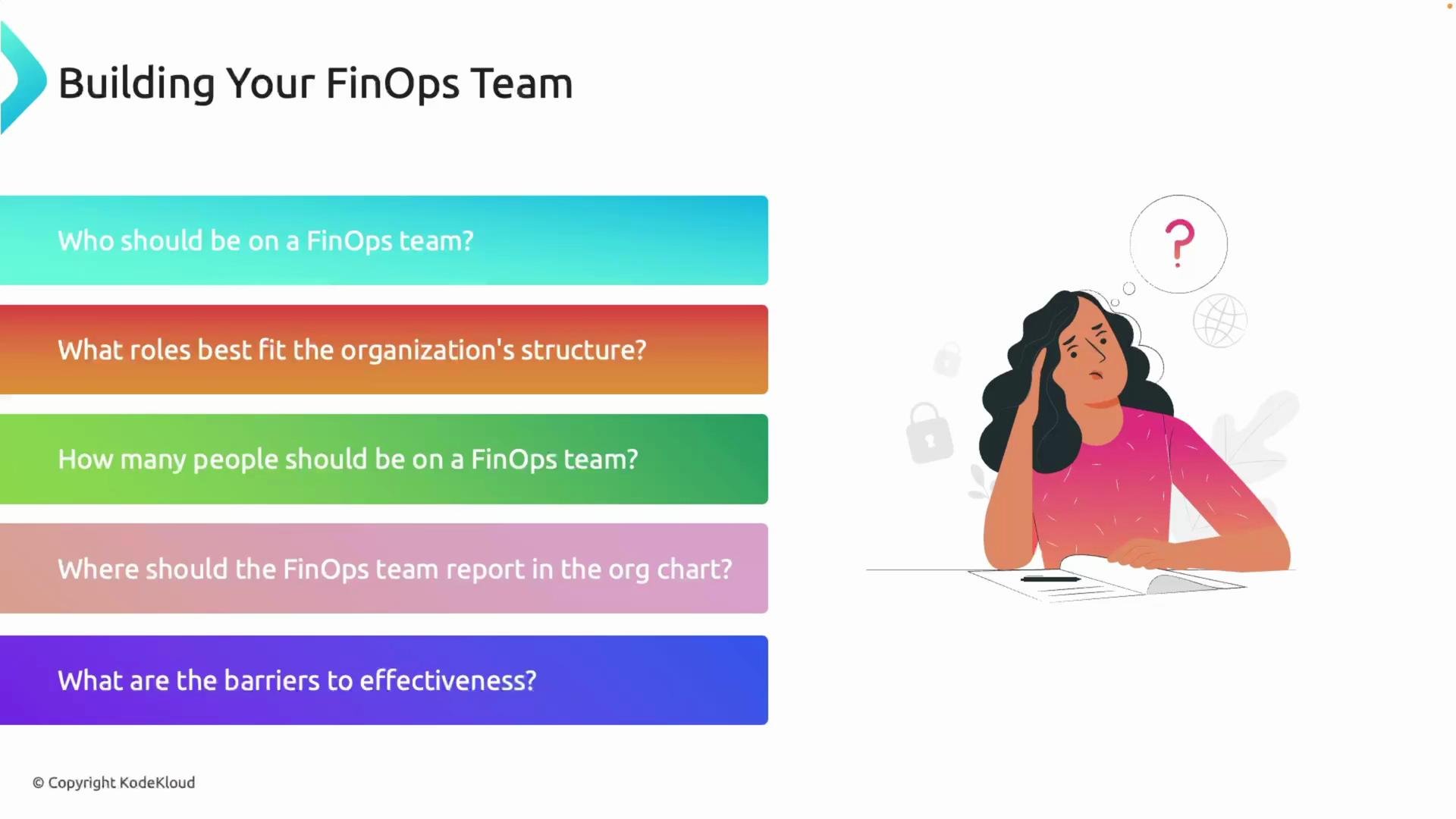
The image focuses on building a FinOps team and lists questions about team composition and effectiveness. It features a person appearing thoughtful next to these points.

Practical next steps (minimum viable plan)

  1. Assemble a core team of 2–3 people (mix of engineering and finance).
  2. Lock down access to billing, tagging, and usage data.
  3. Define team-level cost ownership and simple KPIs (e.g., monthly spend per feature, rightsizing actions).
  4. Run a 90-day pilot focused on one product area to prove ROI.
  5. Document playbooks and scale to additional teams based on demonstrated impact.

Where to go next

Later lessons in this series will show concrete team examples for startups, mid-size firms, and large enterprises along with sample org charts, hiring profiles, and playbooks. Further reading: Thanks for reading.

Watch Video