

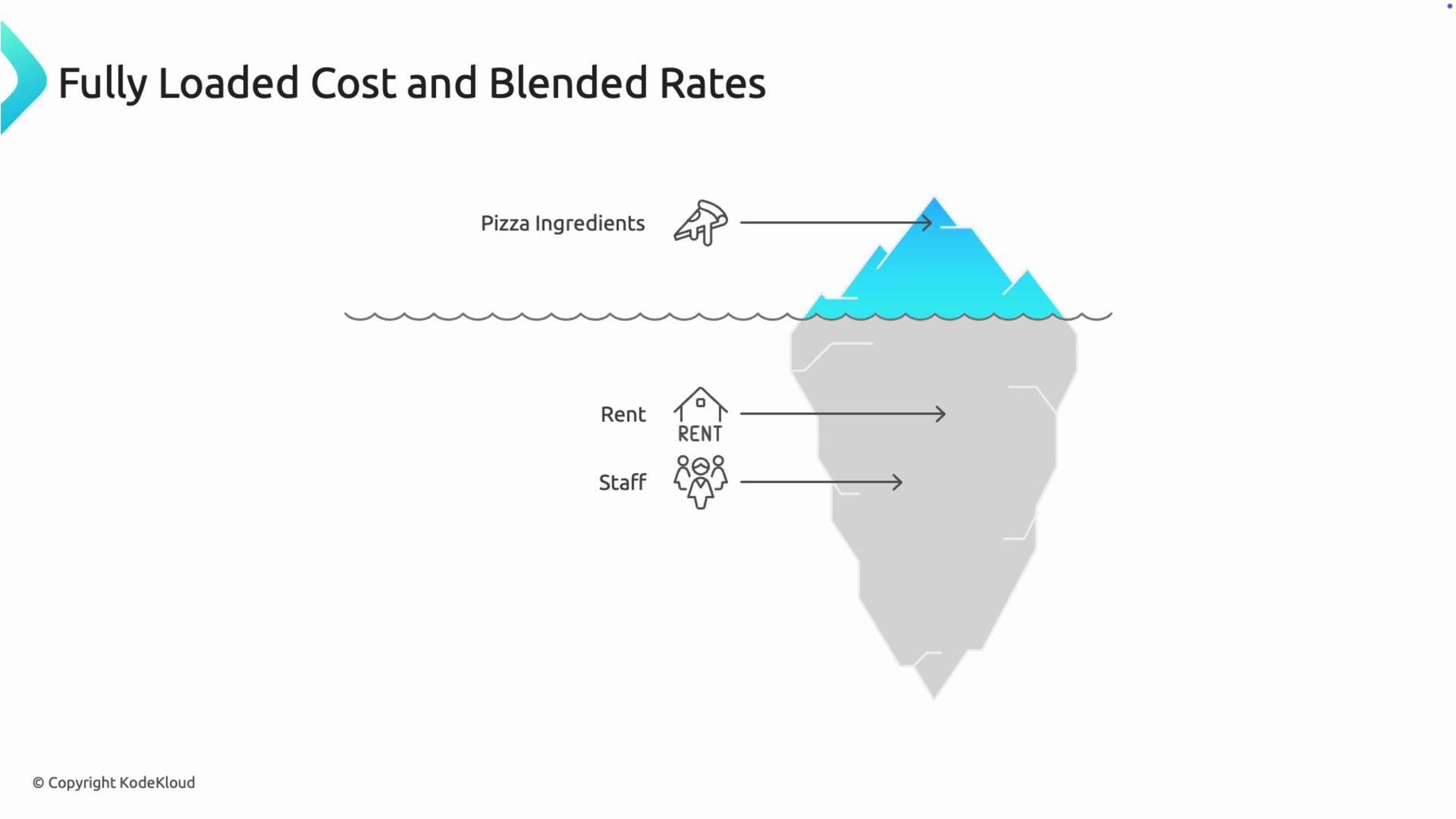

- Teams that only measure raw compute will often underestimate the true cost of running a service.
- Including indirect and overhead costs gives product owners and finance a realistic unit cost to evaluate ROI and pricing decisions.
- Fully loaded cost enables defensible internal chargebacks or showbacks and reduces cross-team disputes.
Blended rates: definition and example
A blended rate is the weighted average unit cost (for example, cost per hour or cost per vCPU-hour) across different purchase types and instance families. If your pizza app runs On‑Demand, Reserved, and Spot instances, each has a different hourly price. The blended rate answers: what is the average cost per hour across all of that usage? Example scenario (rounded for clarity):
Blended rate calculation (Python example):
- The blended rate ($0.68/hr in this example) is the true average hourly cost across the mixed purchase strategy.
- Use it as a single planning metric for forecasting, budget sizing, and making trade-off decisions between purchase types.
How fully loaded cost and blended rates help (key benefits)
-
Optimization and planning
- Use blended rates to identify when On‑Demand usage is inflating your average cost; plan more Reserved capacity or safe Spot usage where appropriate.
- Fully loaded cost helps determine whether a business outcome (e.g., revenue per order) justifies the infrastructure expense.
-
Accurate budgeting and forecasting
- Blended rates smooth pricing and usage variability, making forecasts more stable.
- Rising blended rates can be an early signal of shifting consumption or pricing changes that require attention.
-
Fair cost allocation and accountability
- Apply consistent unit rates for chargebacks or showbacks so teams are accountable for resource use.
- Distinguish storage-heavy vs compute-heavy products and allocate indirect/overhead costs fairly.
Not all cloud providers expose a ready-made blended rate in every billing view. You may need to collect usage and pricing data, centralize it, and compute blended rates using a cost platform, analytics pipeline, or spreadsheet.
Practical tips for implementation
- Aggregate usage and cost by consistent units (hours, vCPU-hours, GB-months) before averaging.
- Include indirect and overhead allocations (e.g., a percentage of support plans, tooling, and training) in fully loaded calculations.
- Recompute blended rates regularly (monthly or weekly) to capture changes in instance mix or pricing.
- Use blended rates for cross-team showbacks, but retain detailed breakdowns for teams that need optimization signals.
- FinOps Certified Practitioner course (example)
- FinOps Foundation — best practices and community resources
- Cloud provider billing docs (AWS, Azure, GCP) — review your provider’s billing and price models