

Overview of the FinOps pillars
Below is a concise summary of the five primary pillars of FinOps. Each pillar highlights the primary focus and typical responsibilities.Detailed pillar responsibilities
-
SaaS (Software as a Service)
- Primary focus: subscription management and recurring spend control.
- Key responsibilities:
- Track vendor subscriptions, renewals, and seat counts.
- Negotiate contract terms and volume discounts.
- Forecast subscription budgets and enforce spend policies.
-
Licensing models
- Primary focus: ensuring licensing is cost-efficient and compliant.
- Key responsibilities:
- Select appropriate license types (per-user, per-core, site license).
- Right-size licenses to actual usage to avoid waste.
- Include licensing costs in financial forecasts and engineering plans.
-
Private cloud
- Primary focus: capacity planning and fair cost allocation across teams.
- Key responsibilities:
- Forecast resource demand (CPU, memory, storage).
- Analyze utilization and right-size instances or containers.
- Produce cost reports that amortize fixed infrastructure across services.
-
Traditional data center operations
- Primary focus: physical capacity forecasting and resource allocation.
- Key responsibilities:
- Plan rack, power, and cooling capacity.
- Allocate physical resources with growth forecasting.
- Avoid both under-provisioning (risking outages) and over-provisioning (wasting capital).
-
Invoicing and chargeback / showback
- Primary focus: building accountability through cost attribution.
- Key responsibilities:
- Design chargeback/showback models that reflect true consumption.
- Implement billing exports and enforce tagging/labeling strategies.
- Create transparent reports so teams understand and own their spend.
Cross-cutting skills: forecasting, reporting, and analytics
- Forecasting: Predict SaaS growth, private cloud capacity needs, and AI compute consumption to enable proactive budgeting.
- Reporting & analytics: Build dashboards, KPIs, and reports that surface cost per service, per environment, or per model inference to guide optimization decisions.
- Communication: Translate technical consumption into business-facing cost narratives so stakeholders can act.
AI use cases and FinOps
AI and ML workloads introduce different cost patterns:- Heavy and variable compute (training, large-scale inference).
- Increased storage demands for datasets and model artifacts.
- Frequent experimentation and iteration that make unit economics (cost per training hour, cost per inference) crucial.
- Define cost-per-unit metrics (training hour, inference request).
- Forecast usage patterns across teams and projects.
- Implement allocation and monitoring to avoid undiscovered runaway spend.
Example: managing an OpenAI API key across teams
- Scenario: multiple teams want to use a single OpenAI API key.
- Practitioner questions:
- Which team consumed how much of the key?
- What budgets or quotas should each team have?
- How is usage tracked and how are budgets enforced?
- Typical solutions:
- Enforce usage tagging or pass-through metadata so requests are attributable.
- Proxy requests through per-team credentials or a gateway that enforces quotas.
- Collect meter-level data and export billing for allocation and chargeback.
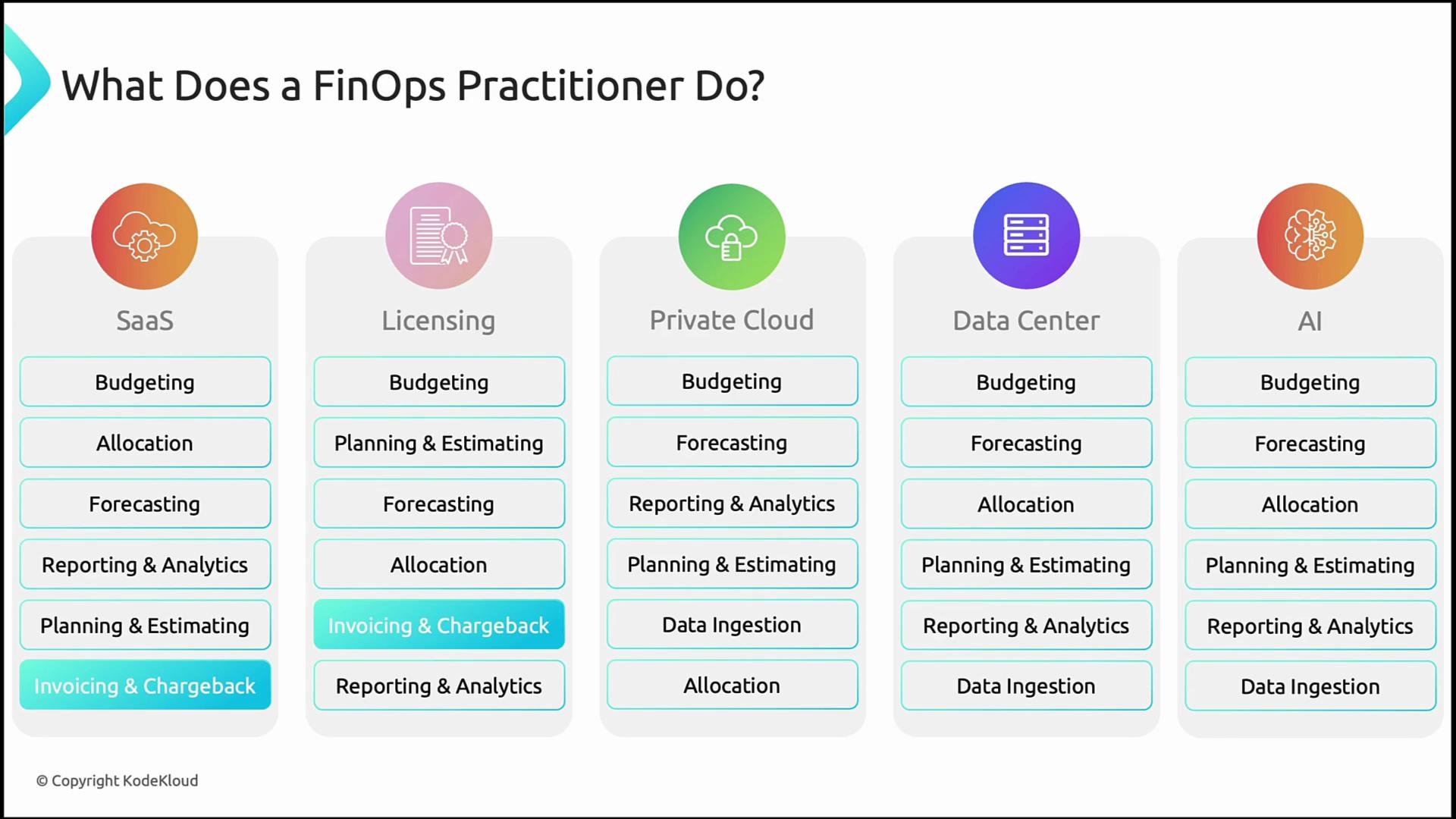
Summing up: skills every FinOps practitioner needs
- Forecast cloud and private cloud costs and assess licensing implications.
- Implement allocation, invoicing, and chargeback/showback methodologies.
- Build reporting and analytics to inform optimization and budgeting decisions.
- Adapt practices for modern workloads (especially AI/ML) where compute and experimentation can dominate costs.
- Collaborate across engineering, finance, product, and platform teams — FinOps is cross-functional.
FinOps is a team effort: engineers, finance, product, and platform teams must work together to keep organizational spend healthy and aligned with business goals.