

FinOps maturity stages at a glance
Run
- You’re in the run stage: FinOps is mature and operational.
- Typical current team size: ~9, scaling up to ~14 in the next 12 months.
- Focus: running programs, driving automations, influencing leadership decisions, and maintaining multiple dashboards and automation pipelines.
- Why the size? This is not organizational bloat—it’s capacity to sustain continuous optimization, automation, and cross-functional influence.
- In the walk phase you have a healthy, operational team.
- Typical current size: ~5, growing to ~8 in a year.
- Focus: moving beyond experimentation, increasing efficiency, rolling out chargeback/showback models, adopting cloud-native tooling, and embedding FinOps into budgeting conversations.
- Most organizations start here.
- Typical size: 3–6 people—sometimes not a formal FinOps team at all.
- Roles are often shared by a cloud financial analyst, an SRE, or an engineering manager who’s tracking cloud spend while doing other work.
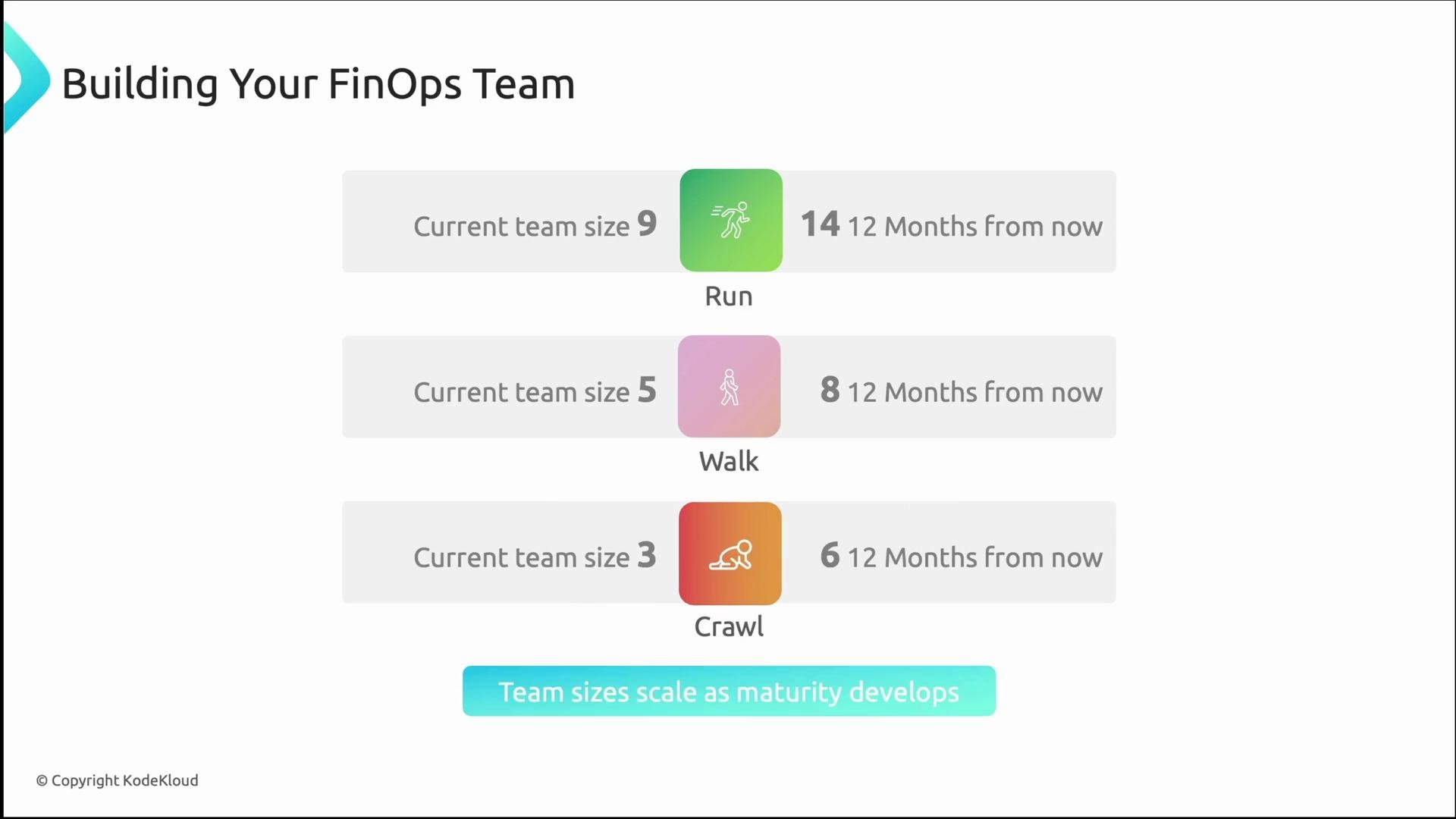
Key takeaway: As FinOps maturity increases, team size generally grows to support automation, governance, and enterprise-wide influence. Bigger teams enable coverage for continuous optimization, tooling, and business alignment—not redundancy.
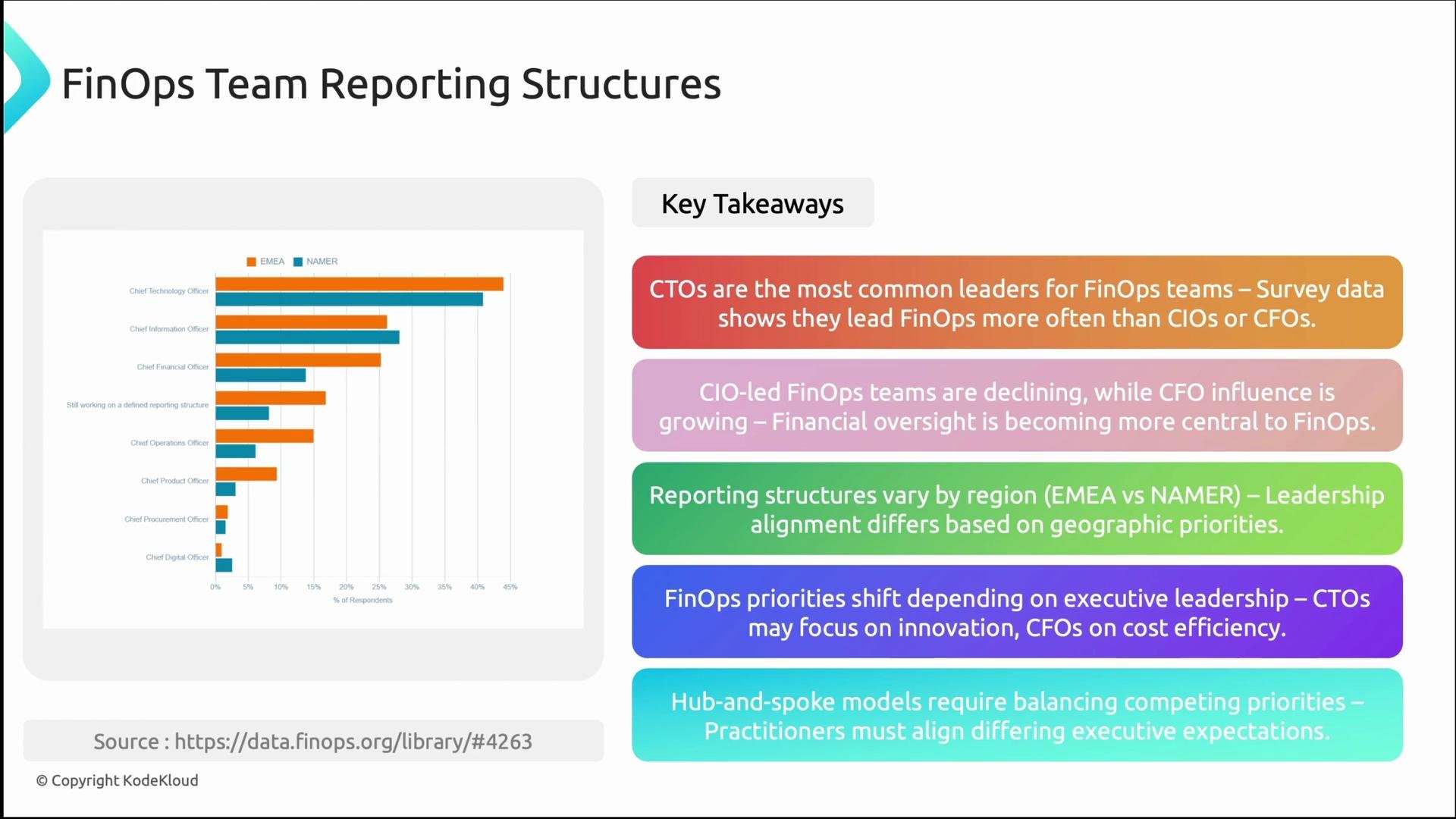
Reporting lines: where does FinOps sit in the org?
The most common reporting lines are CTO and CFO, with variations depending on how the practice began and regional organizational design.- CTO: Many FinOps efforts originate in engineering/technology because cloud expertise and operational stewardship typically live there. Early-stage FinOps often reports to an engineering leader.
- CFO: As FinOps proves its ability to map cloud spend to business outcomes, finance organizations increasingly take ownership to integrate cost governance into budgeting and forecasting.
- Other structures: Startups and matrix organizations may route FinOps under the COO, VP of Engineering, or even a centralized cloud center of excellence. Regional differences (EMEA vs NAMER) and company maturity influence choices.
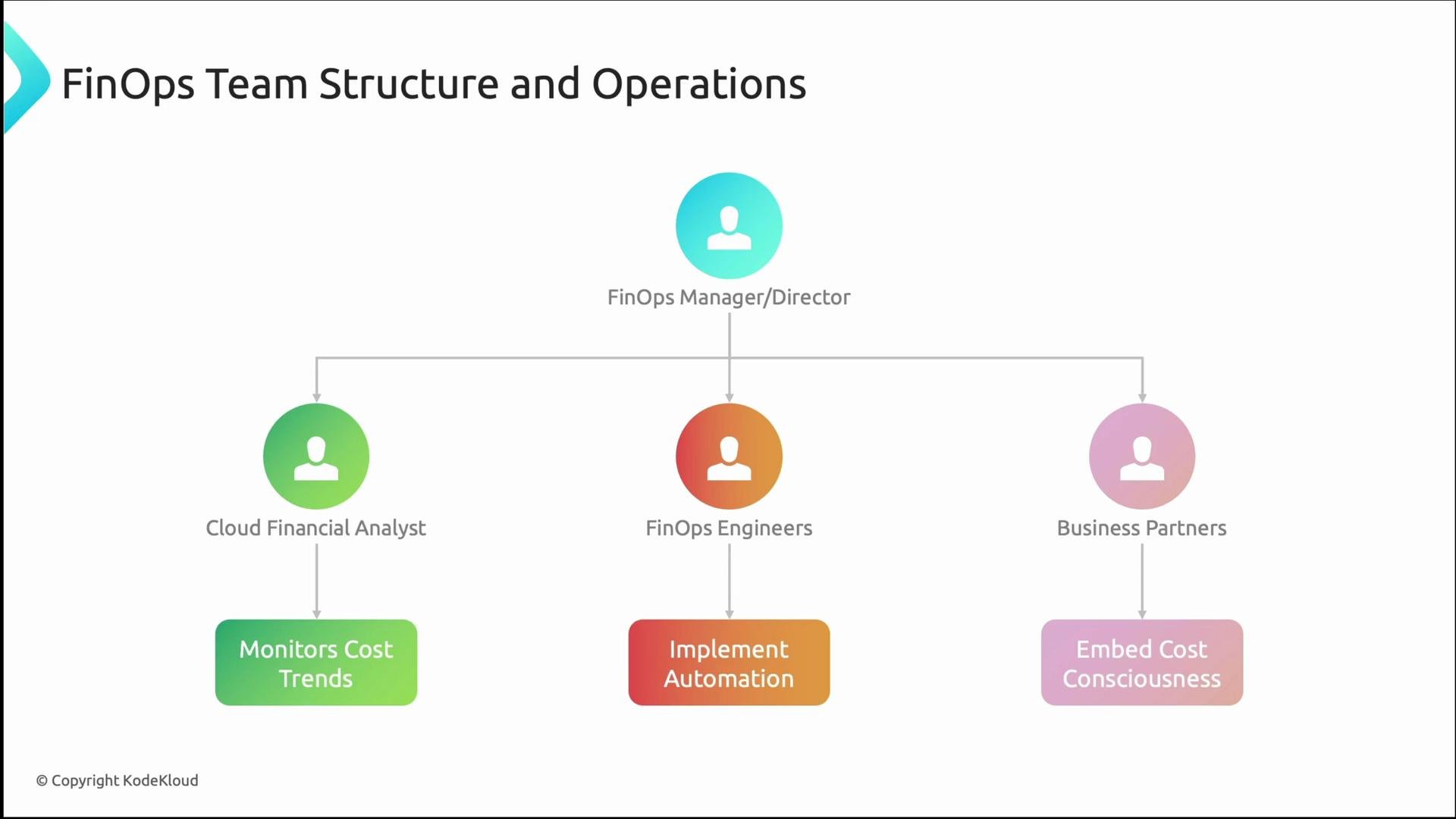
What a mature FinOps team typically includes
A mature FinOps function balances leadership, analytics, engineering, and business partnership. Below is a practical role breakdown you can use when planning hires or reorganizing teams.
This blend of roles enables speed, agility, and alignment between engineering and business goals.
Warning: Team size alone does not equal success. Hiring should follow clear outcomes—automation coverage, governance, cost-to-value alignment, and the ability to influence product and engineering decisions—rather than arbitrary headcount increases.
Summary
- Team size grows with FinOps maturity to support automation, governance, and cross-functional influence.
- Common reporting lines are CTO or CFO, depending on where the practice originated and company priorities.
- A mature FinOps team typically includes leadership, analysts, engineers, and embedded business partners to operationalize cost-awareness across the organization.
- FinOps Foundation — Resources, best practices, and community guidance.
- Cloud Cost Management patterns — Examples and tooling approaches.
- Kubernetes cost allocation basics — Useful for engineering-finance alignment.