Welcome — in this lesson we review the “State of FinOps” and how the FinOps Foundation uses a practitioner-driven survey to capture real-world cloud cost management challenges. The State of FinOps is an annual survey administered by the FinOps Foundation. It collects input from organizations across industries and sizes, and the Foundation uses those results to evolve the FinOps framework, prioritize tooling and training, and highlight emerging trends in cloud cost management.
The State of FinOps is a recurring, practitioner-driven survey that informs updates to the FinOps framework and helps prioritize capabilities where organizations need the most help.
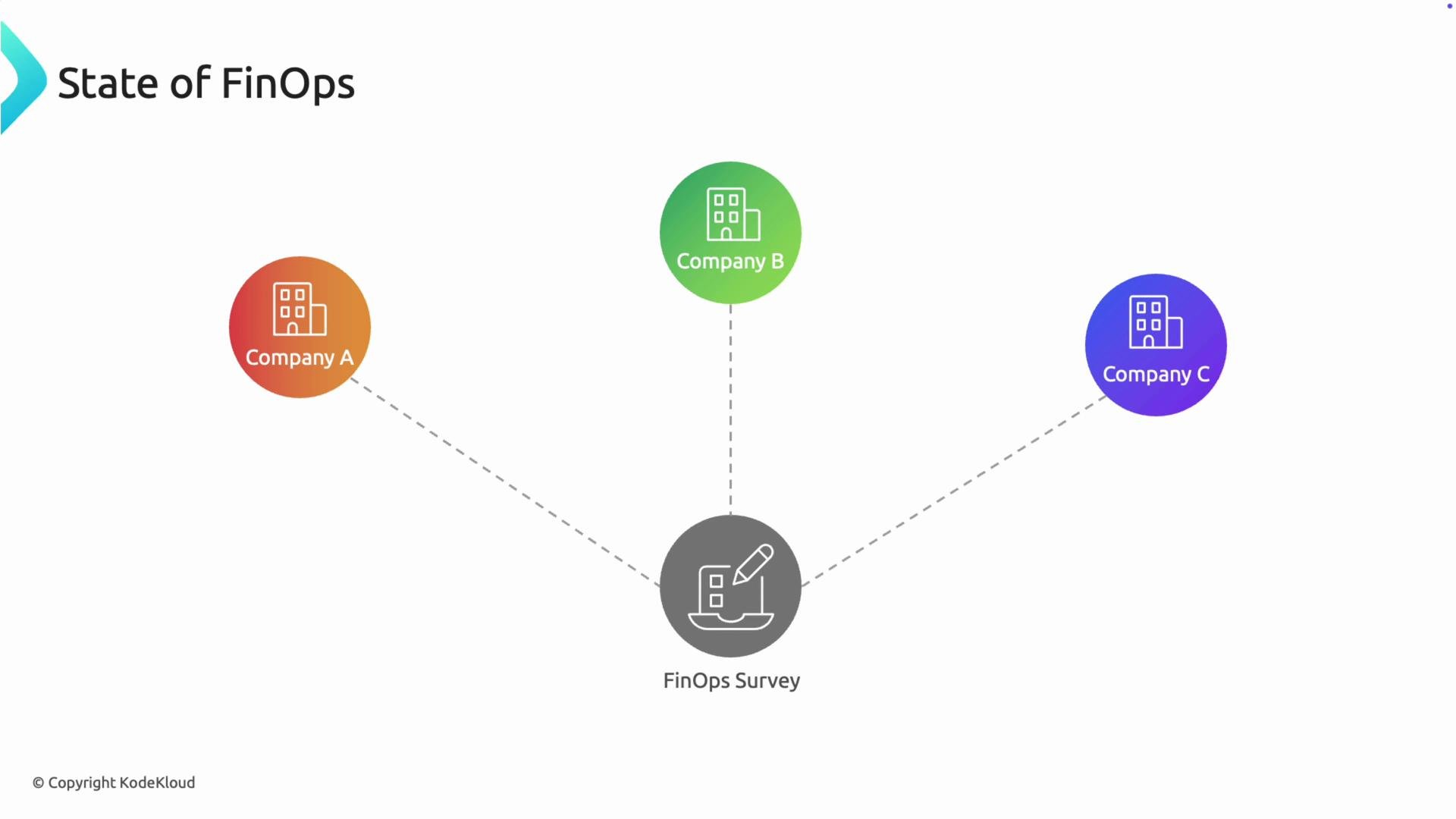
The image displays a diagram titled "State of FinOps" showing three companies (A, B, and C) connected to a central node labeled "FinOps Survey."

What the survey reveals (overview)

The 2025 State of FinOps survey provides a capability model that maps the skills and processes organizations need to manage cloud costs effectively. At first glance the model can look overwhelming — each capability represents a set of practices teams must develop. In reality, organizations show mixed maturity across these areas. Two broad themes emerge from the findings:
  • Workload optimization and waste reduction tend to have the highest maturity because they deliver near-term ROI and are easy to prioritize.
  • Full allocation of cloud spend remains a core, persistent challenge that requires cross-functional governance, consistent tagging/attribution, and cultural change.
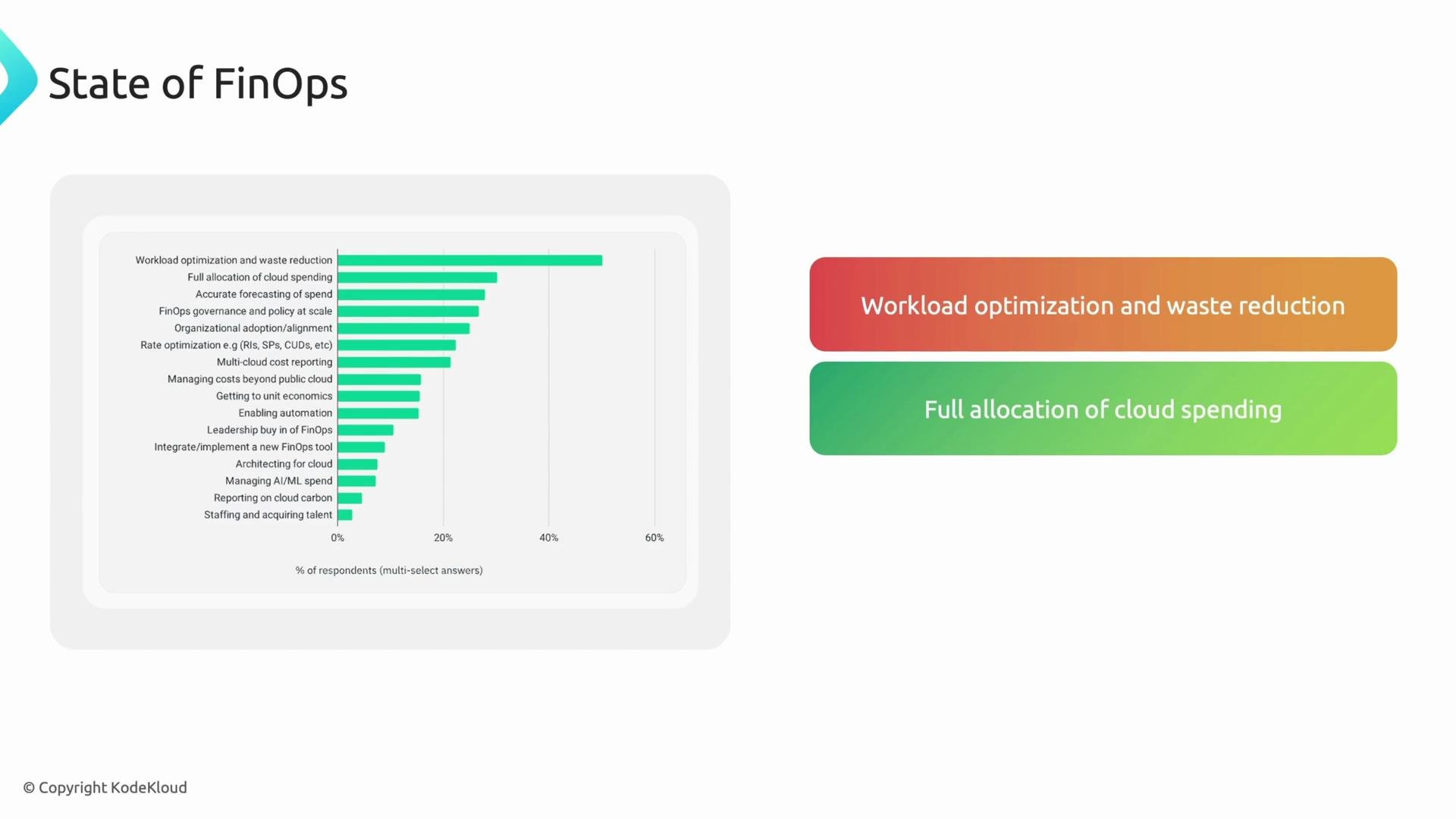
The image displays a chart on the "State of FinOps," highlighting the percentages of respondents focusing on various aspects, such as workload optimization and cloud spending allocation. Two key areas are emphasized: workload optimization and waste reduction, and full allocation of cloud spending.
Accurate allocation of cloud spend is not just a tagging exercise. It requires defined ownership, consistent metadata, and processes to map resources to teams, products, or cost centers — without these, chargebacks and showbacks will be unreliable.

What “full allocation of cloud spending” means

Full allocation means attributing every cloud resource to a team, product, or use case so costs are measurable and actionable. For example, an unowned 700 GB database cannot be charged to a stakeholder or optimized until it’s attributed to a team. Once attributed, teams can:
  • Track usage and costs,
  • Apply chargebacks or showbacks,
  • Prioritize optimization and lifecycle decisions.

Persistent challenge: forecasting cloud spend

Forecasting remains difficult because cloud consumption is highly dynamic. Factors that reduce forecast accuracy include:
  • Autoscaling and bursty workloads,
  • Rapid experimentation and ephemeral resources,
  • New services or architecture changes,
  • Sudden business demand shifts.
Organizations need forecasting techniques that combine historical patterns with anomaly detection and scenario-based projections to account for irregular consumption.

AI’s impact on FinOps

AI adoption is reshaping how organizations consume cloud and how FinOps teams operate:
  • AI workloads increasingly run in public cloud and SaaS but also extend to private cloud and on-prem environments.
  • Vendors and hyperscalers are building massive infrastructure for AI, which increases capital and operational complexity.
  • At the same time, AI is being used as a tool within FinOps for smarter forecasting, automated anomaly detection, and assisting cost allocation.
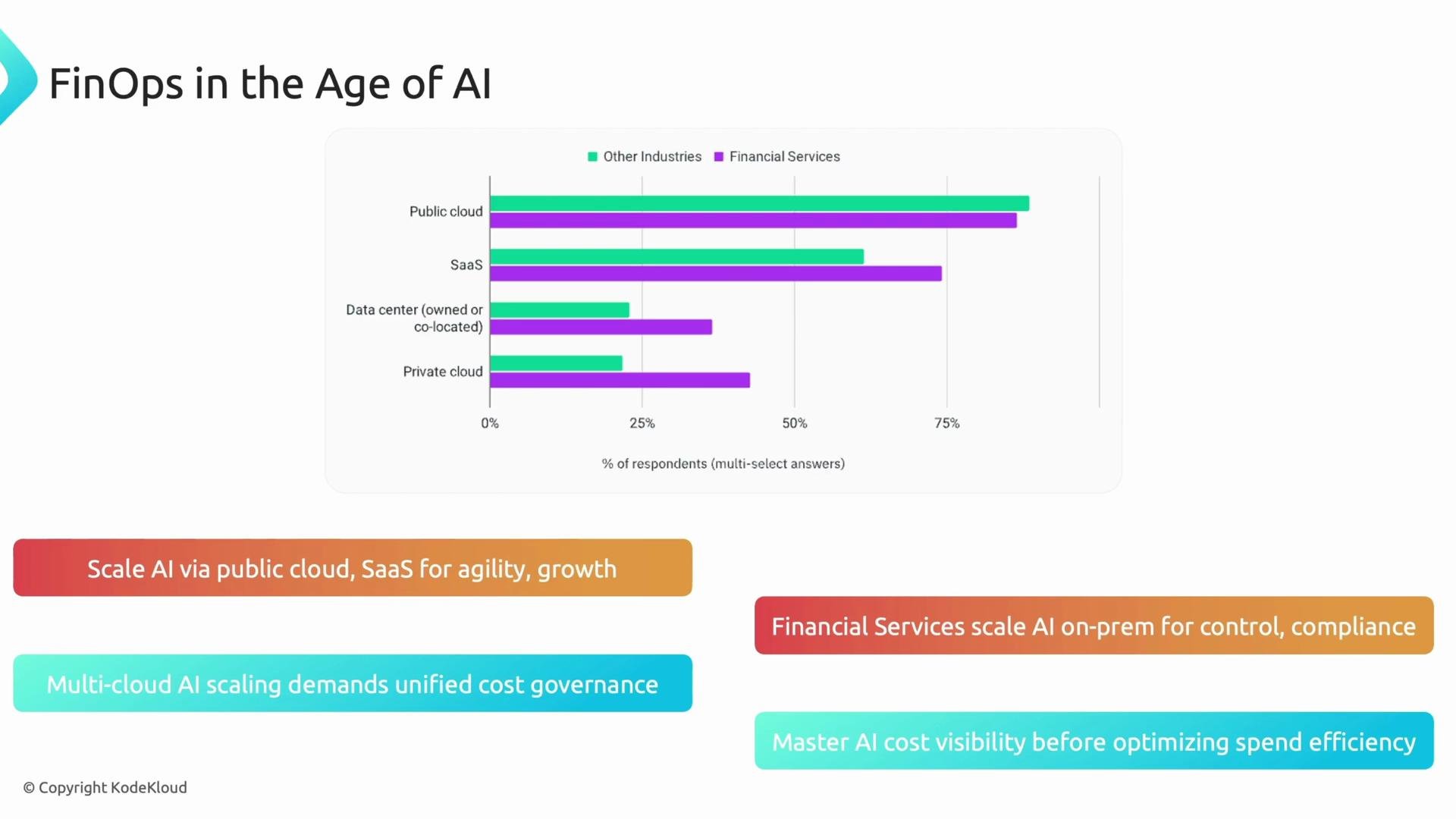
The image features a bar chart comparing cloud usage in financial services versus other industries, alongside insights on AI scaling and cost management strategies.
The FinOps Foundation is responding to these trends by publishing guidance and developing training and certifications that target AI-related cost management and modern forecasting techniques.

Key findings at a glance

FindingImplicationActionable next steps
Workload optimization & waste reduction show higher maturityTeams prioritize quick ROI projectsExpand automation for rightsizing, idle detection, and scheduling
Full allocation of spend remains lowLimits visibility for chargebacks and accountabilityImplement consistent tagging, ownership, and resource inventories
Forecasting is increasingly unreliableTraditional models fail with bursty consumptionAdopt hybrid forecasting (historical + anomaly models + scenario planning)
AI workloads add complexityNew infrastructure and cost patterns emergeCreate AI-specific cost controls, tracking, and templates for allocation

Where this leads for practitioners

This survey sets priorities for FinOps practitioners: improve allocation and governance, modernize forecasting, and incorporate AI-aware cost controls. Day-to-day FinOps work will include establishing tagging and ownership, monitoring optimization opportunities, implementing anomaly detection, and partnering with engineering and finance to operationalize cost policy. We’ll cover practitioner workflows and how to structure FinOps teams in later lessons. Further reading and resources: That’s it for this lesson — see you in the next one.

Watch Video