

FinOps certification is optional. A FinOps practitioner is anyone who understands the FinOps framework and applies it within their organization. Certification adds structured knowledge, frameworks, and recognition, which can accelerate your learning and career progression.
Why consider a FinOps certification?
- Validates your understanding of cloud cost management principles.
- Provides a repeatable framework and best practices for visibility, allocation, and collaboration.
- Helps align teams (Finance, Engineering, Product) around measurable cost outcomes.
- Can accelerate career progression for managers, analysts, and technical practitioners.
Certification tiers at a glance
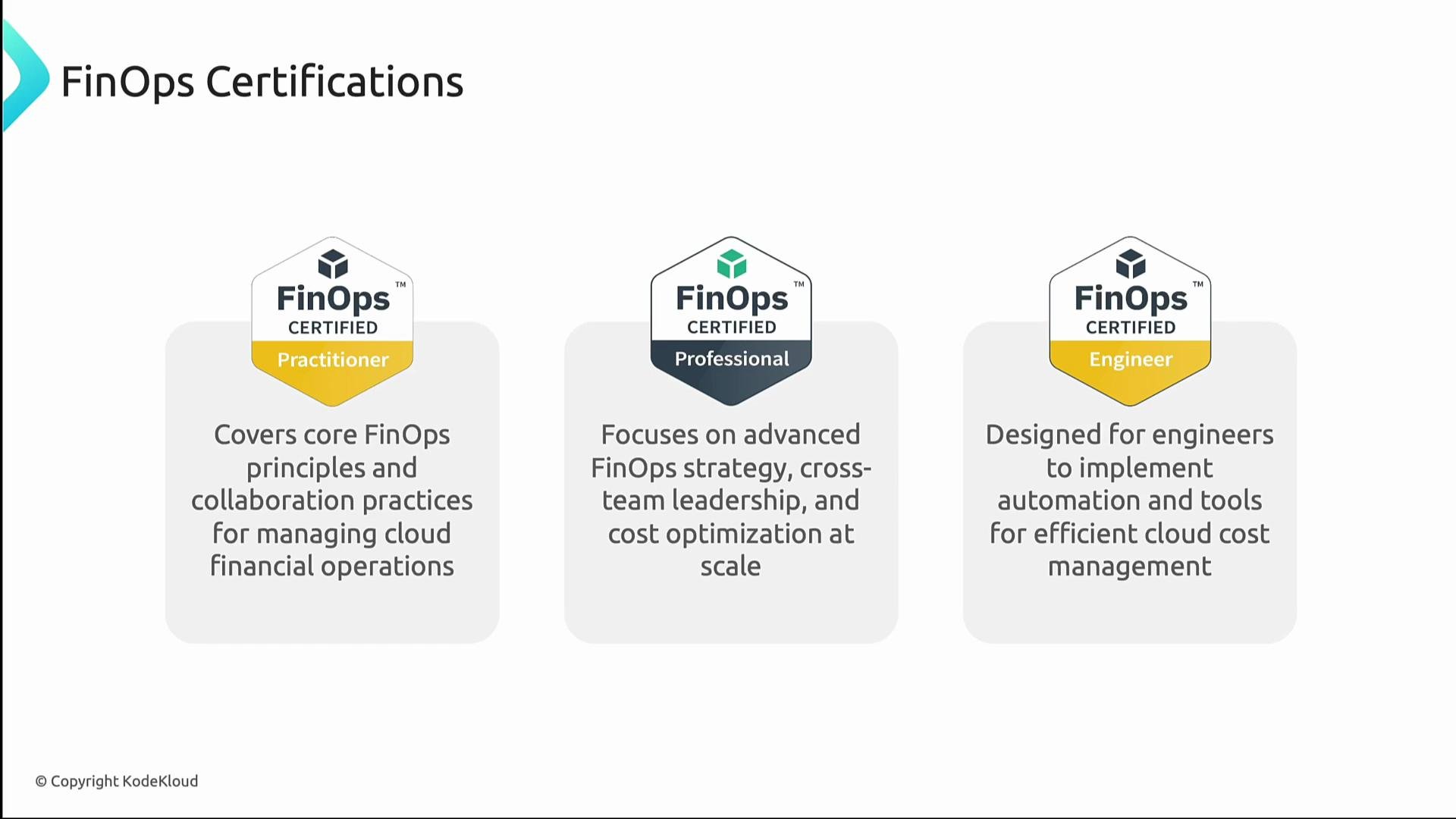
- The Practitioner level builds the foundation.
- The Professional level covers governance, stakeholder engagement, and program growth.
- The Engineer level dives into automation, integrations, and cost-control mechanisms.
Specialized certifications — target skills for specific domains
As you progress beyond the core tiers, specialized certifications deepen domain-specific expertise:-
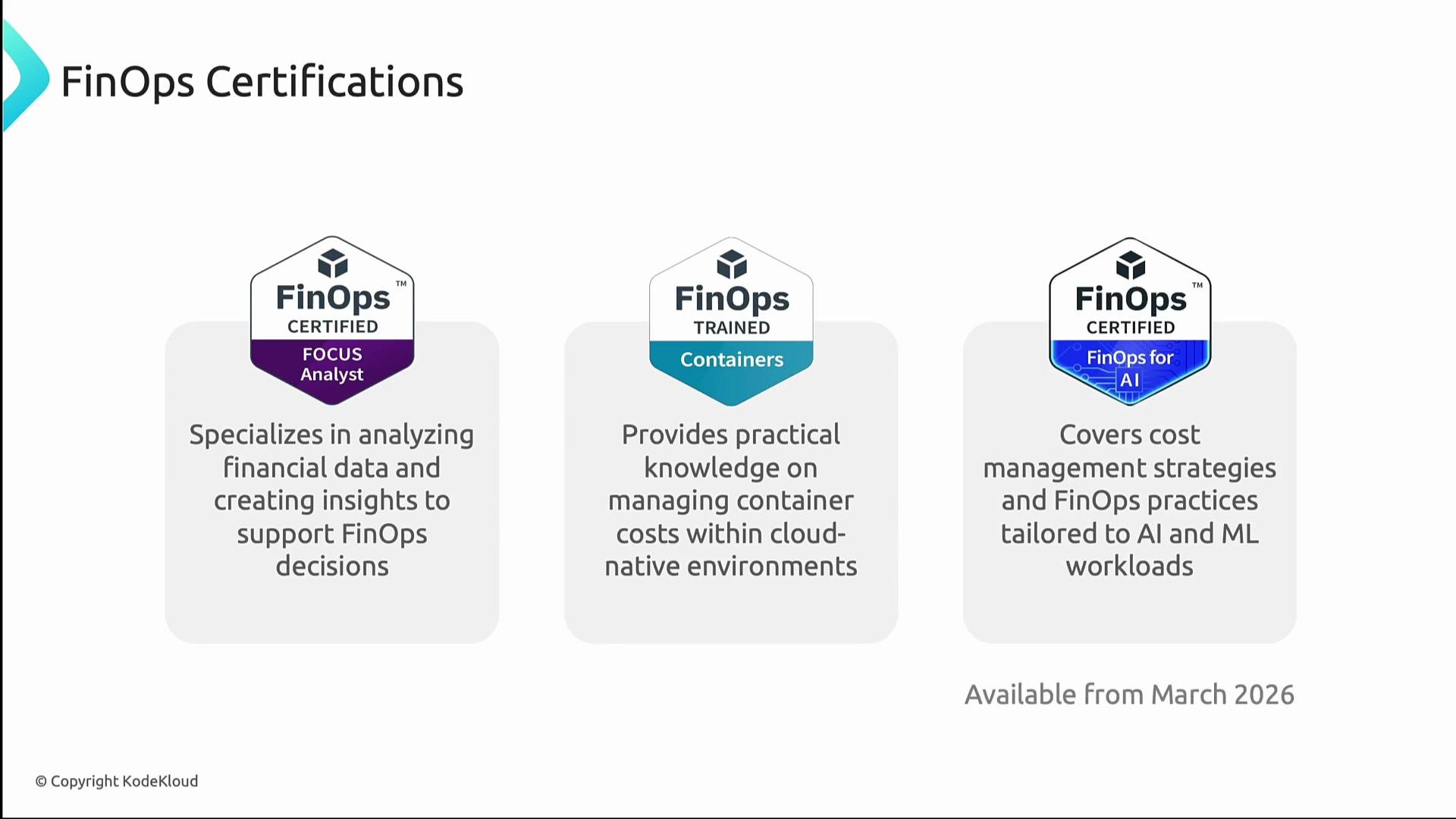
FinOps Certified FOCUS Analyst
- Emphasizes financial reporting, data modeling, and actionable insights from cloud cost data.
- Ideal for finance analysts, BI teams, and anyone who produces cost analytics to support decisions.
-
FinOps Certified Containers
- Concentrates on cost management for containerized workloads, Kubernetes, and orchestration patterns.
- Practical for teams optimizing container resources, autoscaling, and multi-tenant clusters.
-
FinOps Certified AI Engineer (available from March 2026)
- Covers cost strategies for AI/ML workloads: GPU utilization, training vs. inference economics, and pipeline optimization.
- Targets ML engineers and platform teams responsible for model training and inference cost-efficiency.
How to choose the right certification for you
- New to FinOps: Start with the FinOps Certified Practitioner to build a common language and fundamentals.
- Leading a program or cross-functional initiative: Pursue the FinOps Certified Professional for strategy, governance, and stakeholder engagement techniques.
- Building automation or platform tooling: Choose FinOps Certified Engineer to deepen technical skills in cost controls and automation.
- Working in a niche domain (analytics, containers, AI/ML): Add the appropriate specialized certification to gain targeted expertise.
Recommended learning path
- FinOps Certified Practitioner — learn fundamentals (visibility, allocation, collaboration).
- Gain practical experience applying the framework in your environment.
- Choose Professional or Engineer based on whether your role is strategic or technical.
- Add specialized certifications (Analyst, Containers, AI) for domain-specific impact.
Study tips and preparation resources
- Combine theory with hands-on projects: implement tagging, allocation, and cost reporting in a sandbox account.
- Collaborate across teams: run a cost review with Finance and Engineering to practice stakeholder communication.
- Use official course materials and practice exams where available.
- Track measurable outcomes (cost savings, unit economics, cloud efficiency) to demonstrate impact.
Links and references
- FinOps Foundation — Official Site
- FinOps Certification Overview — FinOps Foundation
- Cloud cost optimization resources: