

- Right‑Sizing Optimization
- Spot / Preemptible Instance Strategy
- Storage Optimization
- Network Optimization
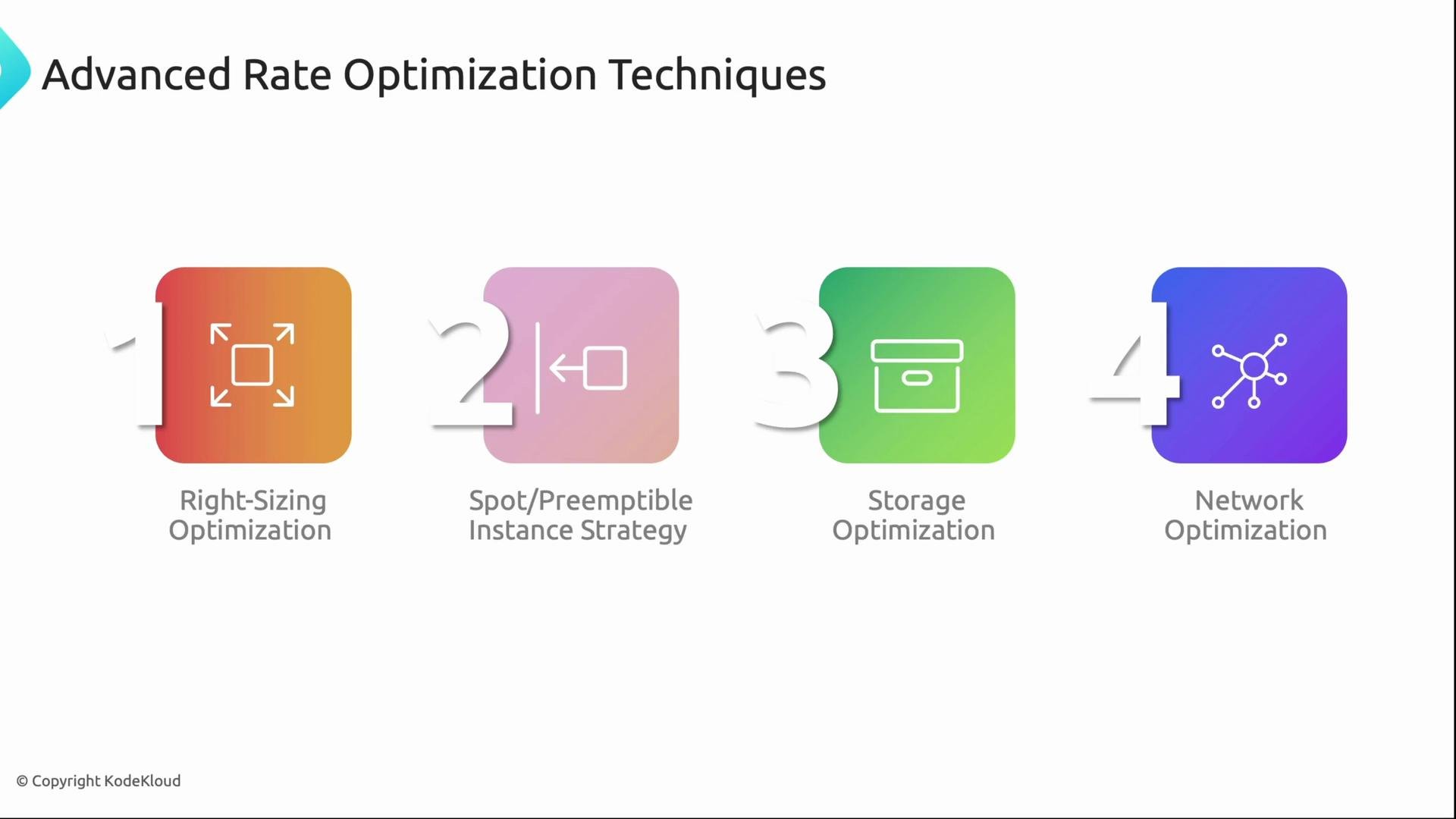
Right‑Sizing Optimization
Goal: match compute size and family to actual workload requirements—avoid paying for unused CPU, memory, or I/O capacity. What RideNow did- Collected utilization metrics (CPU, memory, disk I/O, network) over a representative 2–4 week period using cloud-native monitoring and third‑party tools.
- Identified consistently underutilized instances and workloads with headroom that could be consolidated.
- Resized instances, moved workloads to smaller families, or consolidated multiple low‑utilization instances onto fewer hosts.
- Inform: collect and analyze metrics to detect candidates for resizing.
- Optimize: execute safe changes (resize, consolidate, change family).
- Operate: continuously monitor and automate where possible to prevent regression.
- Metric & analysis: CloudWatch, Prometheus, Datadog, or similar platforms for baseline collection and anomaly detection.
- Automation: use IaC (Terraform, CloudFormation), scripts, or cloud recommendations with automated rollbacks for safe deployment.
- Governance: set review windows, tagging, and approval workflows to ensure business-critical workloads are not downsized inadvertently.
- Example savings observed by RideNow: 20–50% on compute spend where idle capacity was common.
- Tradeoffs: risk of insufficient capacity if baselines are too short. Use canary changes, load tests, and rollback playbooks.
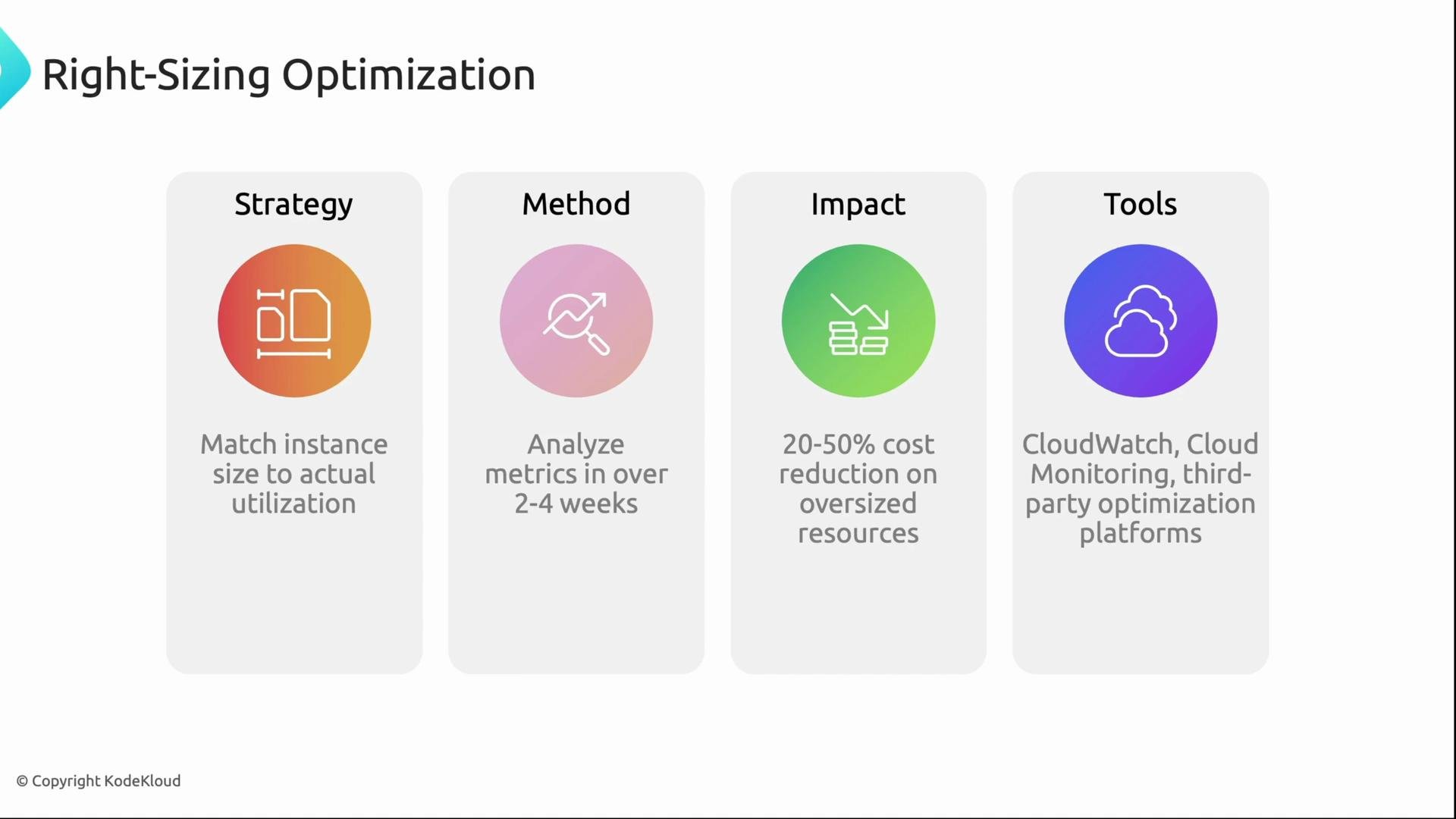
Spot / Preemptible Instance Strategy
Overview: Spot (AWS) or preemptible (GCP) instances are heavily discounted compute that providers can reclaim on short notice. Best for fault‑tolerant, resumable, or non‑latency‑sensitive workloads. RideNow use cases- Nightly ML training and batch ETL jobs that support checkpointing and restart.
- Test and build workloads in CI pipelines that can tolerate interruption.
- Use managed instance pools or Auto Scaling Groups with a mixed policy: a small baseline of on‑demand capacity plus spot for overflow.
- Implement checkpointing, retries, graceful shutdown hooks, and state storage on durable services (e.g., S3, GCS).
- Orchestrate with Kubernetes node pools using a mix of on‑demand and spot nodes (with pod disruption budgets and graceful termination handling).
- RideNow saw 60–70% cost reductions for applicable batch workloads; discounts vary by region and instance type (often 60–90% off on‑demand for many families).
- Tradeoffs: eviction risk—architect for interruptions and maintain a minimum on‑demand baseline for critical services.
Spot/preemptible instances can be terminated with little notice. Ensure your workloads are designed for interruption (checkpointing, retries, fault‑tolerance) and keep a minimum on‑demand base capacity to preserve service availability.
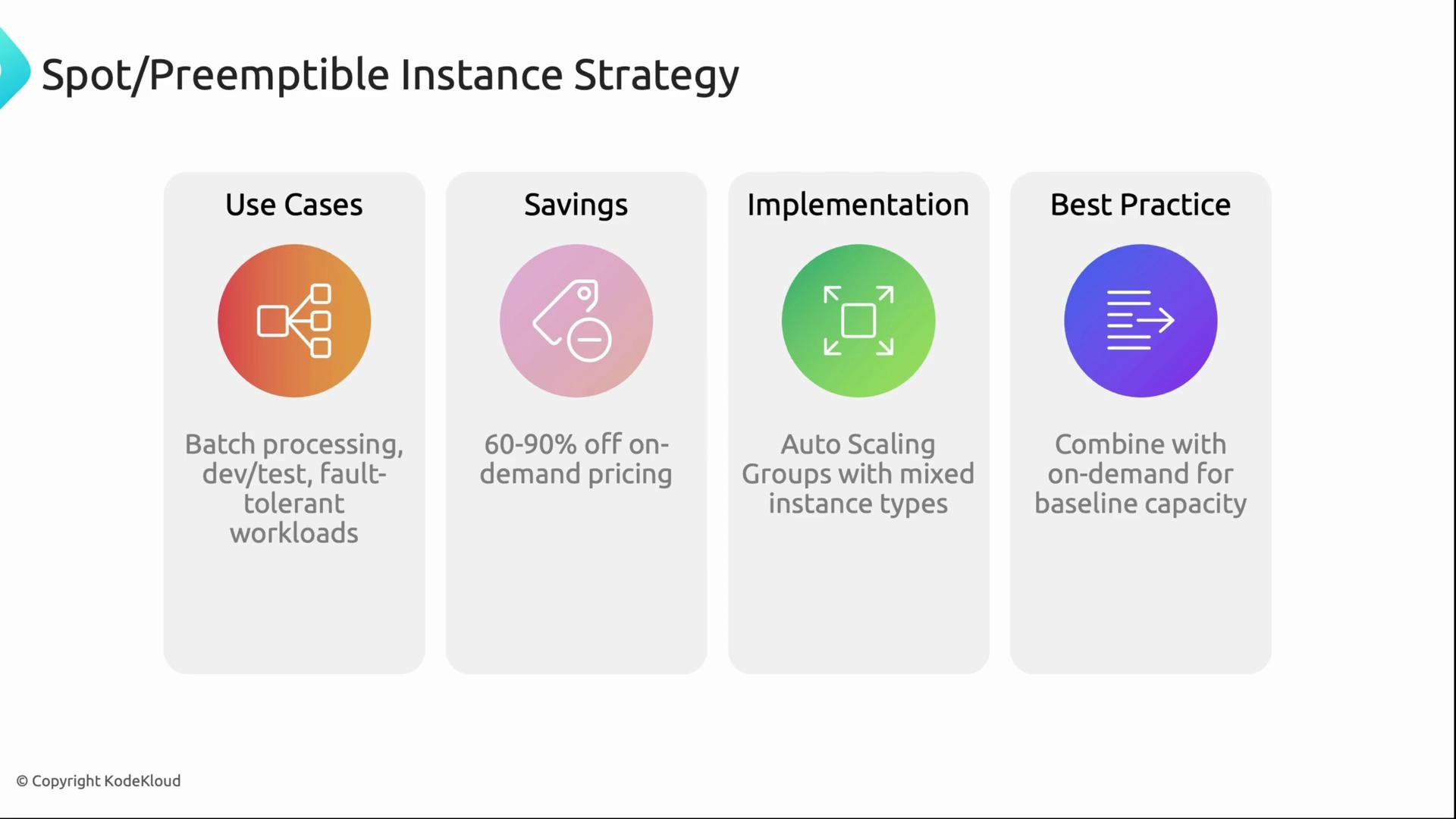
Storage Optimization
Overview: Not all data needs the same performance or availability. Tier storage by access pattern to save money, and automate lifecycle transitions. RideNow use case- Trip telemetry and application logs accumulate rapidly; only a small fraction require immediate access.
- Implemented lifecycle rules to move objects from hot → warm → cold → archive (e.g., transition logs older than 30 days to a colder tier).
- Use built‑in lifecycle management and intelligent tiering:
- AWS: S3 Lifecycle policies, S3 Intelligent‑Tiering
- Azure: Blob lifecycle management
- GCP: Object Lifecycle Management
- Define expected access patterns and test retrieval costs; configure monitoring and alerts for unexpected read spikes.
- Example reductions: 50–80% lower storage costs depending on volume and proportion moved.
- Tradeoffs: higher retrieval latency and potential per‑GB retrieval charges for archived data—include these in total cost analysis.
Be careful: moving frequently accessed objects into cold storage can increase retrieval costs and latency. Validate access patterns and include retrieval cost in your total cost analysis.
Network Optimization
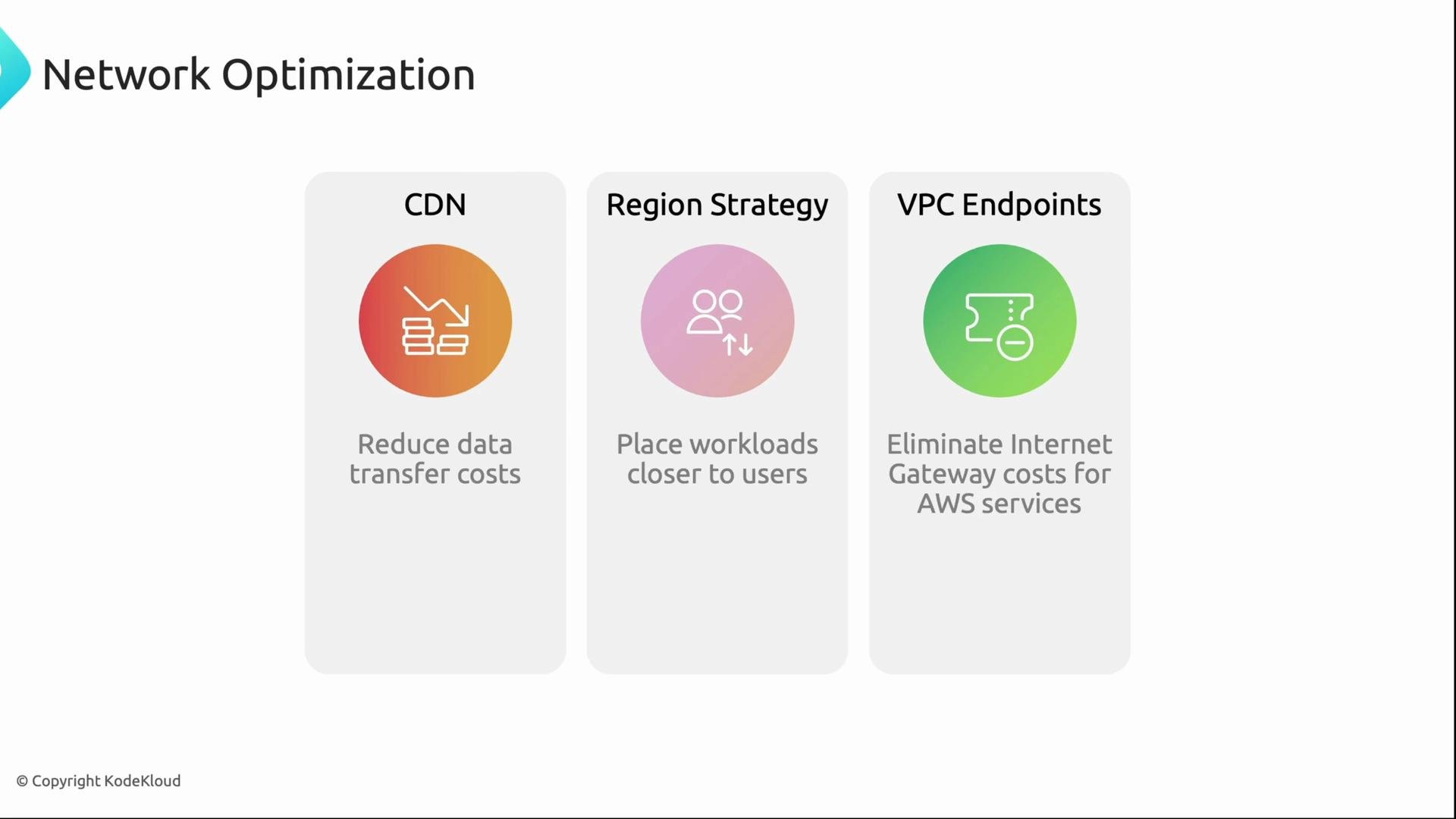
Overview: Egress and cross‑region transfers can be a significant expense for global services. Reduce unnecessary data movement, cache content, and place services closer to users. RideNow approaches- CDN: serve static assets (images, JS, styles) from edge locations to reduce origin egress.
- Regional placement: deploy services near major user clusters (e.g., Europe, Asia) to minimize cross‑region transfer.
- Private connectivity & endpoints: use VPC endpoints or private links for cloud services to limit traffic through NAT/Internet Gateways.
- Audit network flows and egress costs to find high‑cost paths.
- Apply tiered caching, set aggressive TTLs for cacheable responses, and use origin shielding if supported to reduce origin load.
- Evaluate any per‑hour or per‑GB costs for private endpoints against the savings from reduced NAT/Internet egress.
Summary: Combined Impact & Best Practices
RideNow combined these tactics within a continuous FinOps loop—measure (inform), act (optimize), and maintain (operate)—and realized meaningful cost reductions across compute, storage, and networking. Key takeaways- Measure before acting: collect representative metrics for compute, storage access, and network flows.
- Automate safely: use IaC, canaries, and rollback strategies when applying optimizations.
- Match optimization to workload:
- Spot/preemptible: batch, fault‑tolerant jobs.
- Right‑size: stable services with predictable load.
- Storage tiering: archival and infrequently accessed objects.
- Network: CDN and region placement for user‑facing traffic.
- Operate continuously: optimization is ongoing—schedule periodic reviews and automated detection.
Links and references
- AWS EC2 Spot Instances
- GCP Preemptible VMs
- AWS CloudWatch
- S3 Lifecycle Management
- VPC Endpoints (AWS)