

FinOps is a cultural practice as much as a set of tools. The six principles below are designed to help teams turn cloud cost visibility into repeatable, value-driven actions across engineering, operations, and finance.
- Collaboration between teams
The first principle is collaboration. Development, operations, and finance teams should work iteratively and in real time to improve costs, speed, and product outcomes. Collaboration is more than scheduled meetings — it’s a shared way of working. Example actions:
- Weekly review sessions between engineers and finance to spot anomalies and optimization opportunities.
- Shared Slack channels or dashboards for cost alerts and decisions.
- Jointly agreed KPIs that balance speed and cost (e.g., deployment velocity vs. cost per feature).
- Everyone owns their cloud usage
The second principle is ownership. Teams and individuals who deploy resources should be accountable for those resources and their cost impact. Ownership drives accountability and cost-aware behavior. Example actions:
- Tagging conventions and chargeback/showback reports so teams see their own spend.
- Cost reviews during pull requests that estimate incremental monthly run-rate.
- Team-level budgets and alerts that trigger remediation workflows.
- Make FinOps data accessible, timely, and accurate
The third principle centers on data. Teams need reliable, near-real-time cost and usage data to make good decisions. This includes clear dashboards, threshold alerts, and self-serve reporting. Example actions:
- Centralized cost dashboard with per-team filters and drilldowns.
- Automated alerts for cost spikes and forecasting gaps.
- Shared exports of cost data for product owners and engineers.
- Centralized management and influence
The fourth principle is central management of FinOps capabilities and governance. A central FinOps function sets standards, curates best practices, and ensures alignment across the organization — but it need not sit under any specific organizational silo. Example actions:
- A central team defining tagging standards, naming conventions, and guardrails.
- Governance policies for procurement (reserved instances, savings plans).
- Regular reviews of compliance and cost posture with empowered remediation paths.
- Value-driven decisions
The fifth principle stresses business value as the primary decision driver. FinOps helps you weigh cost against business outcomes: revenue, user retention, or product velocity. Example actions:
- Cost-benefit analysis for high-cost features before wide rollout.
- Product metrics linked to cost measures (e.g., cost per active user).
- Prioritization frameworks that include cost as a component of ROI.
- Take advantage of the cloud’s financial flexibility
The sixth principle is to use cloud pricing models intentionally. Cloud gives many pricing options; use them as your usage patterns mature. Example actions:
- Start with on-demand for early development and scale into committed discounts as usage stabilizes.
- Evaluate reserved instances, savings plans, committed use discounts, and spot/preemptible instances for non-critical workloads.
- Run experiments to determine where interruptions are acceptable (spot instances) versus where long-term commitments reduce unit cost.
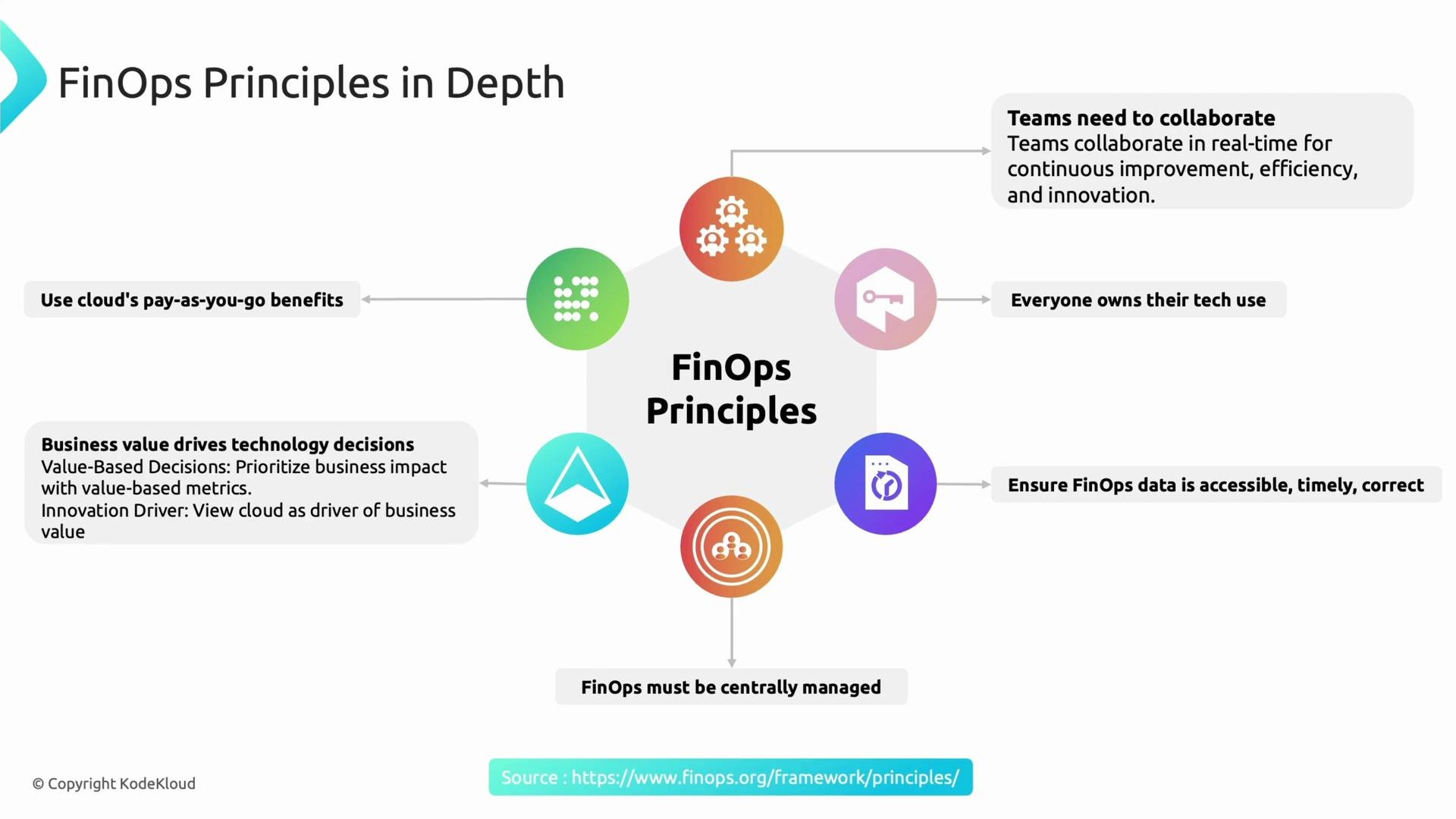
To recap, the six FinOps principles are:
- Collaboration across teams
- Individual and team ownership of cloud usage
- Accessible, timely, and accurate FinOps data
- Central management with organization-wide influence
- Business-value-driven decisions
- Intentional use of cloud financial models (beyond simply on-demand)
- We’ll later map these principles to a concrete AWS best practice so you can see how multiple principles apply together in a real-world use case. Not every principle will apply equally to every decision, but FinOps helps you consistently favor value-driven outcomes.
- Further reading:
- FinOps Foundation: https://www.finops.org/
- AWS Cost Management: https://aws.amazon.com/aws-cost-management/
Tip: Start small — implement one principle well (for example, visibility and ownership) and expand. Quick wins like tagging and alerts create momentum for deeper governance and purchasing optimizations later.