

What the Iron Triangle means
The Iron Triangle helps teams be explicit about priorities. When stakeholders ask for “everything” (high quality, low cost, and fast delivery), the framework makes it possible to show which two dimensions will realistically be prioritized and which will be impacted.The three vertices
-
Quality
Quality includes performance, reliability, and security. In cloud terms this often means choosing higher-performing instances, ensuring redundancy, and selecting premium storage or database options. Examples:- EC2 instances with enhanced networking and larger instance types
- Multi-AZ or multi-region deployments for redundancy
- Premium EBS volumes (io2) for latency-sensitive databases
- Strong security controls (IAM, encryption, monitoring)
-
Cost
Cost encompasses budget constraints, consumption efficiency, and procurement approaches. Typical cost-optimization tactics:- Reserved Instances / Savings Plans for predictable compute
- Spot Instances for interruptible, fault-tolerant workloads
- Use of similar instance families to simplify rightsizing and reuse
- Cost-aware architectures (scheduled start/stop, autoscaling)
-
Speed
Speed covers time-to-market, deployment velocity, and operational agility. To maximize speed teams typically choose managed services and streamlined CI/CD:- Managed services (RDS, Aurora) vs. self-managed databases
- Serverless (Lambda) and other FaaS/PaaS for faster provisioning
- Automated CI/CD pipelines and Infrastructure as Code for repeatable deployments
How this maps to operational contexts
Below are common mappings of operational contexts to the Iron Triangle and what each implies in practice.-
Production-critical workloads (Quality-focused)
Prioritize reliability and performance. Expect higher-cost decisions: redundant architecture, premium instances/storage, multi-AZ/region setups, and frequent backups. Appropriate for mission-critical databases and customer-facing systems. -
Quality + Speed (High quality and high speed)
Achieve both reliability and rapid responsiveness by accepting premium pricing. Example: a primary production database on memory-optimized instances with Multi-AZ replication and read replicas for low latency and high availability. -
Quality + Cost (High quality and low cost)
Aim for reliability while minimizing ongoing cost—often at the expense of deployment velocity. This pattern fits systems where correctness matters but changes can be scheduled (e.g., analytically focused data warehouses that run batch jobs overnight). -
Speed + Cost (High speed and low cost)
Optimize for rapid iteration with low spend—good for dev/test or proofs-of-concept. Typical choices: Spot instances, burstable families (T3/T4g), ephemeral environments, and serverless prototypes. These accept lower performance guarantees and higher interruption risk.
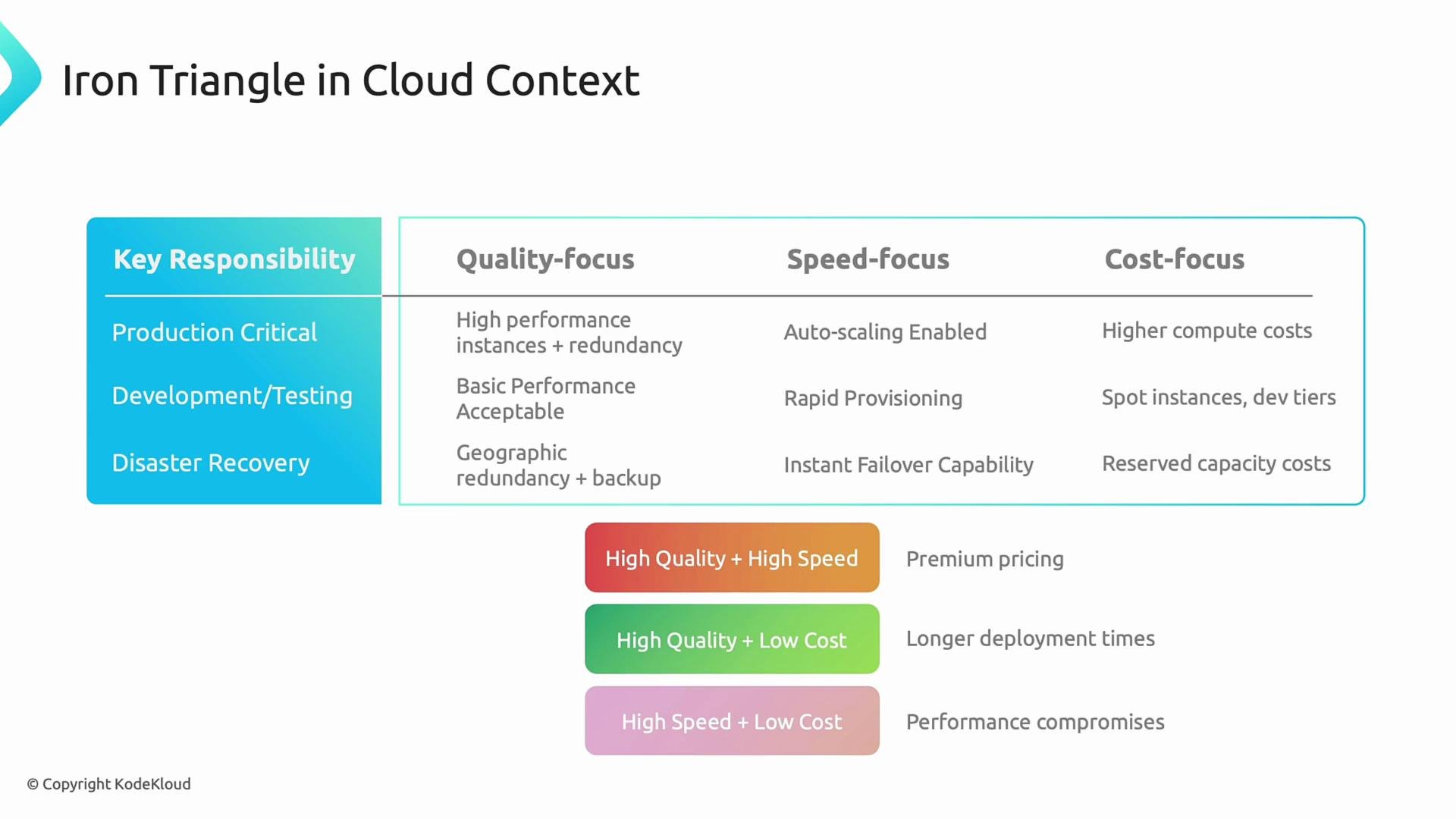
Use the Iron Triangle as a conversation tool: explicitly identify which two dimensions you will prioritize for a given effort, and document the expected impact on the third.
Applying the framework — practical steps
Follow these steps when applying the Iron Triangle to projects, architectures, or procurement:- Clarify priorities: Ask stakeholders which two vertices matter most for this project (Quality, Cost, Speed).
- Translate to architecture: Map the chosen pair to concrete technical choices (instances, managed services, redundancy patterns, procurement models).
- Document impacts: Record how the deprioritized dimension will be affected and what trade-offs are acceptable.
- Mitigate: Use targeted mitigations to soften negative impacts (automation to improve speed, gradual refactoring to improve quality without large cost spikes, or lifecycle policies to reduce cost over time).
- Re-evaluate: Reassess after delivery—should the trade-offs persist, or is a refactor/optimization warranted?
Quick checklist for FinOps practitioners
- Make the trade-off explicit in project documentation and runbooks.
- Use the Iron Triangle during budget planning and architecture reviews.
- Align procurement choices (Reserved vs. Spot vs. On-demand) to your chosen pair.
- Use automation (CI/CD, IaC) to reduce the friction between speed and cost where possible.
- Revisit trade-offs regularly—business priorities and traffic patterns change.