

Definitions
- Showback — Provides visibility into consumption and cost without transferring budget responsibility. Teams receive reports like “your microservice cost $10,000” but are not billed; the goal is awareness and education.
- Chargeback — Allocates cloud costs directly to consuming business units or teams, making the reported spend part of their official budget and financial accountability.
- With showback you notify the team: “Your service cost $10,000.” They may act on it or not.
- With chargeback you allocate that $10,000 to their budget, making them financially accountable.
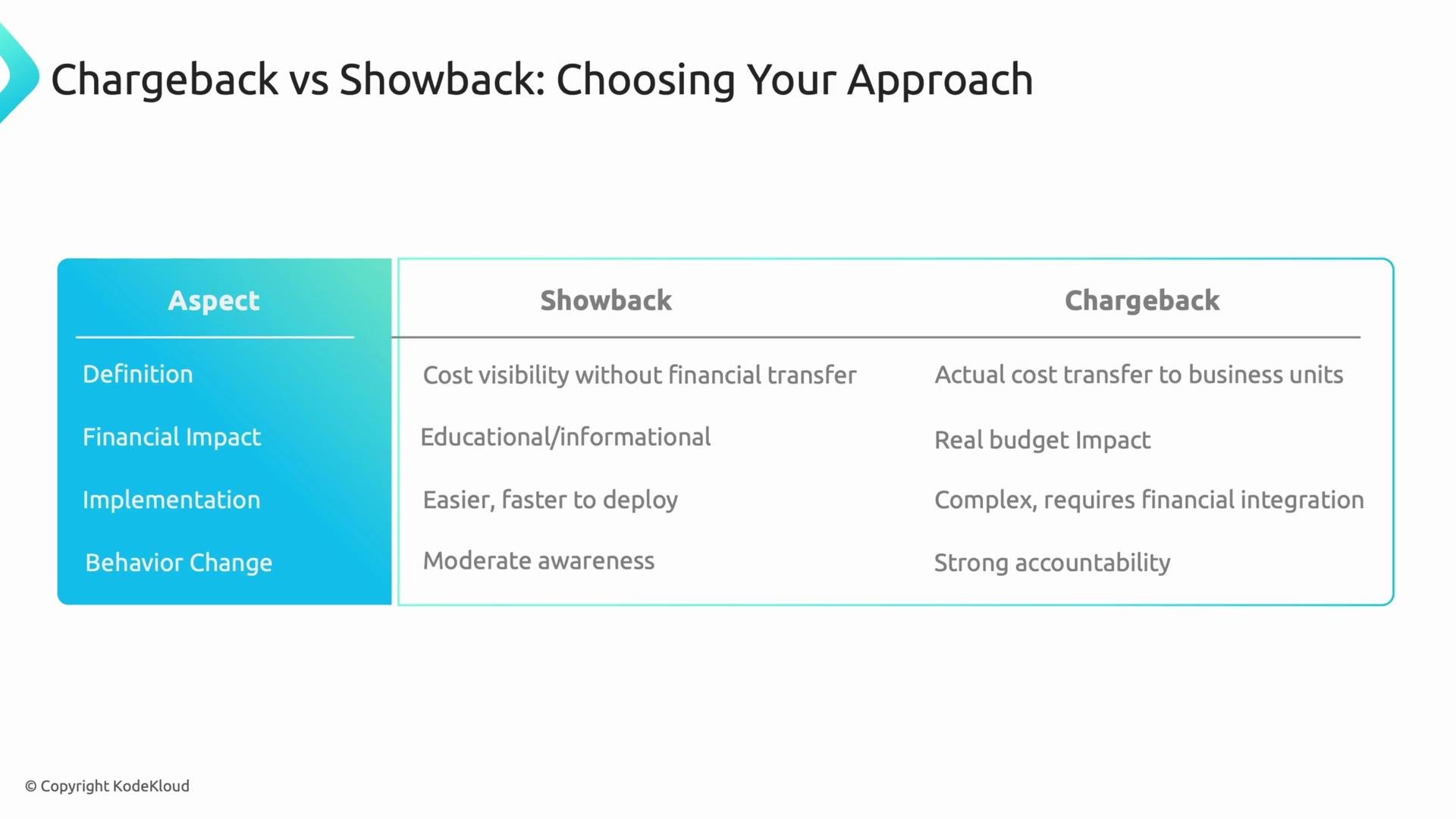
Comparison across key aspects
The table below summarizes core differences and operational requirements between showback and chargeback.Showback is a low-friction entry point to FinOps: it builds visibility and cultural awareness. Chargeback delivers stronger incentives but depends on reliable cost allocation, governance, and organizational buy‑in.
When to use each approach
When to use Showback
Showback is ideal when the goal is to inform teams and encourage learning without imposing immediate financial consequences. Common scenarios:- Early-stage FinOps adoption where culture change is the priority.
- Shared services (e.g., central logging, monitoring) where transparency into split costs matters.
- Developer experience and non-production environments to preserve agility.
- When you want fast visibility with low operational overhead.
- Faster to implement.
- Low risk of disrupting delivery velocity.
- Useful for validating tagging and allocation before enforcing charges.
When to use Chargeback
Chargeback is suitable for organizations that need teams to own their cloud budgets and have the processes to do so reliably. Typical scenarios:- Production workloads and business units that must manage their own budgets.
- Organizations that require explicit financial accountability and prioritization of optimization work.
- When accurate tagging, allocation rules, and finance integration are in place.
- Robust tagging policies and automated cost allocation.
- Clear allocation rules documented and agreed by stakeholders.
- Integration with billing or ERP systems for actual budget transfer.
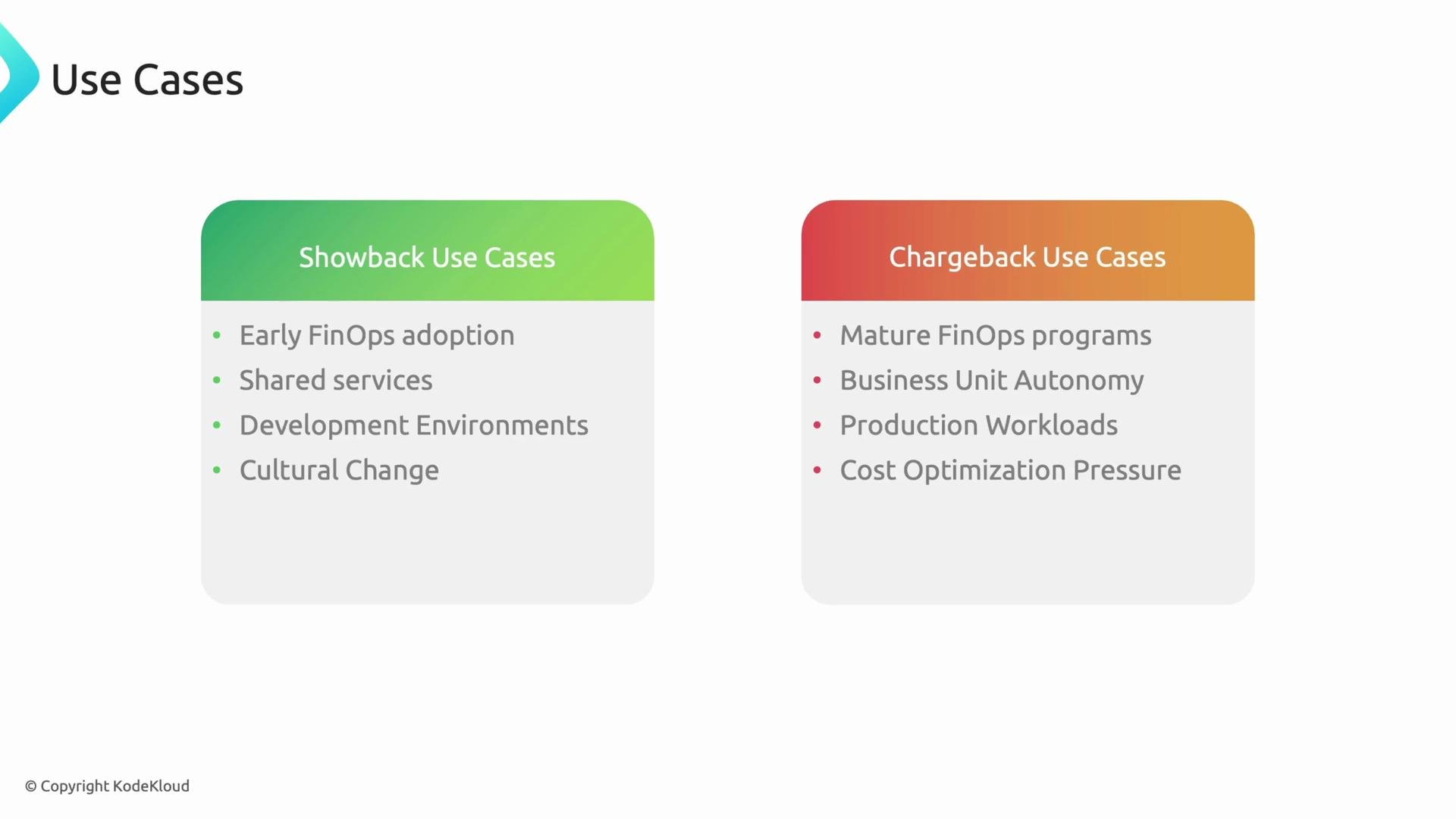
Avoid applying chargeback prematurely—charging dev teams for exploratory or iterative work can reduce velocity and create friction. Only move to chargeback after tagging, allocation methods, and stakeholder alignment are proven.
Additional considerations
- Adoption curve: Many organizations start with showback, iterate on tagging and allocation, then move to chargeback once accuracy and trust are established.
- Incentives: Hybrid programs may combine chargeback with incentives (e.g., returning a portion of savings to teams) to align optimization goals; such schemes require careful design and governance.
- Tooling & governance: Chargeback typically needs automated cost allocation tools and finance integration. Showback can often be implemented with dashboards and scheduled reports.
- Allocation models: Common allocation mechanisms include tags, resource groups, usage metrics, or activity-based allocation. Document and publish allocation rules to avoid disputes.
Quick reference table
Resources and further reading
- FinOps Foundation — https://www.finops.org/
- Cloud cost best practices — https://cloud.google.com/solutions/cost-management (example)
- Tagging strategy guidance — search vendor docs for your cloud provider (AWS, Azure, GCP)
Summary
- Use showback to build visibility and culture with minimal disruption.
- Use chargeback when you have the maturity, accurate allocation, and organizational alignment to make teams financially accountable.
- Choose the model that matches your organizational maturity, the environment (dev vs prod), and your readiness for governance and process change.