

FinOps benefits — at a glance
Engineering persona
Engineers and platform teams gain concrete tools and practices that reduce waste and improve predictability:- Optimized cloud pricing: Apply rightsizing, reserved/commitment plans, and spot/preemptible instances (e.g., reserved instances, committed use discounts, savings plans). Note that spot/preemptible instances are interruptible.
- Accountability for utilization: Use tagging/labels, billing exports, and cost-allocation tooling to provide per-team and per-application cost visibility. This links infrastructure choices to spend.
- Cost-aware architecture: Design decisions that consider storage classes, caching, and autoscaling reduce persistent cost drivers.
- Faster, more predictable delivery: Integrate cost metrics and optimization tooling into the CI/CD pipeline and deployment review process so teams ship quickly within budget.
- Automate rightsizing recommendations into pull-request checklists.
- Add cost alarms to staging and production environments to avoid surprise overages.
Procurement persona
Procurement teams use FinOps to convert raw cloud invoices into actionable purchasing decisions:- Cost visibility and unit economics: Measure cost per shipment processed, per customer interaction, or other business-level units with attribution and allocation.
- Activity-based costing: Implement granular costing by activity/service to enable accurate internal chargebacks and reconciliation.
- Contract and license visibility: Centralize oversight of cloud contracts, licenses, and entitlements to avoid unused seats and penalties.
- Forward-looking negotiation: Leverage historical consumption and forecasts to negotiate better terms and commitment discounts with cloud providers.
- Forecasts and commitment recommendations based on usage trends.
- License utilization dashboards to retire unused entitlements.
Product persona
Product managers make better trade-offs when they can map costs to features:- Feature-level spend visibility: Attribute cloud costs to features or product lines (e.g., real-time shipment tracking vs. batch reporting).
- Cost-driven prioritization: Prioritize features with the best value-to-cost impact, re-scope or replace expensive components when needed.
- Experimentation with cost in mind: Use A/B experiments that include cost per transaction as a success metric.
- Add cost per feature as a KPI in product planning.
- Include engineers and finance in feature cost reviews before large rollouts.
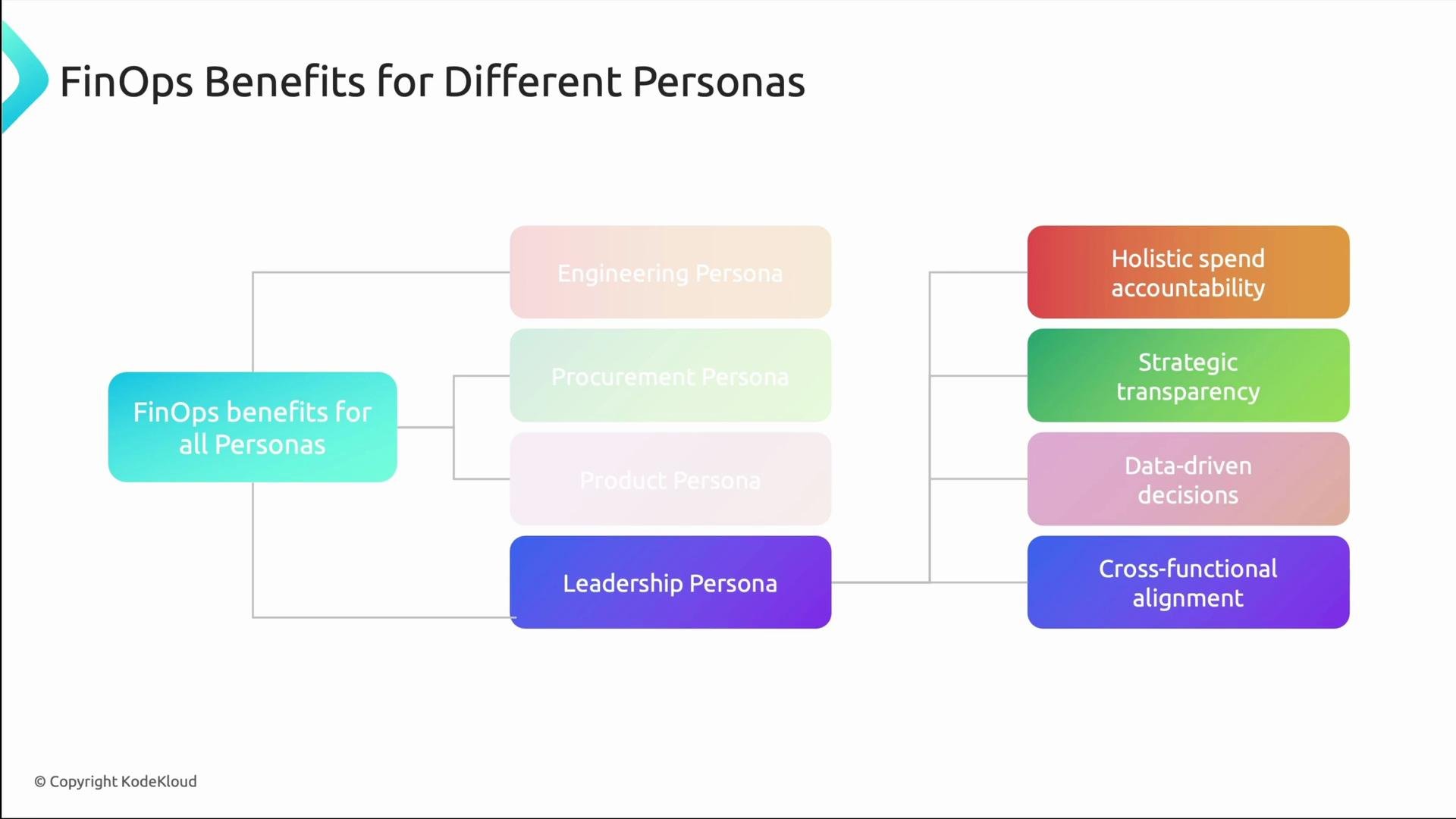
Leadership persona
Leadership gains the visibility and governance needed to set strategy:- Holistic spend accountability: Consolidated views across teams illuminate overages and optimization opportunities.
- Strategic transparency: Accurate spend and forecast data inform investment decisions and resource allocation.
- Data-driven decision making: Replace estimates with precise cloud metrics for planning and budgeting.
- Cross-functional alignment: FinOps fosters shared ownership among engineering, finance, procurement, and product.
- Use FinOps reports in board reviews and quarterly planning.
- Sponsor cross-functional FinOps rituals to maintain alignment and momentum.
FinOps is not just about cutting costs — it’s about maximizing cloud value by aligning technical, financial, and product decisions across the organization.
- FinOps creates measurable value for engineering, procurement, product, and leadership by tying cloud spend to business outcomes.
- The practice depends on telemetry, cost allocation, and cross-functional rituals that embed cost awareness into everyday work.
- Start small: prioritize high-impact areas (biggest spend or highest variability) and expand the practice iteratively.
- FinOps Foundation
- Kubernetes cost optimization patterns
- Cloud provider cost management docs (AWS, Azure, GCP) for provider-specific commitment and pricing options.