

- Basic state — You receive a cloud bill but cannot reliably allocate that spend to teams, services, or projects.
- Advanced state — You can allocate nearly every line item of your cloud bill to owners, identify overspend, and forecast with higher accuracy.
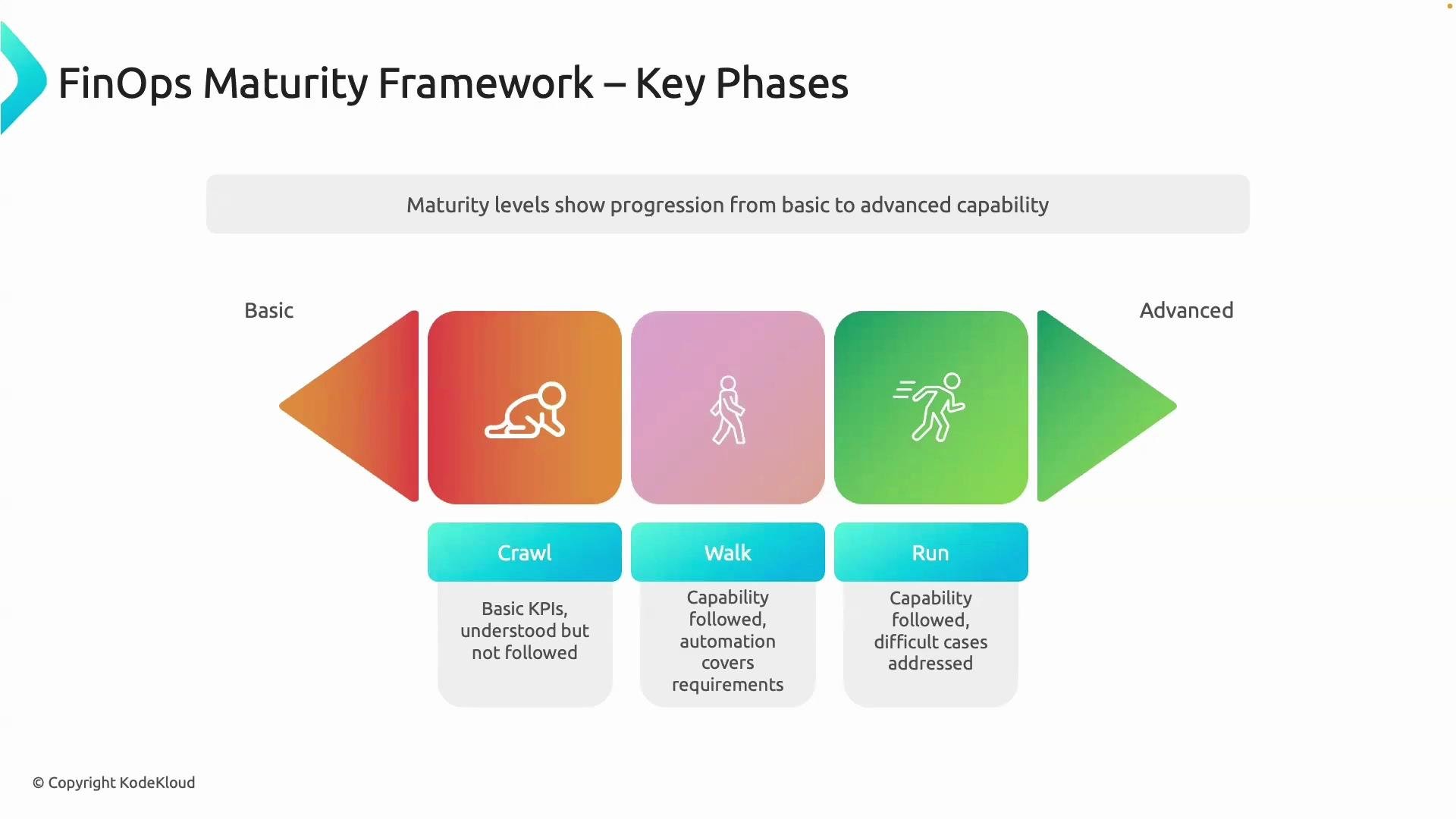
Crawl phase
- What it looks like: Reporting is limited. Teams rely on manual scripts, spreadsheet exports, or ad hoc cost reviews. Tagging and allocation policies may exist but are not consistently applied.
- Capabilities: Basic cost visibility, ad hoc investigations, limited automation.
- Typical goals (aspirational): Begin allocating at least a portion of spend; reduce forecasting variance (for example, target forecasting within ~20%).
- Common gaps: Inconsistent tagging, few automated policies, low organizational adoption of cost ownership or chargeback.
Walk phase
- What it looks like: Practices are becoming repeatable. Teams adopt tagging and allocation more consistently and automation begins to reduce manual effort. Reporting and anomaly detection are in place and acted upon.
- Capabilities: Consistent tagging and allocation for a majority of resources, automated reporting, routine cost reviews, and some cost-optimization workflows.
- Typical outcomes: Many organizations allocate 50–80% of spend, achieve forecasting within ~20% variance, and utilize a significant portion of discounts (for example, ~70% coverage where applicable).
- Why it matters: Walk is a scalable, stable stage where you can detect spikes, embed cost-awareness into engineering practices, and demonstrate measurable savings.
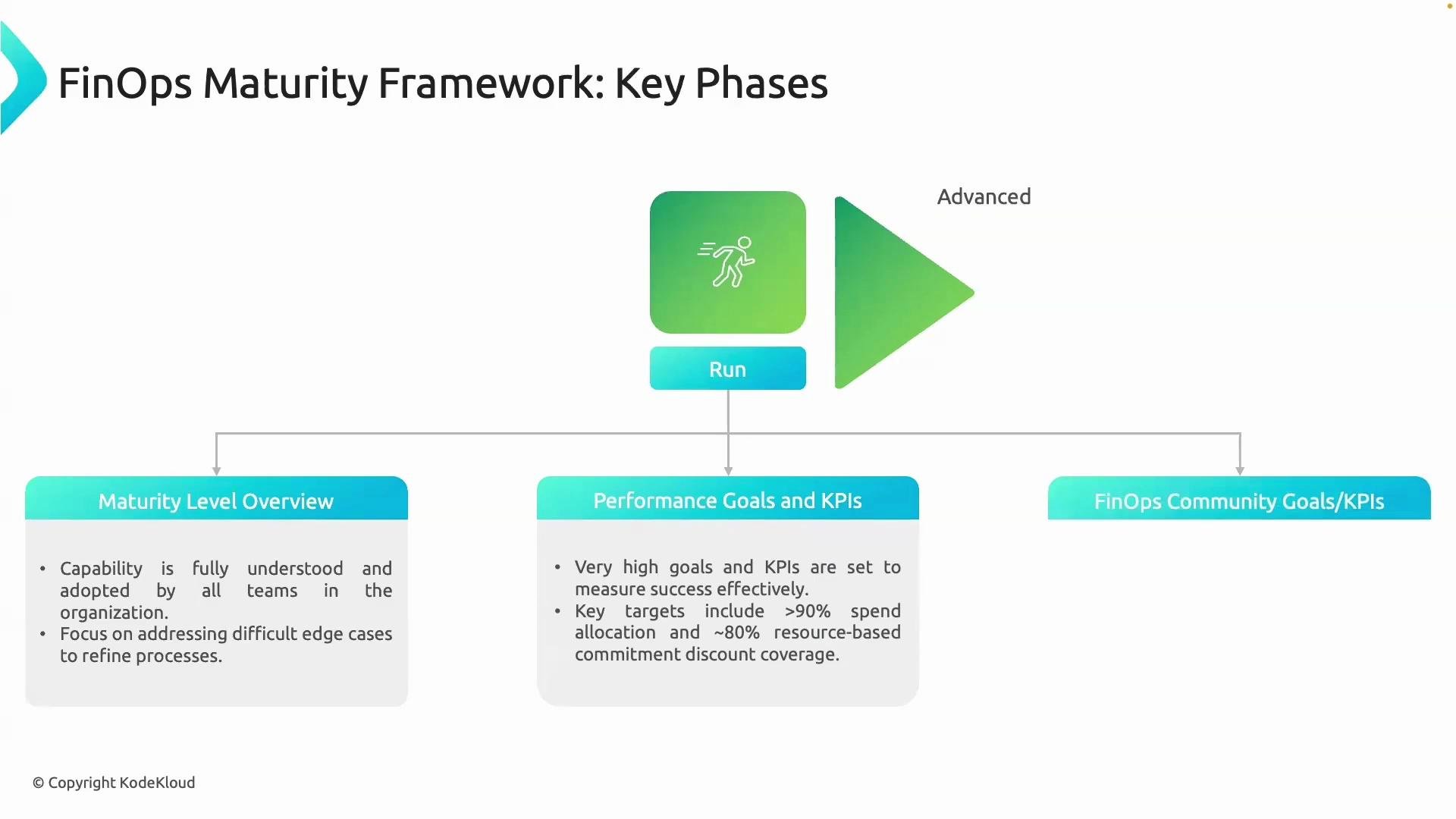
Run phase
- What it looks like: FinOps operates as an organizational operating model across engineering, finance, and product. Governance, automation, and proactive management are embedded.
- Capabilities: Near-complete allocation of spend, centralized and automated governance, aggressive use of discounts/commitments, and tight forecasting.
- Typical KPIs: 90%+ allocation of spend, 80%+ utilization of commitment/discount programs when applicable, and forecasting accuracy often within ~12%.
- Cultural impact: Cost KPIs are broadly understood; teams design with cost in mind and collaborate on optimization and vendor negotiations.
Phase comparison at a glance
Why understanding phases matters (exam and practice)
Knowing the differences among Crawl, Walk, and Run helps you:- Select the right tooling: lightweight reporting in Crawl vs. full FinOps platforms in Run.
- Prioritize work: tagging and repeatable reporting in Crawl/Walk; governance and commitment strategies in Run.
- Align stakeholders: different phases require different levels of finance, engineering, and product engagement.
Tip: Most organizations are in the Walk phase. Prioritize repeatable reporting, consistent tagging, and automation for anomaly detection to achieve fast ROI.
Actionable next steps by phase
- If you’re in Crawl:
- Formalize tagging taxonomy and ownership.
- Build repeatable cost reports (daily/weekly exports).
- Start small: allocate a subset of spend to test processes.
- If you’re in Walk:
- Automate reporting and anomaly alerts.
- Standardize allocation rules and share cost KPIs with teams.
- Improve discount coverage and begin commitment planning.
- If you’re in Run:
- Centralize governance and bake cost checks into CI/CD.
- Optimize across teams, refine forecasting, and lead negotiation strategies with providers.
- Continuously measure and publish KPIs across the organization.
References and further reading
- FinOps Foundation — resources, maturity models, and community best practices.
- Cloud cost management basics — vendor-specific cost tools and documentation.
- Kubernetes cost allocation guide — practical approaches for containerized workloads.