

Why FinOps matters
Imagine a company accelerating its cloud and technology adoption. Product teams move fast, launching features and services. Meanwhile, finance teams scramble to explain month-to-month billing spikes. This disconnect is common in fast-moving organizations. Below is a simplified view of a modern enterprise. On the left are the tech stacks — applications, platforms, and systems powering the business. On the right are the cloud stacks — infrastructure running on AWS, Azure, GCP, and other providers. The factory in the center represents operations, connecting both sides. Although this diagram looks straightforward, it hides a complex, growing set of costs. Cloud consumption happens across regions, teams, and environments in parallel. Many components must work together to deliver products end-to-end, and each contributes to total cloud spend. This example company operates in 13 countries, runs five manufacturing units, manages logistics up to last-mile delivery, and has over 8,000 employees — 2,000 of whom are in technology. You can imagine how quickly cloud costs can grow and how complex managing them becomes.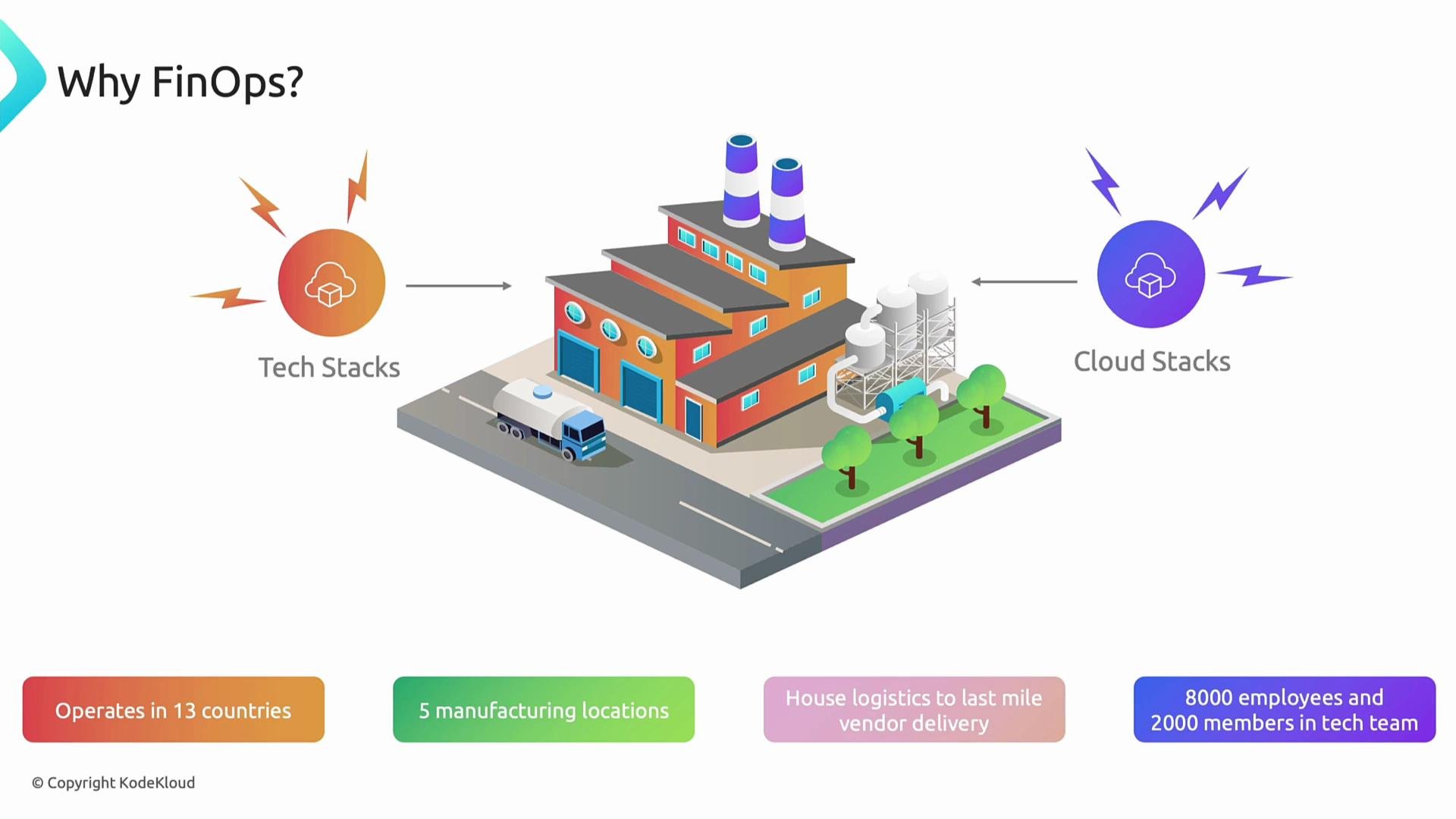
What happens without FinOps
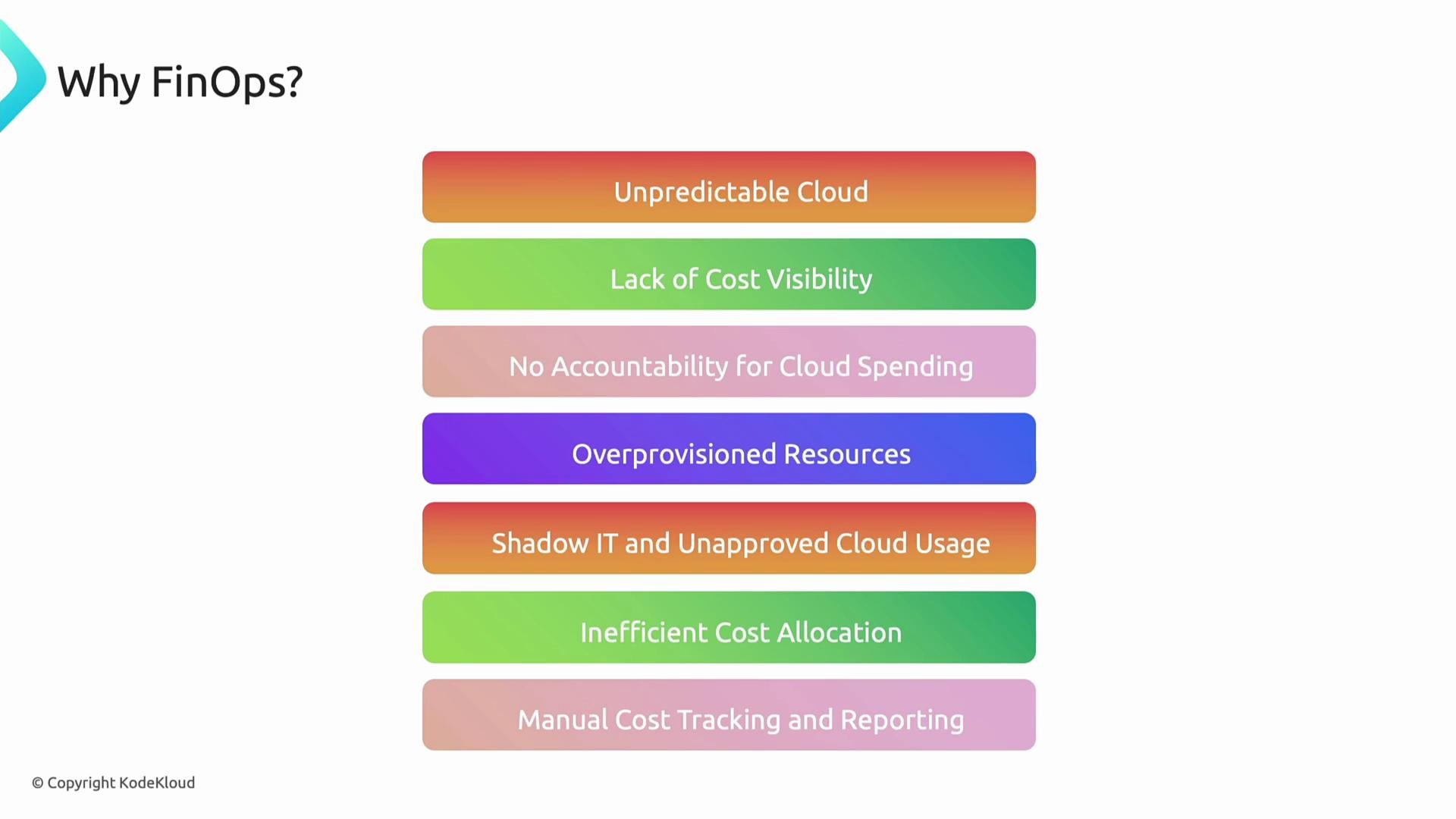
When a FinOps practice is absent, cloud spend quickly becomes unpredictable and inefficient:- Forecasts are unreliable and budgets are hard to trust.
- Cost visibility is limited — it’s unclear who is spending and why.
- Accountability is diffuse; engineering and finance point fingers.
- Resources are overprovisioned or left idle, wasting budget.
- Shadow IT grows as teams bypass governance to move faster.
- Cost allocation and reporting are manual and error-prone.
A core FinOps objective is to reduce this waste by creating shared ownership, improving visibility, and implementing governance that lets teams move fast while staying accountable.
The internal tug-of-war over cost ownership
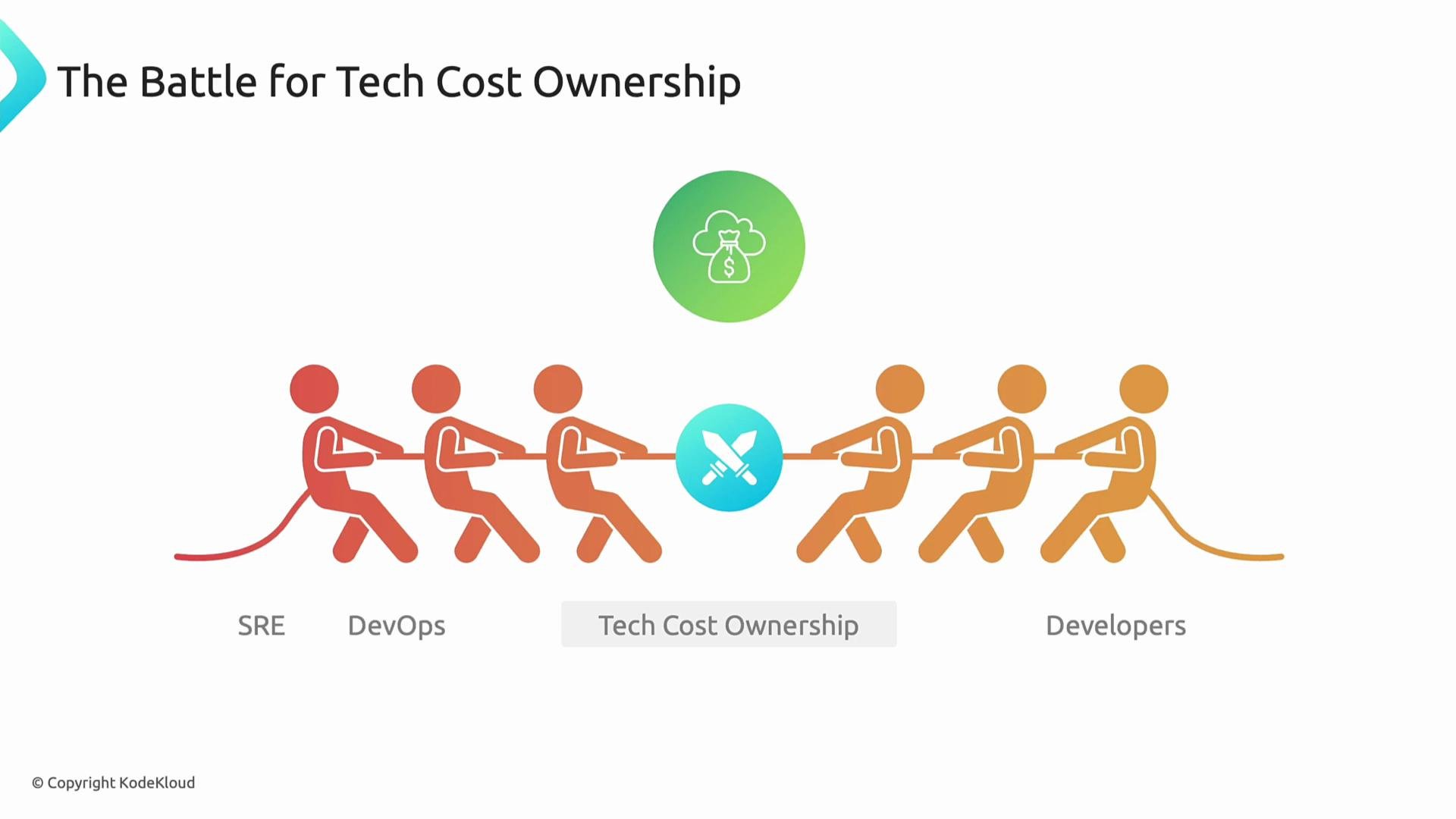
Internally, cloud cost often becomes a tug-of-war:- SREs and DevOps teams prioritize reliability and uptime.
- Developers prioritize fast feature delivery.
- Finance prioritizes forecasting, budget control, and compliance.
What is FinOps?
FinOps is a cultural practice, operating model, and a set of capabilities that bring together people, processes, and tools to manage cloud financials. It is not a single product — it’s a multidisciplinary approach that enables:- Faster product delivery with cost-awareness embedded into engineering workflows.
- Improved predictability of cloud spend and more accurate forecasts.
- Clear ownership and cost allocation across teams and products.
- Better financial control without hampering innovation.
- Cross-functional teams and steering committees.
- Cost transparency with tagging, reporting, and dashboards.
- Real-time and historical cost analysis.
- Budgeting, forecasting, and resource optimization processes.
- Automation for rightsizing, shutdowns, and reservation/purchase management.
Practical outcomes organizations achieve with FinOps:
- Measurable cost savings through optimization (rightsizing, reserved instances, sustained use discounts).
- Faster decision cycles because cost is visible and actionable.
- Predictable budgets and fewer surprise invoices.
- A culture of cost-conscious engineering without blocking innovation.
FinOps is not just a cost-cutting program. If implemented poorly, it can either become a policing mechanism that slows teams down or a set of isolated tactics that fail to produce sustainable governance. Focus on culture, measurement, and automation.
Conclusion
FinOps is about enabling innovation while ensuring accountability, predictability, and visibility into cloud spend. By aligning finance, engineering, and product teams, organizations can control costs without slowing delivery. Next lessons will dive into the FinOps framework, core lifecycle phases (Inform, Optimize, Operate), and the capabilities, metrics, and tooling patterns that make FinOps practical and effective. That concludes this lesson. Speak with you in the next one.Links and References
- FinOps Foundation — https://www.finops.org/
- Flexera: State of the Cloud Report 2022 — https://www.flexera.com/blog/cloud/2022/03/state-of-the-cloud-report-2022/
- AWS Cost Management Docs — https://aws.amazon.com/aws-cost-management/