Welcome — and congratulations on taking the first step toward mastering FinOps. If you’ve ever glanced at your cloud bill and wondered, “where did all that money go?”, you’re not alone. This course is designed to give you practical, actionable answers so you can reduce waste, improve visibility, and align engineering decisions with financial outcomes. I’m Raghunandana Sanur, and I’ll guide you through FinOps — the intersection of finance, operations, and cloud engineering. We’ll unpack the fundamentals, walk through real-world scenarios, and practice cost optimization using a hands-on, gamified format.
This course is ideal for DevOps engineers, cloud architects, finance stakeholders, and anyone responsible for cloud cost management. No prior FinOps certification required — bring your curiosity and cloud billing data.
Why FinOps matters:
  • Reduce cloud waste and improve ROI.
  • Increase collaboration between engineering and finance.
  • Empower teams to own their cloud spend without blocking innovation.
Organizations like Netflix and Spotify use FinOps practices to control costs and accelerate decision-making. In practice, adopting FinOps can lead to measurable savings and clearer accountability across teams. What to expect in this course:
  • Concepts explained through short lessons and hands-on games.
  • Practical exercises that simulate real cost-management scenarios.
  • Tools and techniques you can apply immediately to your cloud environment.
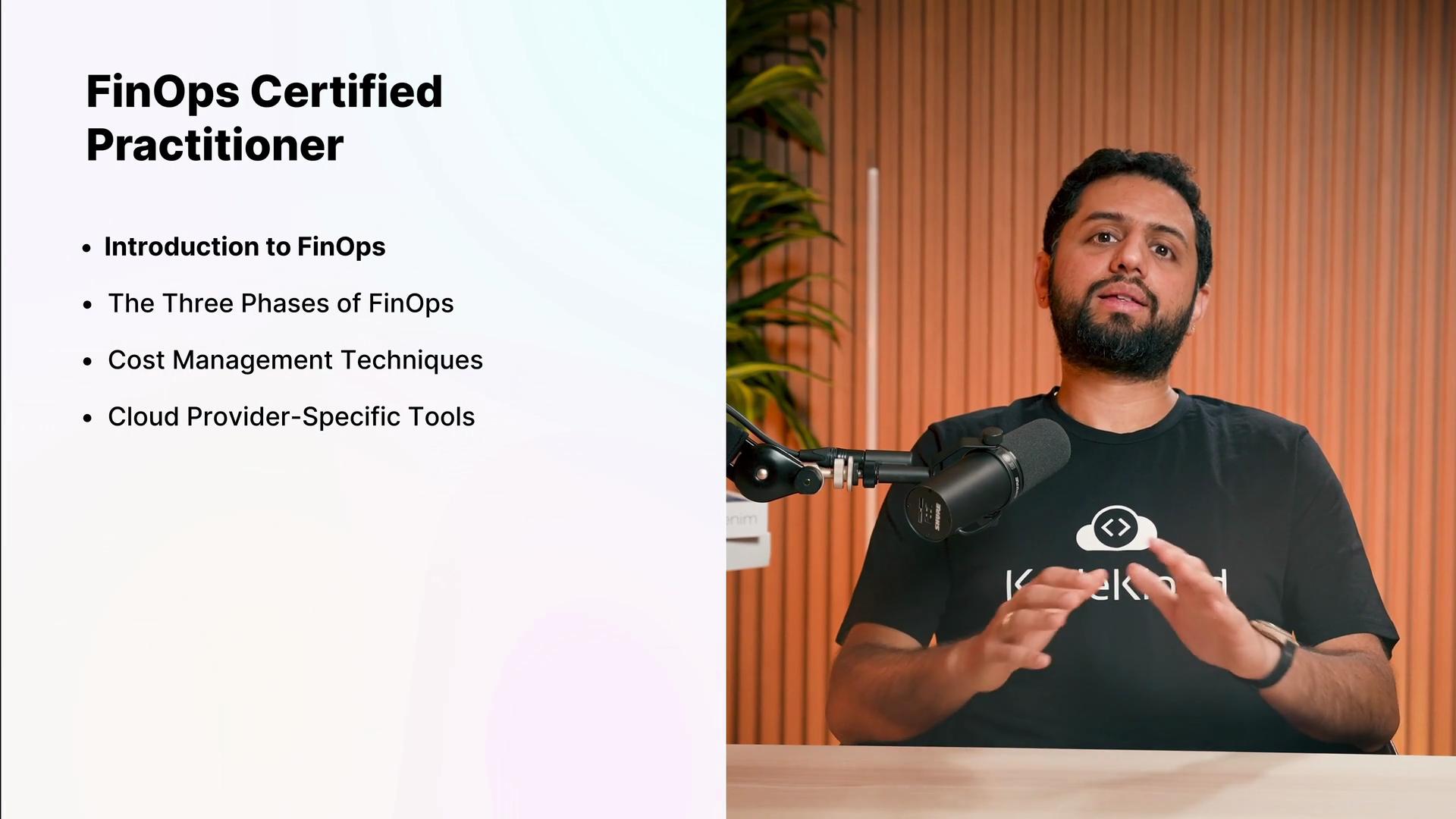
The image shows a person speaking into a microphone about becoming a FinOps Certified Practitioner, with topics including an introduction to FinOps and cost management techniques displayed on the left.
Course roadmap (high-level):
  • Introduction to FinOps and core principles
  • The three FinOps phases: inform, optimize, operate
  • Cost allocation, showback/chargeback, and forecasting
  • Provider-specific and cloud-agnostic tooling
  • Hands-on games to practice decision-making and trade-offs
FinOps in three phases
PhasePurposeKey activities
InformUnderstand and communicate costsTagging, cost allocation, billing analysis, dashboards
OptimizeReduce waste and right-size resourcesRightsizing, purchasing commitments, scheduling
OperateEmbed cost-aware engineeringPolicies, guardrails, runbooks, continuous monitoring
Next, we’ll look at tools and dashboards across providers so you can apply the three phases in real environments. We cover native and third-party tools, including:
  • AWS Cost Explorer and related AWS Cost Management features
  • Azure Cost Management and reporting tools
  • GCP Billing and cost reports
  • Cloud-agnostic dashboards and reporting tools for multi-cloud visibility
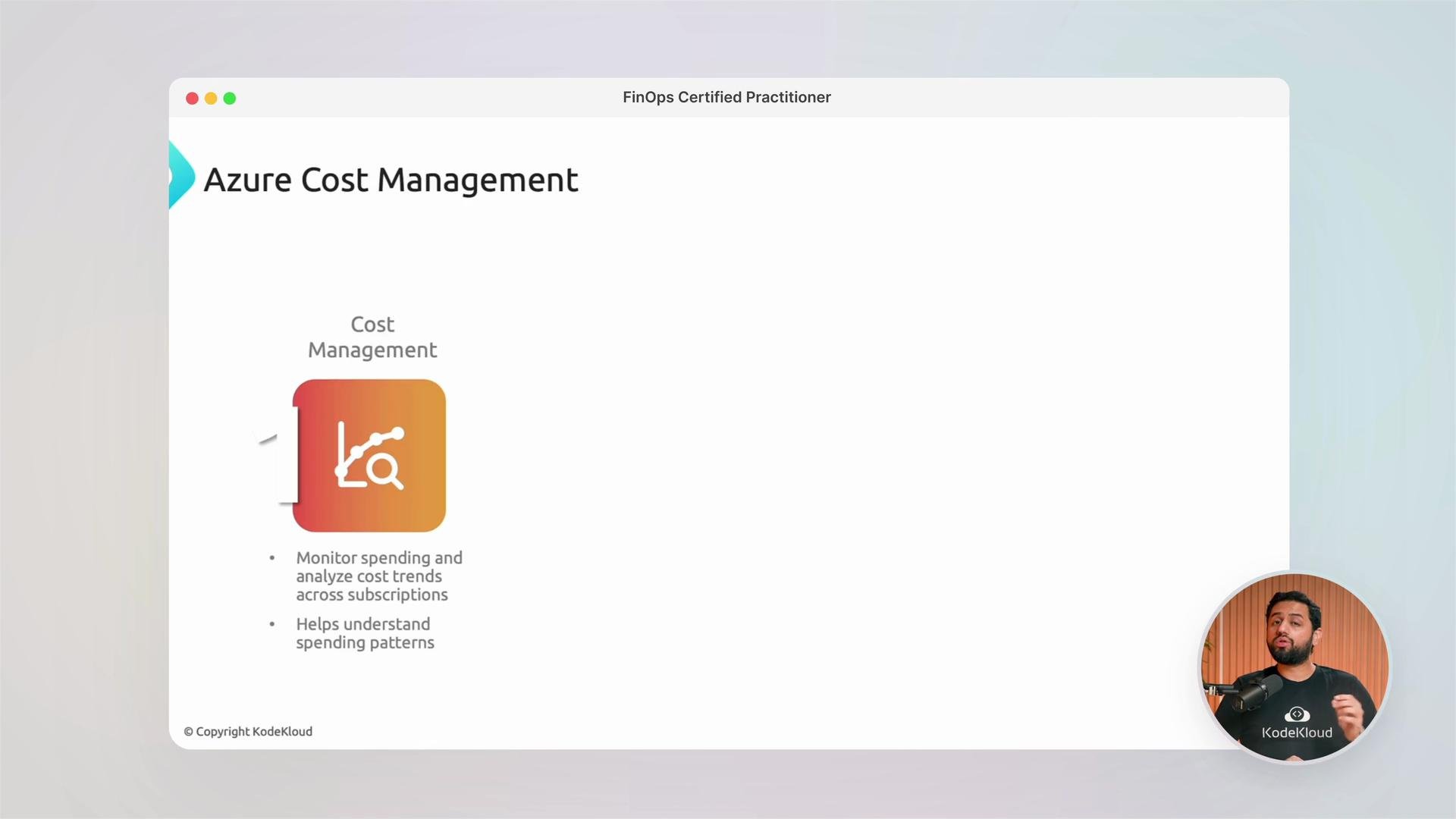
The image is a slide presentation about "Azure Cost Management" with an icon and bullet points emphasizing monitoring and analyzing cost trends. There's also a person in a circular video frame on the lower right corner.
FinOps is not just cutting budgets or spreadsheets. It’s about:
  • Forecasting future spend and capacity
  • Sharing accountability across teams with showback and chargeback models
  • Giving engineers the visibility and autonomy to make cost-effective choices
By the end of this course, you will be able to:
  • Participate confidently in FinOps discussions and meetings
  • Lead cost-efficiency initiatives and recommend optimizations
  • Apply practical techniques to reduce cloud waste and improve ROI
Community and continued learning At KodeKloud, community learning accelerates real outcomes. Use the forum to ask questions, share strategies, and collaborate with peers on exercises and game scenarios.
The image is a webpage from KodeKloud promoting its community features with text about joining study groups and forums, and it includes a world map with profile pictures connected by lines. There are buttons for joining Discord and a community forum, and a circular inset shows a person speaking into a microphone.
Recommended resources and references: Get ready to dive in — we’ll answer the first question you probably have in mind.

Watch Video