

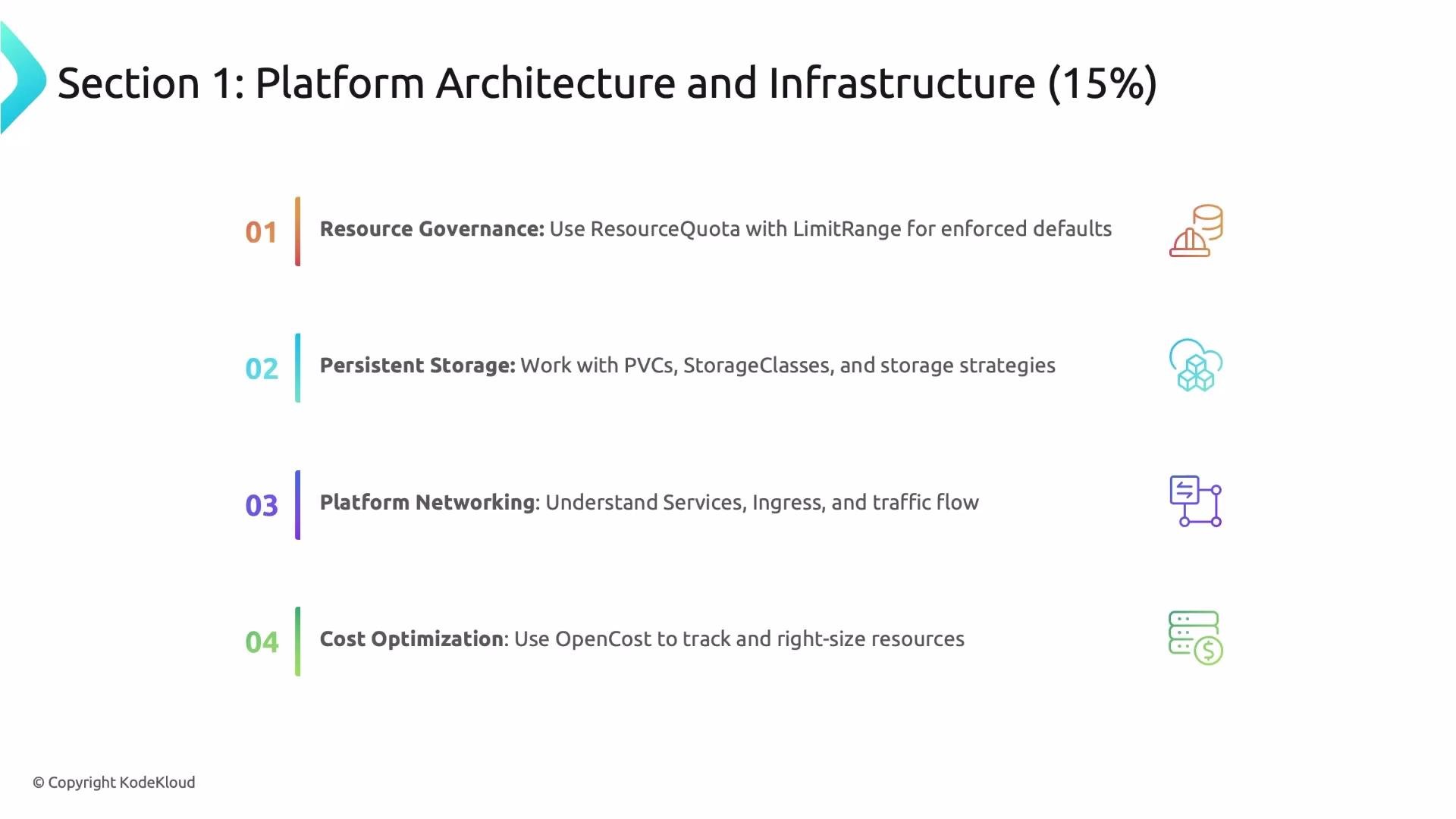
- Resource governance: Use
ResourceQuotafor namespace-level quotas andLimitRangefor per-pod/container defaults and limits — these controls complement each other to enforce resource discipline and predictable cluster behavior. - Persistent storage: Understand
PersistentVolumeClaims(PVCs),StorageClassparameters, and reclaim policies for lifecycle and cost control. - Platform networking: From Cluster Services through the Gateway API, learn how traffic flows across the platform and how ingress/east-west connectivity is managed.
- Cost optimization: Use tools like OpenCost to identify idle resources, right-size workloads, and reduce platform spend.
- GitOps principles: Desired-state configuration, drift detection, and repository design patterns for collaboration and auditability.
- Argo CD deep dive: Applications, sync policies, self-heal, pruning, and Helm integration for reproducible deployments.
- CI/CD with Tekton: Tasks, Pipelines, Workspaces, and how to structure pipelines for repeatable, testable delivery.
- Progressive delivery: Argo Rollouts (or similar) combined with Istio or other service meshes to implement canaries and traffic-splitting strategies.
- Troubleshooting delivery failures: Common failure modes, rollback strategies, and recovery patterns for production incidents.
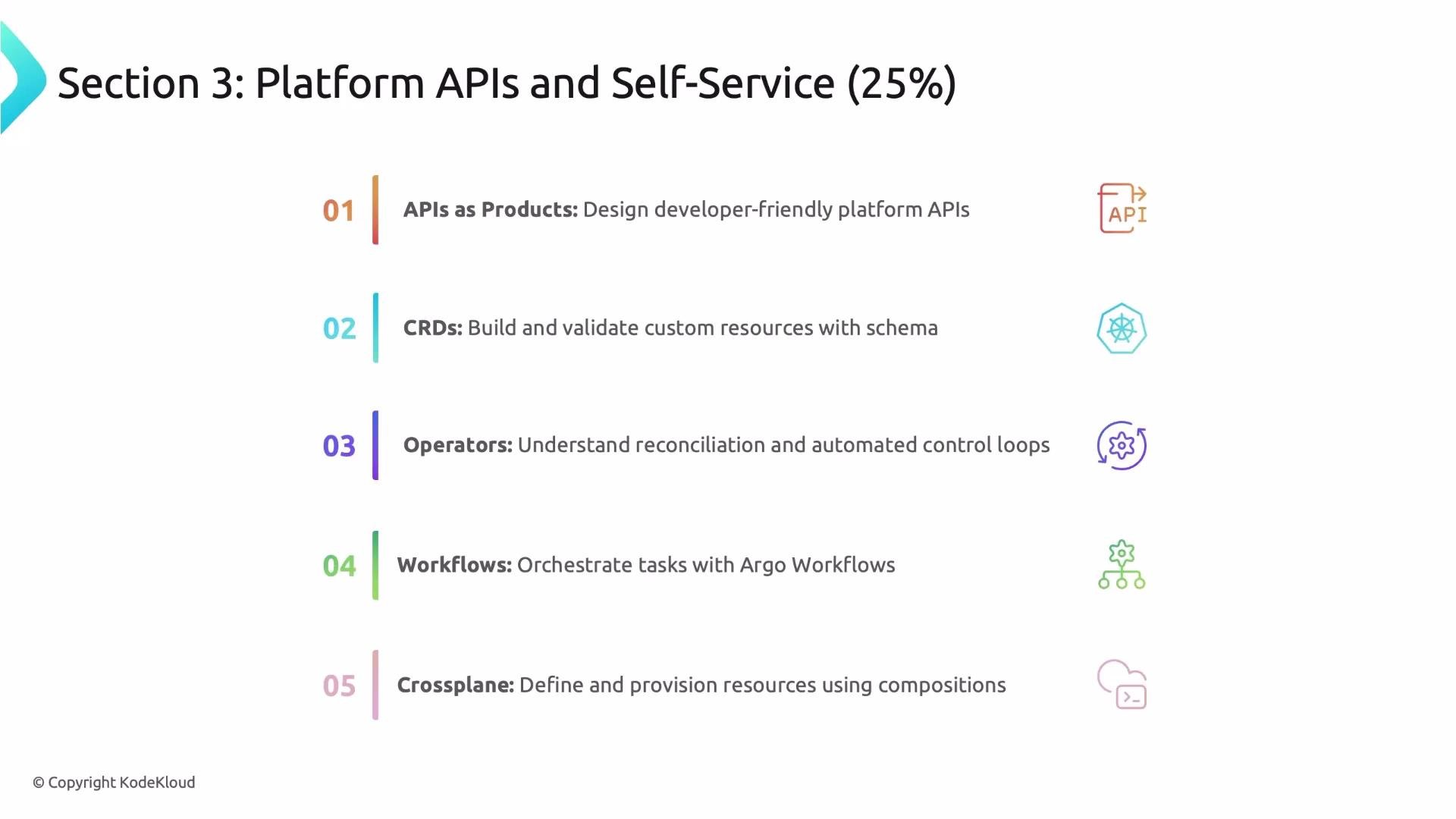
- APIs as products: Design developer-friendly contracts and clear service level expectations for platform-managed resources.
- CRDs: Validation schemas, short names, versioning, and upgrade strategies to minimize breaking changes.
- Operators and reconciliation: How reconciler loops, backoffs, and idempotency enable reliable automation (cert-manager is a concrete example that manages TLS lifecycle).
- Workflow orchestration: Argo Workflows — DAGs, parameters, artifacts, templates — for complex CI/CD and data pipelines.
- Crossplane compositions: Translate developer-facing custom resources into cloud infrastructure and managed services.
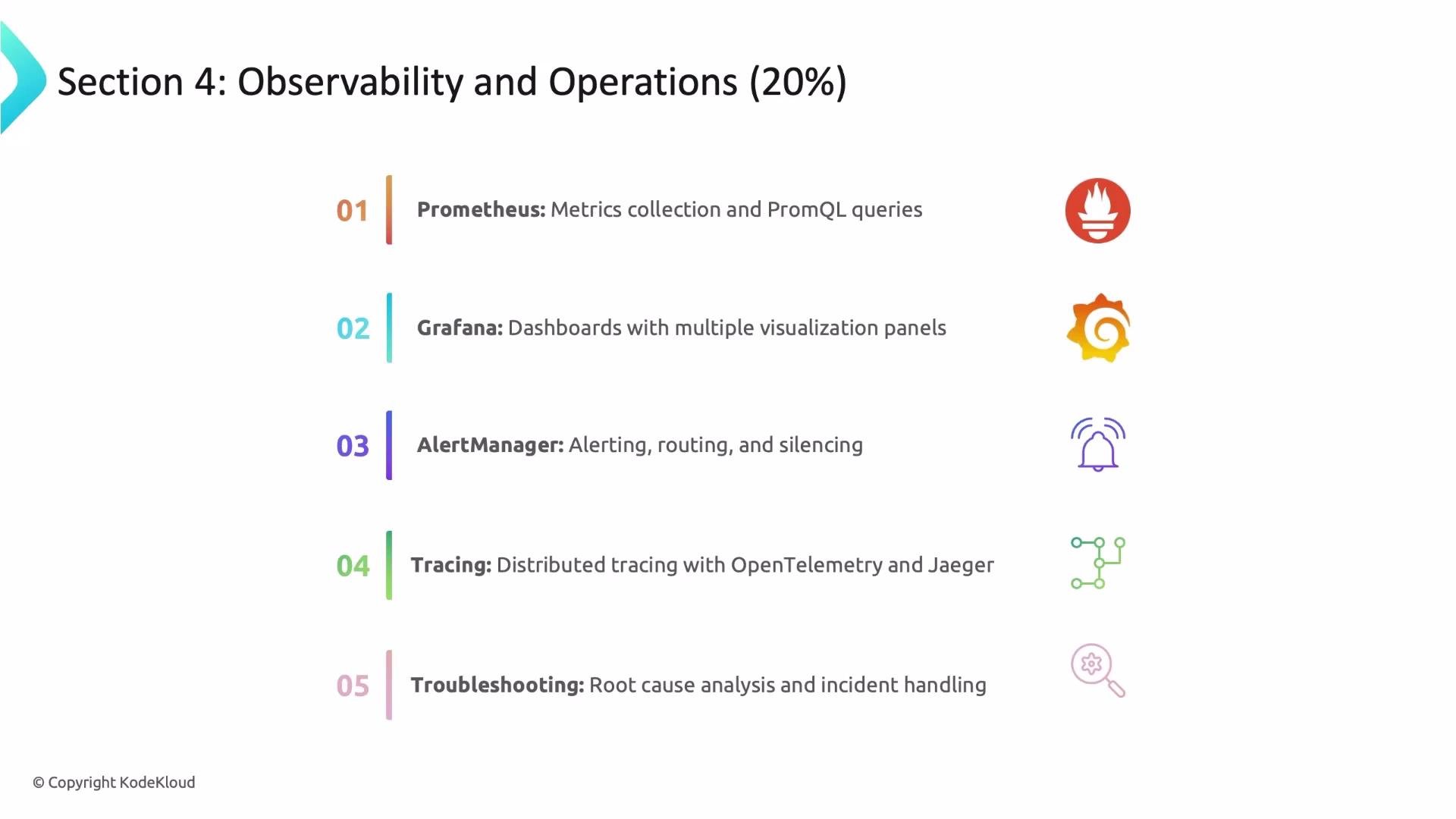
- Metrics and dashboards: Prometheus for collection and Grafana for visualizing service health and SLOs.
- Alerts: Alertmanager for routing, grouping, and delivering alerts to the right team/channel.
- Tracing: OpenTelemetry and Jaeger for distributed tracing to diagnose latency and service interaction issues.
- Incident response: Triage, remediation, validation, and post-incident review practices supported by runbooks and automated checks.
- RBAC: Fine-grained role-based access control to limit privileges and scope of changes.
- Admission control: Gatekeeper (Rego) for complex policy enforcement; Kyverno for YAML-native validation, mutation, and generation.
- Pod hardening: Pod Security Standards (PSS) to enforce runtime constraints and reduce attack surface.
- Service identity and encryption: Istio mTLS (or equivalent service mesh tooling) for secure service-to-service encryption and identity.
- Supply chain security: Image scanning, signing, and provenance; cluster policies that block unsigned or vulnerable images.
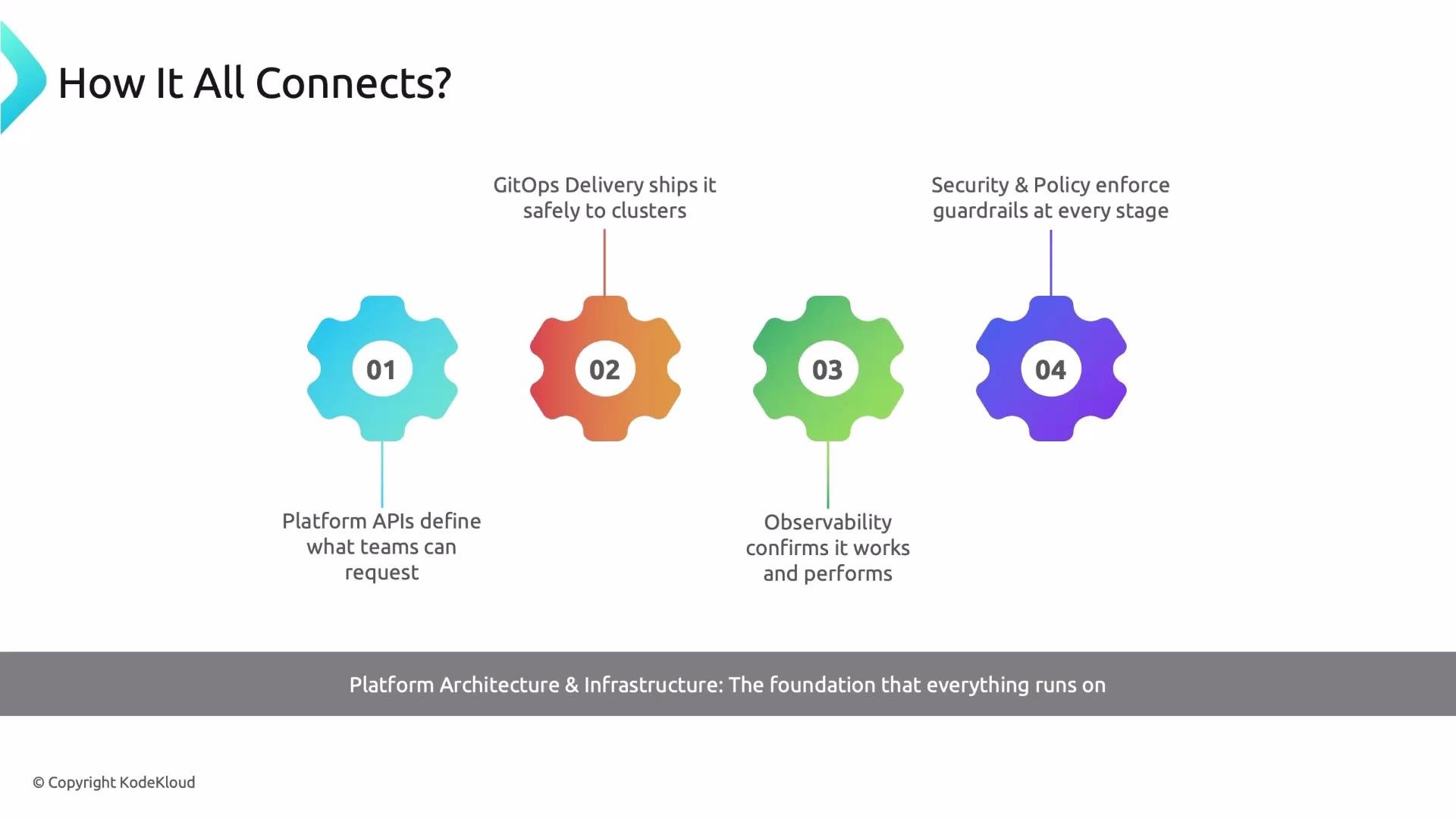
- These five domains work together as a continuous loop:
- Platform APIs: Developers request infrastructure or services via custom resources (self-service).
- GitOps delivery: Argo CD (or similar) reconciles desired state and deploys changes; progressive delivery patterns may be used for safe rollouts.
- Observability: Prometheus, Grafana, and tracing tools validate behavior, capture metrics, and expose issues.
- Security and policy: Admission controllers, PSS, and mTLS enforce guardrails and secure communication.
- All of this runs on top of platform architecture: governance, storage, networking, and cost controls.
Practical exam preparation checklist
- Finish every hands-on lab in the course; labs reflect real exam tasks.
- Re-run labs to improve speed and confidence—time yourself on typical tasks.
- Take mock exams to pinpoint weak topics and prioritize targeted practice.
- Review exam environment tips: navigation, time management, and common pitfalls.
- When practice is consistent and mock scores are stable, schedule your exam.
Finish every lab, practice repeatedly to build speed, and use mock exams to target weak spots — those three steps will pay off the most on exam day.
- Kubernetes Concepts
- Argo CD
- Tekton Pipelines
- Argo Workflows
- Prometheus and Grafana
- OpenTelemetry and Jaeger
- Gatekeeper (OPA) and Kyverno
- Crossplane and cert-manager
- OpenCost