

cluster-admin and exposes a web shell via a NodePort. An attacker discovers that endpoint, escalates to cluster-admin, and enumerates secrets across namespaces—database credentials, API keys, payment processor tokens.
Exposed debugging tools, excessive privileges like
cluster-admin, and publicly reachable NodePorts are a common attack chain. Treat any privileged tooling as high-risk and restrict network exposure.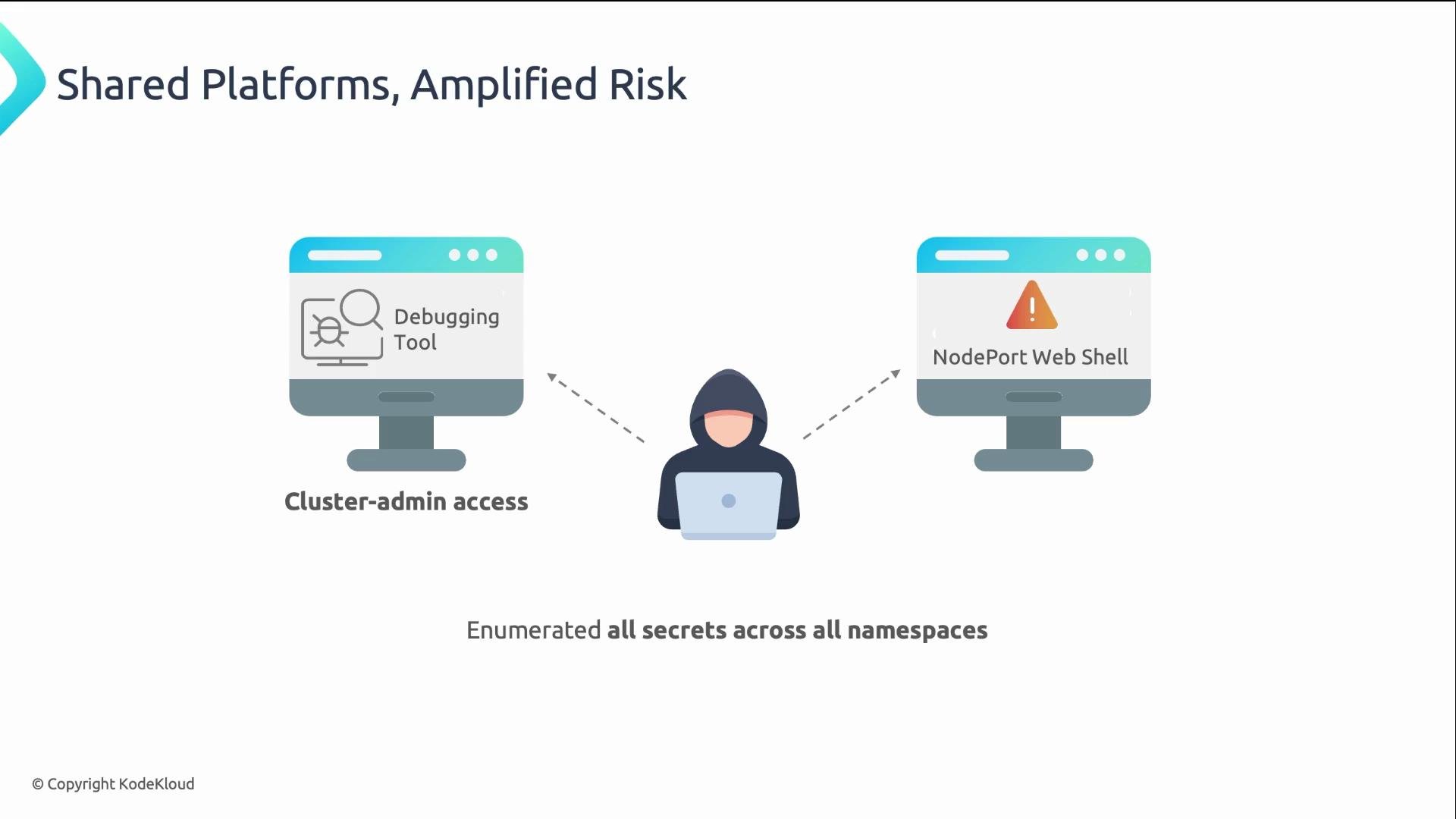
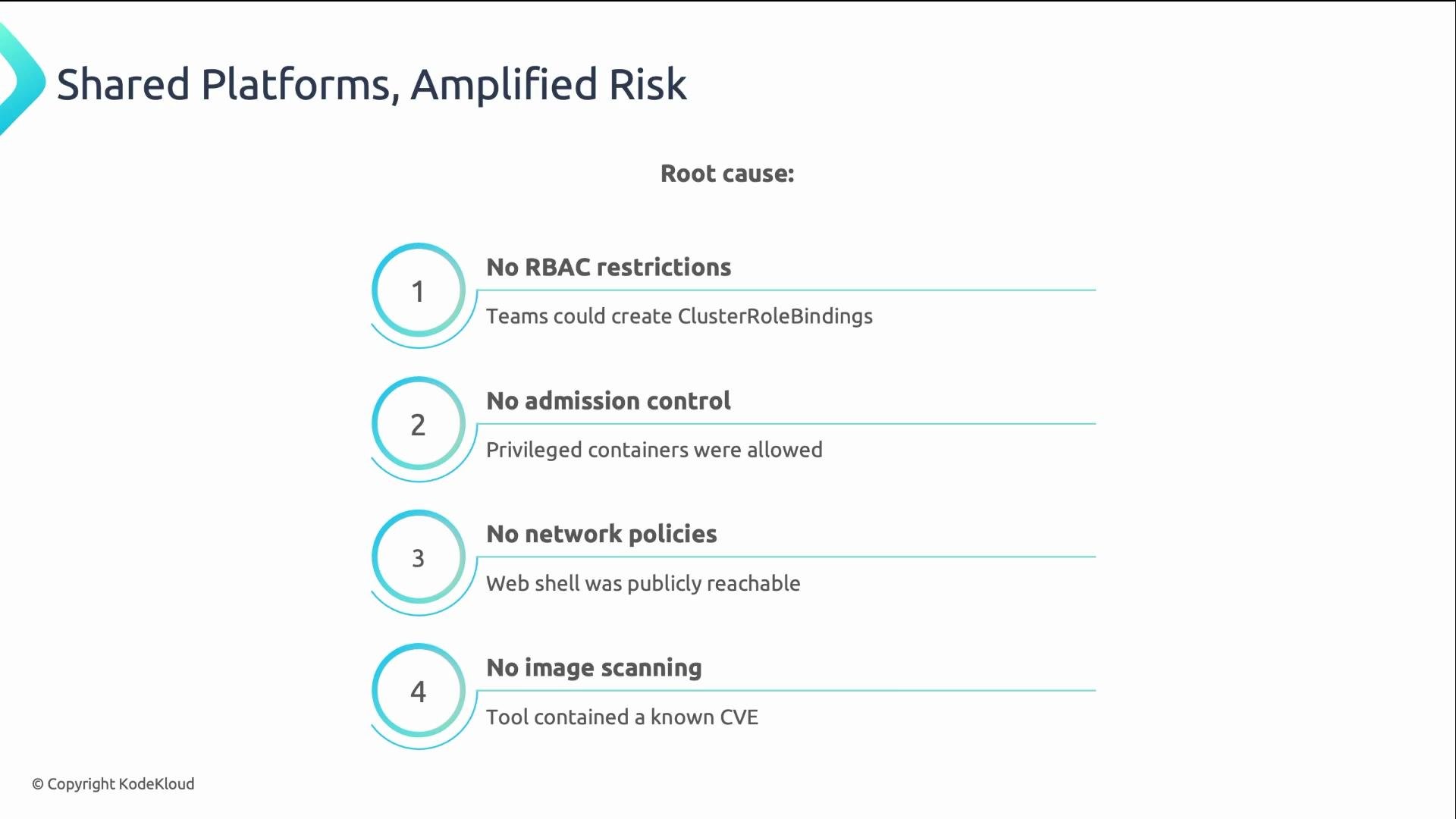
- Improper RBAC: teams can create cluster role bindings or use
cluster-admin. - Missing admission controls: privileged containers and unsafe specs are allowed.
- No network isolation: sensitive endpoints are reachable from outside.
- No image scanning: known CVEs and malicious artifacts are deployed.
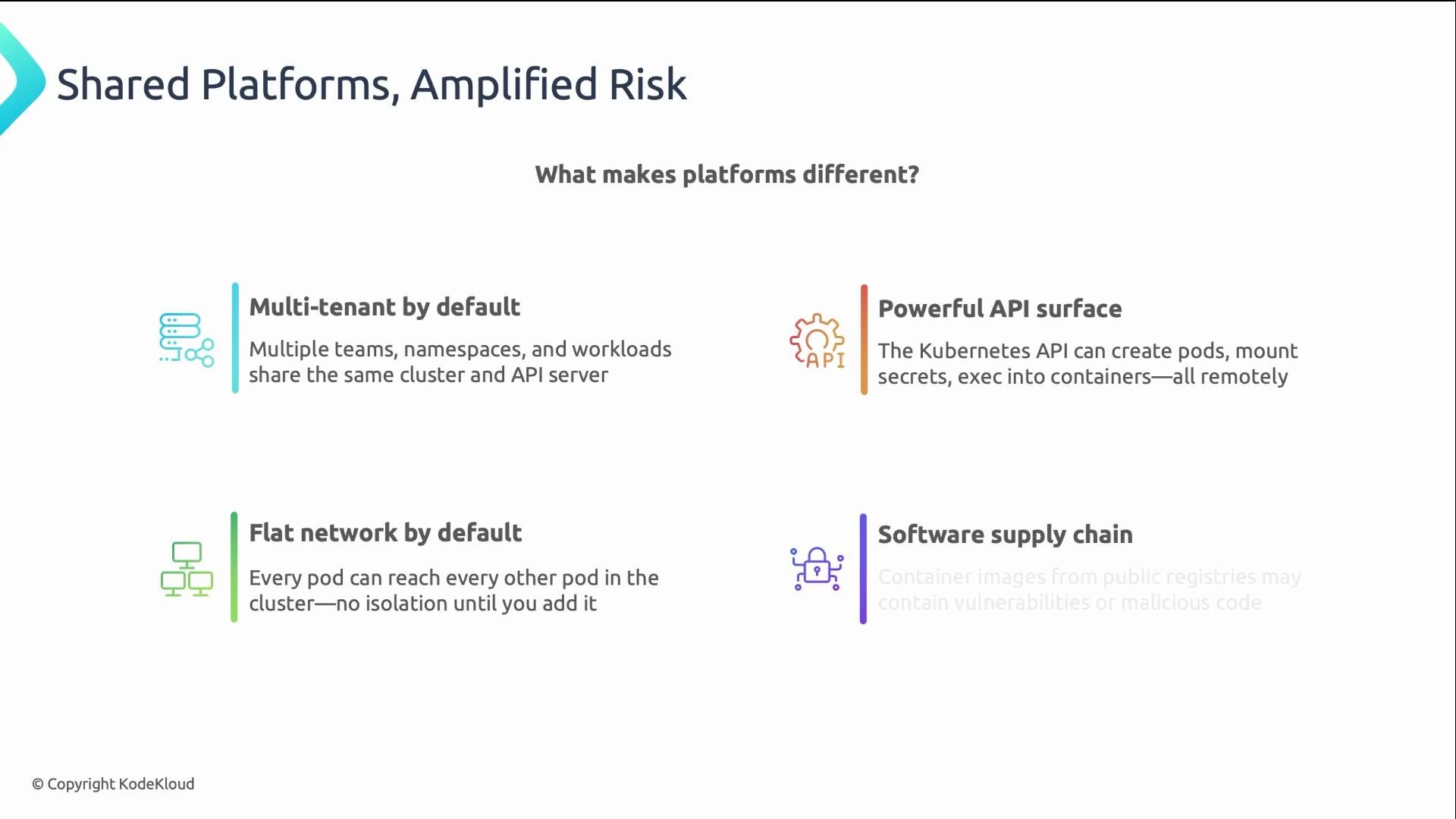
- Multi-tenancy by design: misconfigurations in one namespace can affect others.
- A powerful API server: it can create pods, mount secrets, and perform cluster-wide actions.
- Flat default network: pods can reach each other unless isolation is applied.
- Public images and supply chain risk: base images or charts can contain vulnerabilities or backdoors.
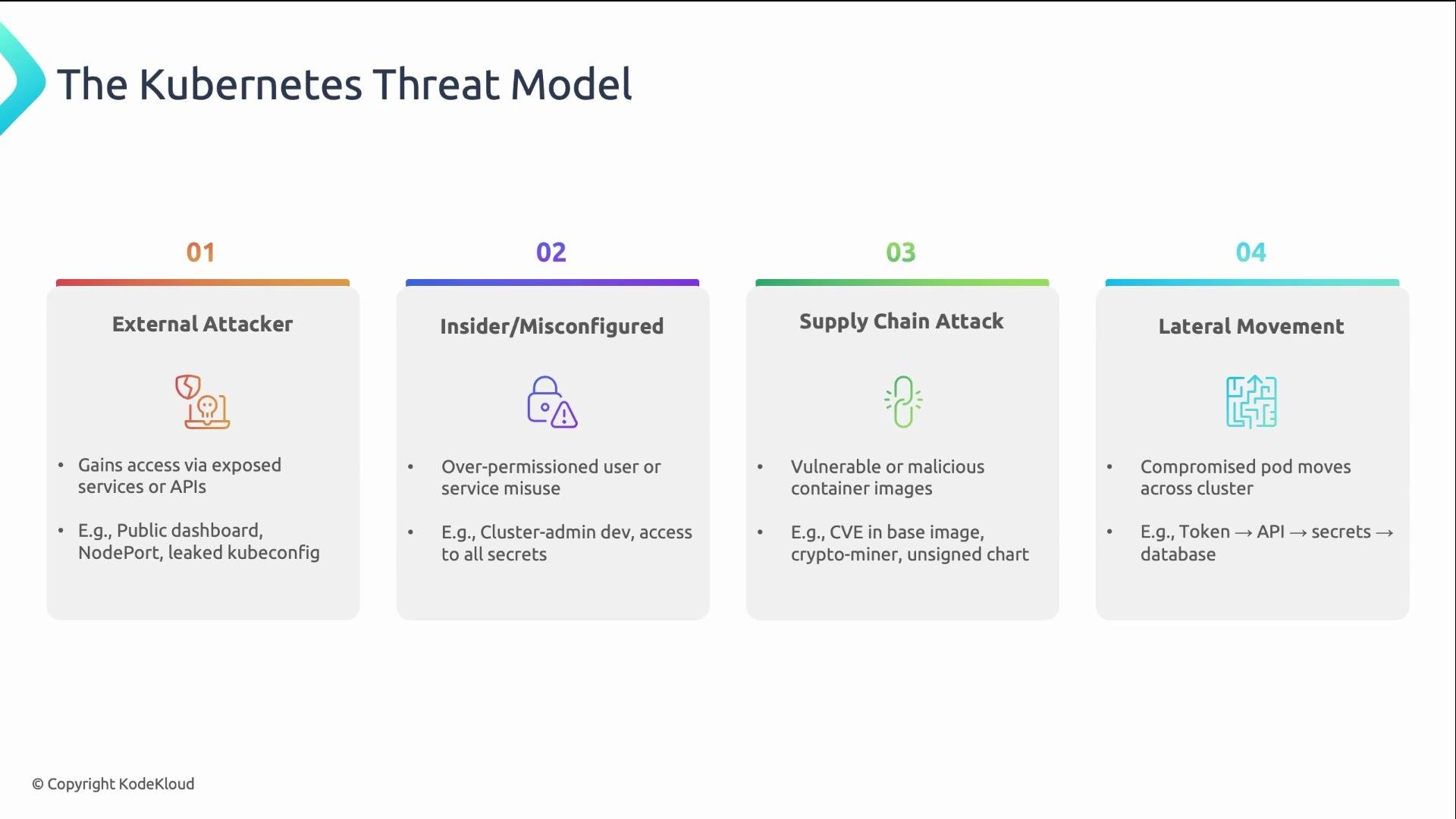
- External attackers: scanning for exposed services, leaked
kubeconfigfiles, or unauthenticated dashboards. - Insider or misconfiguration misuse: overly-permissioned users or automation making destructive mistakes.
- Supply chain attacks: vulnerable base images, malicious Helm charts, or unsigned artifacts.
- Lateral movement: compromised pods using service account tokens to enumerate secrets and pivot.
- Role-Based Access Control (RBAC): define who can do what.
- Admission controllers and webhooks: validate and mutate resources before creation.
- Pod Security Standards (PSS): enforce safe runtime profiles (no privileged containers, limited capabilities).
- Network Policies: control pod-to-pod and external traffic.
- Service mesh with mTLS: encrypt traffic and enforce service identity.
- Supply chain security: image scanning, signing, and provenance verification.
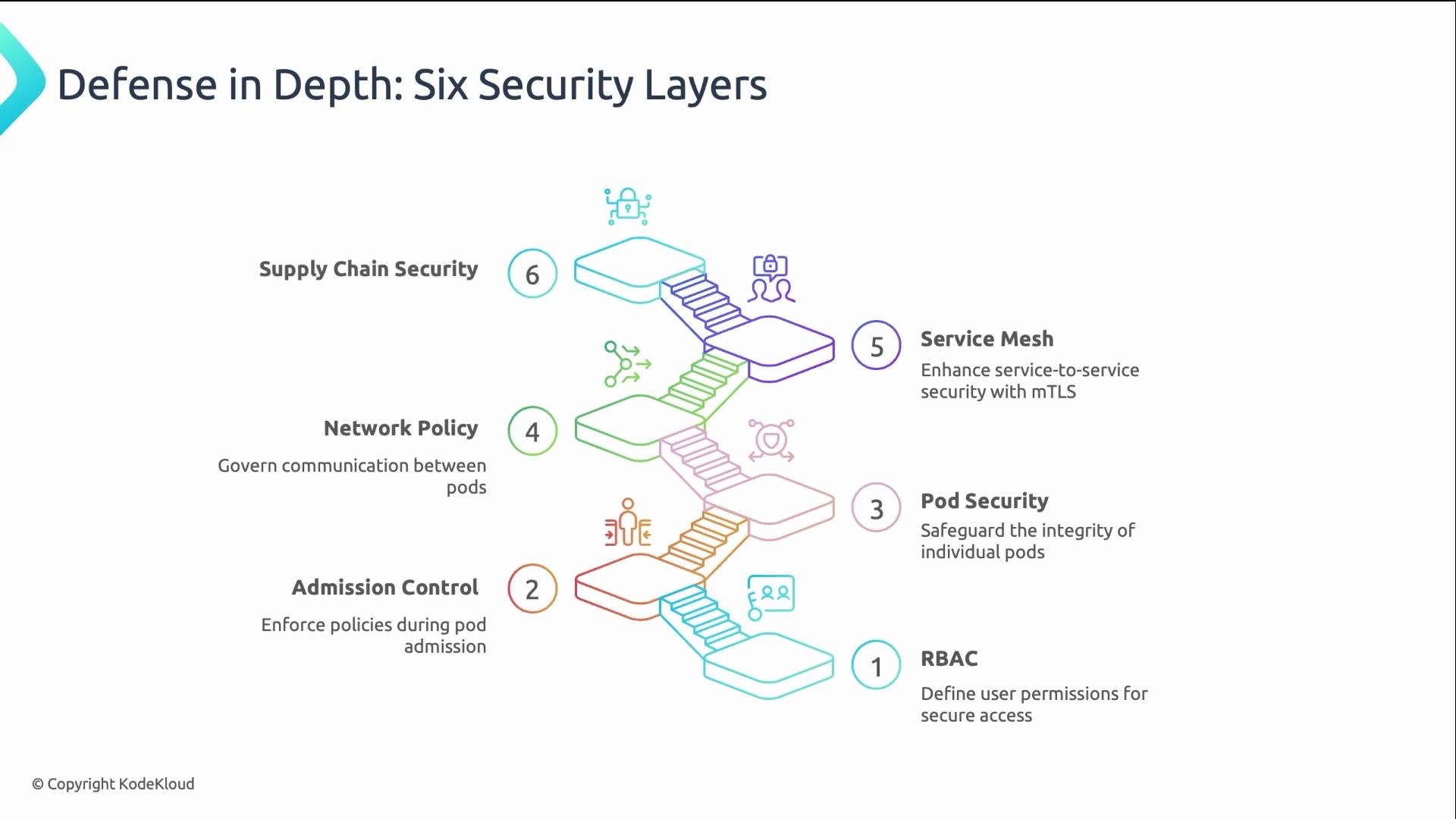
Defense in depth reduces single points of failure. Apply platform-wide defaults so teams inherit secure settings automatically, and require explicit exceptions for risky actions.
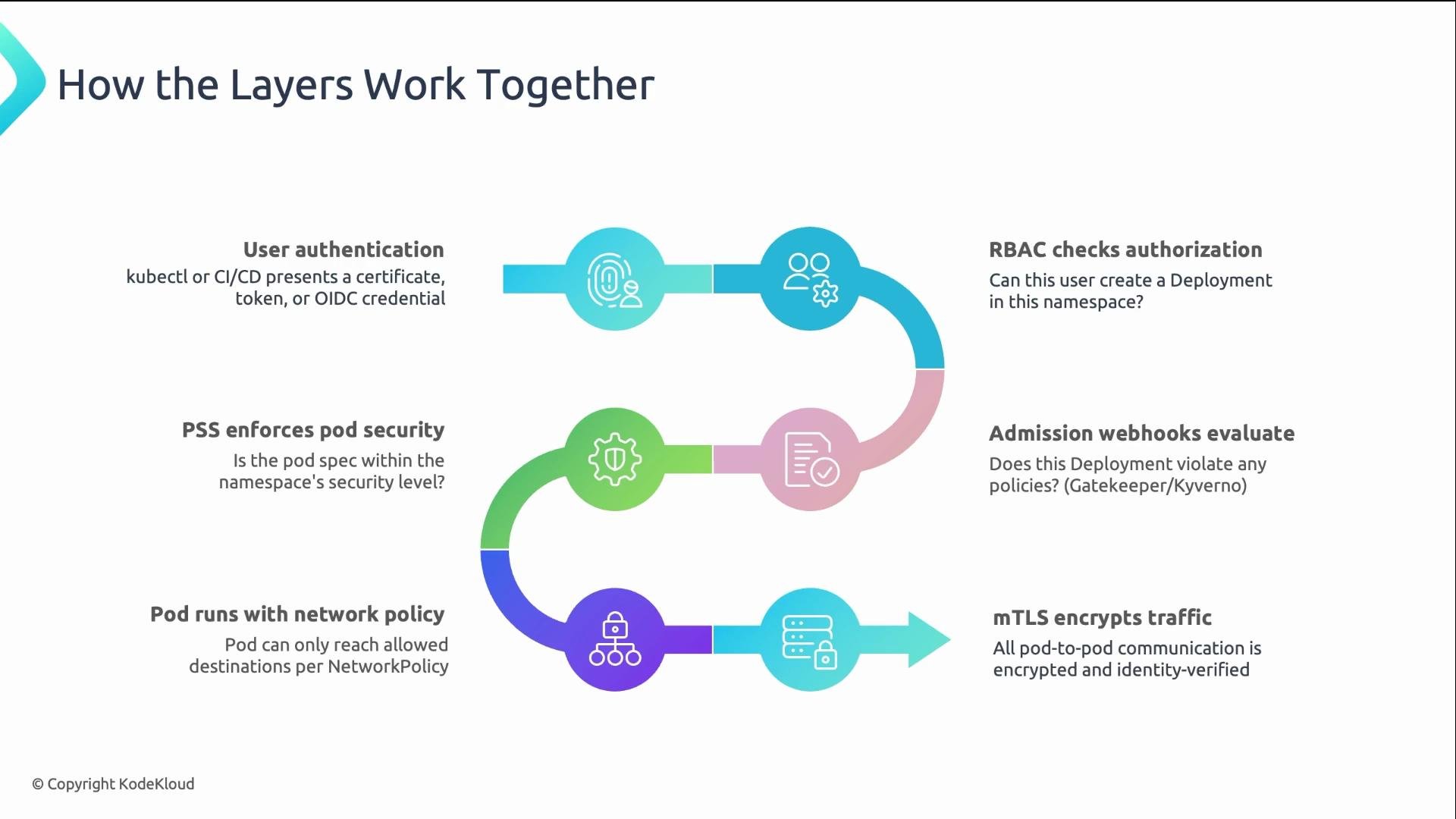
- A user authenticates to the API server (OIDC, client certs, etc.).
- RBAC evaluates whether the user can create a
Deploymentin the namespace. - Admission webhooks validate or mutate the
Deployment/Podspec against policy. - Pod Security Standards enforce runtime constraints before the pod is scheduled.
- If scheduled, Network Policies determine which peers the pod can reach.
- A service mesh enforces mTLS to encrypt communication and verify service identities.
Recommended links and references
- Kubernetes RBAC: https://kubernetes.io/docs/reference/access-authn-authz/rbac/
- Pod Security Standards: https://kubernetes.io/docs/concepts/security/pod-security-standards/
- NetworkPolicy guide: https://kubernetes.io/docs/concepts/services-networking/network-policies/
- Sigstore / Cosign for signing images: https://sigstore.dev/
- Shared platforms amplify risk; one weak workload can impact all tenants.
- The Kubernetes threat model includes external attackers, insider mistakes, supply chain compromise, and lateral movement.
- Defense in depth—RBAC, admission control, PSS, Network Policies, service mesh, and supply chain controls—reduces single points of failure.
- Make the secure choice the default: platform-level enforcement, least privilege, and automated checks before runtime.