

- Compare execution models and how they affect design.
- Learn each tool’s sweet spots and common anti-patterns.
- Apply a decision framework and platform patterns that combine tools effectively.
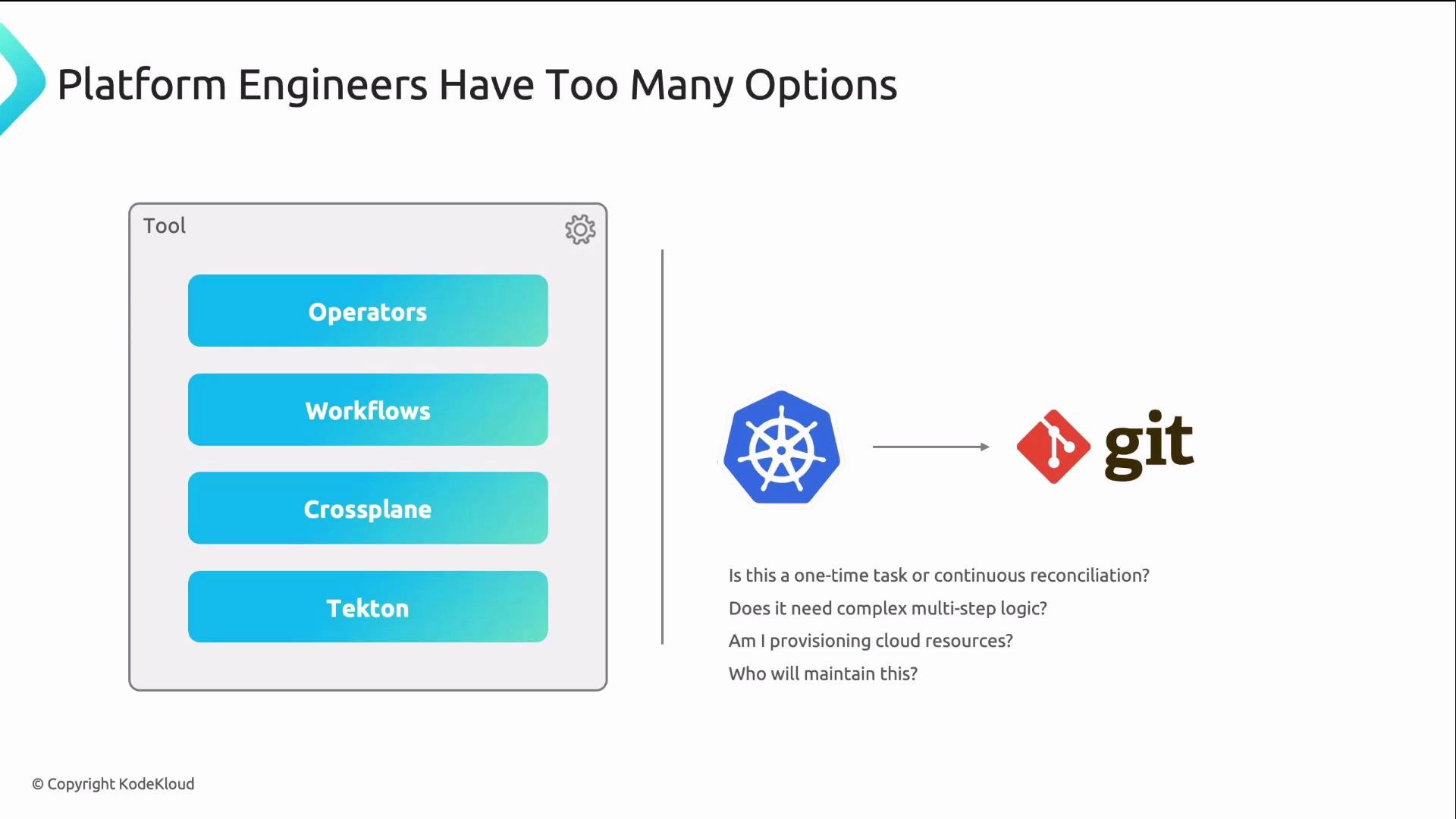
- Is this a one-time task (run to completion) or continuous reconciliation?
- Does it require complex, multi-step logic or DAG-style dependencies?
- Am I provisioning cloud resources or managing runtime application state?
- Who will maintain this automation and in which language?
Operators
- Sweet spot: continuous reconciliation and operational lifecycle management of stateful applications (backups, scaling, upgrades, failover).
- Use when you need continuous reconciliation: if resources drift or are deleted, the operator enforces desired state.
- Use when operational runbooks and domain knowledge must be encoded (for example, safe zero-downtime PostgreSQL major upgrades).
- Typical implementations: Go using Operator SDK and controller-runtime (also possible with Helm or Ansible-based operators via Operator SDK).
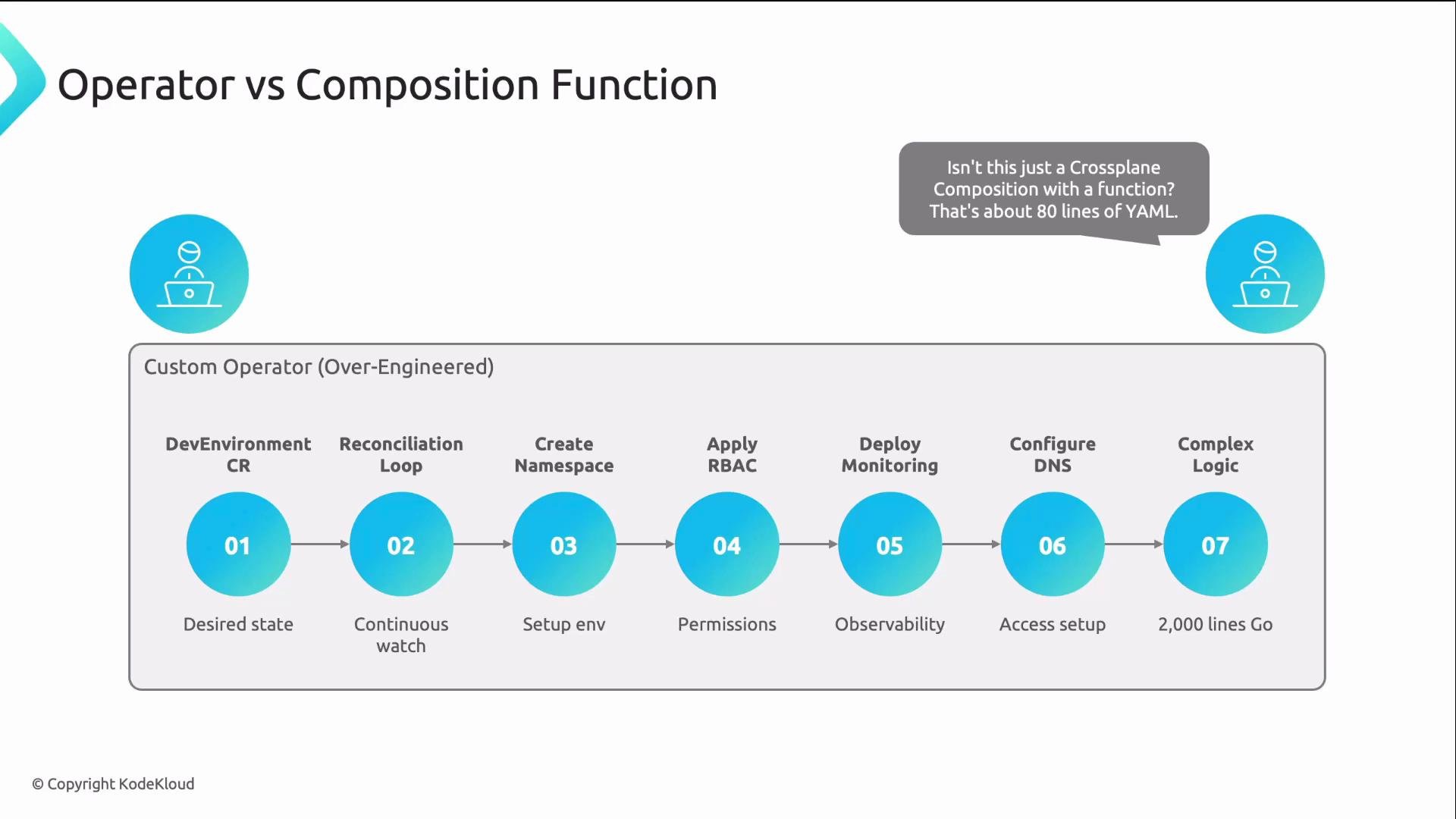
- Anti-pattern: avoid writing an operator for run-to-completion multi-step jobs — the reconciliation loop adds unnecessary complexity.
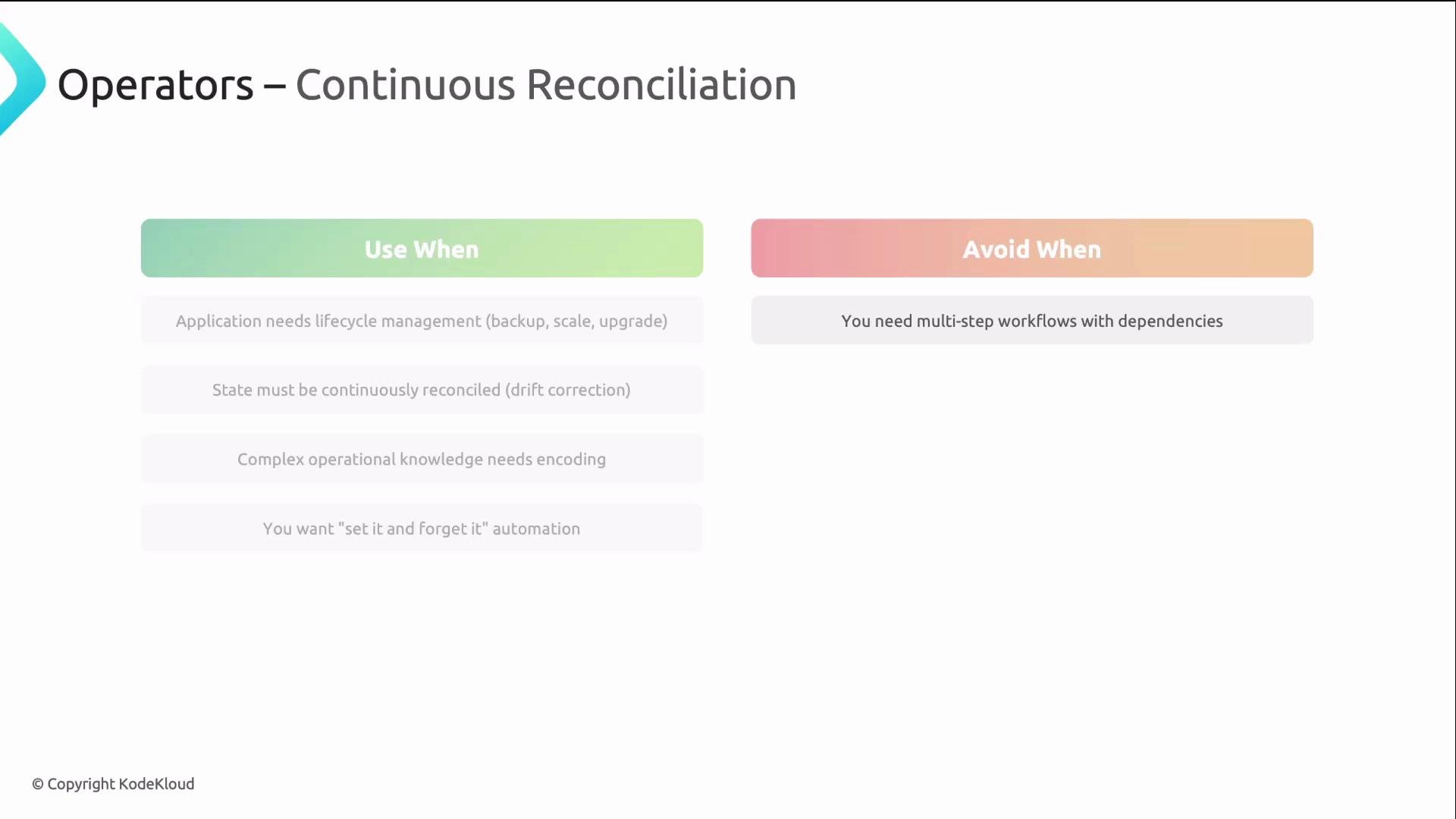
Operators are best for long-lived, stateful responsibilities. If you only need to “create once and forget,” prefer a composition or workflow instead.
Argo Workflows
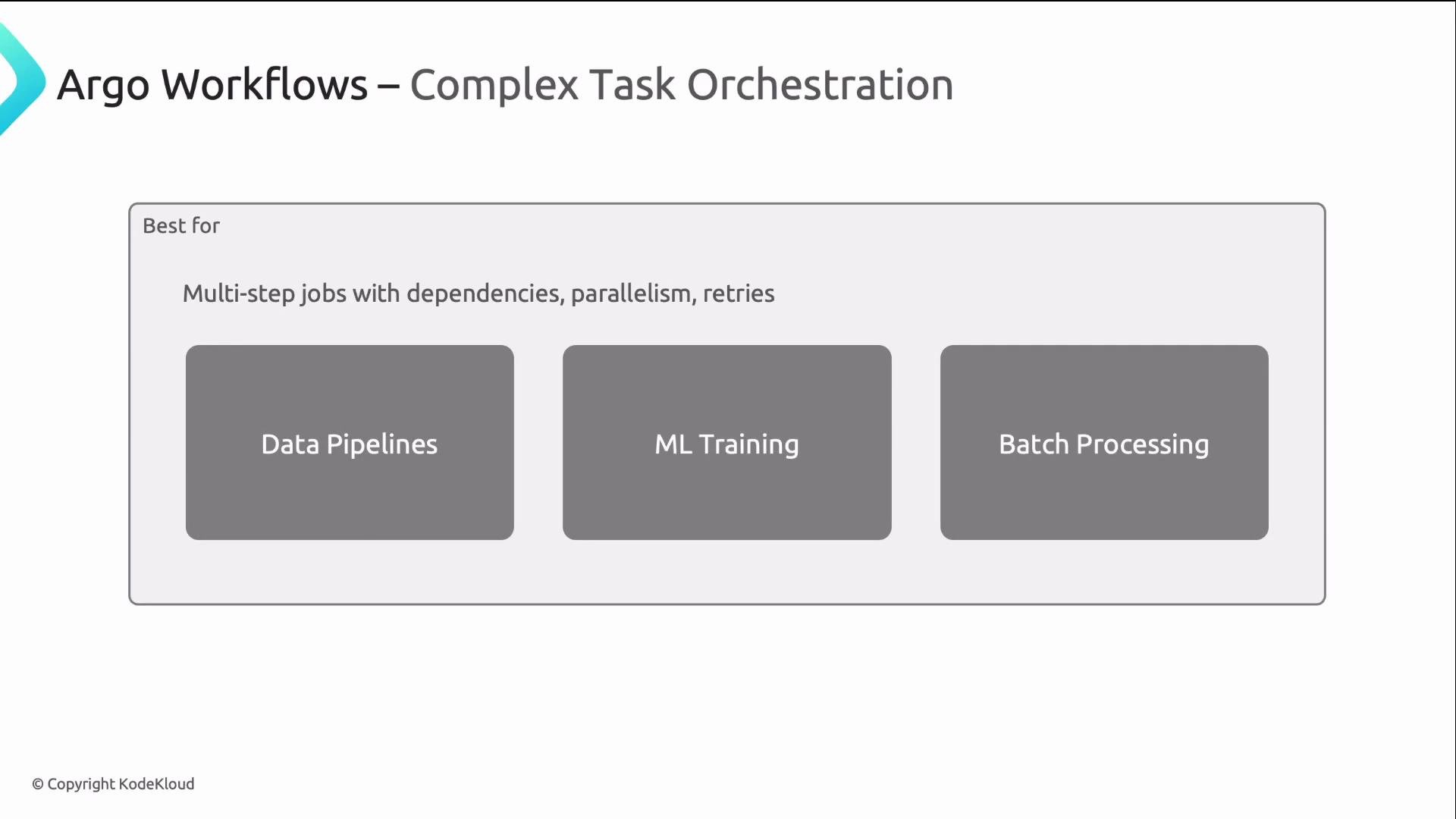
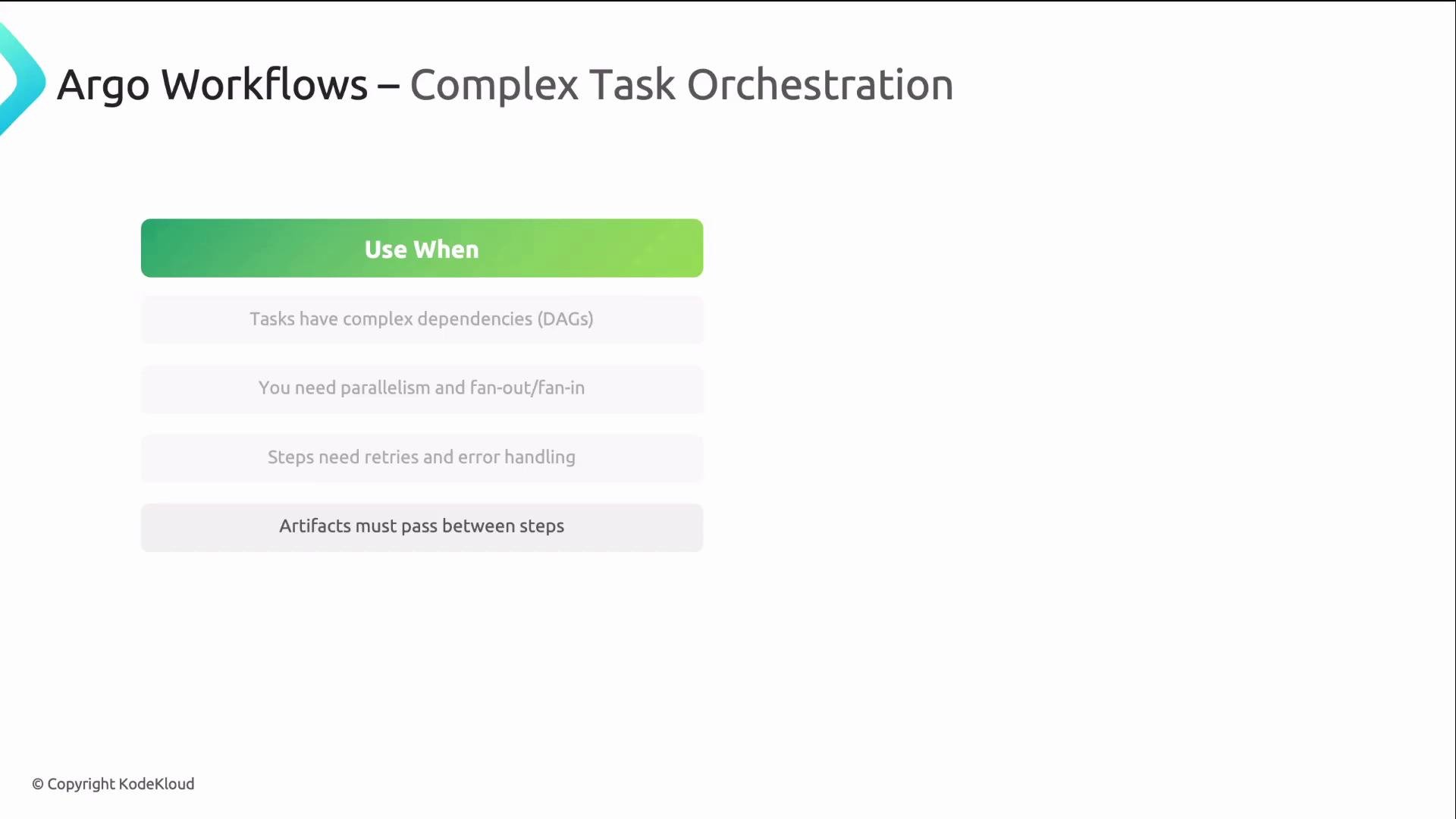
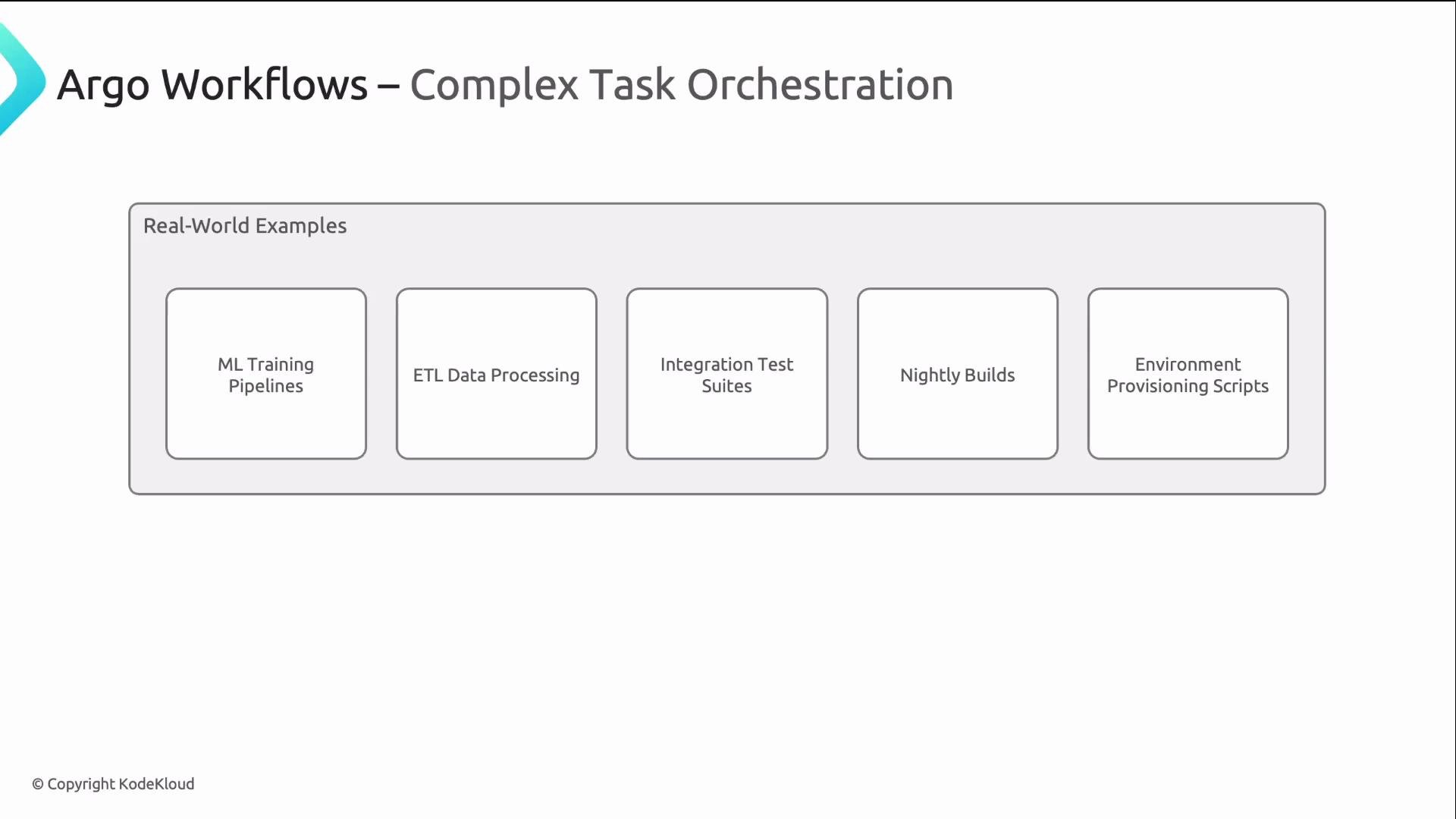
- Sweet spot: complex, run-to-completion jobs with dependent steps and DAG-style orchestration.
- Use when you need task orchestration: sequential or parallel steps, retries with backoff, artifact passing between steps, and conditional branching.
- Workflows execute and exit — they do not perform long-lived reconciliation or drift correction.
- Anti-pattern: do not use Argo Workflows to manage continuous runtime lifecycle of stateful services. For simple, single-container jobs, Kubernetes Job may suffice.
Crossplane
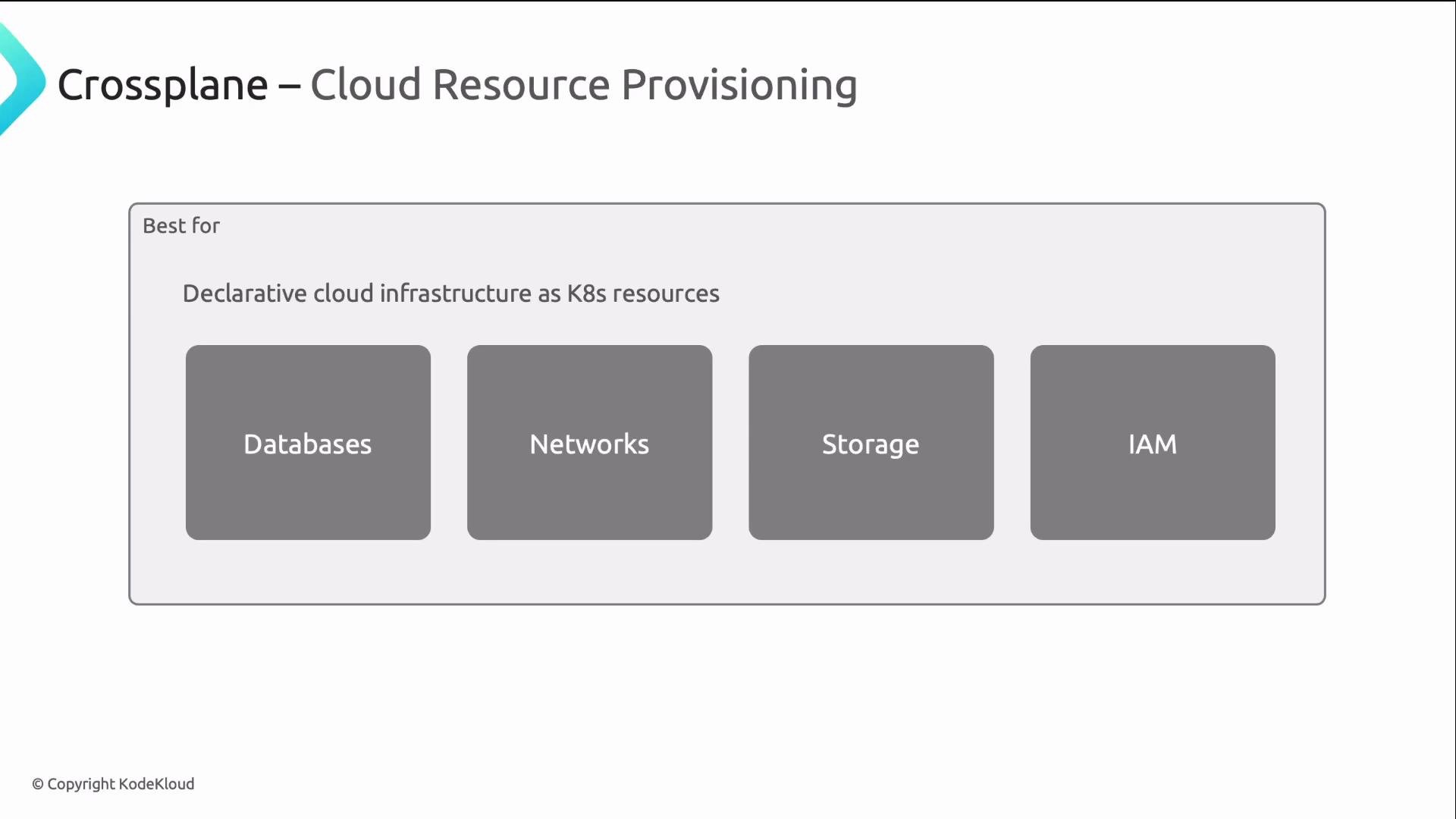
- Sweet spot: declarative cloud infrastructure exposed and managed as Kubernetes resources.
- Use when provisioning cloud resources (databases, VPCs, storage, IAM). Crossplane exposes cloud APIs as CRDs and reconciles cloud resources continuously.
- Use Crossplane to build self-service platform APIs (Compositions and XRDs) so developers can request cloud resources with Kubernetes-style
kubectl apply. - Crossplane performs drift detection and self-healing for cloud resources.
- Anti-pattern: avoid Crossplane for ephemeral compute jobs or complex multi-step workflows; use an orchestration engine (Argo Workflows). For runtime lifecycle of stateful apps, prefer operators.
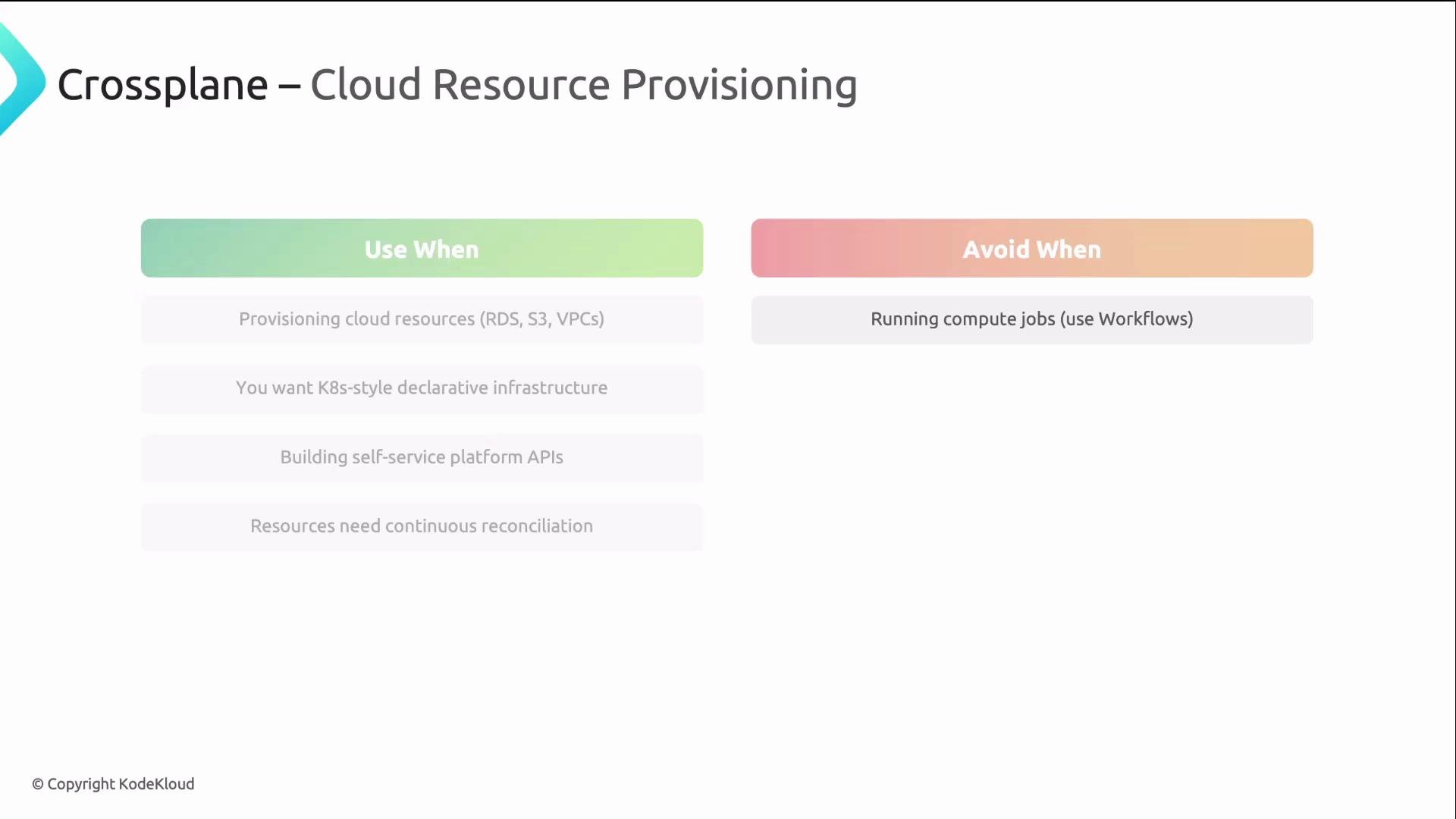
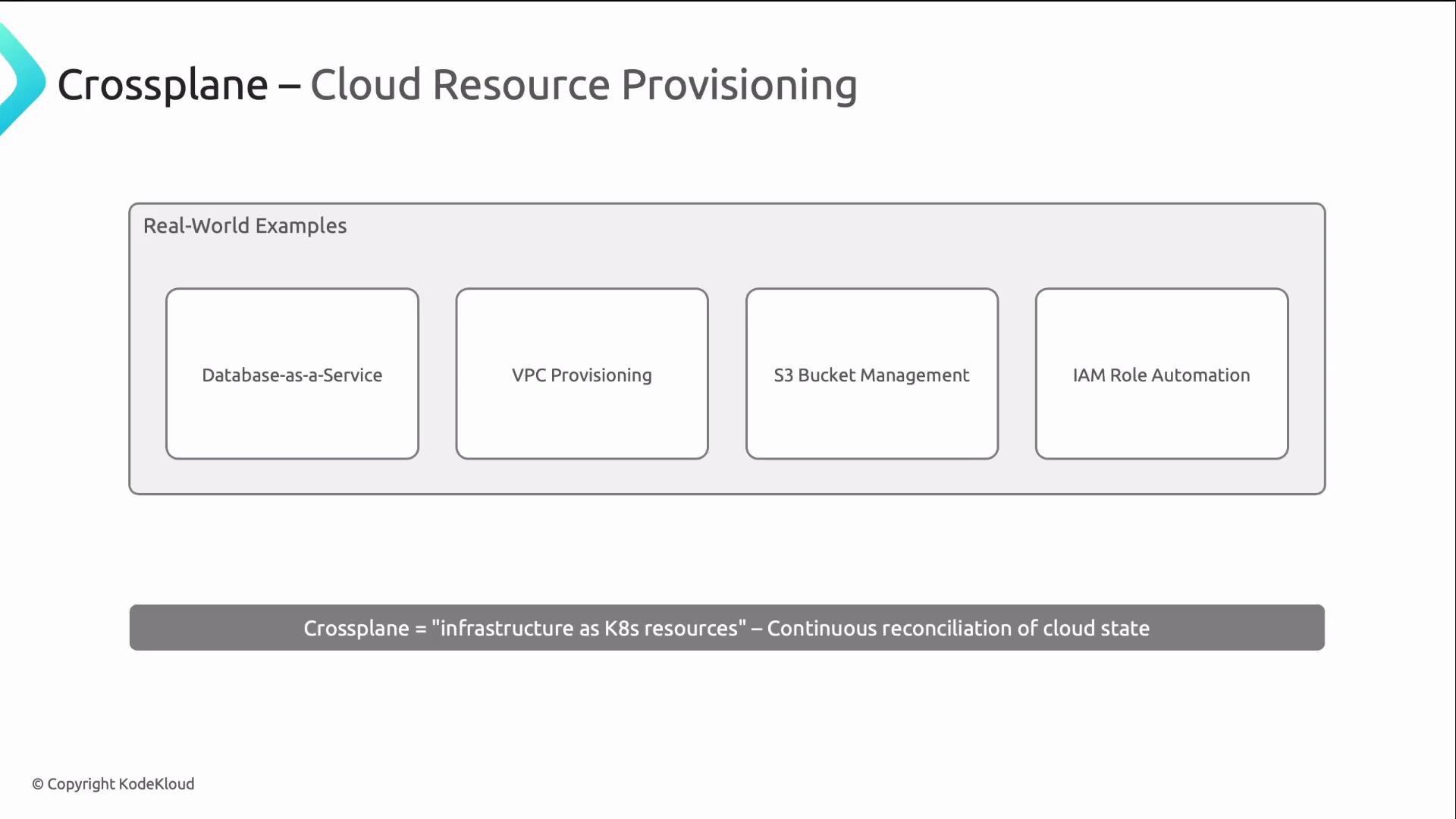
Do not replace an operator’s runtime reconciliation responsibilities with Crossplane. Crossplane manages cloud resources; operators manage runtime application behavior and complex operational logic.
Quick Cheat-Sheet (execution model is the key)
- Operators and Crossplane: run continuously, reconcile state, and correct drift.
- Workflows (Argo Workflows): run to completion, execute a DAG of steps, then exit.
- If you need drift correction or long-lived reconciliation → Operator or Crossplane.
- If you need complex multi-step DAG logic → Workflow engine (Argo).
- If you need managed stateful application lifecycle → Operator.
- If you need declarative cloud resource provisioning → Crossplane.
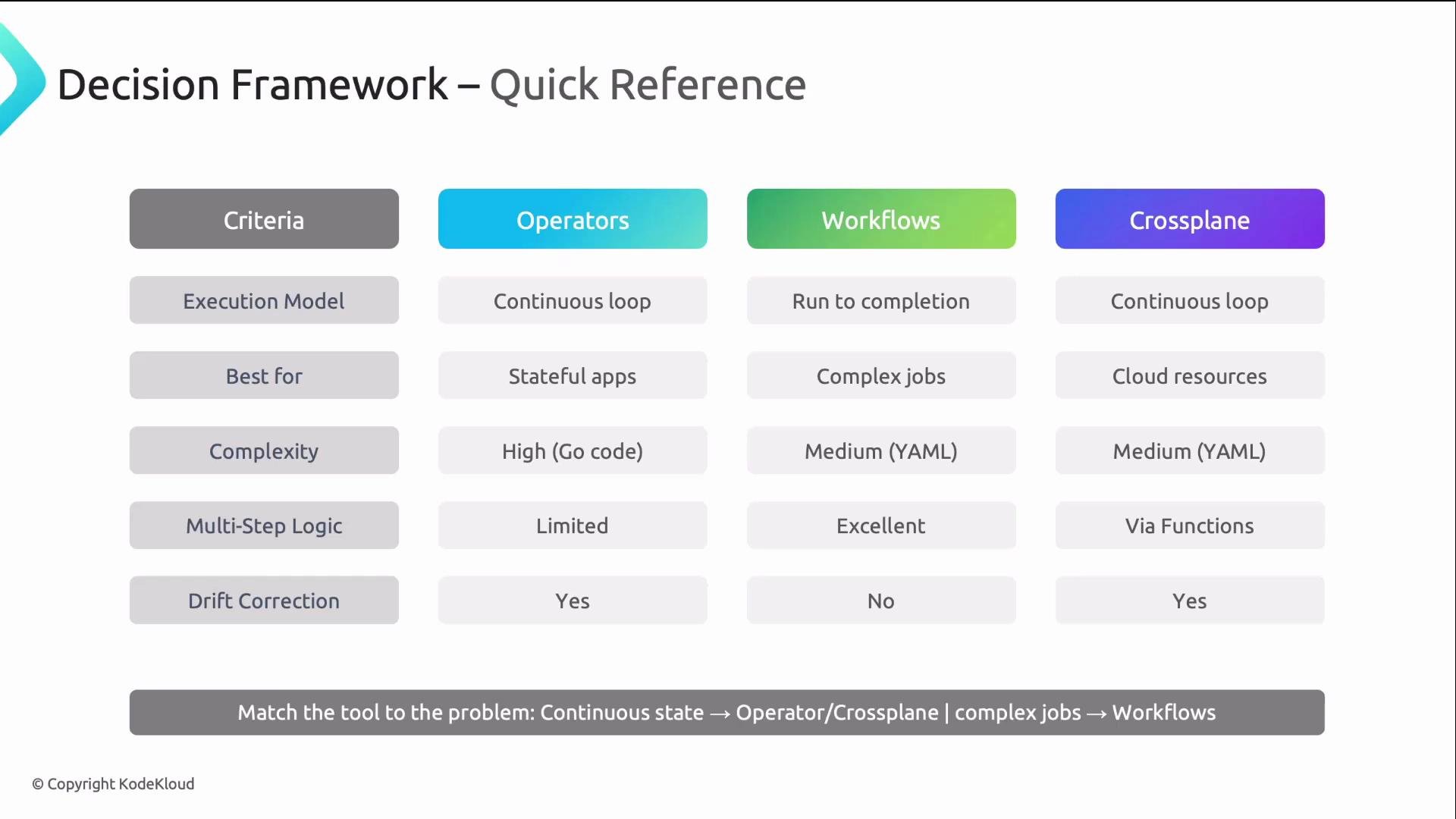
Comparison Table
Decision Checklist (quick mapping)
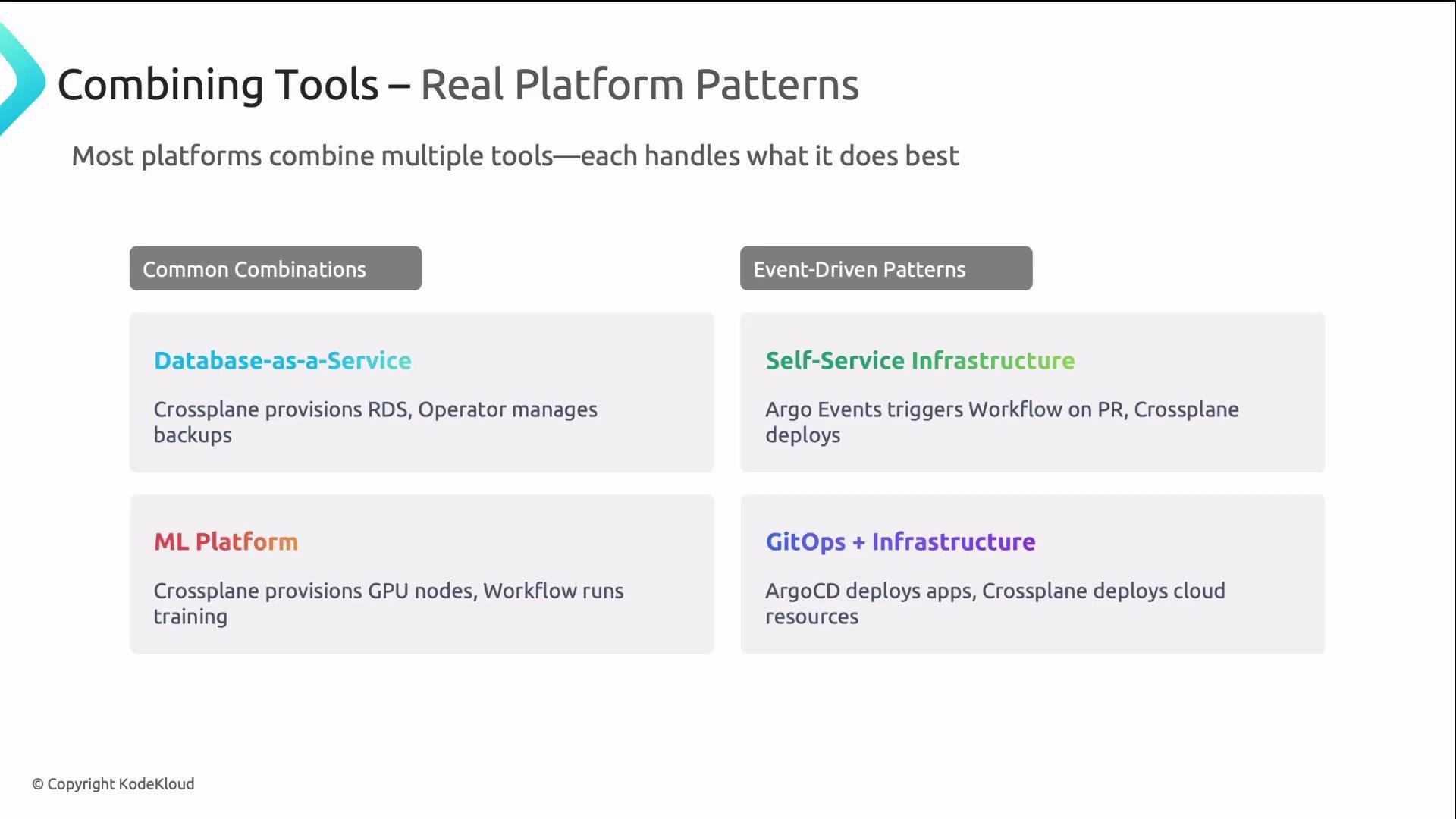
Common Platform Patterns (combine tools)
- Database-as-a-Service: Crossplane provisions RDS; a PostgreSQL operator manages backups, failover, and schema migrations.
- ML platform: Crossplane provisions GPU nodes and object storage; Argo Workflows orchestrates training (data fetch → train → evaluate → upload).
- Self-service infra: Git/GitOps triggers validation workflows; on success, Crossplane provisions requested infrastructure to an environment.
- GitOps + infra: Argo CD deploys apps; Crossplane provisions cloud resources; both reconcile continuously.
- Infrastructure: Crossplane (declarative cloud resources)
- Orchestration: Argo Workflows (complex run-to-completion pipelines)
- Runtime management: Operators (stateful application lifecycle)
- Deployment: Argo CD / Tekton (CI/CD and GitOps)
Key Takeaways
- Use operators for stateful application management and continuous reconciliation.
- Use workflows for complex multi-step, dependency-driven jobs that run to completion.
- Use Crossplane for declarative cloud resource provisioning and drift correction.
- Combine tools by layer: provision infra with Crossplane, orchestrate pipelines with Argo Workflows, manage runtime with operators, and deploy with GitOps/CI systems.
- Avoid over-engineering: match the execution model (continuous vs run-to-completion) to the problem.