Controllers continuously reconcile desired state, but many platform tasks are one-off: data migrations, multi-step environment setup, or ad-hoc provisioning. Imperative Bash scripts or simple CI jobs often lack the expressiveness, retries, observability, and parallelism required for these workflows. This article explains why scripts fail for complex automation and how to use Argo Workflows and Argo Events to build resilient, declarative, and event-driven platform automation:
  • Why scripts and pipelines break for complex platform automation.
  • How to author Argo Workflows using Steps and DAG patterns.
  • Building reusable WorkflowTemplates with parameters.
  • Passing artifacts reliably between steps.
  • Triggering workflows from external events with Argo Events.
The image lists two learning objectives: understanding script failures in complex automation and creating Argo Workflows with steps and DAG patterns.
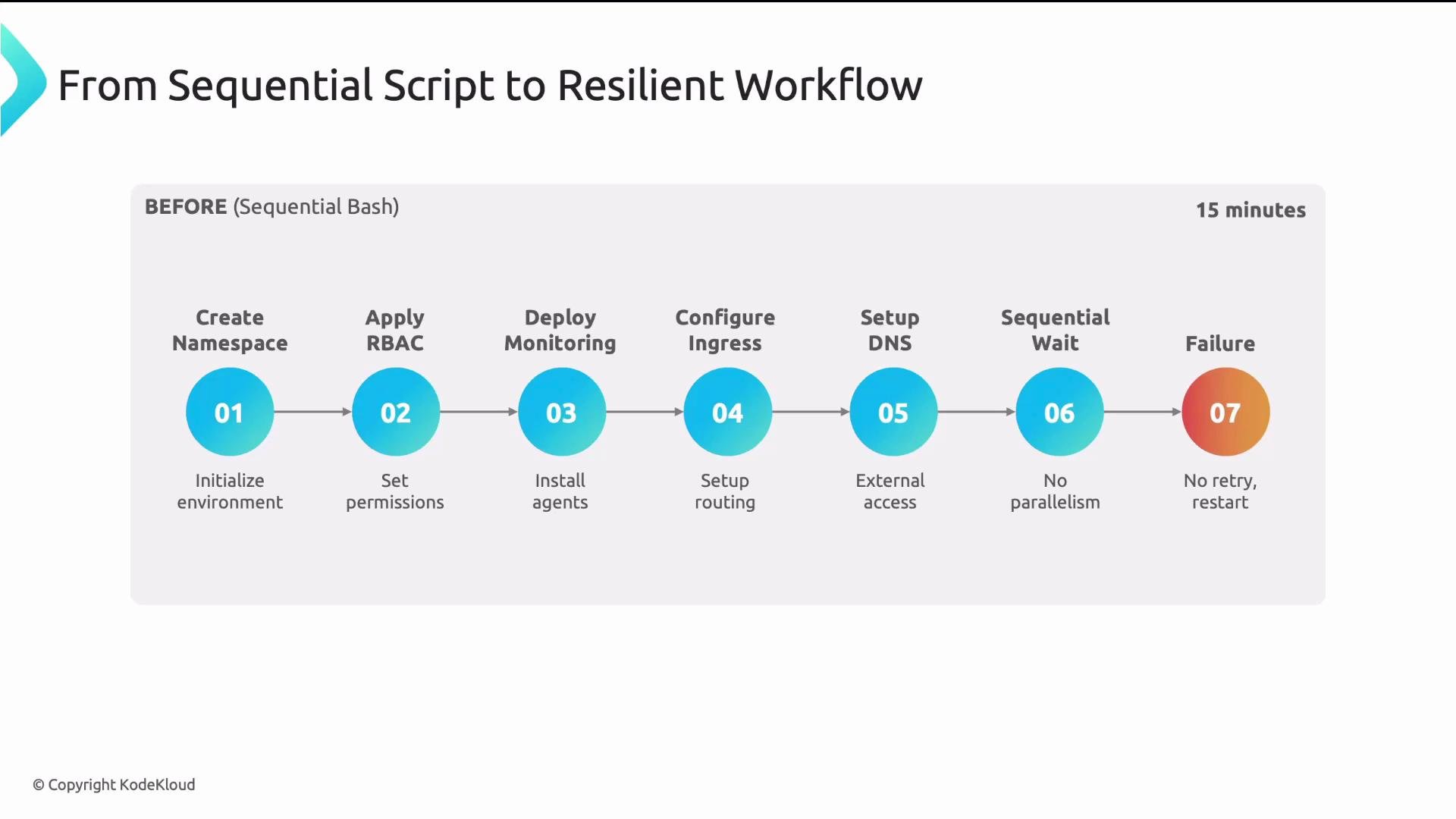
Problem scenario: a 50-line Bash script to provision a development environment A platform team had a single Bash script that: created a namespace, applied RBAC, deployed monitoring agents, configured Ingress, and set up DNS. It ran sequentially even though many steps were independent. When a later step (DNS) timed out, the script failed entirely, requiring manual rollback and a full re-run.
The image illustrates a sequential workflow process for a script, detailing seven steps from initialization to potential failure, highlighting issues like no parallelism and lack of retries.
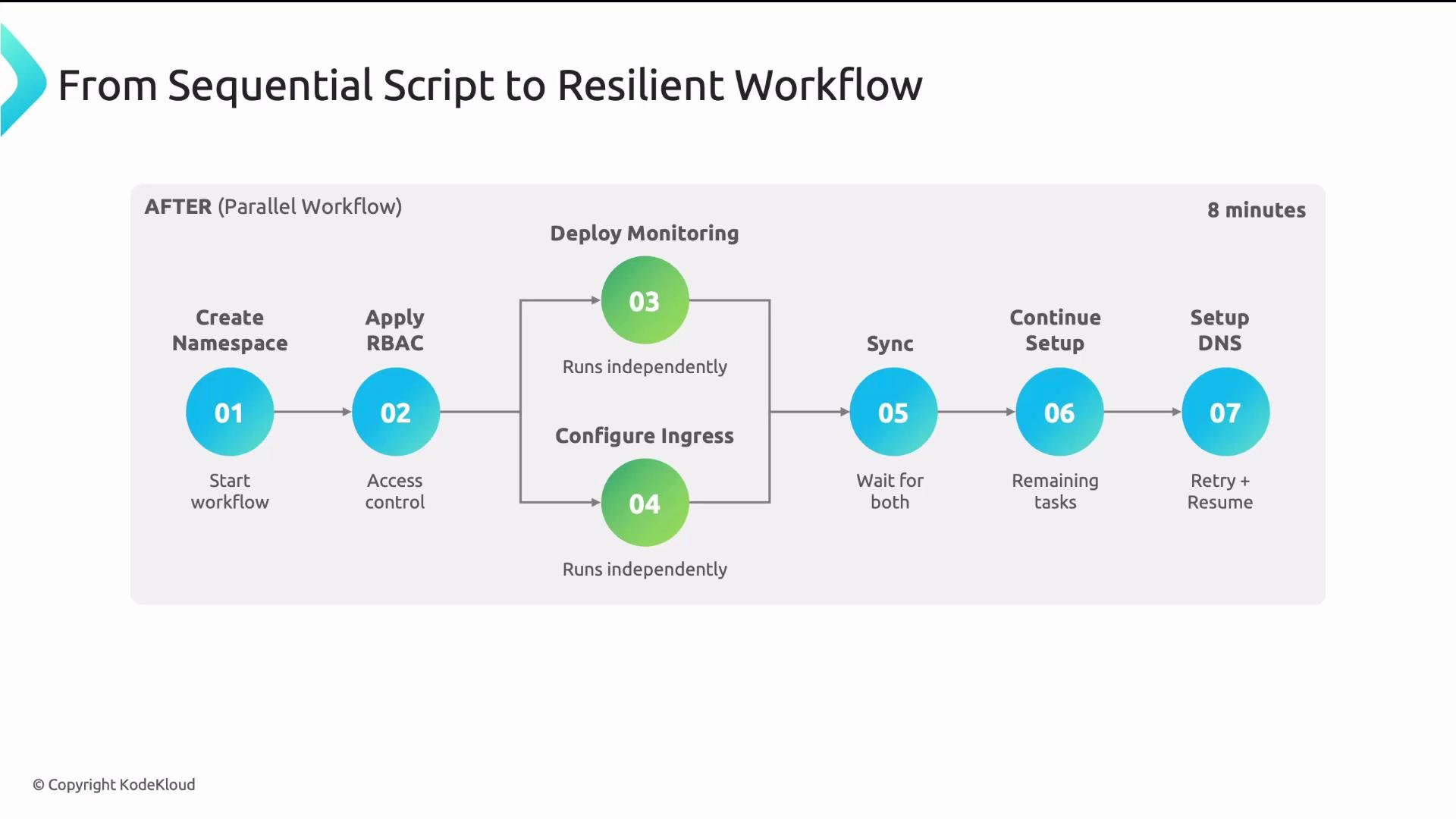
Because Bash executed everything sequentially, independent steps that could have run concurrently extended the runtime (15 minutes vs 8). When the DNS step failed, there were no retries, backoff, or resumability—manual intervention was required.
The image illustrates a parallel workflow titled "From Sequential Script to Resilient Workflow," detailing seven steps, including "Create Namespace," "Apply RBAC," "Deploy Monitoring," "Configure Ingress," and more, designed to complete in eight minutes.
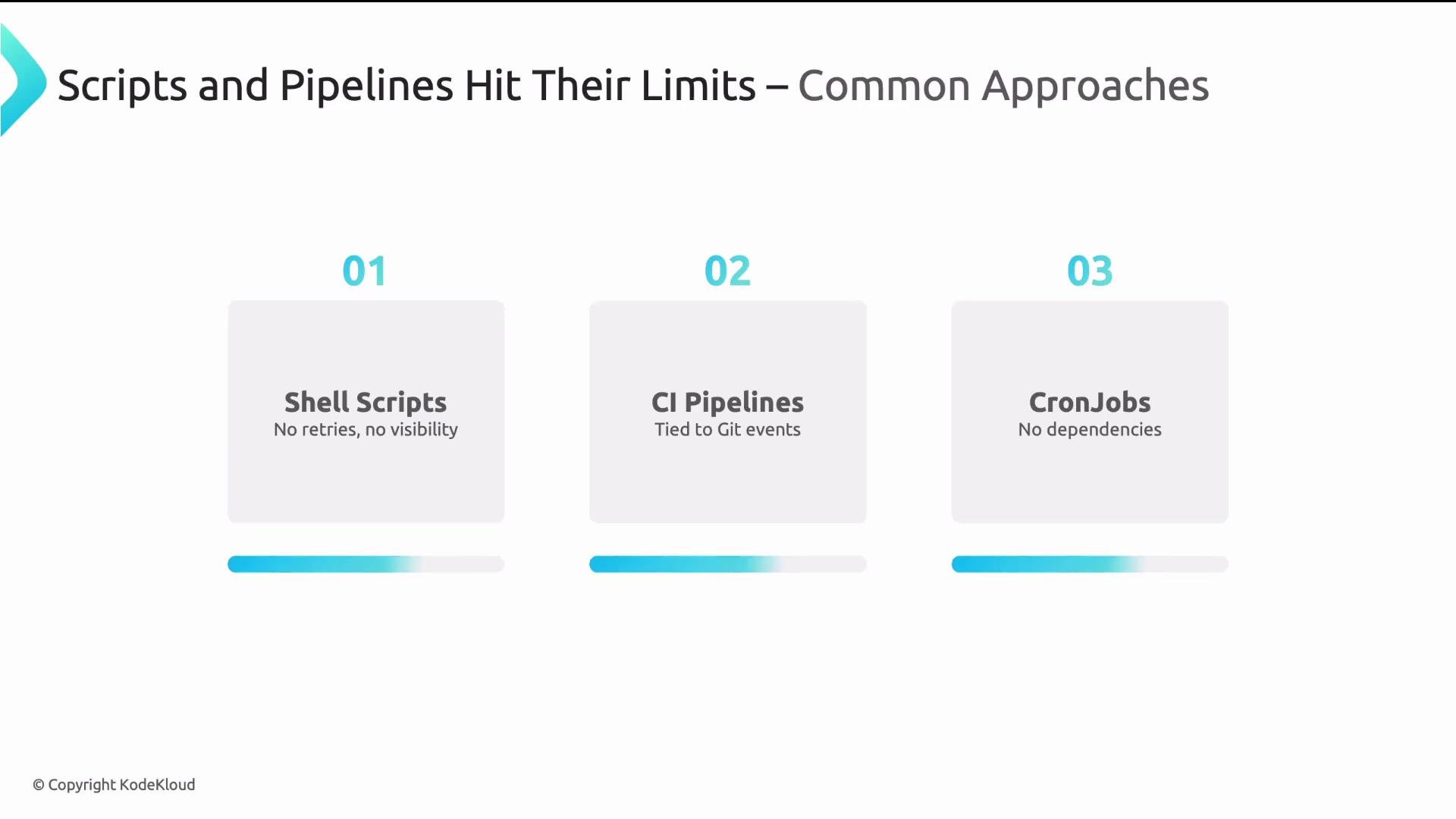
Common automation approaches and their limits The slide shows three common approaches to platform automation: shell scripts, CI pipelines, and CronJobs. Each has limitations for complex orchestration.
The image highlights common limitations of scripts and pipelines, comparing shell scripts, CI pipelines, and CronJobs in terms of aspects like retries, visibility, dependencies, and event ties.
Table: automation approaches at a glance Common problems with scripts/pipelines
  • No explicit dependency graph (cannot express “run C after A and B” cleanly).
  • Sequential execution for many implementations—independent tasks run one after another.
  • Little or no retry/backoff/resume semantics.
  • Poor observability into the exact failing step or current execution state.
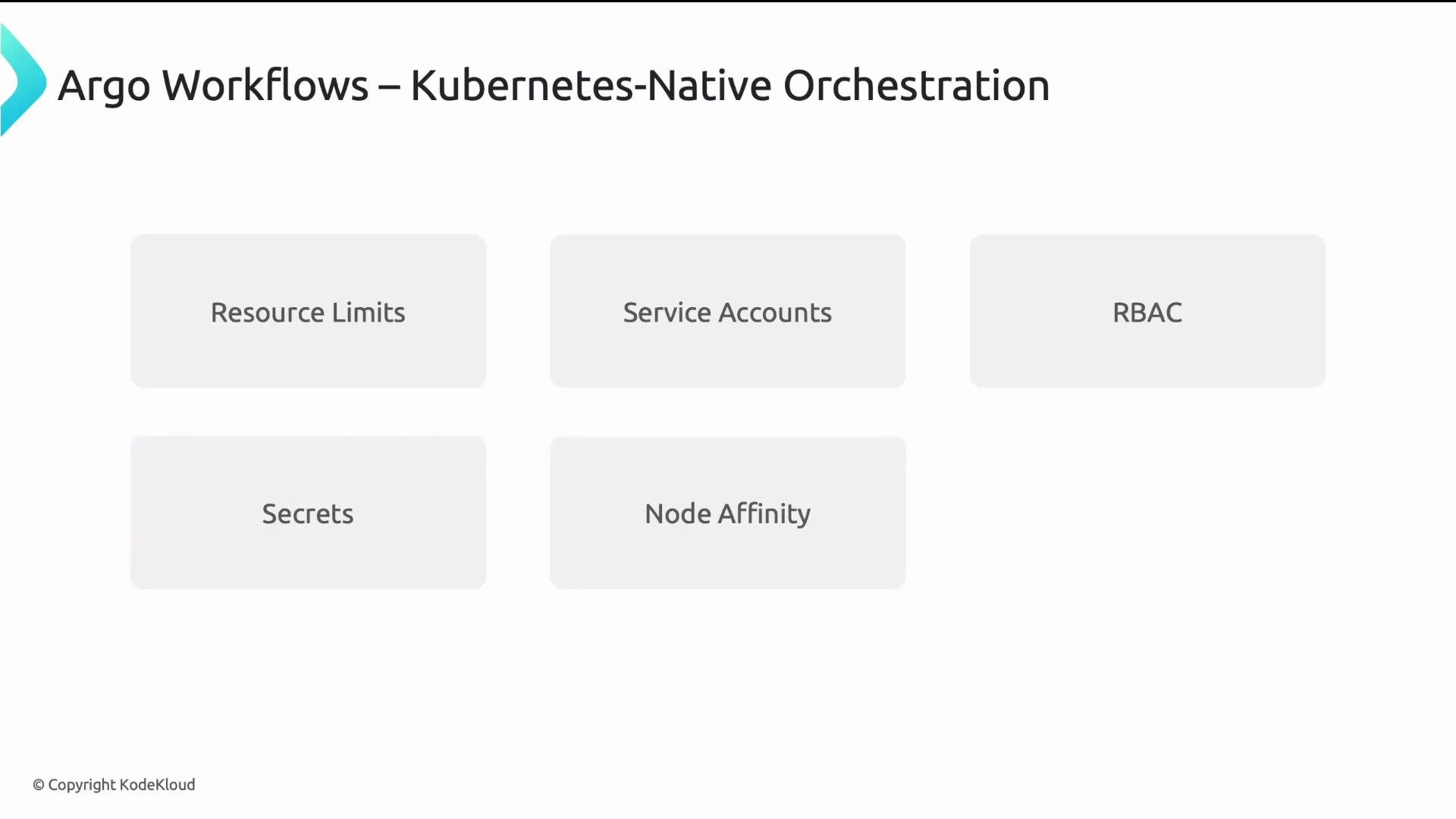
For robust platform automation you need a workflow engine that is Kubernetes-native and declarative. Why Argo Workflows? Argo Workflows runs each step as a Kubernetes pod, so you gain all Kubernetes primitives—resource requests/limits, service accounts, RBAC, secrets, node affinity, and priority classes. Workflows are CRDs (YAML), so you can store them in Git for auditable, declarative automation.
The image is a diagram highlighting key elements of Argo Workflows in Kubernetes, featuring topics like Resource Limits, Service Accounts, RBAC, Secrets, and Node Affinity.
Core capabilities
  • DAGs and Steps: express dependencies and control parallelism.
  • Retries and timeouts: set per-step retries with backoff, and per-step timeouts.
  • Artifacts: share files between steps using S3, GCS, MinIO, etc.
  • UI and CLI: visual graphs, logs, task timing and retries; CLI submission and monitoring.
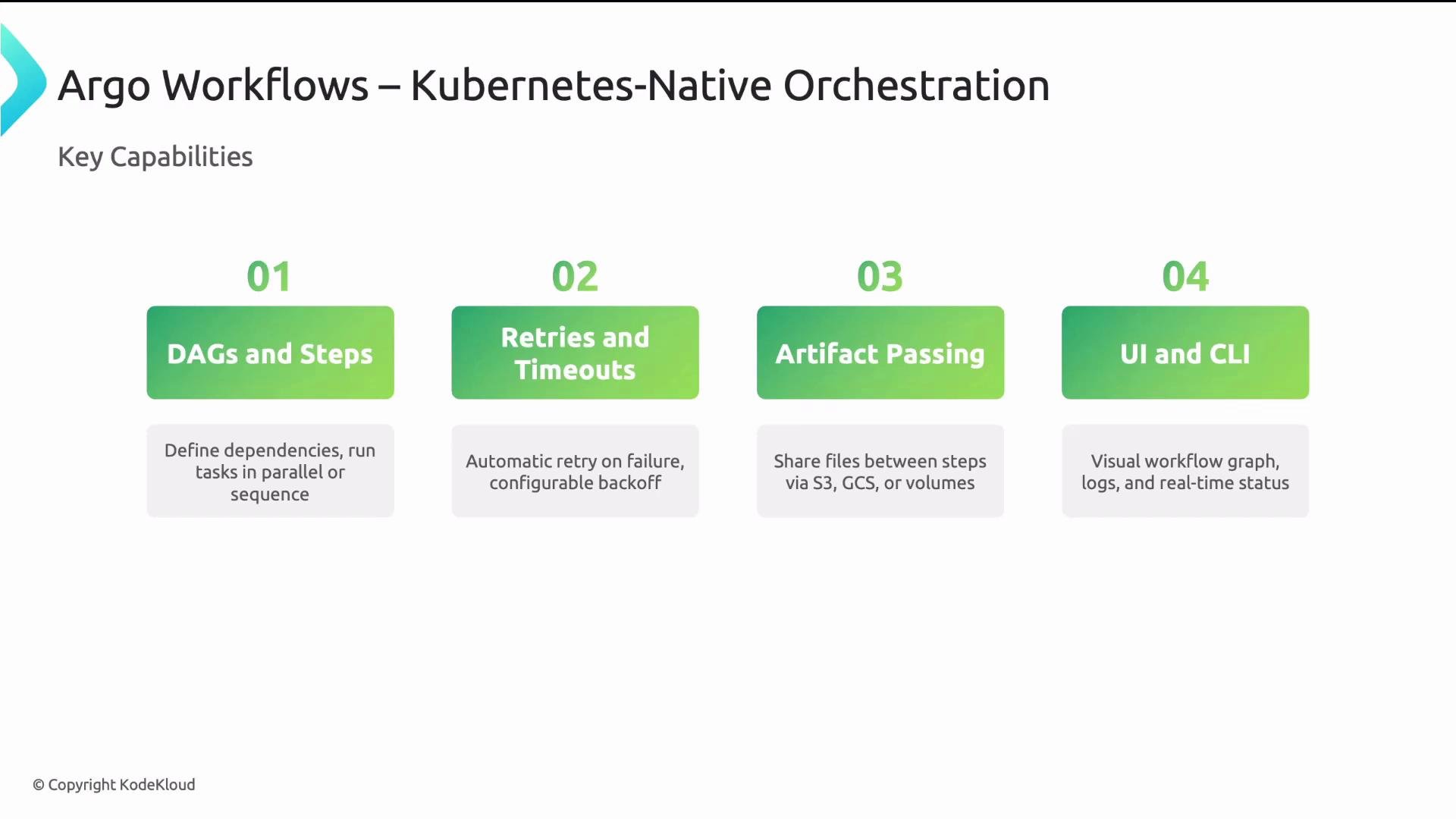
The image outlines the key capabilities of Argo Workflows for Kubernetes-native orchestration, including DAGs and steps, retries and timeouts, artifact passing, and UI and CLI features.
Expressing execution order: Steps vs DAGs Argo supports two primary patterns to express execution order:
  • Steps: a list-of-lists pattern where the outer list is sequential phases and each inner list contains steps that run in parallel. Best for mostly linear pipelines with some parallel groups.
  • DAGs: explicit nodes with dependencies. Best for complex graphs with multiple concurrent paths and explicit dependency control.
Correct Steps example (array-of-arrays):
DAG example with explicit dependencies:
Tasks whose dependencies are satisfied will run immediately, letting Argo maximize parallelism safely.
Use Steps for straightforward, mostly linear pipelines. Choose DAGs when explicit dependency control and multiple concurrent paths are required.
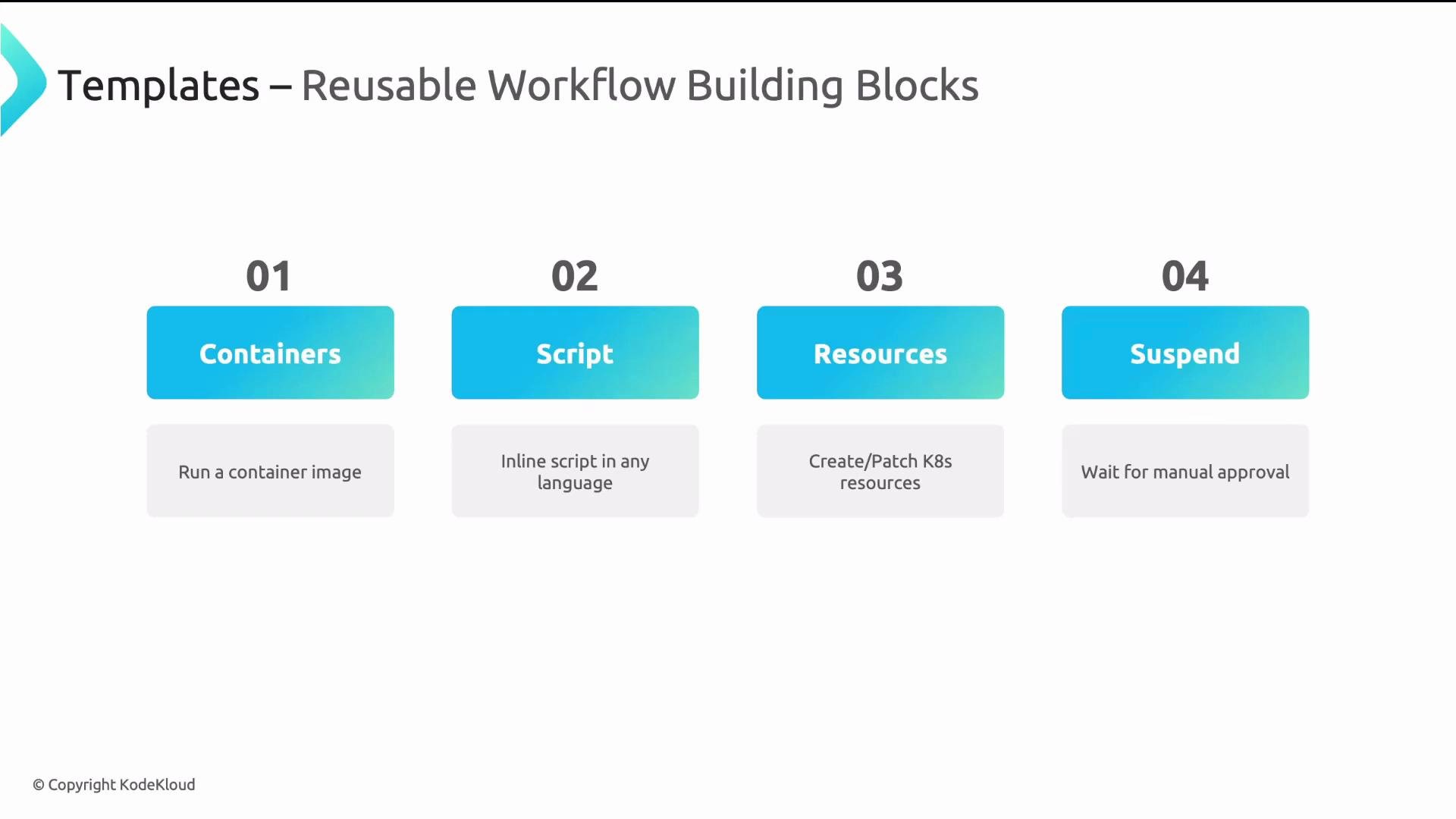
Templates: reusable building blocks Templates are the modular units of Argo Workflows. Define them once and reuse across workflows. Common template types:
The image outlines four reusable workflow building blocks: Containers, Script, Resources, and Suspend, with descriptions for each.
WorkflowTemplates and ClusterWorkflowTemplates WorkflowTemplates provide namespaced, reusable definitions. Use them to create a library of platform tasks. For cluster-wide reuse, use ClusterWorkflowTemplate. Example WorkflowTemplate (kaniko build):
Parameters make templates flexible. Pass values at runtime or wire outputs from earlier steps into other templates. For example, a deploy template can accept a namespace parameter to operate across environments. Artifacts: reliable file passing between steps Because each step runs in its own pod with an isolated filesystem, you must use artifacts to pass files between steps. Typical flow:
  • Step A writes a file (e.g., /tmp/artifact.tar) and declares it as an output artifact.
  • Argo uploads that artifact to the configured artifact repository (S3, GCS, MinIO).
  • Step B declares the artifact as an input and Argo downloads it into the pod before the step runs.
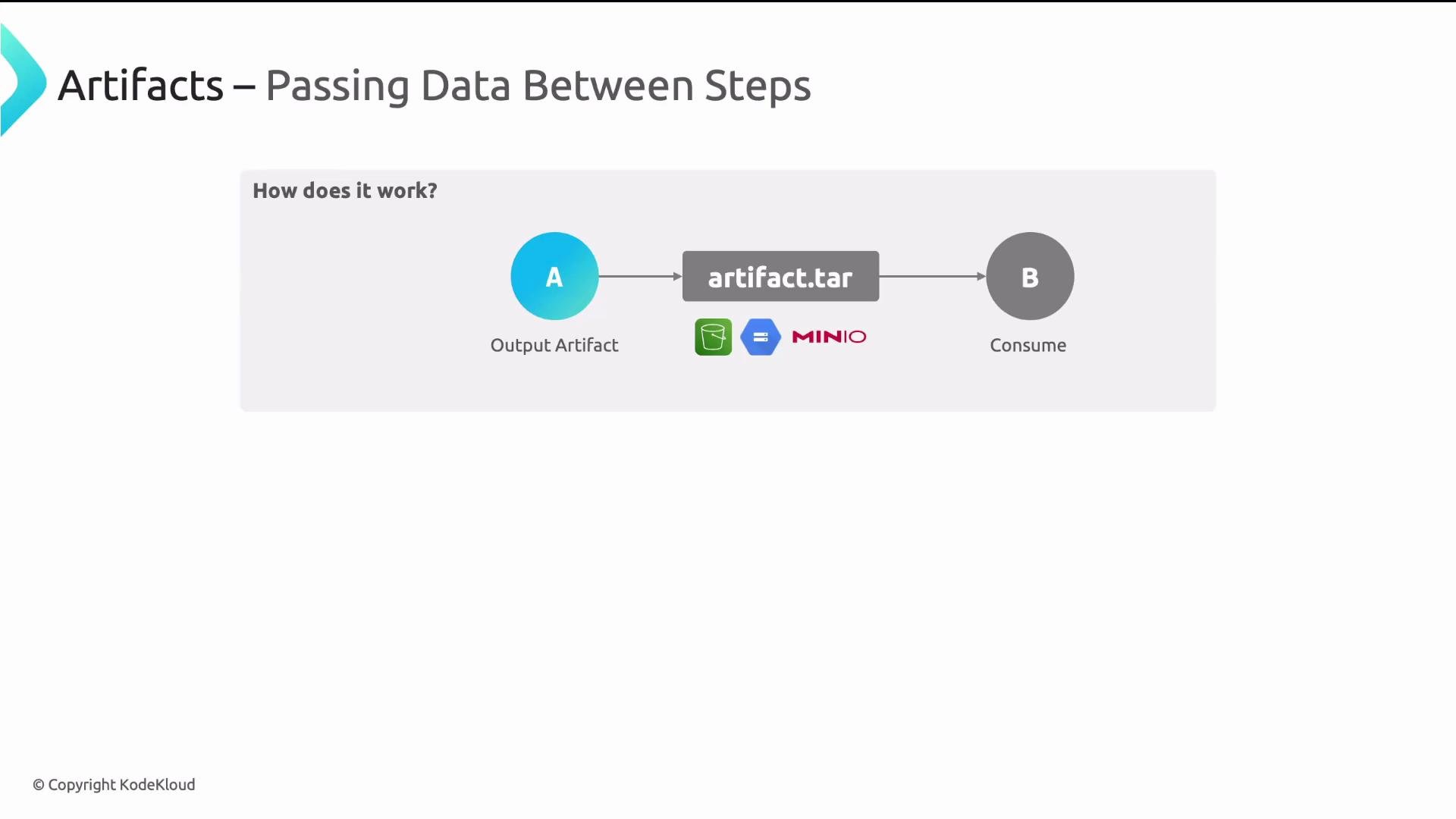
The image is a flowchart illustrating how data is passed between steps using artifacts, with a process from step A (Output Artifact) to step B (Consume) via "artifact.tar," involving tools like S3, Google Cloud Storage, and MinIO.
Producer/consumer artifact example Producer template snippet (writes /tmp/msg.txt and exposes it as an output artifact):
Consumer template snippet (declares message as an input artifact and reads it):
Configure artifact backends via the artifact repository ConfigMap in the argocd/argo namespace (or your Argo namespace). For local demos use MinIO; for production use S3, GCS, or another supported backend. Artifacts are ideal for build outputs, test results, generated configs, or any files that subsequent steps require. Argo Events: external triggers and event-driven automation Argo Events extends Argo Workflows to react to external events and trigger Workflows (or other actions).
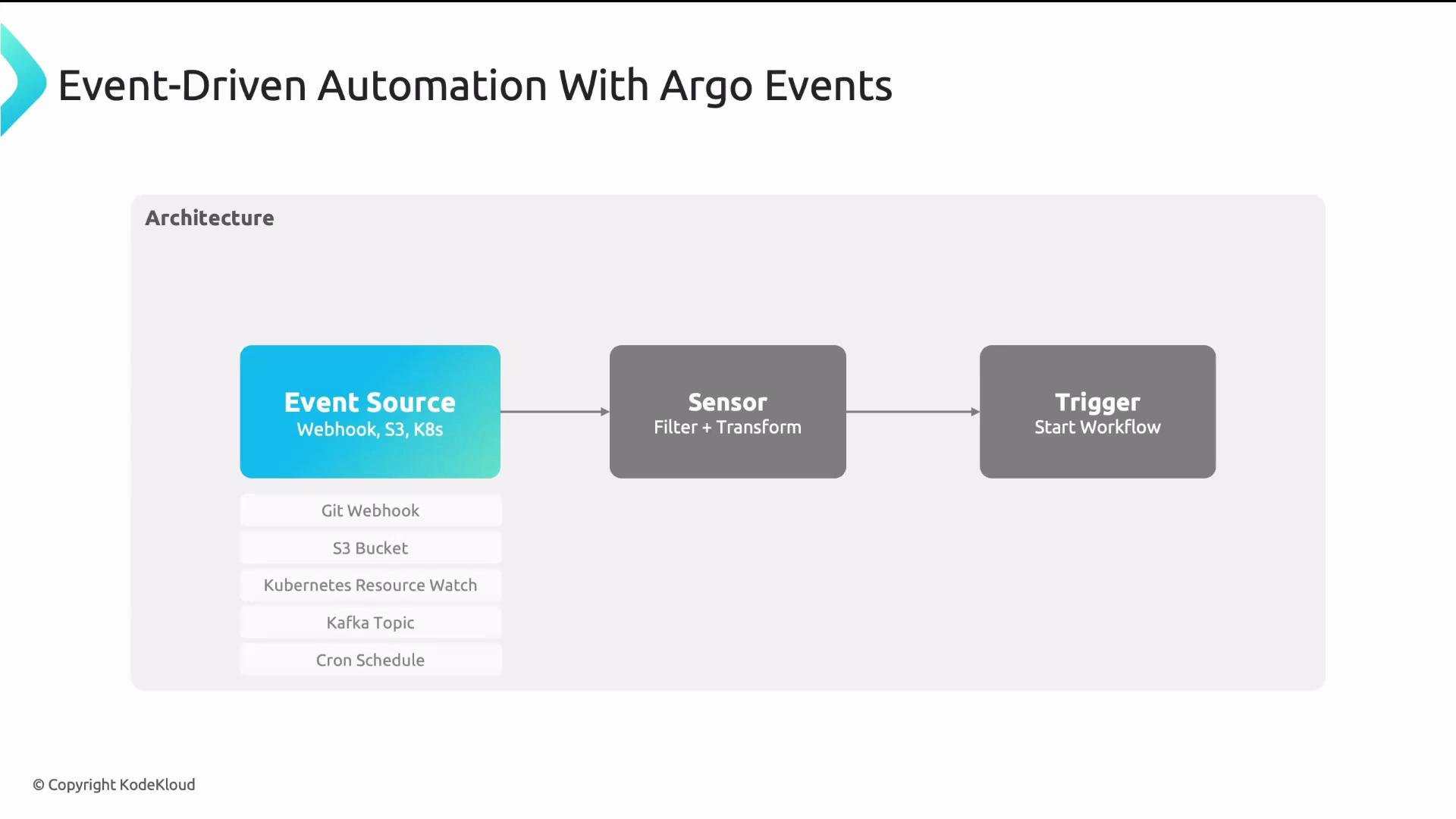
The image illustrates the architecture of event-driven automation using Argo Events, showing a flow from the event source to a sensor and then a trigger.
Argo Events components
  • EventSource: connects to external event streams (Git, webhooks, S3, message queues) and listens for events.
  • Sensor: filters and transforms events, extracting parameters (for example, trigger only on pushes to main and pass the commit SHA).
  • Trigger: performs an action—commonly submits an Argo Workflow.
Example use cases
  • Git push triggers a build and deploy pipeline.
  • File uploaded to S3 triggers a data processing workflow.
  • Creation of a CRD triggers infra provisioning workflows.
  • Cron-like schedules trigger nightly cleanup or reporting workflows.
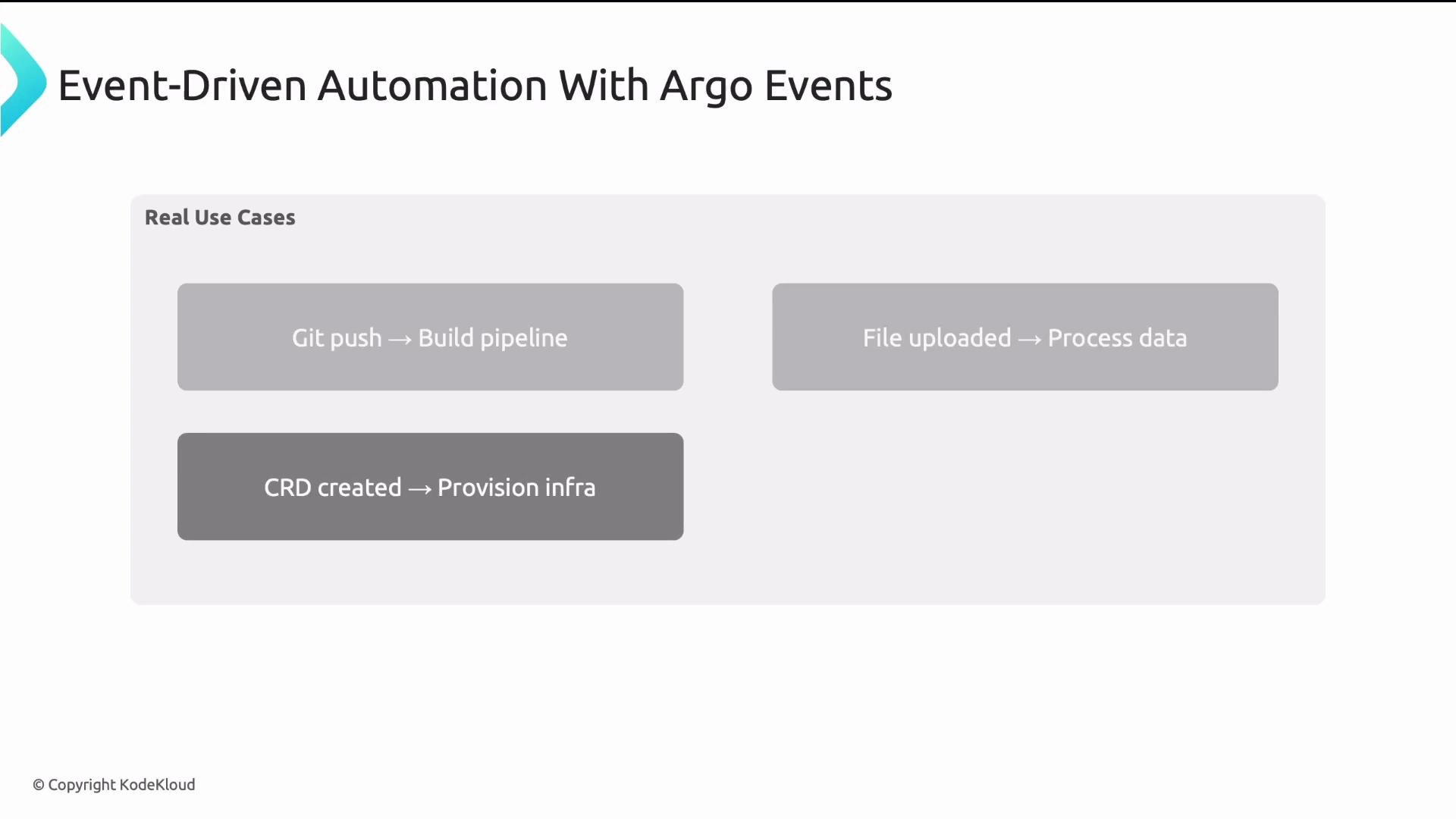
The image illustrates event-driven automation use cases with Argo Events, including scenarios like Git push triggering build pipelines and file uploads leading to data processing.
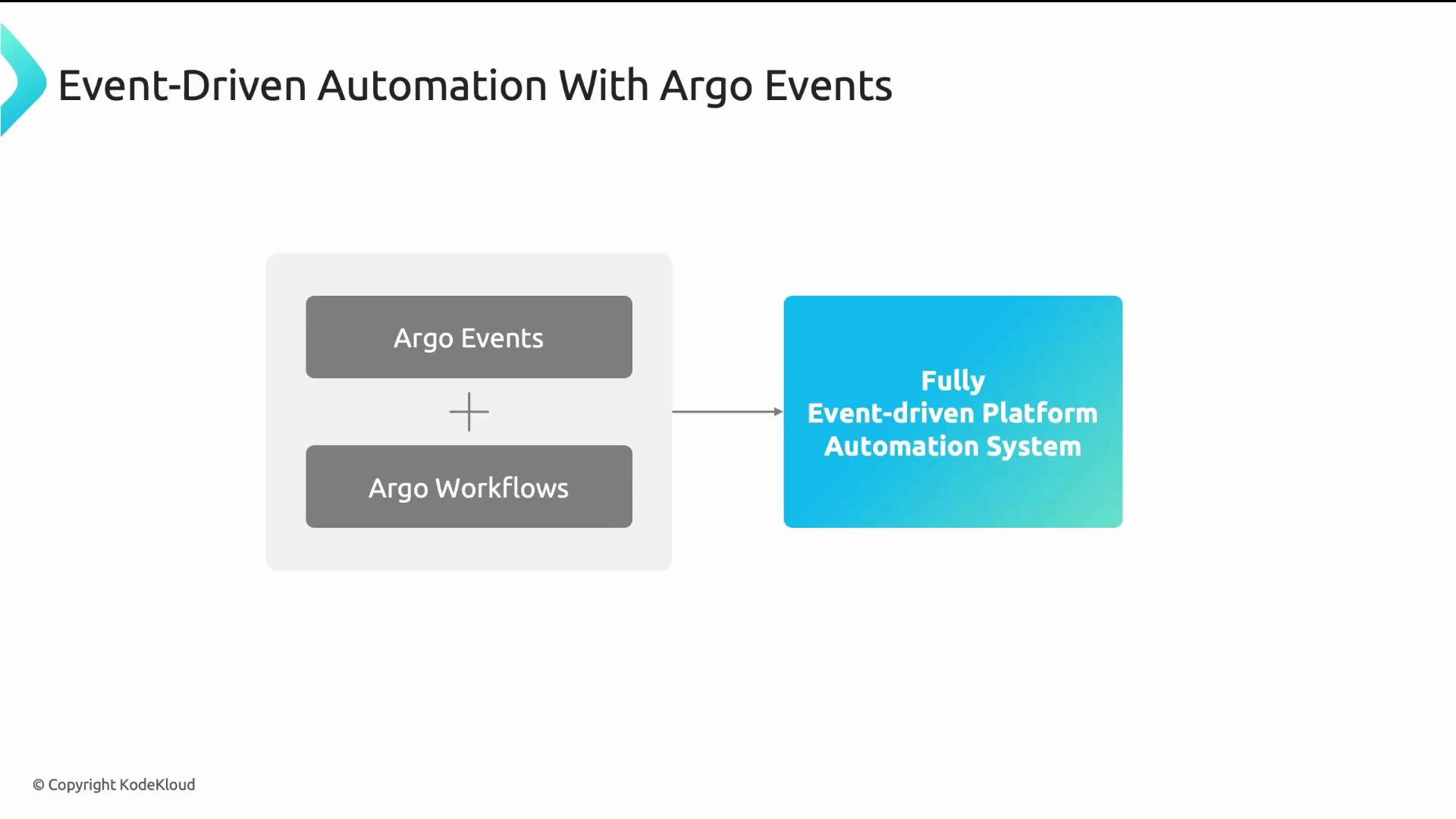
Combined architecture Together, Argo Events + Argo Workflows provide a fully event-driven automation platform. Declare what should happen when an event occurs; the system manages execution, retries, artifacts, and observability.
The image illustrates a process of event-driven automation using Argo Events and Argo Workflows, resulting in a fully event-driven platform automation system.
Key takeaways
  • Workflows are a better fit than scripts for complex platform automation—especially when you need parallelism, retries, and observability.
  • Use Steps for simple, mostly linear pipelines; use DAGs when you need explicit dependency graphs and complex concurrency.
  • Templates and WorkflowTemplates make automation reusable and parameterizable across teams and environments.
  • Artifacts provide reliable file transfer between isolated pods and are essential for build/test artifacts and generated configurations.
  • Argo Events adds event-driven capabilities so your automation reacts to external triggers (Git, webhooks, object stores, message queues).
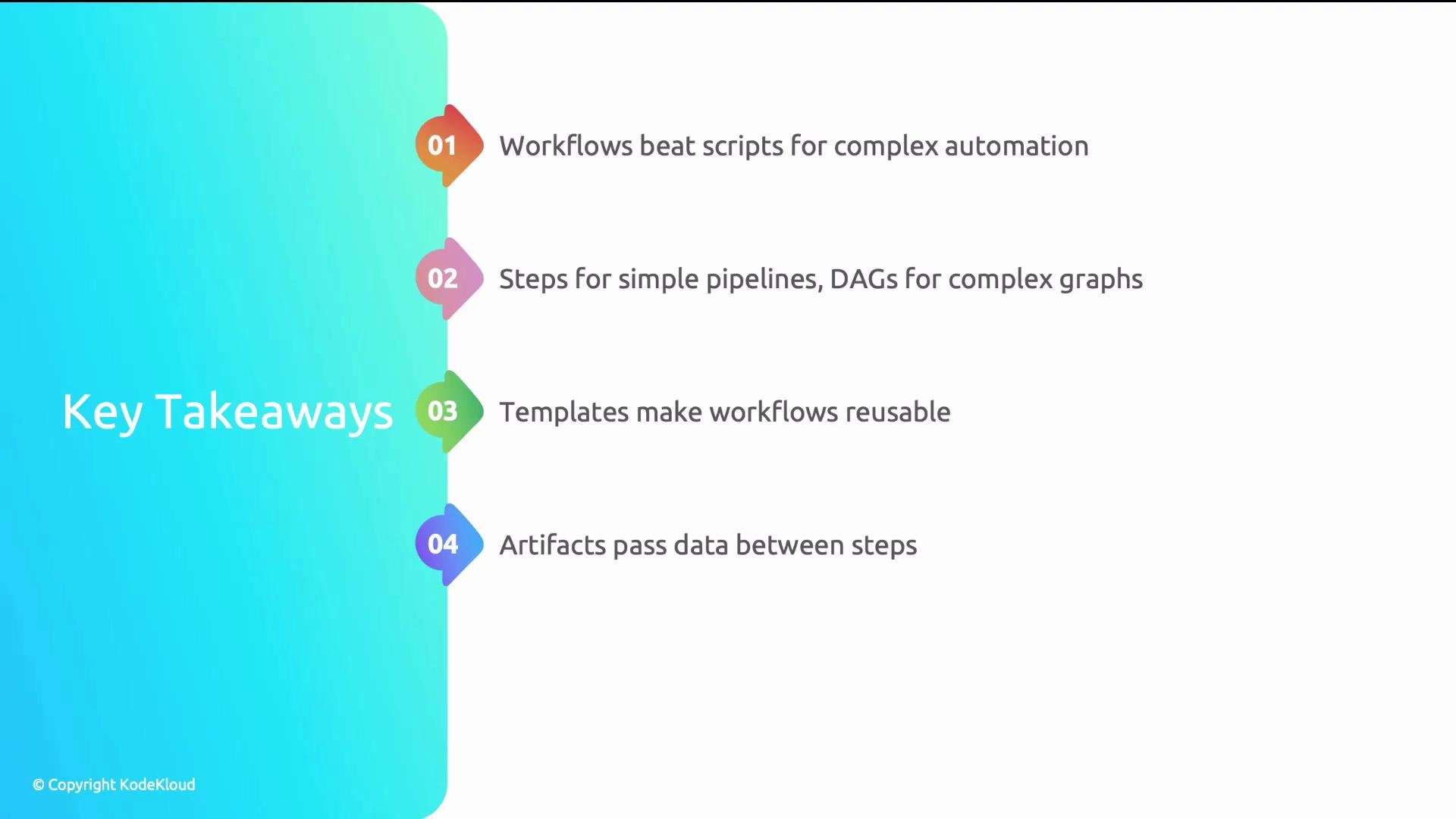
The image outlines four key takeaways about workflows: they are preferable to scripts for complex automation, use DAGs for complex graphs, templates enhance reusability, and artifacts facilitate data transfer between steps.
Further reading and references

Watch Video