

- Kubernetes for the Absolute Beginners
- Kubernetes for Administrators — prepares for the Certified Kubernetes Administrator (CKA)
- Kubernetes for Developers — prepares for the Certified Kubernetes Application Developer (CKAD)
Course comparison
Kubernetes for the Absolute Beginners
This introductory course is designed for learners with little or no experience with containers and orchestration. It focuses on clear, high-level explanations and guided hands-on practice to build confidence:- Fundamental Kubernetes concepts and terminology (Pods, ReplicaSets, Deployments, Services)
- Setting up a lightweight lab environment for experimentation
- Basic YAML manifests and resource definitions
- Deploying and exposing simple applications
Kubernetes for Administrators
This course is targeted at administrators who manage production clusters. It covers the operational skills and best practices required to run Kubernetes reliably and securely:- Cluster architecture, control plane and worker nodes, and high-availability design
- Scheduling, resource requests/limits, and QoS
- Storage integration, PersistentVolumes, and provisioning patterns
- Monitoring, logging, observability, and troubleshooting workflows
- Maintenance tasks: upgrades, backups, and rolling updates
- Security hardening and RBAC for cluster operations
Kubernetes for Developers
This course is focused on application design and deployment within Kubernetes. Developers learn practical patterns for building cloud-native applications without needing to be platform experts:- ConfigMaps and Secrets for configuration management
- Service accounts and basic RBAC concepts for app-level permissions
- Multi-container Pods and sidecar patterns
- Liveness/readiness probes and health checks
- Application-level logging and monitoring
- Jobs, CronJobs, and batch workloads
- Service discovery, networking considerations, and packaging apps for Kubernetes
- Hands-on exercises to build, package, and deploy apps
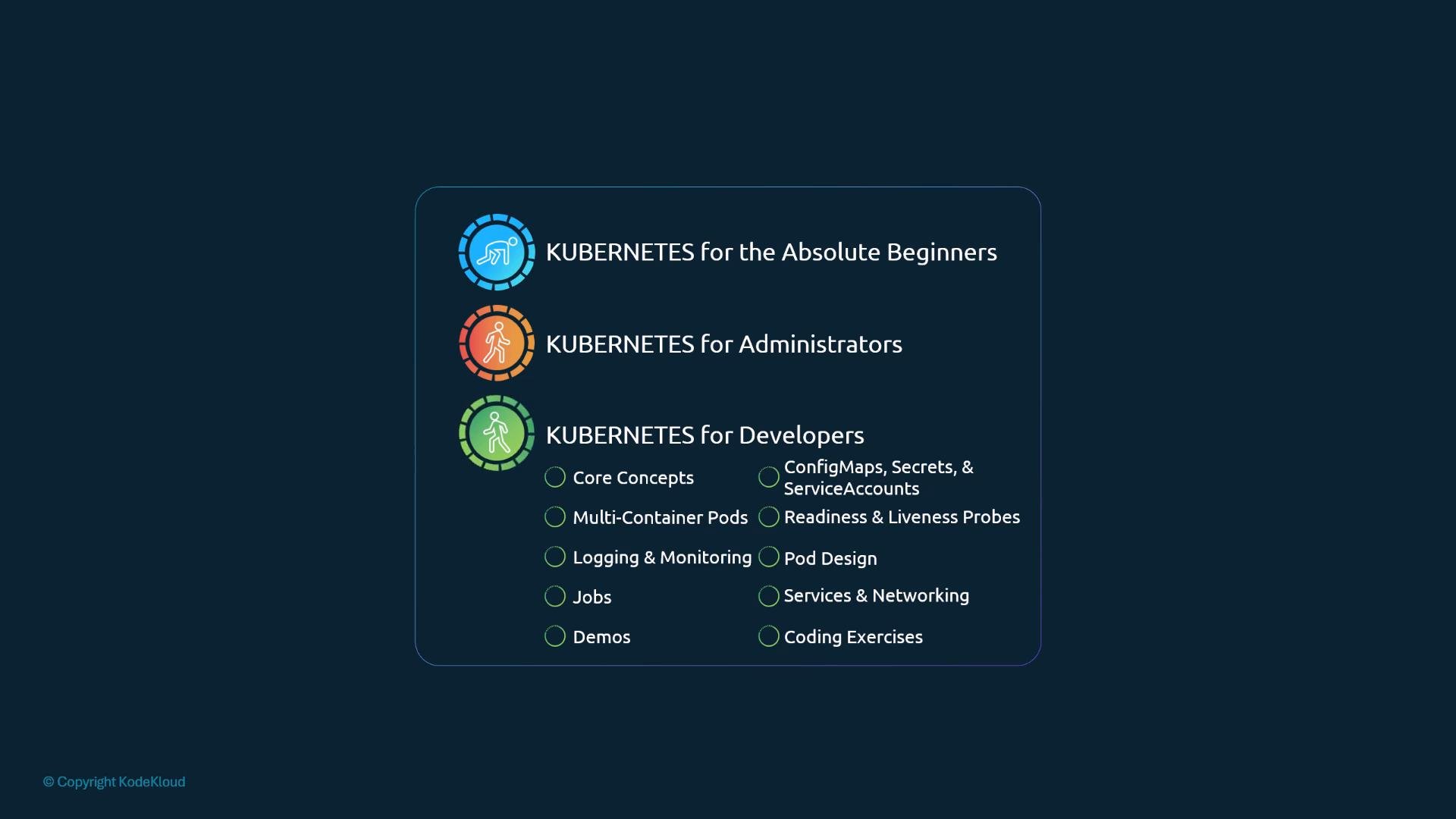
You do not have to complete the courses in a strict order. For example, an aspiring administrator can start with the Beginners course and then take the Administrators course (and pursue CKA). A developer might take the Beginners course first, then the Developers course (and pursue CKAD). Choose the path that aligns with your role and certification goals.
Links and references
- Kubernetes Documentation
- Certified Kubernetes Administrator (CKA) — course
- Certified Kubernetes Application Developer (CKAD) — course
- Kubernetes for the Absolute Beginners — course