

Azure AD Privileged Identity Management (PIM) is a robust service that empowers organizations to manage, control, and monitor access to critical resources across Azure, Azure AD, Office 365, and various SaaS applications. In this article, we delve into the fundamentals of PIM, exploring how it operates and why it transforms security management for enterprises.Documentation Index
Fetch the complete documentation index at: https://notes.kodekloud.com/llms.txt
Use this file to discover all available pages before exploring further.
Key Features of PIM
PIM’s primary goal is to significantly reduce the number of users with permanent access to secure information. Consider an IT administrator who needs temporary access to a confidential database. With PIM, only authorized individuals are granted temporary privileges, effectively reducing the risk of security breaches.Just-in-Time (JIT) Access
PIM leverages just-in-time privileged access to provide elevated permissions only when they are necessary and for a limited duration. This means that once an IT administrator is granted access to a resource, the privileges are automatically revoked after a designated period, thereby reducing the risk of unauthorized or accidental exposure.Time-Based and Approval-Based Role Activation
Another major advantage of PIM is its support for both time-based and approval-based activations. For instance, when a developer requires access to a critical service, their request is reviewed and approved by a designated administrator. The access is then activated for a pre-determined time frame—such as 2 or 8 hours—ensuring that elevated permissions are strictly temporary.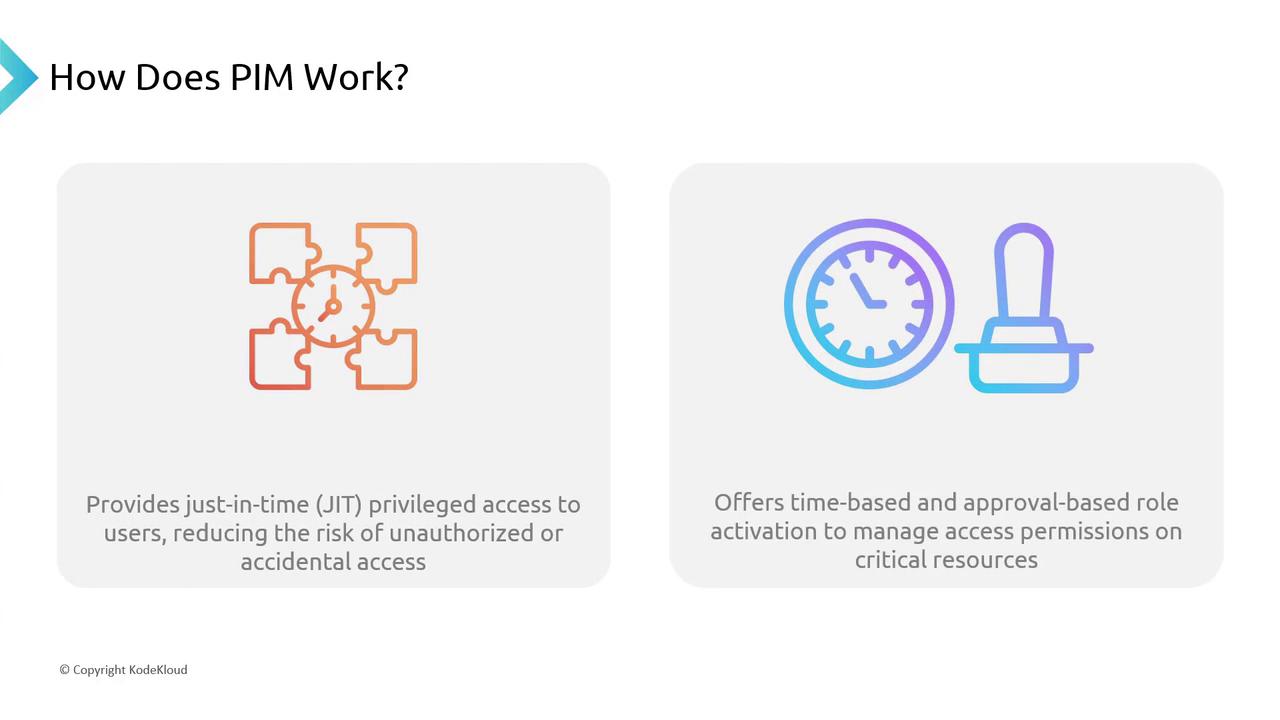
PIM’s design is aligned with the principle of least privilege, ensuring that users obtain only the minimum necessary access to perform their tasks.
Why Use PIM?
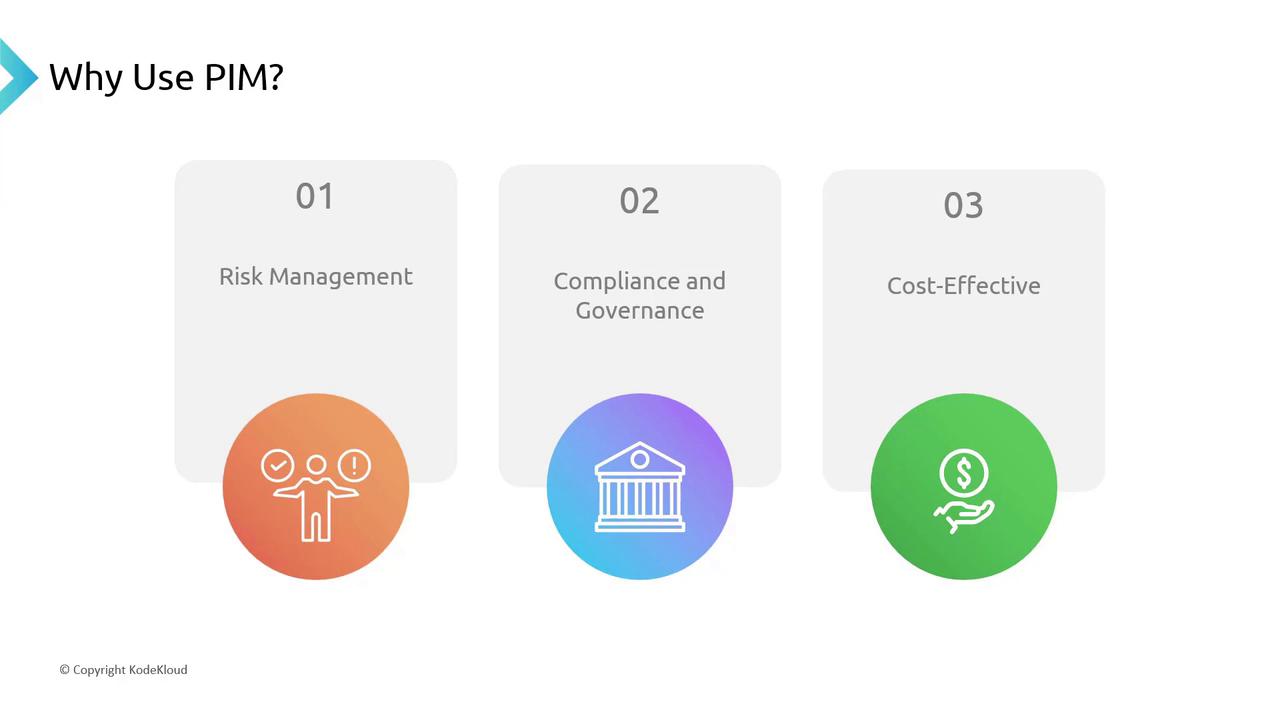
PIM introduces an additional layer of security by replacing direct, permanent access assignments with temporary, controlled permissions. Below are the key benefits:| Benefit | Description |
|---|---|
| Risk Management | Mitigates internal and external threats by reducing excessive or inappropriate access. |
| Compliance and Governance | Ensures adherence to regulatory standards such as GDPR and HIPAA, protecting both data and assets. |
| Cost-Effectiveness | Centralizes and automates access control, reducing administrative overhead and associated costs. |
When setting up PIM, ensure that both time-based and approval-based role activations are configured correctly to fully leverage PIM’s security benefits.