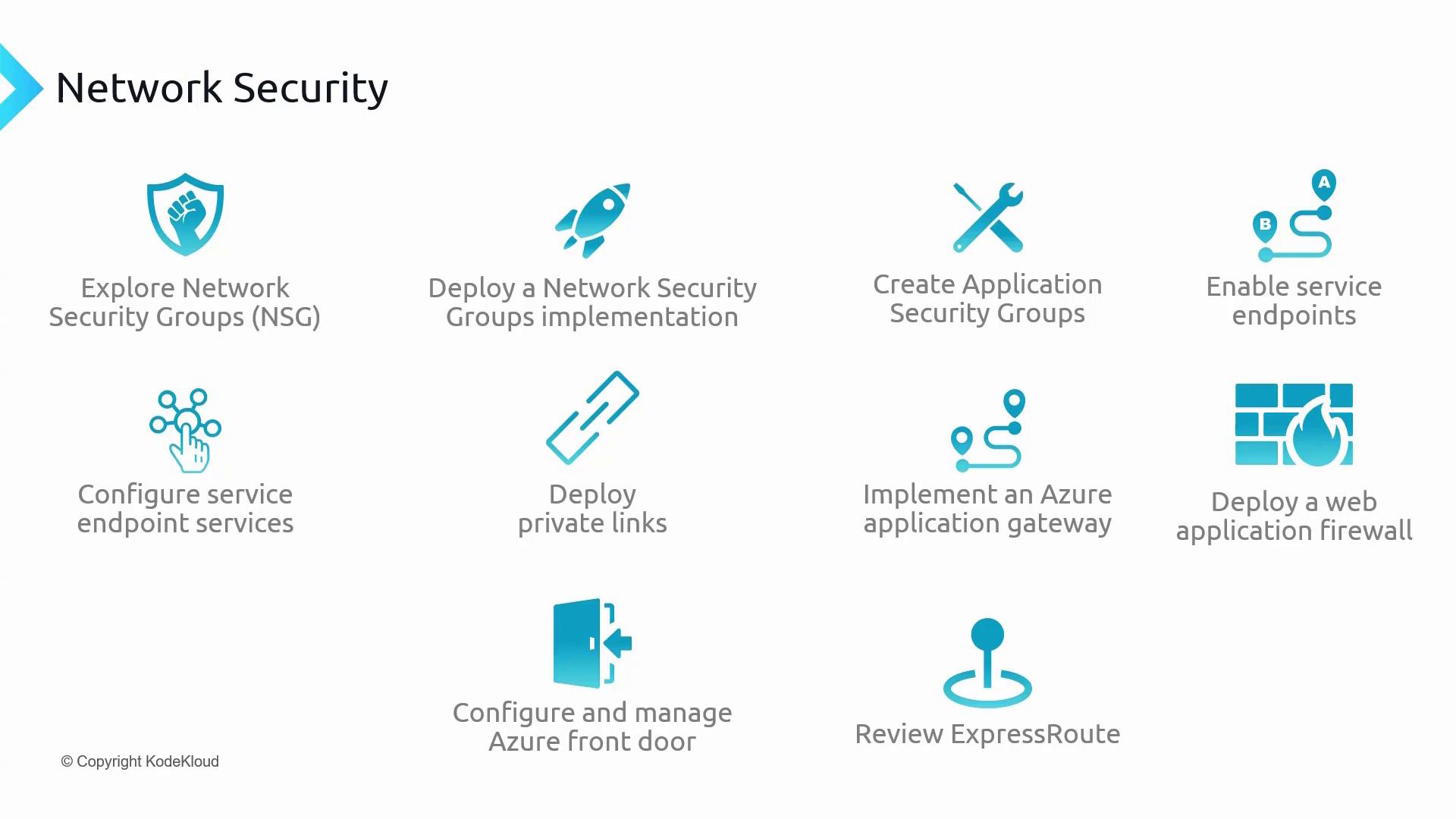
This lesson explores network security within a defense-in-depth strategy, covering key topics like NSGs, ASGs, service endpoints, private links, and Azure security services.
Welcome back! In this lesson, we continue our comprehensive exploration of network security as part of the broader defense-in-depth strategy. Previously, we discussed how Microsoft manages physical security in their data centers, while Azure AD handles identity and access management—including conditional access, identity management, and multi-factor authentication.In an earlier lesson, we examined perimeter security through DDoS protection, Azure Firewall, and the hub-spoke network strategy. Now, we shift our focus specifically to network security.The key topics covered in this lesson include:
Network Security Groups (NSGs)
Application Security Groups (ASGs)
Enabling and configuring service endpoints
Deploying private links
Implementing Azure Application Gateway
Deploying a Web Application Firewall (WAF)
Configuring and managing Azure Front Door
Reviewing ExpressRoute
Even if you have a firewall in place, using Network Security Groups (NSGs) provides an additional layer of micro-segmentation at the virtual network level, ensuring granular control over network traffic.
Below is a diagram that summarizes the essential network security tasks, including deploying NSGs, creating application security groups, and configuring various Azure network services.
Let’s begin by taking an in-depth look at Network Security Groups (NSGs).