

What are audio embeddings?
Audio embedding models encode variable-length audio into fixed-length vectors by extracting acoustic and semantic patterns. Think of an embedding as a compact fingerprint of an audio clip: the model maps similar sounds (e.g., the same spoken phrase or the same song snippet) to nearby vectors in embedding space, enabling semantic search, nearest-neighbor matching, and efficient indexing.Audio embeddings let you compare audio at scale without manual tagging. They’re useful for retrieval (find similar sounds), classification (genre, mood), and downstream tasks (ASR, speaker verification).
How they work (high-level)
- Preprocessing: audio is normalized, resampled, and often converted to spectrograms or mel-frequency representations.
- Feature extraction: neural networks (CNNs, transformers) learn representations from raw audio or spectrograms.
- Pooling / projection: variable-length outputs are pooled and projected to a fixed-size vector (the embedding).
- Contrastive / supervised learning: training objectives (self-supervised fine-tuning, contrastive audio-text alignment) shape embeddings to capture semantic similarity.
Real-world use cases
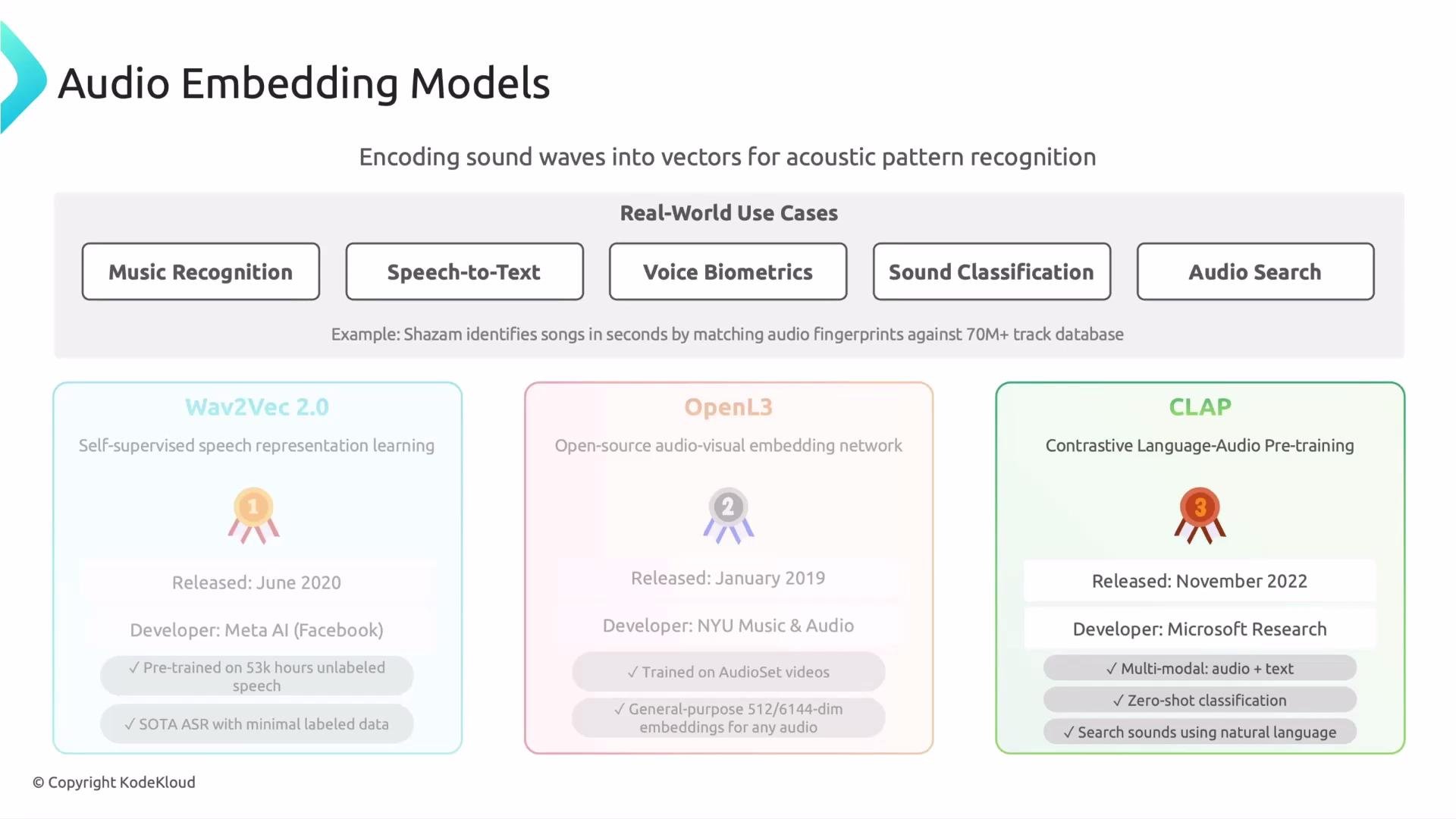
Audio embeddings power many practical products and research systems:- Music recognition (Shazam-style matching)
- Speech-to-text and automatic captioning
- Voice biometrics and speaker identification
- Song/genre classification and recommendation
- Audio search and retrieval (search by sound or natural-language queries)
Top audio embedding models
Below are widely cited audio embedding models and what each brought to the field.- Wav2Vec 2.0: a breakthrough in self-supervised speech representation learning — reduces dependency on large labeled transcripts.
- OpenL3: designed for general audio-visual embedding; useful in music and environmental sound tasks.
- CLAP: aligns audio with text to enable multimodal, natural-language-based retrieval (akin to CLIP for images).
Why these models matter
By converting waveforms into semantic vectors, audio embeddings enable:- Scalable semantic search across large audio corpora (podcasts, call archives)
- Fast and robust speaker identification across long recordings
- Natural-language-based audio retrieval (“find audio that sounds like rain on a rooftop”)
- Improved accessibility (automated captioning and indexing for DHH users)
- Production systems that index or classify audio at scale, often with limited labeled data
Practical considerations
- Dimensionality vs. latency: higher-dimensional embeddings often capture more nuance but increase storage and nearest-neighbor search cost.
- Indexing: pair embeddings with a vector database (FAISS, Milvus, Pinecone) to perform efficient similarity search.
- Preprocessing: consistent sampling rates, silence trimming, and normalization are important to get repeatable embeddings.
- Privacy & compliance: voice biometrics and speaker ID require careful legal and ethical handling (consent, data retention policies).
Voice and speaker biometric data is sensitive. Ensure appropriate consent, secure storage, and compliance with local regulations before deploying speaker identification systems.
Matching models to use cases
Resources and further reading
- Wav2Vec 2.0 paper and code (Meta AI)
- OpenL3: Audio-visual embeddings (NYU) and
AudioSet(Google) — https://research.google.com/audioset/ - CLAP: Contrastive language–audio pre-training literature and implementations