

- Semantic search
- K-nearest neighbor (KNN) search
- Hybrid search (vector + filters)
- Range / threshold search
- Multi-vector (multimodal) search
- Approximate nearest neighbor (ANN) search
- Two-stage retrieval with re-ranking
Semantic search
- What it is: Convert a natural language query into an embedding, then retrieve items whose embeddings are semantically close. Results prioritize meaning over literal keyword overlap.
- When to use: Conversational assistants, semantic product search, FAQ matching, code search.
- Example: Query “find products similar to a gaming laptop” matches products that share the same intent or attributes even if they don’t share keywords.
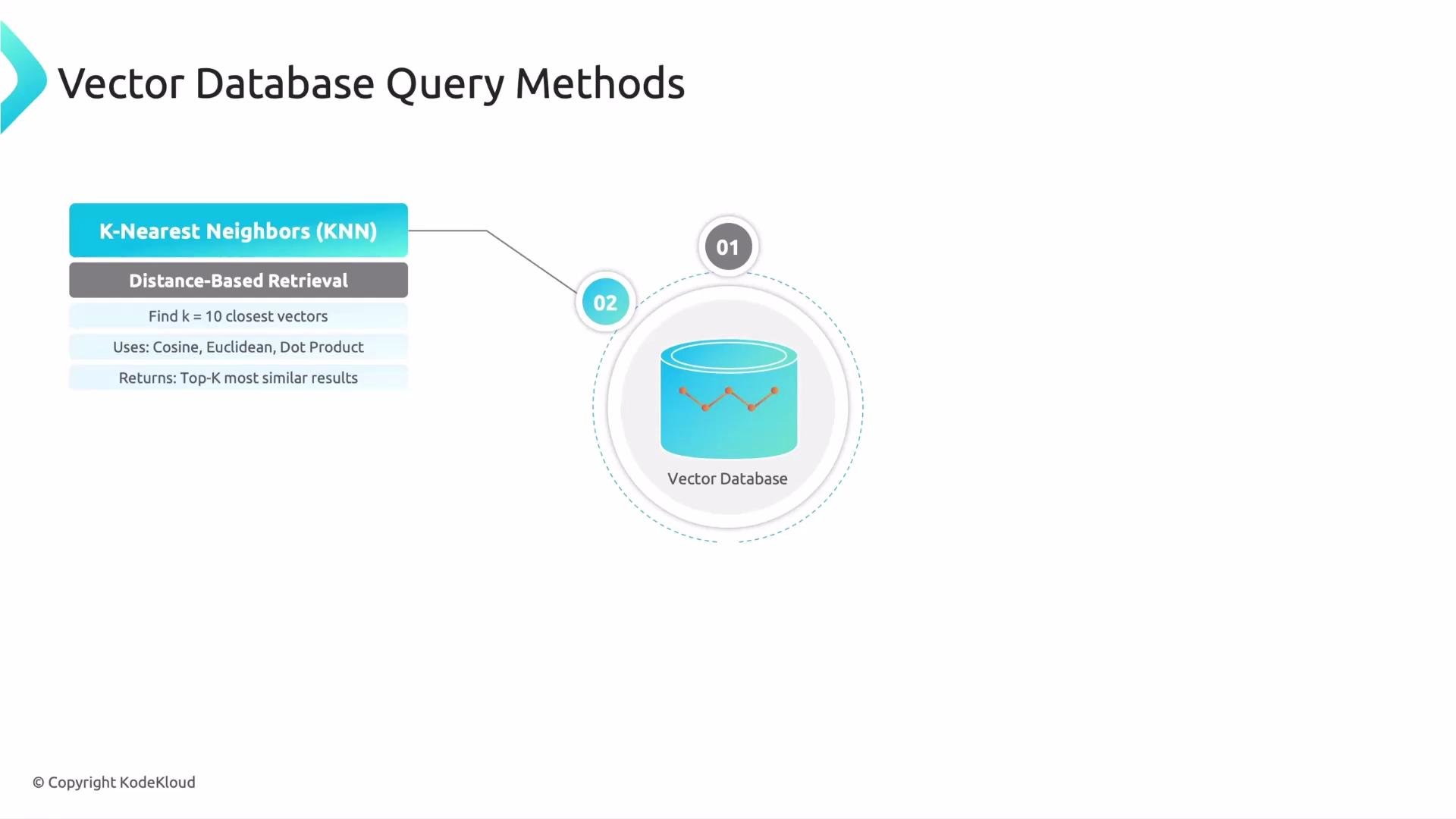
- What it is: Compute exact distances (cosine, dot product, Euclidean) between the query vector and every stored vector, then return the top-k closest items.
- When to use: Small-to-moderate datasets or workflows that require exact nearest neighbors (no approximation).
- Trade-offs: Precise but computationally heavy at scale.
Exhaustive KNN is exact but does not scale well to millions or billions of vectors — expect high CPU and memory costs as dataset size grows.
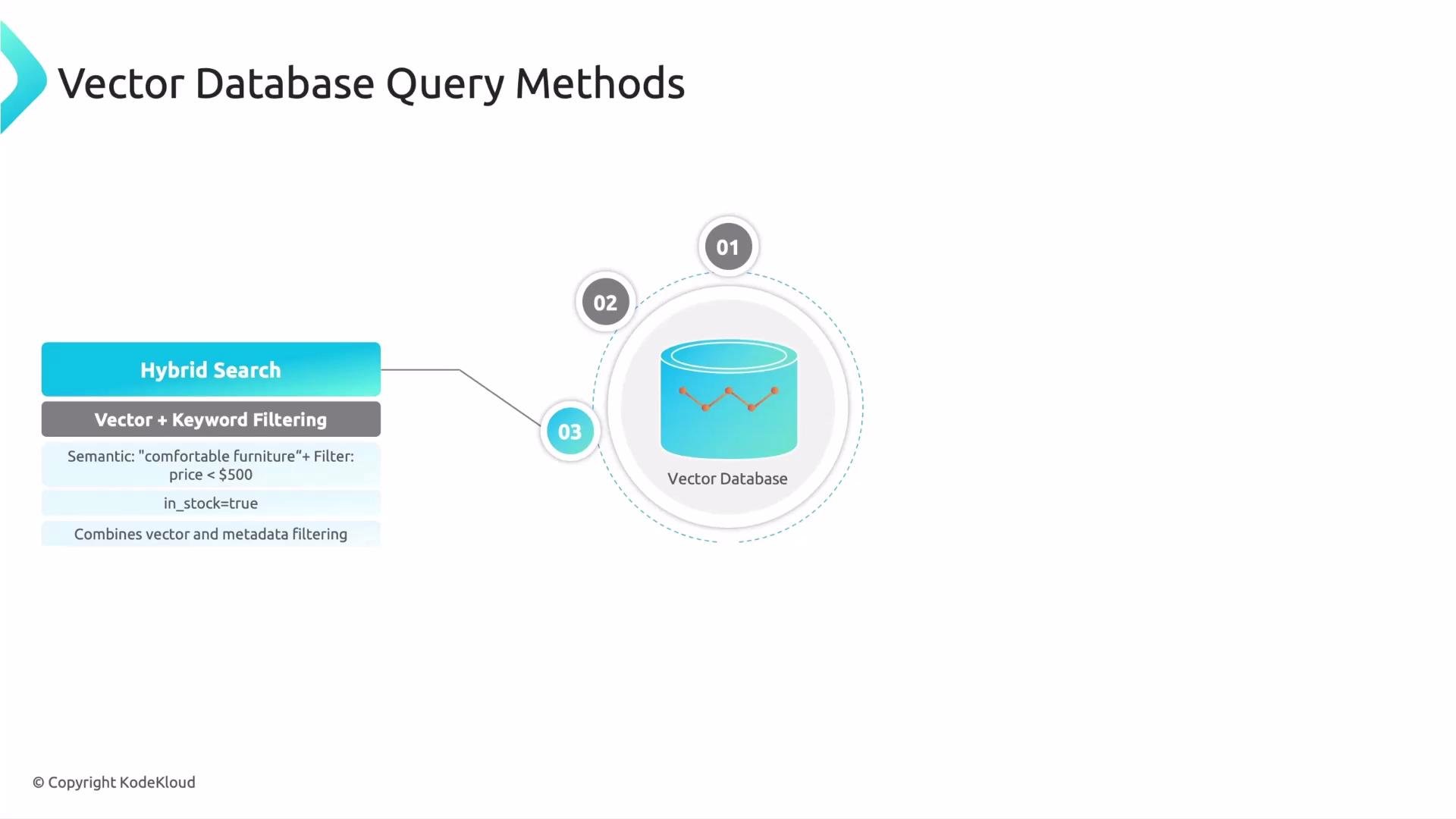
- What it is: Combine vector similarity with structured filters (metadata, numeric ranges, boolean flags). For example: “Find items semantically similar to ‘cozy home decor’ AND price < 100 AND in stock = true.”
- When to use: E-commerce catalogs, inventory-aware recommendations, business search where both semantics and exact attributes matter.
- Benefit: Precision from filters + recall and relevance from semantic matching.
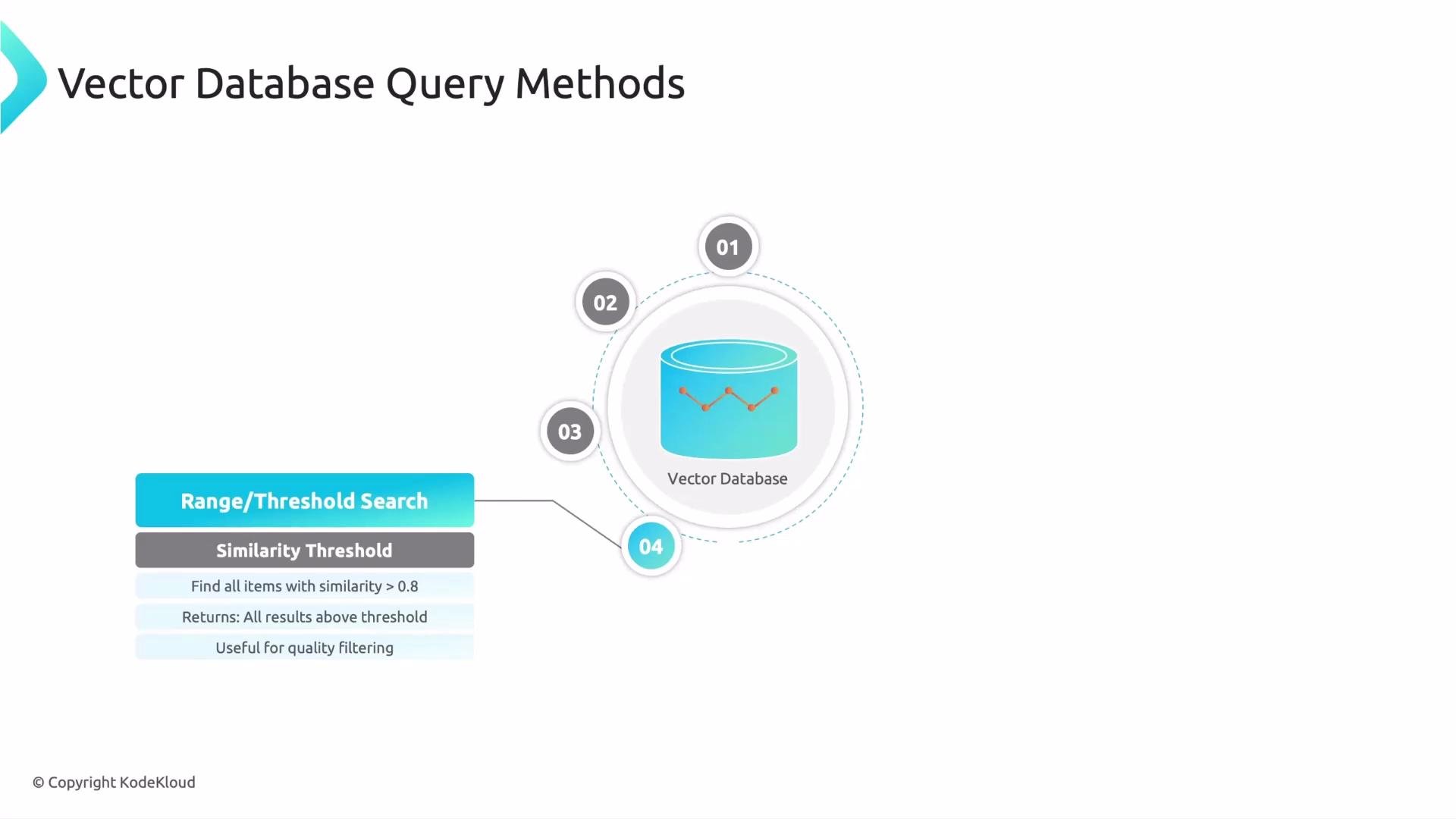
- What it is: Instead of asking for top-k, return all items whose similarity exceeds a given threshold (e.g., similarity > 0.9).
- When to use: High-precision needs like deduplication, exact matches by meaning, or flagging near-duplicates for moderation.
- Trade-offs: You may get variable result counts (including zero); tune thresholds based on validation data.
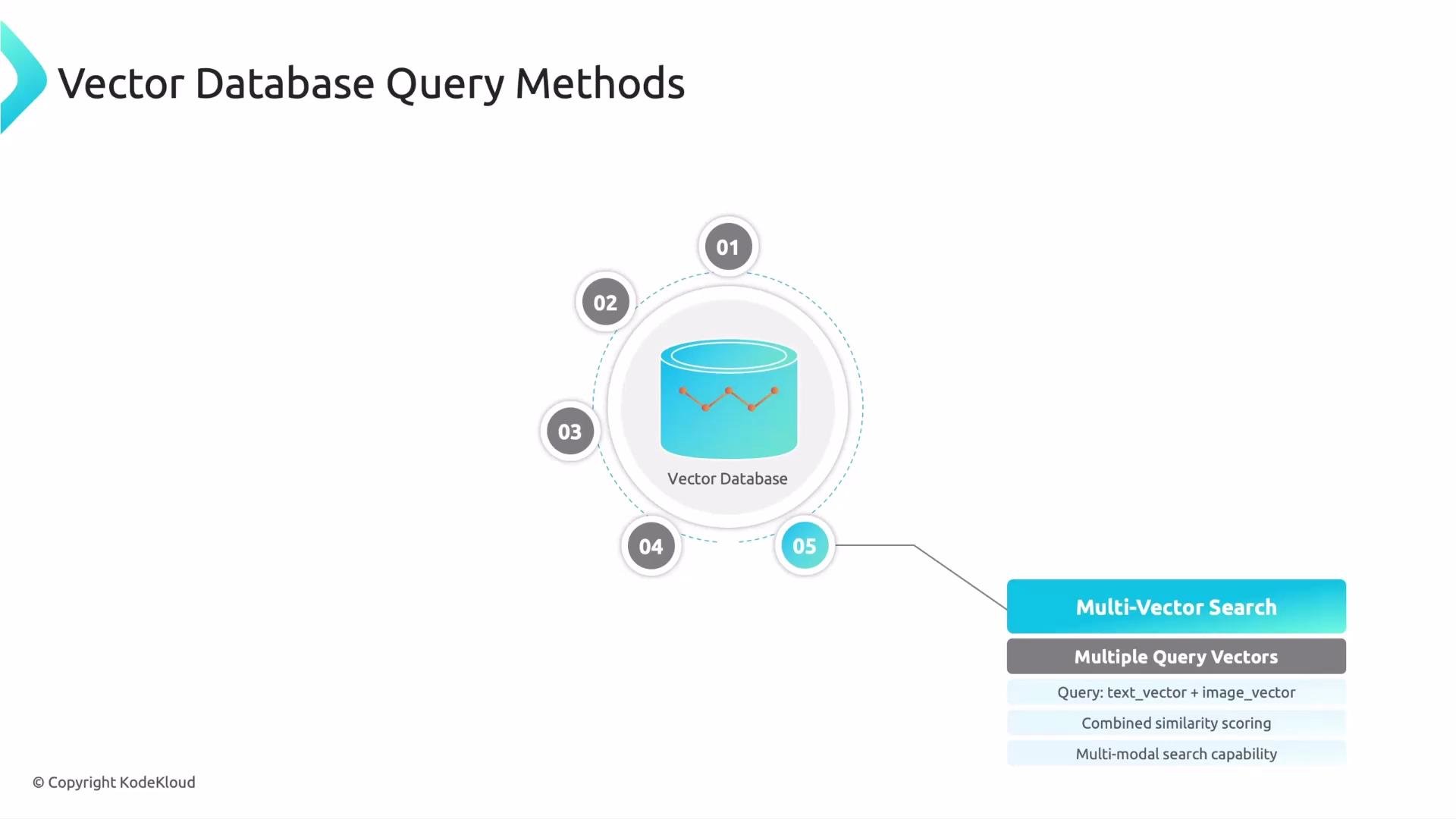
- What it is: Submit multiple query vectors (for example, text + image). The database combines similarity scores (often weighted) to find results that satisfy multiple modalities simultaneously.
- When to use: Product search that mixes example images and descriptive text, multimodal retrieval, or any use case where signals from different encoders should be combined.
- Implementation note: You can weight each modality differently depending on importance (e.g., 0.7image_score + 0.3text_score).
- What it is: Use index structures and heuristics (e.g., HNSW, IVF, PQ) to find vectors likely to be near the query without exhaustively scanning every item.
- When to use: Large-scale systems (millions to billions of vectors) where latency and cost are primary concerns.
- Trade-offs: Slight loss in recall/accuracy in exchange for major gains in speed and reduced memory usage.
- Practical note: ANN index parameters (e.g., ef, PQ code size, number of probes) let you tune the accuracy/latency trade-off.
- Pattern: A fast first stage retrieves a candidate set (often via ANN or a lightweight model). A slower, higher-precision model then re-scores those candidates to produce the final ranking.
- Stage 1: Fast retriever returns top-N candidates (e.g., 100).
- Stage 2: Re-ranker (cross-encoder or LLM-based scoring) refines ranking and filters results for quality.
- When to use: Production search systems that need both low latency and high ranking quality (e.g., RAG, QA systems, enterprise search).
- Benefit: Best of both worlds — you retain speed from ANN while achieving final precision with an expensive model.
ANN + re-ranking is a common production pattern: use ANN to quickly get a compact candidate set, then apply a more expensive but precise model to re-rank for final quality.
- The seven query methods above cover the core retrieval strategies used in modern vector search systems. Choose based on your dataset size, latency constraints, precision/recall needs, and whether you must combine structured filters or multiple modalities.
- Next steps: explore index architectures (HNSW, IVF, PQ), tuning ANN parameters, and building re-rankers (cross-encoders or LLM-based scorers) for production-grade pipelines.
- Understanding KNN and distance metrics
- HNSW, IVF, PQ overviews: check vendor docs (e.g., Faiss, Milvus, Pinecone) and academic references
- Two-stage retrieval / RAG patterns: various online guides and research papers