Hands-on tutorial converting a Markdown policy into SentenceTransformer embeddings, storing vectors in LanceDB, and performing semantic search with code examples and chunking strategies.
Welcome — in this hands-on demo we’ll convert a Markdown policy document into vector embeddings using a SentenceTransformer, store them in LanceDB (an open-source vector database), and run semantic search over the document. All code runs in a Jupyter notebook; the examples below show the essential code, explanations, and sample outputs so you can reproduce the workflow.Table of contents
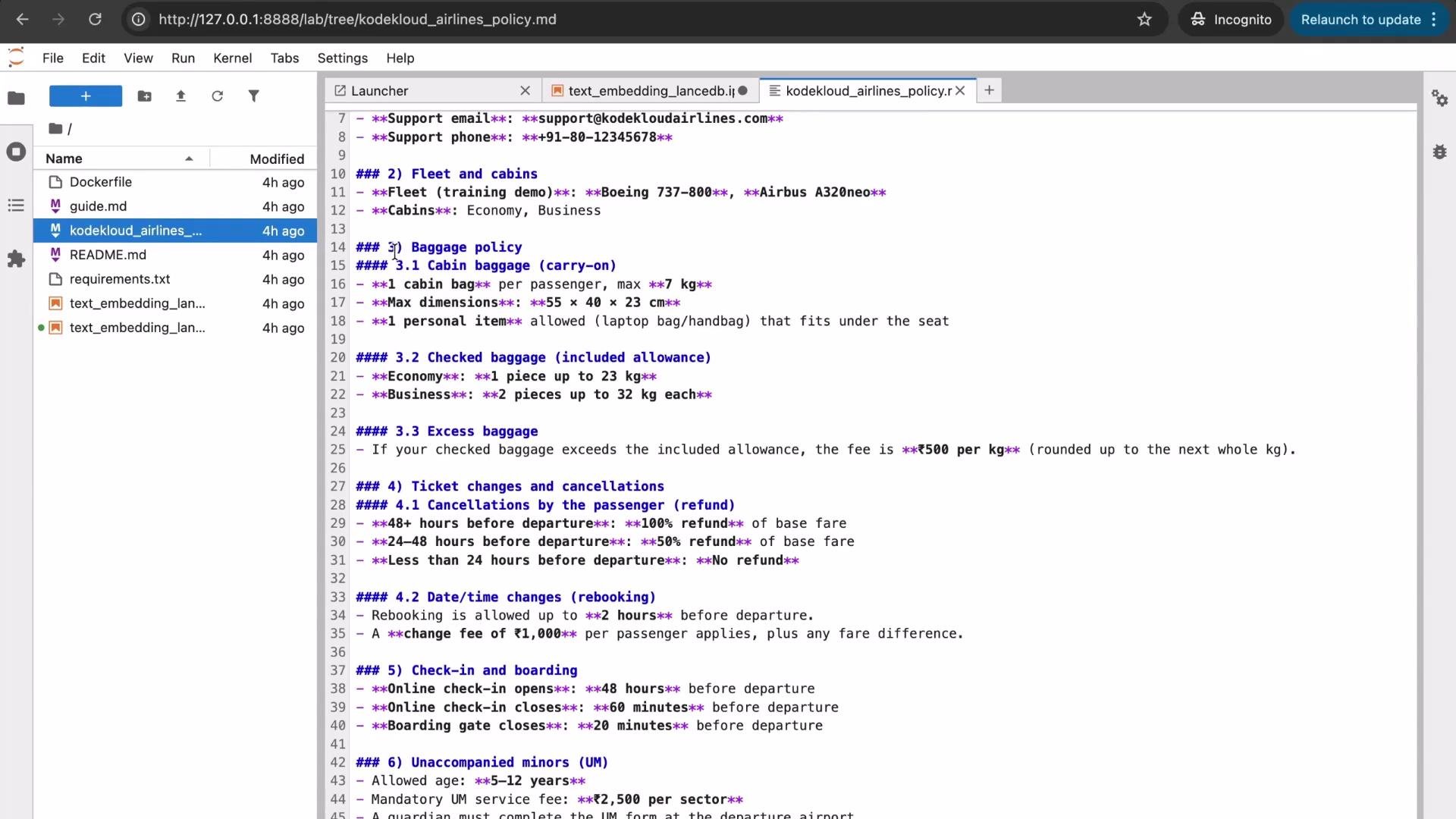
This policy includes sections for baggage, ticket changes and cancellations, pets, check-in, boarding, and more. We’ll create semantic chunks from these sections and embed them.
Embedding an entire long document at once reduces retrieval granularity. The recommended approach is to split into semantic chunks (for example, by headings) and embed each chunk independently.The following chunk_by_headings function groups content by top-level headings (#, ##, ###) and discards very short buffers. It returns a list of dictionaries with section and text keys.
def chunk_by_headings(md: str) -> list[dict]: """ Split markdown text into chunks grouped by the most recent heading. - Headings: lines starting with '#', '##', or '###'. - Ignore very short chunks. """ lines = md.splitlines() chunks = [] current_section = "(start)" buffer_lines = [] def flush_buffer(): text = "\n".join(buffer_lines).strip() if len(text) >= 60: chunks.append({"section": current_section, "text": text}) for line in lines: heading_match = re.match(r'^(#{1,3})\s+(.*)', line) if heading_match: # Flush previous buffer flush_buffer() buffer_lines = [] current_section = heading_match.group(2).strip() else: buffer_lines.append(line) # Flush the final buffer flush_buffer() return chunks
Run the chunker and inspect the first few chunks:
chunks = chunk_by_headings(policy_text)print("Number of chunks:", len(chunks))for i, c in enumerate(chunks[:5], 1): print(f"Chunk {i} section: {c['section']}; chars: {len(c['text'])}")
We use the all-MiniLM-L6-v2 SentenceTransformer (compact, high-quality for semantic search). If you pull from the Hugging Face Hub frequently, consider setting HF_TOKEN as an environment variable to avoid unauthenticated rate limits.
If you see warnings about unauthenticated Hugging Face Hub requests, set a HF_TOKEN environment variable to increase rate limits and speed up downloads.
Load the model and encode a test string:
MODEL_NAME = "all-MiniLM-L6-v2"model = SentenceTransformer(MODEL_NAME)example = "What is the cabin baggage limit?"v = model.encode(example)print("Model:", MODEL_NAME)print("Vector shape:", v.shape)print("Vector preview:", np.array2string(v[:10], precision=3))
Example console output (actual numbers may differ):
Warning: You are sending unauthenticated requests to the HF Hub. Please set a HF_TOKEN to enable higher rate limits and faster downloads.BertModel LOAD REPORT from: sentence-transformers/all-MiniLM-L6-v2Model: all-MiniLM-L6-v2Vector shape: (384,)Vector preview: [ 0.063 -0.030 -0.080 0.035 0.013 0.002 0.059 0.028 -0.015 0.032]
Create (or recreate) a local LanceDB store, encode each chunk into a normalized embedding vector, and store rows with section, text, and vector fields.
DB_PATH = str(BASE_DIR / "lancedb_kodekloud_airline")TABLE_NAME = "policy_chunks"# Optional: recreate DB folder each run for a clean demo.if Path(DB_PATH).exists(): import shutil shutil.rmtree(DB_PATH)db = lancedb.connect(DB_PATH)texts = [c["text"] for c in chunks]sections = [c["section"] for c in chunks]# Encode and normalize embeddingsvectors = model.encode(texts, normalize_embeddings=True)rows = [ {"section": sections[i], "text": texts[i], "vector": vectors[i].tolist()} for i in range(len(texts))]if TABLE_NAME in db.table_names(): db.drop_table(TABLE_NAME)tbl = db.create_table(TABLE_NAME, data=rows)print("Rows in table:", tbl.count_rows())
You should see the row count equal to the number of chunks created (for example, 10).
Try a few representative questions to demonstrate semantic search behavior.
Example: “What is the cabin baggage weight limit?”
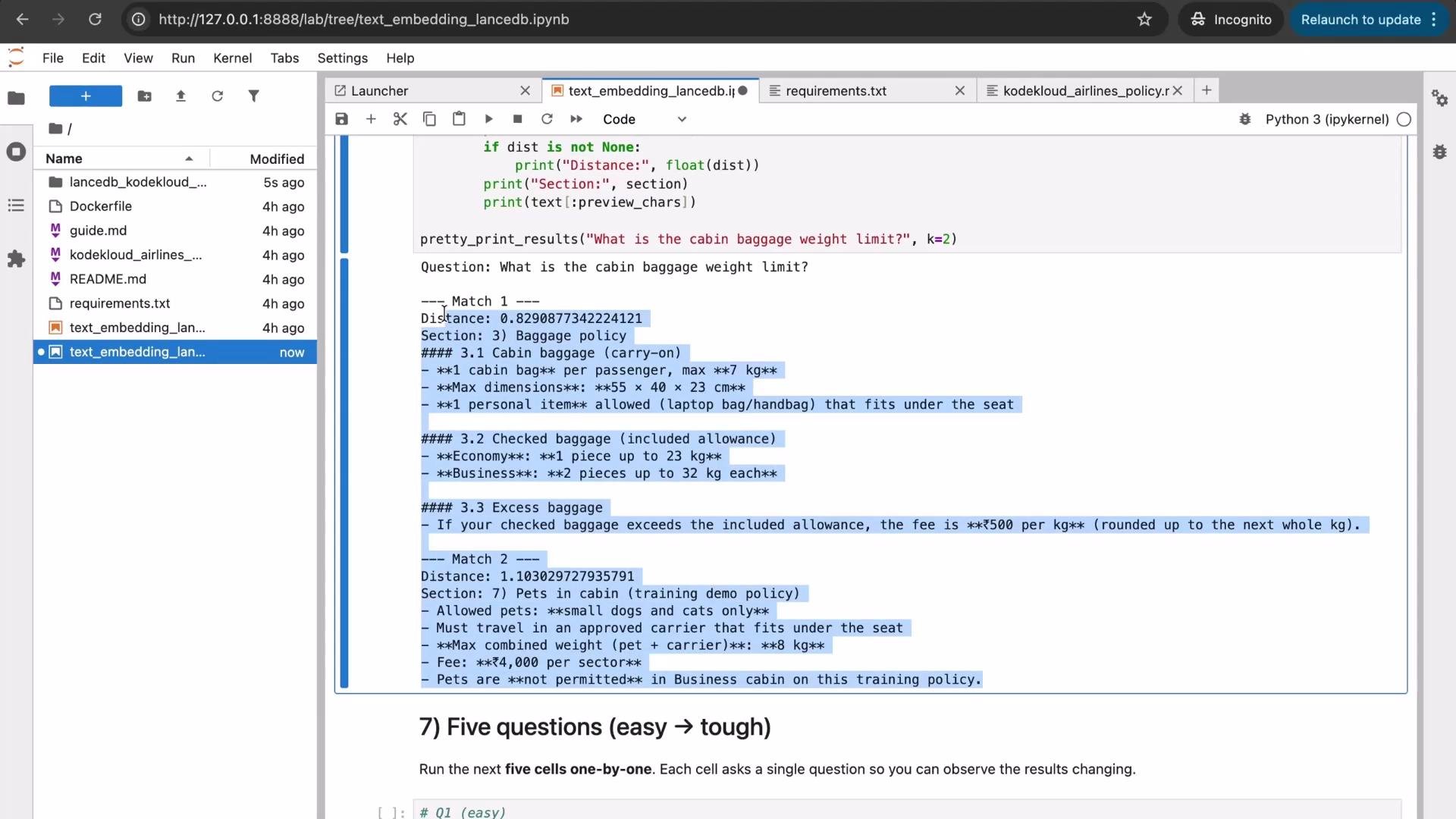
pretty_print_results("What is the cabin baggage weight limit?", k=2, preview_chars=600)
Sample output:
Question: What is the cabin baggage weight limit?--- Match 1 ---Distance: 0.8290877342242142Section: 3) Baggage policy### 3.1 Cabin baggage (carry-on)- **1 cabin bag** per passenger, max **7 kg**- **Max dimensions:** **55 x 40 x 23 cm**- **1 personal item** allowed (laptop bag/handbag) that fits under the seat### 3.2 Checked baggage (included allowance)- **Economy:** **1 piece up to 23 kg**- **Business:** **2 pieces up to 32 kg each**--- Match 2 ---Distance: 1.103027927395791Section: 7) Pets in cabin (training demo policy)- Allowed pets: **small dogs and cats only**- Must travel in an approved carrier that fits under the seat- **Max combined weight (pet + carrier):** **8 kg**
The top match is the baggage policy chunk. The second match references pet weight (pet + carrier), which can be returned because embeddings capture semantic relationships — sometimes leading to plausible but different interpretations.
Try additional queries:
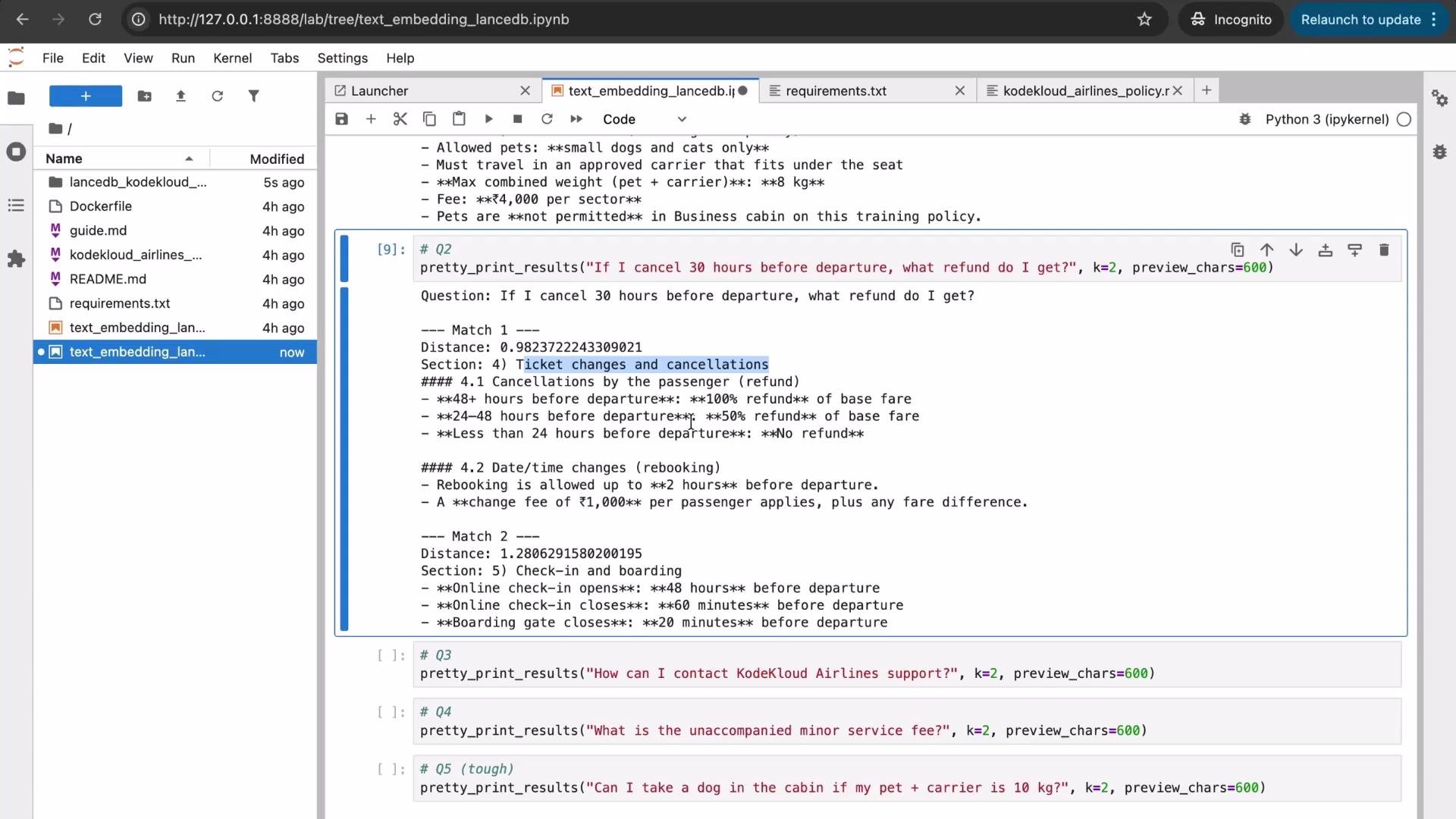
pretty_print_results("If I cancel 30 hours before departure, what refund do I get?", k=2, preview_chars=600)pretty_print_results("How can I contact Kodekloud Airlines support?", k=2, preview_chars=600)pretty_print_results("What is the unaccompanied minor service fee?", k=2, preview_chars=600)pretty_print_results("Can I take a dog in the cabin if my pet + carrier is 10 kg?", k=2, preview_chars=600)
A sample cancellation-related query should return the ticket change and cancellation policy as the top match; ambiguous queries can return multiple sections that are semantically related.
Embeddings provide semantic matching, not exact keyword/string matching: paraphrases and related concepts can match.
Retrieval quality depends on chunking strategy, model selection, and the currency of the embedded document.
Ambiguous queries may return plausible but incorrect sections. Combining retrieval with a downstream RAG (Retrieval-Augmented Generation) pipeline, intent classification, or rule-based filters can improve precision.
If the source document changes, re-embed the affected chunks and update the vector store to reflect the latest content.
Quick summary table: pros/cons
Topic
Advantages
Considerations
Chunking by headings
Captures natural semantic boundaries
Short headings may produce sparse chunks — tune the minimum length
all-MiniLM-L6-v2
Small, fast, effective for semantic search
Not specialized for domain-specific vocabulary; consider larger or tuned models if needed
LanceDB
Lightweight local vector DB with search APIs
For production, consider managed/vector DBs with sharding and persistence policies
Performing semantic search and displaying top matches
Embedding documents into a vector database simplifies semantic retrieval and enhances search experiences across knowledge bases and documentation.Further reading and references: