

Core capabilities
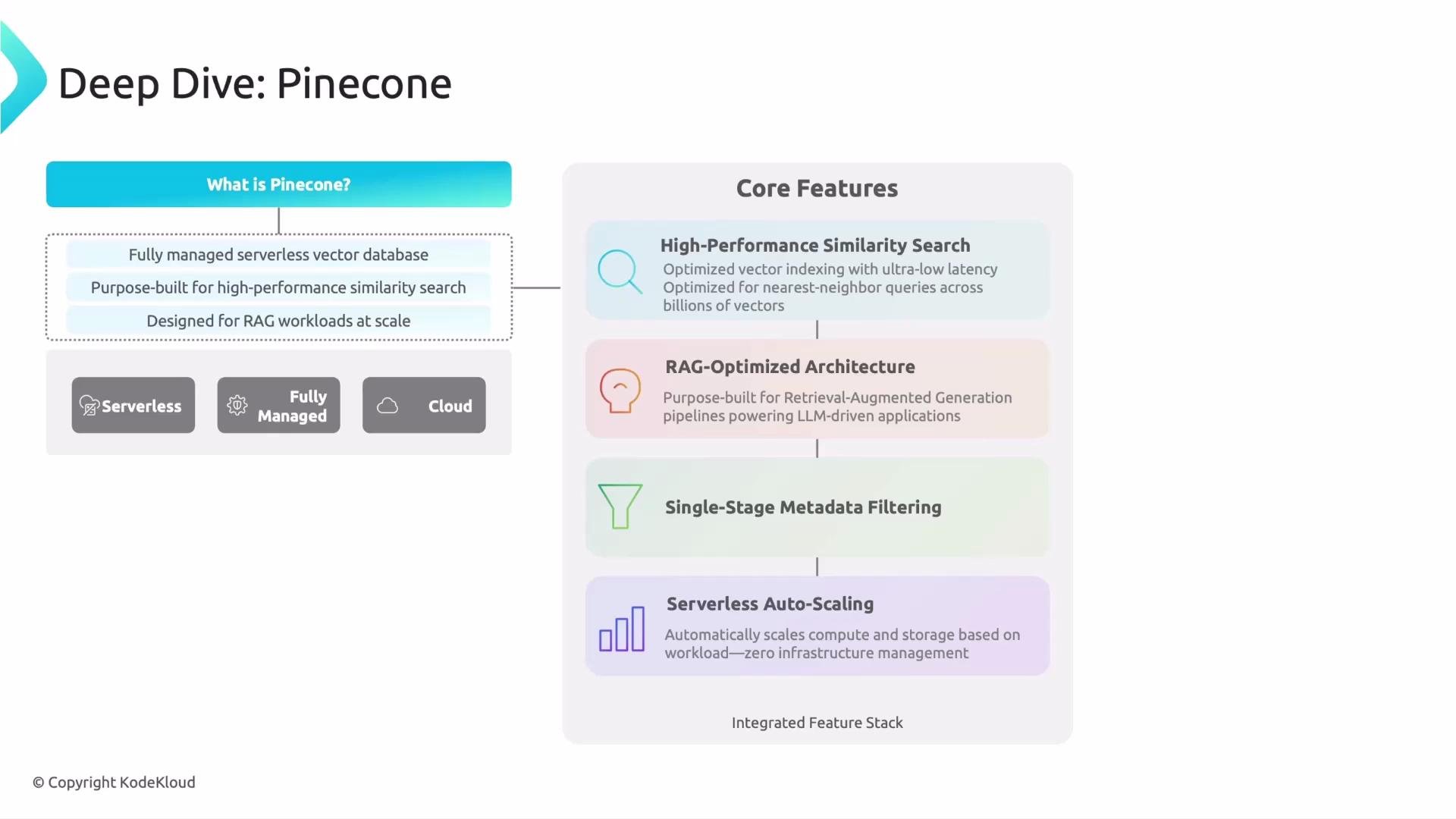
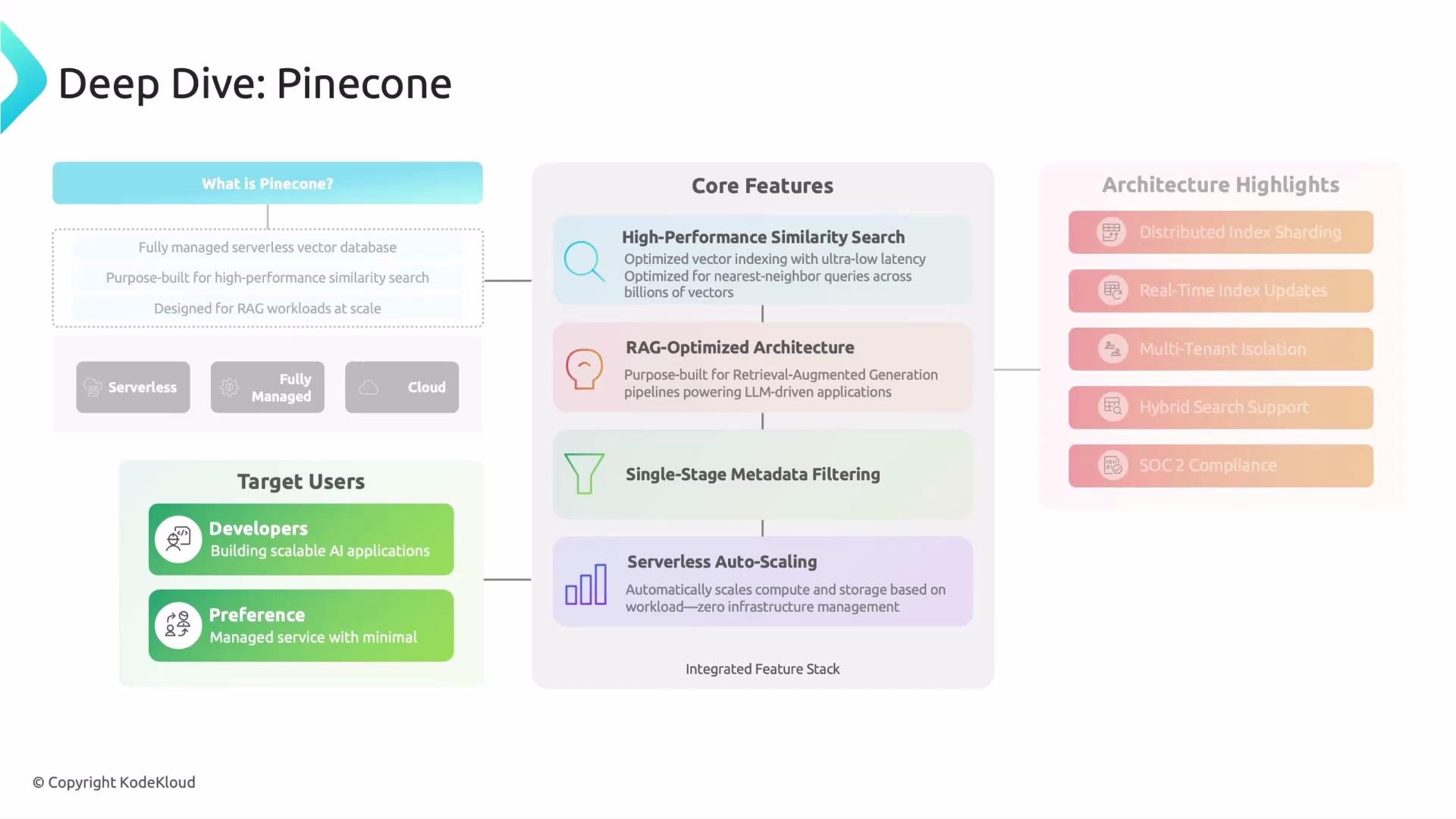
Pinecone delivers several features designed for production AI retrieval systems:- High-performance similarity search — optimized for fast nearest-neighbor lookups across large vector collections.
- RAG-optimized architecture — engineered for retrieval-augmented generation workflows and low-latency retrieval.
- Single-stage metadata filtering — applies metadata constraints during retrieval to reduce unnecessary work and improve latency.
- Serverless auto-scaling — compute and storage automatically scale to match workload demands.
Quick comparison: when to choose Pinecone
Architecture (high-level)
- Distributed indexing and sharding — an index is split across nodes to distribute data and queries, enabling parallelism and scale.
- Real-time index updates — near real-time insertions and updates keep vector representations current as source data changes.
- Multi-tenant isolation — separates workloads to ensure isolation between users or applications.
Single-stage metadata filtering means the system applies metadata constraints during the retrieval phase itself instead of retrieving candidates and then filtering them afterward. This reduces I/O and CPU on irrelevant candidates and generally gives faster, more predictable latency.
Who benefits from Pinecone?
Pinecone is primarily for developers and teams building AI applications that require fast, scalable vector retrieval with minimal operational effort. Typical scenarios include:- Retrieval-augmented generation (RAG) for LLMs.
- Semantic search over large document collections.
- Recommendation engines based on vector similarity.
- Real-time personalization or anomaly detection with vector embeddings.
- Low-maintenance infrastructure (managed, serverless behavior).
- Sub-100ms query latency at scale.
- Ability to scale to billions of vectors without manual sharding or capacity planning.
- Simple API-driven integration for quick prototyping and production use.
Key value propositions
- Zero-ops vector search — minimal operational burden and no server management.
- Predictable, low-latency queries for large-scale similarity searches.
- Elastic scale to billions of vectors with automatic sharding and distribution.
- Simple APIs and client libraries for rapid integration across languages and frameworks.
Further reading and references
- Pinecone documentation: https://www.pinecone.io/docs/
- Retrieval-Augmented Generation (RAG) primer: https://www.retrieval-augmented-generation.example/ (reference articles and tutorials)
- Vector databases overview: https://en.wikipedia.org/wiki/Vector_database (background reading)