

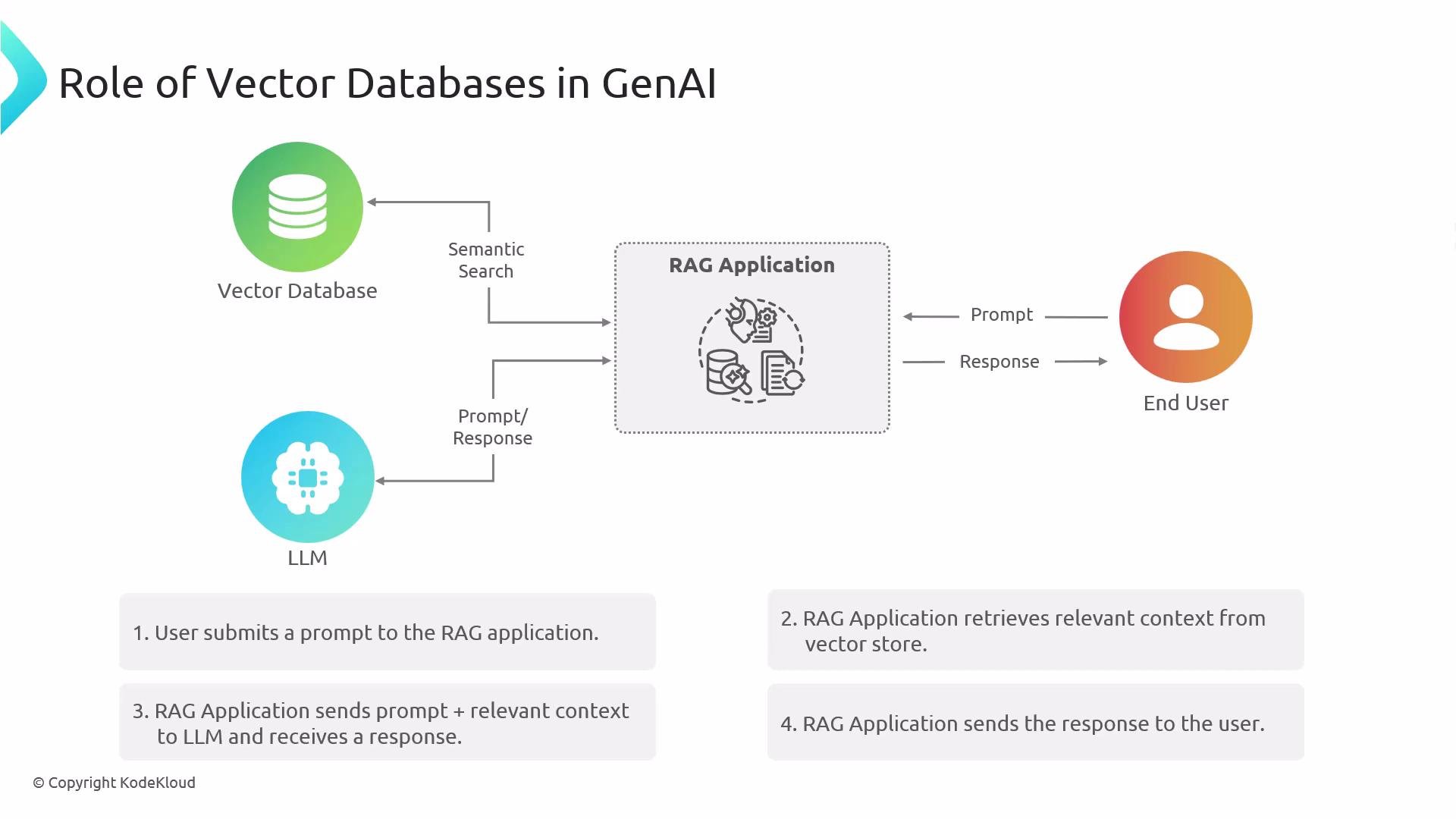
- User submits a prompt to the RAG application (example: “What is the current temperature in Berlin?”).
- The RAG system converts the prompt (or relevant parts of it) into an embedding and issues a similarity query against a vector database. The vector database stores dense embeddings of documents, telemetry, or records paired with metadata, and supports fast nearest-neighbor search to find semantically relevant items.
- Common similarity search methods include HNSW, IVF, and PQ (used by FAISS, Milvus, Weaviate, etc.).
- The vector database returns one or more context items — e.g., the latest sensor readings, a recent policy update, airline rules, or a healthcare document. In some architectures, very fresh signals (like live weather) may be fetched from a dedicated API, but many systems ingest those signals into the vector store so they become directly retrievable by RAG.
- The RAG system sends the original prompt together with the retrieved context to a large language model (LLM) such as Claude, GPT, or Grok. The LLM synthesizes an answer using both the prompt and the retrieved context.
- The synthesized response is returned to the user.
- Vector databases enable fast, semantically rich retrieval of context using dense embeddings, improving relevance and answer quality.
- Without a retrieval layer (or other up-to-date source), GenAI systems can return stale or irrelevant information.
- Vector stores are especially valuable in production for domains requiring current, authoritative context: policies, airline operations, healthcare, customer support, telemetry-driven systems, and knowledge bases.
Vector databases are central to many RAG architectures: they provide scalable, low-latency semantic retrieval that LLMs rely on to produce accurate, context-aware responses.
Architecture diagram
This diagram shows the RAG flow: user prompt → embedding + vector DB retrieval → context + prompt to LLM → response to user.
- Vector databases and similarity search overview: https://www.pinecone.io/learn/what-is-a-vector-database/
- Retrieval-Augmented Generation (RAG) patterns and best practices: https://www.pinecone.io/learn/rag/
- Large language models (LLMs): https://en.wikipedia.org/wiki/Large_language_model
- Popular vector search engines: FAISS, Milvus, Weaviate, Pinecone (search their official docs for deployment details)