

- Semantic search and information retrieval — find relevant documents by semantic similarity rather than exact keywords.
- Question answering and retrieval-augmented generation (RAG) — retrieve supporting documents to improve generative answers.
- Document clustering and topic grouping — group similar documents or detect themes.
- Chatbots and conversational AI — maintain context and find relevant prior turns or knowledge.
- Recommendation systems — compute similarity between items and users using vector distances.
-
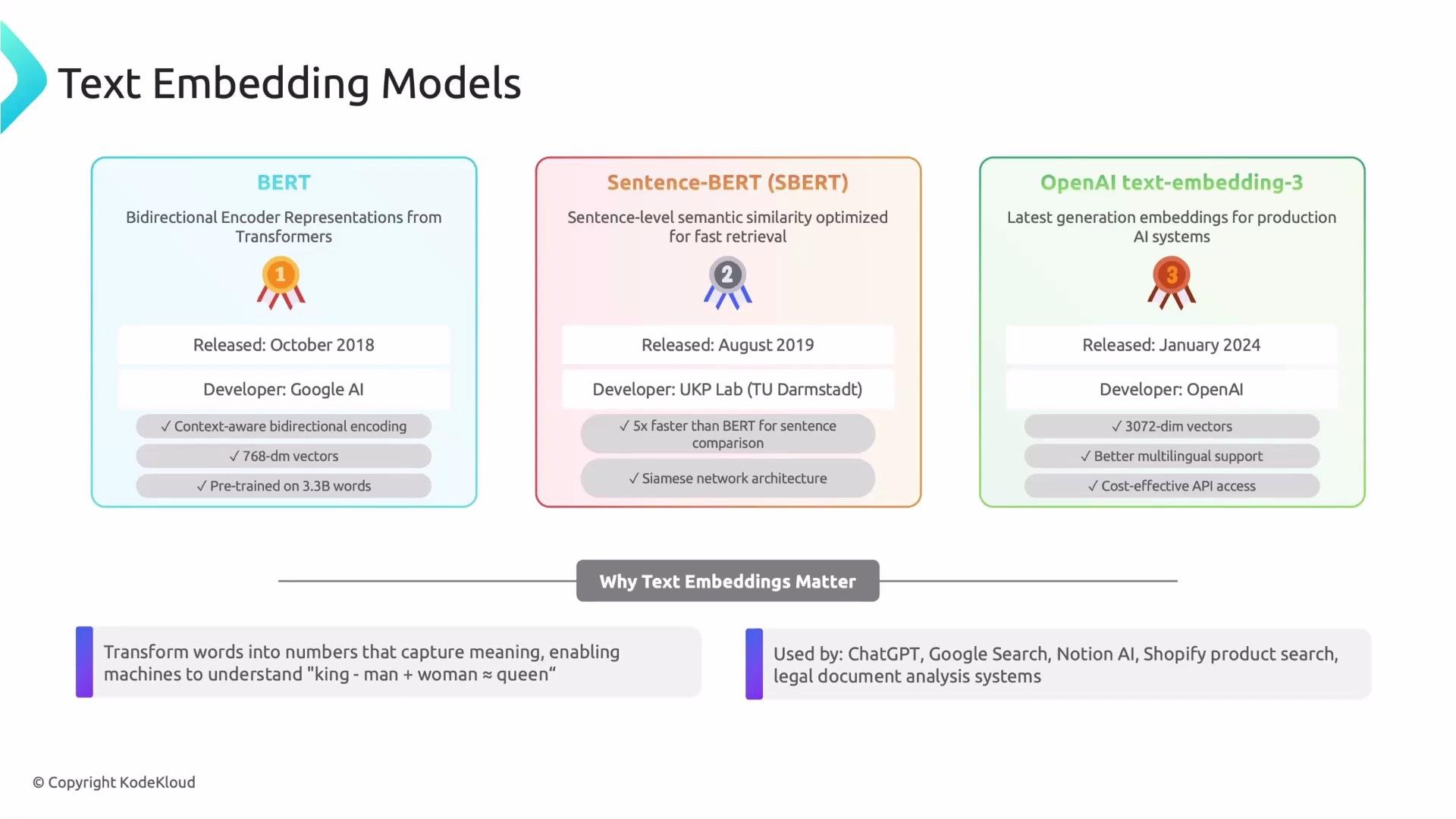
BERT (Bidirectional Encoder Representations from Transformers)
- Developer & release: Google AI, October 2018
- Key idea: Transformer encoder trained with masked language modeling for true bidirectional context by attending to tokens on both sides during pretraining.
- Typical embedding size: 768 dimensions for BERT-base (you can derive pooled sentence embeddings or token-level vectors depending on the application).
- Pretraining data: ~3.3 billion words (BooksCorpus + English Wikipedia).
- When to consider: foundational encoder for contextual representations and fine-tuning for downstream tasks.
-
Sentence-BERT (SBERT)
- Developer & release: UKP Lab / Nils Reimers & Iryna Gurevych, August 2019
- Key idea: Adapts BERT to produce meaningful fixed-size sentence embeddings using Siamese/triplet networks and pooling strategies so embeddings are suitable for cosine-similarity based retrieval.
- Performance: Designed to be far more efficient than naive BERT pairwise comparisons—embeddings can be precomputed and compared with dot-product or cosine similarity.
- When to consider: open-source, low-cost semantic search and clustering at scale.
- More info: https://www.sbert.net/
-
OpenAI text-embedding-3
- Developer & release: OpenAI, January 2024
- Key idea: Production-focused embedding model designed for rich, multilingual representations with managed API access.
- Embedding size: 3072 dimensions (higher capacity for nuanced semantics).
- Access: Available via API with cost-effective, production-ready options.
- When to consider: modern RAG systems, AI search tools, and multilingual applications that prefer a managed embedding service.
- Docs: https://platform.openai.com/docs/guides/embeddings
Why embeddings matter
Text embeddings convert words, sentences, and documents into numeric vectors that capture semantic relationships. With these vectors you can efficiently perform nearest-neighbor search, measure semantic similarity, cluster content, and even observe vector arithmetic analogies (for example, relationships like “king − man + woman ≈ queen” illustrate semantic structure beyond keyword overlap).
- Use SBERT or other open-source sentence-level models for efficient, offline embedding computation and low-cost semantic search where you can precompute vectors.
- Use managed, high-dimensional embeddings such as OpenAI’s
text-embedding-3for production RAG systems when you need robust multilingual support and a simple API. - Use BERT as a foundational encoder when you need to fine-tune models for task-specific representations or when building customized pipelines.