

What is a vector?
A vector is a numeric list (an array) that encodes descriptive attributes about an item so a computer can process and compare meaning. Think of describing a friend to someone who has never met them: “tall, funny, loves coffee, speaks quickly.” A vector does the same for data — it turns characteristics into numbers.- Words, images, audio, and video can all be converted into arrays of numbers.
- Each array (vector) is a sequence of numeric values (usually floating-point) that capture features or semantics of the original item.
- As you encode more attributes, the vector’s dimensionality increases.
The embedding process
Turning text, images, or audio into vectors is called embedding. Embeddings are produced by models that map inputs into a numeric space where similar items are positioned near each other. When you embed many items (millions or billions), each becomes a point in this high-dimensional space, enabling similarity-based retrieval.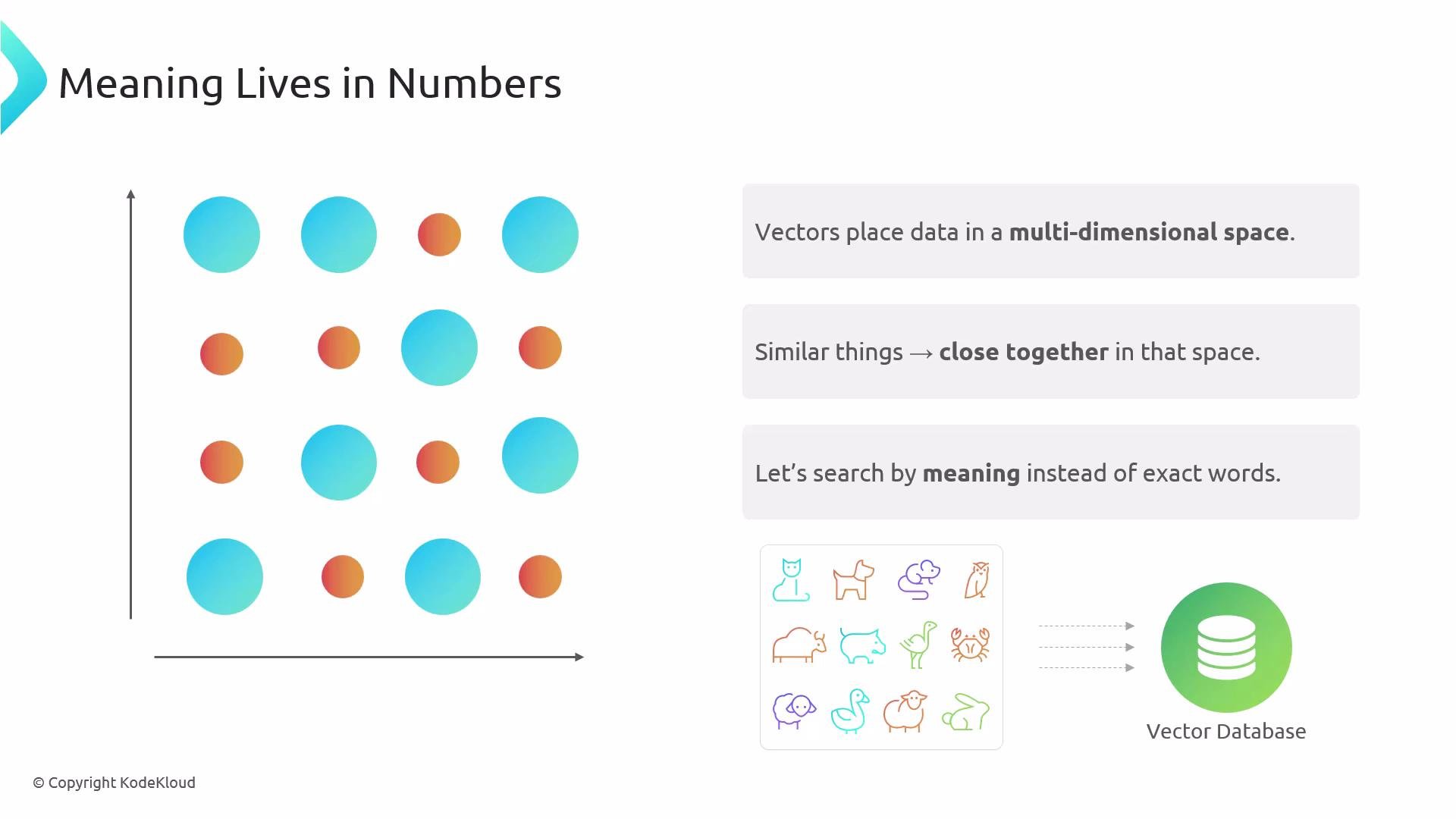
Why proximity matters
Imagine storing one vector per animal in a vector database. Animals that share attributes (for example, “can fly”) cluster together because their embeddings are similar. That makes it possible to ask semantic questions like:- “Give me a bird that cannot fly” — even if the term “penguin” never appears in the query, the database can surface relevant matches based on geometric closeness in vector space.
How vector search works (brief)
- Index: embeddings are stored and indexed (often with techniques like approximate nearest neighbor search) to enable fast similarity queries.
- Query embedding: a query (text, image, etc.) is embedded into the same vector space.
- Nearest neighbors: the system finds vectors closest to the query embedding using a distance metric (e.g., cosine similarity, Euclidean distance).
- Return ranked results: items most semantically similar to the query are returned.
Common vector use cases
Examples of embeddable data types
Key points
- A vector is a numeric representation (array) encoding features or semantics.
- Dimensionality increases as you encode more attributes.
- Embeddings place similar items near each other in high-dimensional space.
- Vector search finds items by semantic similarity (nearest neighbors), not only keyword matches.
Embedding = converting data (text, images, audio) into numeric vectors so that semantic similarity corresponds to geometric proximity in vector space.
Further reading & references
- Vector Databases — An introduction (Pinecone)
- Semantic Search — Wikipedia
- Approximate Nearest Neighbors (ANN) — overview and algorithms