

How it works (high level)
- Append the incoming write (insert/update) to a durable write-ahead log. Appending and flushing is very fast because it is sequential I/O.
- Return success to the client as soon as the log write is safely persisted.
- A background indexing worker consumes the log asynchronously, batching many entries and applying consolidated updates to the index.
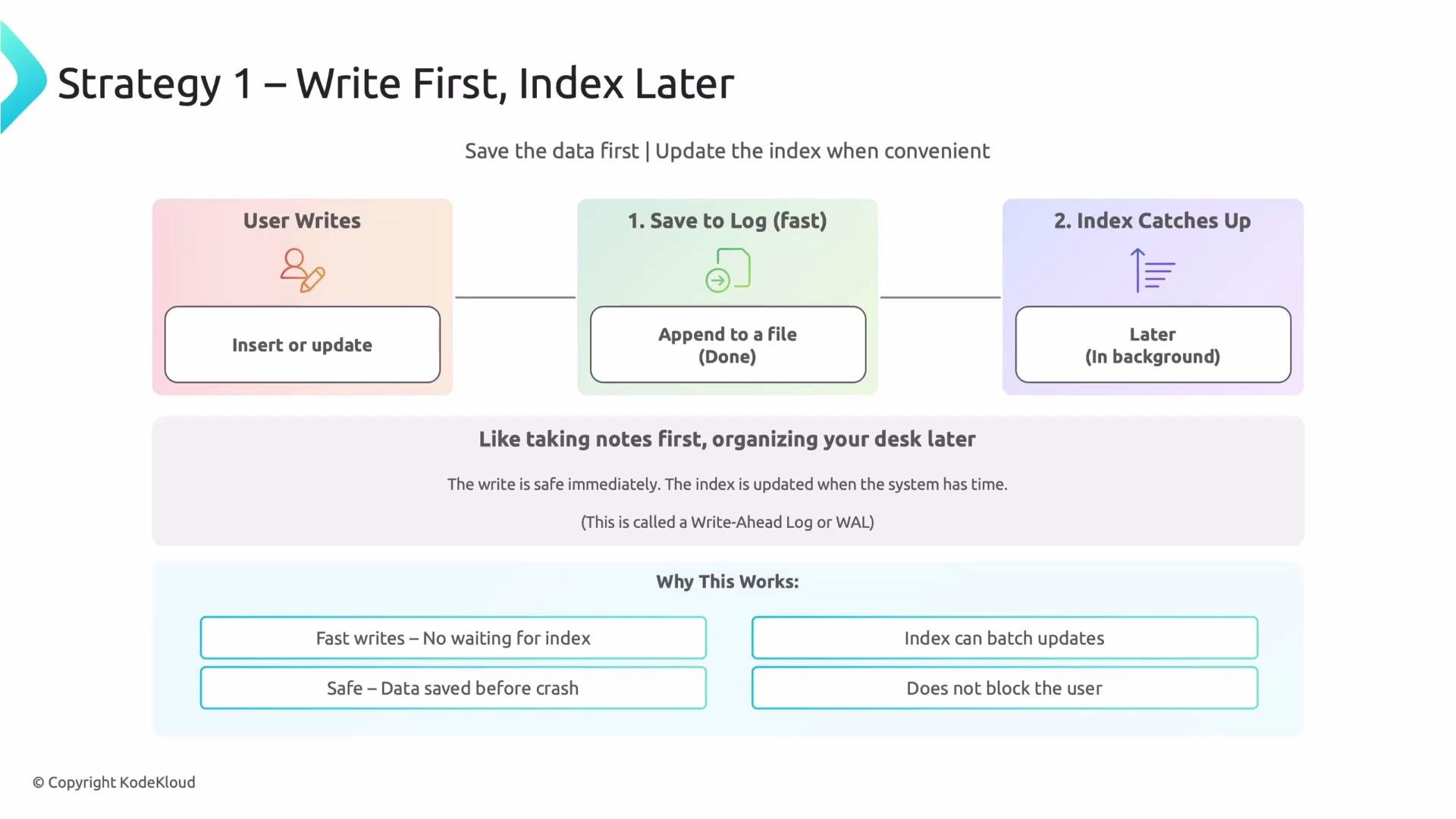
Why this strategy works
- Low write latency: user requests are acknowledged immediately, without blocking on expensive index updates.
- Durability: writes are persisted to stable storage before acknowledging success.
- High throughput: indexers can batch many log entries into larger, more efficient index operations.
- Fault tolerance: after failure, the persisted log enables replay and index reconstruction.
Benefits vs Trade-offs
Practical considerations and implementation tips
- Durable log management: rotate, compact, and checkpoint logs to prevent unbounded growth.
- Background workers: design indexers to consume at whatever rate system resources permit, with backpressure and idempotency.
- Batching and coalescing: combine multiple updates to the same key to reduce redundant index work.
- Recovery and replay: ensure replay logic is deterministic and compatible with your index format.
- Observability: monitor the lag between log persistence and index application to detect issues early.
Write-first, index-later is ideal when low write latency and durability are top priorities and your application can tolerate eventual consistency for reads.
When to use this pattern
- High write volumes where immediate acknowledgment matters (e.g., profile updates, telemetry collection).
- Systems where reads can accept slight staleness or where a secondary fast read path (cache) covers most reads.
- Architectures that already rely on append-only logs (WALs, Kafka, or CDC streams).
When this pattern may not be appropriate
- Applications that require strong read-after-write consistency for all operations.
- Small systems where the added complexity of background indexing outweighs the performance gains.
Production examples
Many large-scale platforms persist user changes immediately and let search or analytics indices catch up asynchronously. For example, social networks often accept a profile edit instantly and update full-text search indices later to avoid blocking the user.Links and references
- Write-ahead logging (WAL) — overview and motivation
- Apache Kafka — an example durable log used for streaming and indexing pipelines
- Change Data Capture (CDC) patterns — techniques for propagating changes