

- The metric determines which candidates are considered “close” and therefore returned to downstream systems.
- Embedding generation (model architecture, normalization) often dictates which metric is appropriate.
- Wrong choices can yield results that are numerically close but semantically irrelevant.
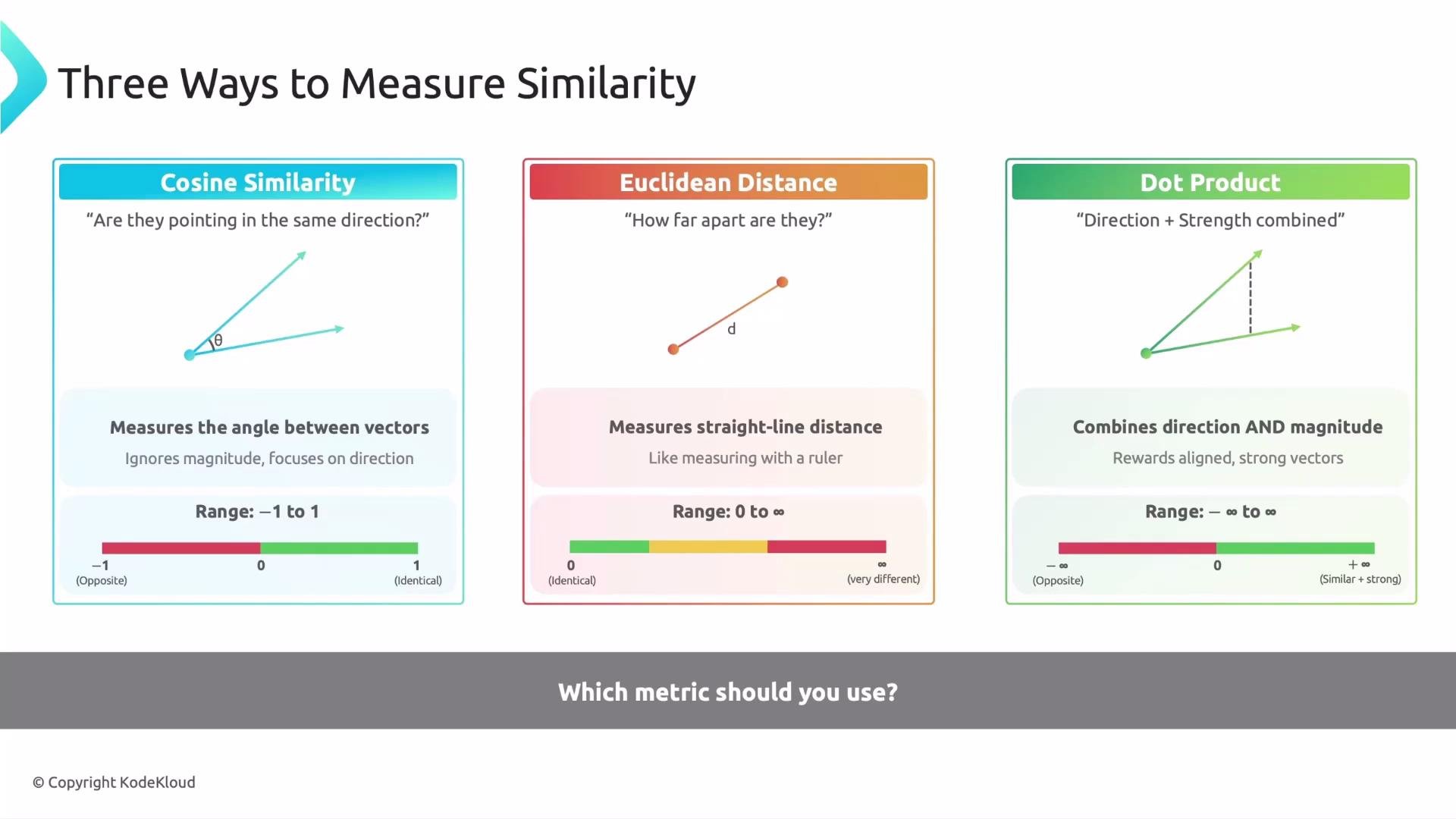
- Intuition: measures the angle between two vectors and ignores their magnitudes. Vectors pointing in the same direction are similar regardless of length.
- Formula:
cosine(u, v) = (u · v) / (||u|| ||v||) - Range:
-1to1(1= same direction,0= orthogonal/unrelated,-1= opposite). - When to use: ideal for text embeddings and semantic search where topic/ direction matters more than length. Short and long texts about the same topic can still be similar.
- Typical usage: commonly used with text embedding services such as OpenAI embeddings and supported by vector databases like Pinecone.
- Intuition: the straight-line distance between two points in vector space (like measuring with a ruler). It depends on magnitude.
- Formula:
euclidean(u, v) = ||u - v|| - Range:
0to∞(0= identical vectors; larger values = more distant). - When to use: appropriate when absolute magnitude encodes important information, for example in some image similarity tasks, sensor measurements, or anomaly detection where vector length represents intensity or scale.
- Typical usage: supported by vector databases such as Weaviate and often used in computer vision scenarios.
- Intuition: combines direction and magnitude — it measures alignment while scaling by vector lengths.
- Formula:
dot(u, v) = Σ u_i * v_i - Range:
-∞to+∞(unbounded). - When to use: useful when both direction and magnitude matter, for example recommendation systems where raw model outputs (scores) are meaningful and should affect ranking.
Practical tip: if you normalize all vectors to unit length, the dot product becomes equivalent to cosine similarity. Normalization is common when you want to remove magnitude and compare only direction.
How to choose between them
- If you care only about semantic direction/topic and want to ignore length differences, use cosine similarity (or normalize vectors and use dot product).
- If absolute magnitude encodes meaningful signals (intensity, confidence, energy), prefer Euclidean distance or unnormalized dot product.
- Use dot product when the model’s raw outputs (magnitudes) should directly influence ranking or scoring.
- OpenAI Embeddings Guide
- Pinecone Vector Database
- Weaviate Vector Search
- FAISS — Facebook AI Similarity Search
- Milvus — an open-source vector database