

- Performance: running embedding models and updating a large vector index for every incoming message can become a throughput bottleneck and cause service degradation.
- Cost and stability: keeping expensive embedding inference and synchronous index updates on the critical path raises compute costs and complicates reliability under traffic spikes.
- Think of a busy restaurant: washing each plate immediately would slow the kitchen. Instead, plates are stacked and washed in batches. Similarly, systems persist chat messages immediately and index them later in batches to maintain throughput.
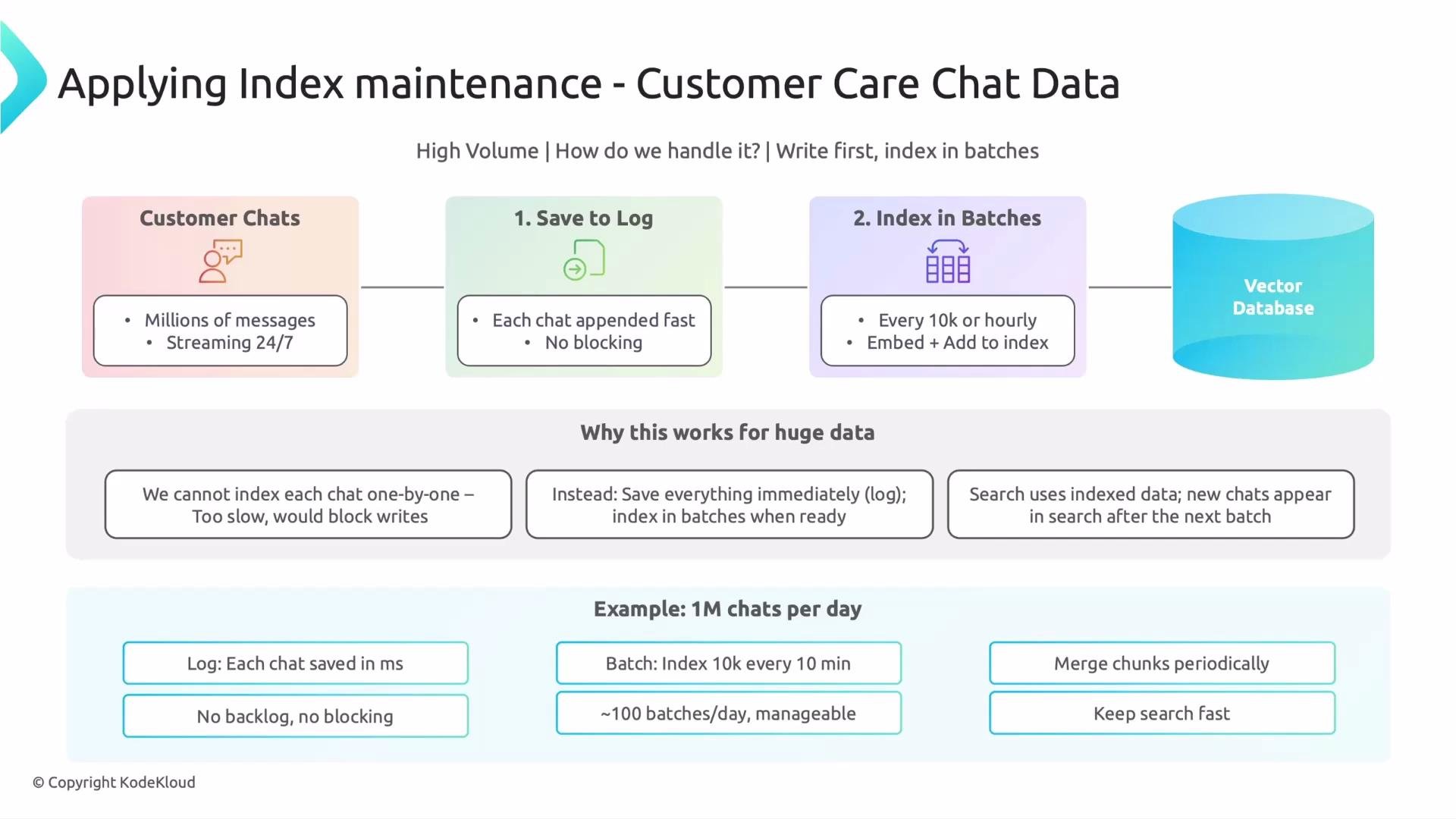
- Ingest: As messages arrive, append each chat to an append-only log (also called a write-ahead log or message queue). This append is fast and non-blocking so the service can accept new messages with minimal latency.
- Buffering: Messages accumulate in the log until either a configured batch size is reached (for example,
10_000messages) or a time threshold elapses (for example, every10m). - Embedding and indexing: A background worker consumes a batch from the log, runs the embedding model on the batched text, and performs a bulk upsert into the vector database (vector store).
- Search visibility: Search and retrieval read from the already indexed vectors. Newly logged messages become searchable after the next batch completes — providing eventual consistency with bounded indexing latency.
- Throughput: Bulk embedding calls and bulk upserts amortize per-message overhead and decrease load on the vector store.
- Reliability: The critical path for accepting messages remains quick and non-blocking, reducing the risk of failures during spikes.
- Cost efficiency: Fewer model calls and index operations lower compute and I/O costs.
Real-world example
Consider a global company that receives ~1,000,000 chat messages per day (for example, an airline or large retailer during peak season). If each chat triggered an immediate embedding and index update, compute costs and the risk of index contention would spike. Instead:
- Each chat is appended to a durable log in a few milliseconds so ingestion stays non-blocking.
- A batch job runs every 10 minutes (or when a threshold is reached), computes embeddings for the collected messages, and performs a bulk upsert into the vector database.
- The search service stays responsive because only batched updates touch the index; newly arrived messages become searchable after the next batch completes.
Best practices checklist
- Use a durable append-only log (file-backed service, cloud object store, or a message system such as Kafka) to ensure no data loss and to support replay.
- Make upserts idempotent so retrying failed batches does not create duplicates.
- Monitor and alert on indexing lag (time between message arrival and search visibility).
- Encrypt sensitive data and apply access controls before calling embedding models.
- Consider hybrid approaches: for very high-priority messages, perform a fast in-memory index for immediate searchability and index the full record in the batch pipeline.
Batching is a practical balance: it preserves fast ingestion and system stability while keeping search responsive with bounded latency.
Be mindful of privacy and compliance when storing chat logs and creating embeddings. Ensure you have appropriate retention policies, access controls, and data minimization in place.
- Accept messages quickly via an append-only log to keep ingestion non-blocking.
- Use controlled, batched embedding and bulk-upsert jobs to reduce cost, increase throughput, and protect the index from contention.
- Expect eventual consistency for new messages; tune batch size and interval to meet your freshness, cost, and latency goals.
- Implement robust operational patterns (retries, idempotency, monitoring, and privacy safeguards) to make the pipeline production-ready.
- Kafka — event streaming
- Vector databases and best practices (example vendors and docs)
- Embedding model considerations